I feel that we need to sit down with a cup of coffee or tea and just chat about something. If you move in the same circles I do, you’ve probably heard about this post from Made in his Image. There’s a lot of good things being said about how destructive the modesty culture can be, so I’m not going to rehash a lot of that here. I wanted to shine some light on the biggest problem with this specific post.
I got sunburned on my ass a few weeks ago, when nothing else on me got sunburned at all. We were only at the beach for an hour, and I ended up having to spread aloe vera all over my butt for a week and sit down funny for a few days. Why did I only get sunburned on my bottom?
Because it’s the only part of me that’s never, ever, seen the light of day.
I grew up in Northwest Florida– the part of Florida known as the Emerald Coast. It is a stunningly, breathtakingly beautiful beach. We rarely ever went– only when family came to visit, usually, and those visits were sparse– because it was considered ungodly to go the beach. And if we went, I wore a t-shirt and culottes. My mother made swim-culotes out of a really light, swimsuit-type material.
Even in college, when I’d left a lot of those childhood beliefs behind, I couldn’t bring myself to wear a swimsuit to the beach. I bought an amazingly cute tankini– I still think it’s cute, even today– and it generously covered my badonk-adonk, but I still felt incredibly nervous wearing it. I ended up wearing cute-off shorts on top of it when I went to the beach with some friends, and faked being asleep when I overheard them making fun of me for that choice.
Yup. “Modesty” is a sacrifice. It’s a sacrifice I made for most of my life, and paid for my standards with humiliation and embarrassment.
But, when I went to the beach with my husband a few weeks ago, I wore a bikini for the first time. It wasn’t “skimpy,” not that it matters, and I was able to take off my cover-up without shame, without the sharp knife in my gut telling me that I was dressing as the “strange woman” from Proverbs. It was a victory for me– a small triumph over the shame and oppression I’d known for over half my life.
That’s the only thing the modesty culture does.
It doesn’t stop men from ogling us– not even Christian men. I’ve gotten cat calls, jeers, shouts, obscene gestures, propositions, and whistles all while “modestly” dressed. I’m talking full-blown “modesty.” High-necked t-shirts, a-line and loose knee-length skirts. Sometimes I looked cute, sometimes I looked dumpy. It doesn’t matter. How I’ve been dressed has never made a difference whatsoever in how men have treated me. I was raped while wearing a knee-length skirt and a long-sleeved, loose and flowing top that covered my collar bone. Modesty has never, in my experience, stopped a man from doing whatever he wanted to do with my body– whether it was physically manhandle it, goosing me or grabbing my vagina through my skirt in the middle of chapel, or simply objectify it.
Let me say it again: men could not give a flying f*** how a woman is dressed. She’s a woman. She has boobs and a vagina, and that makes her public property in a world where I’ve been screamed at, cursed at, for refusing to even acknowledge a cat call from a car.
When I started dressing however I wanted, modesty be damned– when I started wearing shorts and tank tops, for example, none of that sort of behavior increased. It stayed exactly the same.
But, this article, like every other article I’ve read on modesty, emphasizes that it a woman’s obligation to help protect men from our bodies. It’s our duty to make sure that we make it possible for men to forget that we’re a woman– which is, frankly, impossible. I don’t care how loose your clothes are– if you have T&A, there’s no getting rid of it, there’s no hiding it.
So what happens?
We have articles where the author has to stubbornly insist that she’s not “insecure about her body,” and clarify that she is “independent in her swimwear choices.”
We have articles where the author compares women to an ooey-gooey chocolate cake.
And let’s look at that for a second. Rachel has this to say about her metaphor:
Now, let’s pretend that someone picked up that chocolate cake and followed us around all the time, 24/7. We can never get away from the chocolate, it’s always right there, tempting us and even smelling all ooey gooey and chocolate-y. Most of us, myself included, would find it easy to break down and eat the cake. And we would probably continue to break down and eat cake, because it would always be there. Our exercise goals would be long gone in no time.
I’m going to try to be fair here: Rachel was probably, in her head, only referencing masculine lust here. When she wrote out this dandy little metaphor, she was probably only thinking that “breaking down” didn’t mean anything besides a man thinking less-than-platonic thoughts about the woman in the bikini.
However, regardless of what I’m positive were the best of intentions, Rachel has just contributed torapeculture.
Because, in this metaphor where a woman is a chocolate cake, the woman has no choice. A woman, plain and simple, just is a chocolate cake, and the fact is that, as a woman, there’s nothing she can do to change that.* She doesn’t have a say in the matter. She’s a woman. She’s ooey-gooey and smells like heaven, and so she gets eaten. No one asks her if that would be ok. No one asks her if that’s what she wants.
Because she’s a cake.
She exists to be eaten.
*I would like to point out that gender and sexuality are a sliding scale– I’m not trying to exclude transgender people, just dealing with the essentialist and gender binary nature of the article.
HA note: The following is reprinted with permission from Libby Anne’s blog Love Joy Feminism. It was originally published on Patheos on June 6, 2013.
*****
Question: What do presents, chocolate bars, roses, chewing gum, and packing tape have in common?
Answer: Nobody wants them when they’re used.
Presents, chocolate bars, roses, chewing gum, and packing tape have all been used by abstinence educators and various Christian leaders and teachers to illustrate to young people how having sex before marriage will ruin them and leave them disgusting and unwanted. Those who grew up in the purity culture probably knew the answer to the question asked in the title before even opening this post.
I had to go through the True Love Waits program. The “activity” I remember the most was a wrapped present. I held the package and stood at the front of the room. Then, the youth leaders lined up the guys and each of them tore off some of the paper. Then I had to read some paragraph about how virginity is like a gift – no one wants a present that was “meant for them” to have already been opened by someone else.
Because of that one activity, I never told anyone I was raped at 15 until years later. I can’t even imagine the rest of the damage that was done to the other girls in the group.
Laura’s comment reminded me of Samantha’s post from several months back. In her case, the teachings she received about purity led her to stay in an abusive relationship long after she should have left—because she believed that, having given up her virginity, she was ruined for anyone else. Here is why Laura’s comment reminded me of Samantha’s post:
When I was fourteen, I went to a month-long summer camp at the college I would later attend. Like most Christian summer camps, this one involved going to a chapel service twice a day. Most of the time they were fun, lighthearted– until one evening they split up the girls and the boys. Great, I remember thinking, because I knew exactly what was coming. Segregation can only mean one thing– they were going to talk about sex. I sighed when they made the announcement. Again? I thought wearily.
That evening, when the camp counselors had shooed all the men and boys out of the building, the speaker got up to the podium. She didn’t even beat around the bush, but launched right into her object lesson. Holding up a king-size Snickers bar, she asked if anyone in the audience wanted it. It’s a room full of girls– who doesn’t want chocolate? A hundred hands shot up. She picked a girl close to the front that wouldn’t have to climb over too many people and brought her up to the stage. Very slowly, she unwrapped the Snickers bar, splitting the package like a banana peel. She handed it to the young woman, and asked her, very clearly, to lick the chocolate bar all over. Just lick it.
Giggling, the young lady started licking the chocolate bar, making a little bit of a show of it. At fourteen, I had no idea what a blow job was, so I missed the connection that had a lot of girls in the room snorting and hooting. The young lady finished and handed it back to the speaker. As she was sitting down, the speaker very carefully wrapped the package around the candy bar, making it look like the unopened package as possible.
Then she asked if anyone else in the room wanted a go.
No one raised her hand.
And Samantha gives a second example, too:
My sophomore year in college, another speaker shared a similar object lesson– ironically, in the exact same room, also filled exclusively with women. She got up to the podium carrying a single rose bud. At this point I was more familiar with sexual imagery, and I knew that the rose had frequently been treated as a symbol for the vagina in literature and poetry– so, again, I knew what was coming.
This speaker asked us to pass the rose around the room, and encouraged us to enjoy touching it. “Caress the petals,” she told us. “Feel the velvet.” By the time the rose came to me, it was destroyed. Most of the petals were gone, the ones that were still feebly clinging to the stem were bruised and torn. The leaves were missing, and someone had ripped away the thorns, leaving gash marks down the side.
Rescued kidnapping victim Elizabeth Smart said Wednesday she understands why some human trafficking victims don’t run.
Smart said she “felt so dirty and so filthy” after she was raped by her captor, and she understands why someone wouldn’t run “because of that alone.”
Smart spoke at a Johns Hopkins human trafficking forum, saying she was raised in a religious household and recalled a school teacher who spoke once about abstinence and compared sex to chewing gum.
“I thought, ‘Oh, my gosh, I’m that chewed up piece of gum, nobody re-chews a piece of gum, you throw it away.’ And that’s how easy it is to feel like you know longer have worth, you know longer have value,” Smart said. “Why would it even be worth screaming out? Why would it even make a difference if you are rescued? Your life still has no value.”
To illustrate his not terribly complex point, Worley called a stocky young man from the audience onto the stage and then pulled out a length of clear packing tape.
“This is Miss Tape. She looks pretty good, right? She’s tall, right? She’s … what else is she?” Worley raised his eyebrows at us encouragingly.
“Thin!” someone shouted out.
“Right! She’s thin,” he said, and wiggled the piece of tape so it undulated in the air. “And she has nice curves!” Worley winked. “So they have sex.”
To illustrate the act of coitus, Worley wrapped the piece of tape around the volunteer’s arm. After a few more minutes of make believe, we came to the inevitable bump in the road when Worley said the volunteer had decided to move on to other chicks. Worley ripped the piece of tape off his arm.
“Ouch,” said the volunteer.
“How does she look now?” Worley asked, holding the crumpled Miss Tape up for inspection.
I fought back the urge to yell, “like a dirty whore?”
Presents, chocolate bars, roses, chewing gum, packing tape—these sorts of metaphors abound in circles where what I call “purity culture” is strongest, and each one is used to illustrate how having sex before marriage will ruin you, rendering you dirty and potentially even unable to bond or form real relationships for the rest of your life. In the effort to keep young people from having sex before saying marriage vows, Christian leaders, pastors, and parents resort to threatening their youth, doing their utmost to scare them out of having sex and slut-shaming like crazy in the process.
In case you were wondering, no, this isn’t healthy, and the result of these teachings has been a generation of Christian youth with warped and toxic ideas about sex, dating, and even their own bodies. And in the process, these very teachings have led young women like Laura, Samantha, and Elizabeth to leave their rapes unreported, remain in abusive relationships, and stay with their abductors.This is not okay.
How about you? What similar metaphors have you encountered, and how have they affected your life?
Mental Health — From Shame to Seeking Help, Part Four: Shame Meets Truth
HA note: This series is reprinted with permission from Lana Hobbs’ blog, Lana Hobbs the Brave. Lana describes herself as “an aspiring writer and a former religious fundamentalist” who currently identifies as “post-Christian.” She was homeschooled in junior high and highschool. Part Four of this series was originally published on June 12, 2013.
This is the next part in a series about my journey from doubting mental illness exists, to finally getting help. For introduction and post list, see here. And if Dr. R ever reads this, I would just like to say, ‘thanks’. Thanks for writing honestly about a mental illness that still has a heavy stigma on it. You changed my life, and gave me a shot at happiness.
Luke and I married in May 2008. Luke worked during the summer but neither of us took classes. We had a beautiful summer in our little apartment on campus. I was pretty happy, homemaking for two in an apartment was much less stressful than big-sistering for a crowd. Cooking was a delight because Luke was sure to eat everything and love most of it.
I still felt sick frequently and had periods of intense mental fogginess and confusion I now recognize as being caused by depression, but my life was pretty easy during the summer.
I planned a Spanish class to teach for homeschoolers during the fall and prepped for that. I cooked and cleaned and kissed Luke passionately when he came home. He came home for lunch every day and I loved it. On rough days, i just slept extra and took a long bath to relieve achy muscles, no pressure from Luke to get anything done.
Then came school, and concentration was not optional any more. I was soon deep into my junior year.
Then the fog came back hard. The emotional stress was less, without all the courtship stuff going on, but the mental fog and exhaustion were worse than ever. I now recognize those as trademarks of deep depression, but at the time it was just more ‘sickness’. I felt guilty for ever marrying and tying Luke to a sick woman; I sat at the computer in intense pain with a blank mind; I slept a lot. I felt, again, like the world, and especially the people I loved, would be better off if I were dead. Only now, with Luke, i could talk about it. He disagreed.
I didn’t understand why my brain wasn’t working like normal. I felt foggy and frustrated and like a complete failure.
And then one day, a breakthrough. A teacher, Dr. R, had us workshop a paper she had written. It was about bipolar disorder – her bipolar disorder. I squeezed back my initial, automatic reaction of ‘mental illness is rare if it’s real at all’ and read it.
And… while I could put all my struggles aside as me not being a good enough Christian, I couldn’t do the same for another person. She wrote about her struggles, her diagnosis, her management of her life after diagnosis. She wrote with honesty, seriousness, and hope about bipolar disorder. I thought that bipolar was something that got people locked into mental hospitals. But the truth, from people who experienced and knew about mental illness and bipolar disorder, was slowly opening my mind. I read more about it afterwards, searching on google when no one was looking because I was embarrassed. What i read felt so familiar to me; except I had never had a severe manic episode. (in later years,I discovered bipolar 2 and cried. It felt so familiar).
While not all of her experiences with bipolar fit me, the depression as she described it, the mood swings, the not feeling right inside your own head, the times of high energy and grandiose thought – i could identify with all of that, and i believed about her what i never believed about myself, that mental illness was real, and treatable – not something requiring shame and more prayer.
And I thought the thought I never allowed myself before: maybe I have a real mental illness. And I hated myself for daring to think that I wasn’t just a horrible excuse for a Christian. The shame of my uncontrollable feelings was huge, but I thought I was supposed to feel it; the shame would spur me on to Godliness. The idea my problems weren’t my fault had no room in my mind. But Luke, he latched on to it. He believed about me what I never let myself believe; that I was really a kind, good, hardworking and loving person with problems I couldn’t control. He took those words ‘mental illness’ and he used them like a balm.
“I know you’re frustrated you can’t manage this, but we’re pretty sure you have a mental illness like bipolar. So it’s okay, just rest.”
Sometimes I welcomed his words, but more often the old response came out. For years.
Sometimes, ridiculous as it is to say them while taking medications, I still say it: “no, I don’t, I’m just a bad person!”
I quit school that semester. I wish i’d gotten help then, maybe I’d have salvaged my school year. But for then, it was right to limit my stress. Luke was afraid the stress of school was slowly killing me, and I just didn’t know how to continue, so against my parents advice, I withdrew from most of my classes, thereby losing my scholarship and therefore ending my college career (though someday I might return, I had no intention of returning at the time because we were so immersed in patriarchal culture at the time that educating me, a woman, wasn’t really worth the money. Until I quit, I’d been paid to go to college because of my scholarships, but spending money on my education was unthinkable.)
In February 2009, I got pregnant.
Pregnancy was tough, both physically and emotionally.
I remember an email that made me very angry. Not irritated, which I knew it merited, but furious. I-want-to-punch-through-a-wall FURIOUS. I was shaking with rage. I had never been so furious in my life before – with so little provocation – and I was frightened of myself even while feeling the fury. For weeks my sleep was bad and I kept getting angry at little things.
Luke didn’t tell me to get over my anger, although he was sad to see me so upset and confused about it. He just let me feel it, uncondemned. I didn’t want to feel it, but I had no choice.
It was a very unhappy, unproductive hypomania.
I still regularly hated myself for depression and for daring to think I was clinically depressed instead of just incredibly sinful, but there was something about this anger, the fact i’d seldom felt the same level of anger before, that made me feel okay about saying “This isn’t my fault. I can’t control this.”
All I could do was make sure I did no harm, and that was enough. There was a little secret in my mind, slowly growing until I could believe it more often and the secret was this:
“Mental illness is real. You are not a bad person. You are a person with a mental illness”.
It started very small, with that confusing anger and the word ‘bipolar’, but first of all with Doctor R’s story, her truth. And eventually it would become my truth and set me free.
Mental Health — From Shame to Seeking Help, Part Three: The Shame Of Failing To Be Happy
HA note: This series is reprinted with permission from Lana Hobbs’ blog, Lana Hobbs the Brave. Lana describes herself as “an aspiring writer and a former religious fundamentalist” who currently identifies as “post-Christian.” She was homeschooled in junior high and highschool. Part Three of this series was originally published on June 10, 2013.
When I began to write about my college sickness and depression, I found it emotionally difficult to recount some specific stories. My writing teachers always say ‘show don’t tell’ – meaning in part that specific stories are better than generalities. I hope you will forgive my generalities in this part, because the stories are difficult. Also my parents… are good parents in many ways, but they did not understand my depression and frequently added to the stress and shame of depression while trying to help me be a more godly person. They didn’t intend to hurt me — except when they thought I needed it for my own good — but despite their intentions to be godly parents they did hurt me deeply, and I cannot avoid that fact in this section especially. I wonder sometimes how my life would be different if we had believed depression existed. I write this series and hope that people will understand the damage that can be done by denying mental illnesses.
I became sick with a bad cold during Christmas break 2006, my first year of college.
It never went away, and became all-over body aches and exhaustion before January ended.
I was a high-stress perfectionist student on top of that.
I was weepy, home relationships were strained (which became cyclically both a cause and effect of emotional pain), and I threw myself deeper into praying and schoolwork, and fighting to feel happy despite the stress. My unhappiness at home had my parents claiming I didn’t really love them. I once tried to explain that I was trying very hard to be happy, but that further offended them. I suppose they thought if I really loved them I wouldn’t have to fight. I didn’t know why it was such a struggle, but it was. I know now it was partly depression and partly that I didn’t feel safe in an environment where I was judged for the emotions I did my best to control but never could.
I was full of sadness and had trouble coping with everything. I was always tired and had trouble concentrating on my work frequently. I felt sick constantly. Luke, now my husband, was my best friend at the time. He was both a source of comfort and trouble — trouble because, in purity/courtship culture, mixed-gender friendships are frowned on as emotionally impure, unless you plan to get married.
I didn’t want to throw away my best friendship I had ever had, so I didn’t end it (best decision ever), but I prayed and prayed God would protect us from emotional impurity. At the same time, I didn’t confide in Luke and get as much comfort from my only friend who seemed to understand, because of that fear of ‘giving away a piece of my heart’. (I think now that most of this ‘emotional purity’ stuff was useless worry and stress. Would a male best friend really wreck my relationship with any other man if I didn’t marry the best friend? I think that’s unlikely. But at the time I was terrified he would marry someone else, and frustrated because I felt that flirting or taking initiative in the relationship was sinful.) My parents were very invested in my emotional purity, heaping on me an extra layer of shame and fear of messing up; they were counting on me to stay true to the purity teachings, and I was terrified to fail them.
I was dealing with fear about ‘emotional impurity,’ plus I was trying to get straight As in college, cope with family stress and help a very emotional pregnant mother, do chores, help with my siblings, all while dealing with depression and periodic hypomanic/depressive mixed episodes with no understanding and very little support.
In retrospect, I think I did a pretty awesome job to still be alive.
But at the time, I didn’t understand why I handled everything so poorly. Why I couldn’t just feel happy. Why I cried so much. Why I couldn’t help but hit myself hard where bruises wouldn’t show, why I wanted to kill myself, why the future looked so bleak when I had a big strong almighty God I was supposed to be trusting.
What was I doing wrong?
I prayed for joy. I prayed that God would reveal to me any sins I had sinned unknowingly so I could repent — I wondered if I was being punished for something I didn’t know was wrong. Everything I knew about God indicated he worked like that.
I sometimes had panic attacks at night — only I didn’t know they were panic attacks. I thought I was being attacked by demons, either as a test for God to strengthen me, or because I’d had an evil attitude and invited them into the house (giving the devil a foothold).
I didn’t understand why God didn’t care more about me — in a way that felt caring. They say God disciplines and tests (refines) the children he loves, but I wanted a God who would hold me and cut me some slack. I thought perhaps if I could just fight harder to be happy, just trust more, just worry less, then I would be happy. I had dreams of being a missionary and didn’t know how I would manage living a deprived life when I was handling college so poorly.
The most understanding advice I got was that everyone got discouraged sometimes and God is good, hold on. The least encouraging advice was that I didn’t really love God or trust him at all.
But Iknew I was trying so hard. Since it obviously wasn’t working, no one would believe I was, but I was doing the best I could. If God was merciful and graceful and loving, I would have thought it would have been enough. My parents — and people in general — often judged how hard I was trying by results, but they made serious assumptions about my starting point. And I was starting pretty far behind when it came to happiness.
The misery continued. The depression, which I never imagined was real, made me sicker. I didn’t get better over summer break, like my mother expected.
I did in fact go to some doctors after eight months of being sick. One doctor thought I was stressed, that there was nothing really wrong with me, and she offered anti-depressants for the stress. Of course I refused, medication being evil and me being sick, not depressed — or so I thought. I took antibiotics, which only made me feel nauseous. I went on a strict, almost carb-free diet because my mom suspected candida was behind everything. I had no more yeast infections for years, but it didn’t cure me of my many symptoms, it only made me weaker from lack of nutrition. Friends began worrying about my weight, although only Luke’s mom said anything at the time.
At the beginning of the second fall semester, Luke and I began courting (for us it was like engagement, but the ring came later, at Christmas). It was a very happy time, but also stressful. Courtship brings your parents and families into your relationship more than usual, and while my parents felt like they should be more involved, we felt like there were a lot of extra fingers in our pie. But what can you do, that’s what courtship should be, right? I didn’t even consider objecting when my mother continued to read all my emailed correspondence with Luke. The new relationship and my parents’ continued concerns for us to be ‘godly’ added new stress to all family dynamics. I feel sorry for the pressure my parents felt, although they invited it on themselves. As the young female, I had the least agency in this confusing circle of relationships and felt like I was stuck in the middle. Plus, relationships are just hard sometimes. Depression compounded all of this, and I was frequently sad when I was expected to be happy.
Furthermore, my parents, my mother especially, were very strongly in favor of a no-touch courtship to protect us from impurity. They felt very strongly they should protect us from ourselves and indicated they wouldn’t be able to trust us alone if they knew we were touching. God designed touch to be a fire that quickly led to consummation, said my mother. (My mother-in-law, to my surprise, recently pointed out that this would not have been anything near the end of the world.) Frightened of what romantic touch might do to our judgement, and of requiring constant watching, we agreed to a no-touch courtship and engagement.
I missed those loving man hugs, even though I had never experienced them. Just a hug, an arm around the shoulder to be comforted during my many tears during that difficult courtship and depression.
Writing this reminds me of the terrible feeling of loneliness and confusion. I keep getting up to find Luke for a hug, because my mind feels like I am trapped there again, but I know I’m not.
We finally got married May 23, 2008, after nine months of courtship and two years of college.
It was a very good time for us, even though I still was ‘sick’ and struggling with intermittent depression. Although I’ve only had a few really deep depressions since then, I have had very few periods of health and full mental clarity that were longer than a couple weeks since I first got sick my first year of college at age 18. I’m 25.
I wish I hadn’t been taught what I was taught about depression. I wish I had believed depression was real, chemical, and not my fault. This section of my life that could have been happier (but still would have been difficult) was clouded by depression, dark fogginess, and pain caused by stress and depression.
We couldn’t figure out the sickness, but the sadness I knew about — I just wasn’t a very good person, and I was lucky God loved me as much as he did, even if he didn’t love me the way I wanted.* I wanted to feel loved, but I took it on faith that God did love me, and squashed my doubts with the Bible.
The idea that I had a highly treatable mental illness never crossed my mind.
One day, though, I would read something from someone actually admitting, not condemning or denying, mental illness, and that would begin a very slow change.
*****
*As noted in other sections, I no longer identify as Christian. I also do not believe the Bible teaches what I believed about depression and God making it go away. People differ on what the Bible actually teaches about God, but let’s not debate that here. The point is, with the things I’d been taught about God and depression, and with God not helping me with my unrecognized depression despite all my praying and trusting and trying to do my part, you can imagine that Christianity doesn’t appeal to me anymore.
“I learned at a young age to keep my different opinions to myself and to let her have her say no matter what.”
I recently came across a blog called Homeschoolers Anonymous, it caught my eye since I was homeschooled for several years and never set foot in a public school.
As I started reading the blog, I found myself relating to things that were being said there more and more. And when I read the “About” section on their website, that is when I knew I had finally found a place that understood me and the struggles I have gone through to get where I am today, and wouldn’t just dismiss my misgivings about homeschooling telling me “Oh, not all homeschoolers are like that! You just weren’t homeschooled the right way!”
My mother homeschooled my brother, sister and I from K-12 grades. I’m not sure on her exact reasoning for homeschooling us since she was never homeschooled herself and also was a private school teacher for several years. I suspect she would have preferred to have us in a private school, however, living in a very, very very rural area of the state that wasn’t possible nor cost effective. So that left her with homeschooling or having her kids attend *dramatic gasp* public school.
The subject of our education was something that my mom and dad never could seem to agree on. My mom wanted to continue homeschooling us, while my dad wanted us to attend public school once we were older. This topic continued to be something that they both strongly disagreed on even after they divorced. My mom got custody of the three of us kids and we would see our dad every other weekend.
She continued to homeschool us and our curricula consisted of books she would find for us at yard sales and at the library, she also enrolled all of us in 4-H and told us that it was part of our schooling. Once I was in my 3rd or 4th year of high school she bought a computer program called Switched On Schoolhouse.
Once a week we would go to a homeschool co-op, once I was in high school it lost it’s appeal for me because everything was geared towards the younger kids and I was the only one in high school. It was very lonely and also frustrating at times because there were classes in the co-op that I wanted to take (such as the one where you were taught how to change the oil and other basic things on your car) but was told that those were only available for the boys. They had something called Contenders of the Faith (for the boys) and Keepers of the Home (for the girls), I don’t have much experience with either of those programs since they were (as I’ve said before) geared towards the younger kids.
There are times that I have huge doubts as to how intelligent I really am. At home my mother primarily focused on my brother and his education, while my sister and I got the leftovers. It was very tiresome to always hear all the time about how “smart” and “brilliant” my brother was, how well he always did on his schoolwork and how creative he was.
I suppose you must be wondering if my mother ever tried to pass a specific social, political and religious ideology on to us kids. Short answer, yes. She only ever had either conservative talk show, or the Christian music station playing on the radio. I grew up listening to Rush Limbaugh. She also made sure that we were very involved with the church we went to (even though it was a 45 minute drive one way) and was always volunteering us for things, while at the same time not letting us choose what we really wanted to do if it didn’t match her high ideals for us.
Being the oldest I was the first one to graduate of the three of us (even though my brother had skipped a grade or two). Two weeks after graduation I was taking college classes online, even though I had informed my mother that I didn’t want to start college right after high school. I wanted to take a year off and get a job (still hadn’t had a real job at that point, nor was I even driving on my own), work in an inner city church as a volunteer. I wanted to experience the world like I never had before being confined either to the secluded farm, homeschool group, 4-H or church. I didn’t even know what I wanted to go to college for, so it made sense in my 18 year old mind to not go to college until I knew what it was that I wanted to do. And I knew that when I did go to college I would want to stay in a dorm and not take classes online.
Of course that wasn’t good enough for my mom, who took it upon herself to enroll me in an online university to take classes to get an associates degree in business administration. It was her plan for me to eventually turn the farm into a “ranch for disadvantaged youth” and that’s why I had to take these courses.
After trying my very best in the first semester I came to her in tears wanting to drop out. I had toughed it out for a semester and that was enough to reinforce my belief that business administration wasn’t for me. I tried to tell her all of this, but instead got to hear a lecture about how she didn’t raise any quitters. I told her that I would rather have a job, and she told me that in order to have a job that didn’t involve “flipping burgers” that I would have to go to college. Disagreeing with my mother is near impossible if you want to be vocal about your differing opinion, she is very dead set on being right all the time so I learned at a young age to keep my different opinions to myself and to let her have her say no matter what.
I took online classes for eight more months before the university kicked me out because my grades had plummeted so low. It was a great relief for me even though my mother was constantly chewing me out about being a failure because now I could finally get a job.
Overall I would describe my homeschooling experience as negative. Now that I am close to 30 years old and about to have a child of my own, I know that I would not want my daughter to go through what I went through. I don’t want her to be as ill-prepared when it comes to functioning in the real world as I was. I understand parents wanting to protect their kids from all the bad stuff that goes on in the world…however, you have to have balance and know that eventually you will need to teach and equip them how to handle different situations that they will face once they get out on their own.
After all, doesn’t every parent (no matter what their religious or political standings) want their child to be an independent and self-reliant adult in the real world?
If You’re Just Gonna Call Us Homos, Please Get In Line
By Nicholas Ducote, HA Community Coordinator
People have called me fag, gay, or homo for years now. When I was the weird, sheltered homeschooled kid, my co-workers persistently mocked me for my social awkwardness. They usually chose to mock me by calling me some variation of a gay slur. At one point, while working at Walgreens, my co-workers created a big foam board and hung it on my locker. They decorated it with brightly-colored foam words, which read “Nick is gay.” The managers and assistant managers laughed along with my co-workers. They only requested that it be taken down when the district management came to visit the store a few weeks later.
My Freshman year of college, roughly five hours from Walgreens, one of my new, so-called friends dubbed me “Gay Nick.” For two years, I endured daily name-calling and shaming over my social awkwardness. In fact, he still likes to occasionally post on my Facebook wall and call me Gay Nick. I gave up on our friendship when he informed me that New Orleans didn’t deserve to be rebuilt after Katrina because of some racist reason. To put it plainly, my social options Freshman year were limited.
Name-calling is the easiest way to dismiss someone. Today, another former colleague and peer resurrected this tactic and called me “homo”:
I’ve known Josh Craddock for almost seven years now. Josh traveled to numerous Communicators for Christ (CFC) conferences while I was interning and our team was tasked with evaluating Josh. He wanted to be an intern, but was advancing quickly through the alumni/training programs, so we monitored him closely. He was a hard worker, diligent, and kind. I personally recommended him to serve and eventually he did.
It’s ironic when I consider that Josh Craddock and I were once “servant leaders” together in CFC. We taught thousands of high schooled Christian homeschoolers how to be confident public speakers with sharp critical thinking skills. Even HA’s other Community Coordinator, Ryan Stollar, spent three years working with CFC. In fact, Ryan was one of their original student leaders, touring with them for the first three years of CFC’s existence. Ryan said, of his time with CFC,
“If there’s one thing I will never forget from my time with Teresa Moon and CFC, no matter how far I may “stray” from the narrow path I was prepared for, it’s to do one’s best to communicate with civility and grace, even when you disagree with someone else. This is one of the most important things I have learned — and I learned it from a conservative Christian homeschooling mom, and I am grateful for it. I am disappointed that Josh apparently did not learn the same lesson from the same individuals during his time with CFC. Even when I choose (and oh boy, I do!) to disagree with my very teachers, I hope to do so in a way that does not shy away from the disagreement but still grants the opposing side its humanity. Josh, on the other hand, is choosing the path of dehumanization. Which not only hurts what he perceives to be the side that opposes him — it also only serves to hurt “his side” as well.”
Today Josh Craddock chose to refer to us as a part of a “whiney, disgruntled cohort of self-loathing atheistic homos hell-bent on undermining the family.” When many of the Homeschoolers Anonymous cohort (love you all!) took to social media questioning Josh, he responded with this gem:
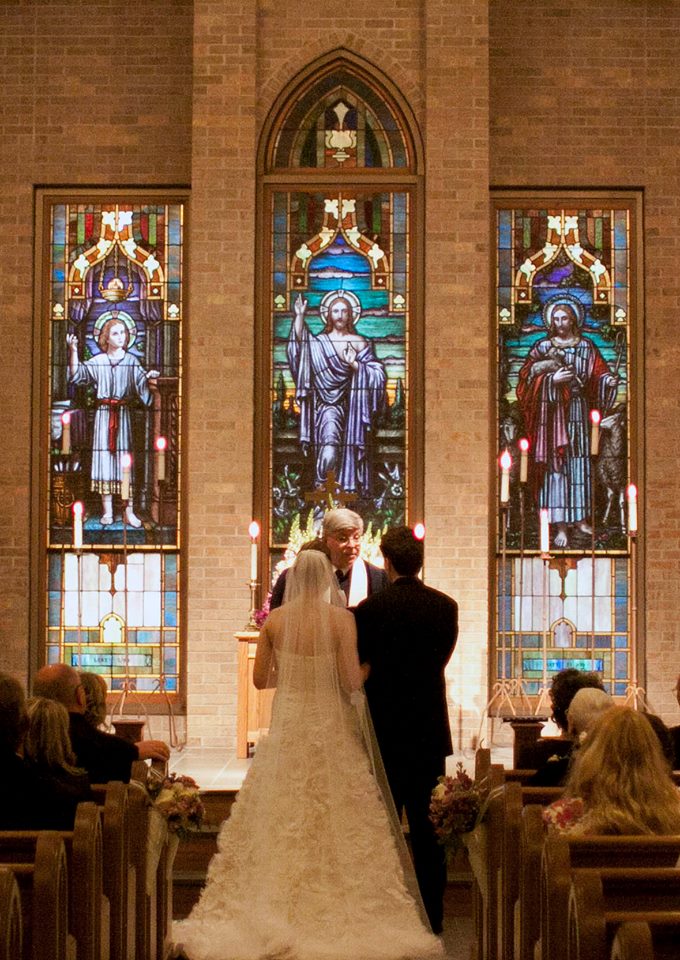
For what it’s worth, I married my wife a year and a half ago in a Methodist Church in Louisiana (picture below). But even if I was all of the things he described, that would have zero bearing on whether my message would still be worth spreading. If you think getting a few replies is trolling, maybe you should calibrate your Troll Meter. What you fail to realize is that Homeschoolers Anonymous, our message, and our contributors do not fit into a simple box with clear-cut labels. So if your only response to our advocacy is that I’m a homo, I’d say get in line with the scores of other people who have tried to dismiss me with name-calling.
It was the beginning of December last year when the words lit up my computer screen like lights on a Christmas tree:
“PATRICK HENRY COLLEGE CHANCELLOR MICHAEL FARRIS THREATENS TO SUE QUEERPHC!”
I had no idea what QueerPHC was. But I knew Patrick Henry College. It was that college I thought about going to back when I competed in NCFCA. Honestly, apart from a few friends from my debate days going to PHC, I hadn’t given as much as a passing thought to PHC in the years since.
In fact, I probably would still be unaware of happenings at PHC — still unaware of the existence of QueerPHC — if it were not for Michael Farris.
So in a sense, I need to thank Michael Farris for bringing QueerPHC to my attention. If Farris never threatened to sue the group, I — like a lot of people, probably — wouldn’t have known anything about it.
But threaten to sue he did. And that is why I am writing this story.
A little background information:
In July of 2012, a group of Patrick Henry College alumni got together and created a blog. Their very first blog post was on July 3, where they said:
“This is a collaborative blog produced by several Patrick Henry College (PHC) students, current and former. We, being a group of people, do have varying opinions and beliefs, but one thing we do share in common is our desire to help and encourage other Patrick Henry College students, current and former, in any way that we can.”
The purpose of the blog was to provide education and information about LGBT issues, because PHC itself did not offer such education and information:
“Patrick Henry College does not offer courses in Queer Studies, Sex Ed, or Gender Equality. However, these are issues that are of pressing importance in our culture today and are of importance to us personally. We hope to use this blog to provide information on those topics that are taboo at PHC.”
But then the proverbial shit hit the metaphorical fan.
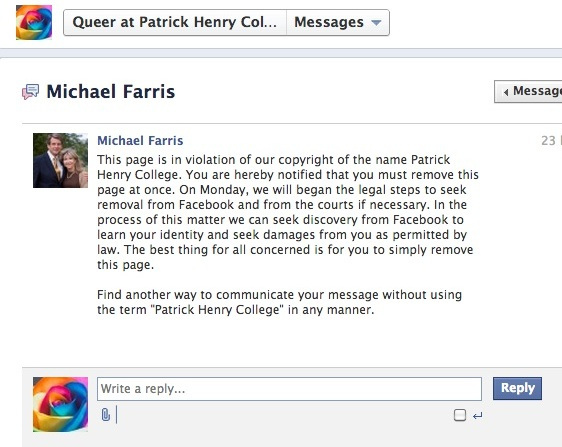
Over the first weekend in December, Michael Farris, the college’s chancellor, used his own Facebook page to contact Queer PHC and threaten them with a lawsuit:
Photo from Queer PHC.
Text is,
This page is in violation of our copyright of the name Patrick Henry College. You are hereby notified that you must remove this page at once. On Monday we will began [sic] the legal steps to seek removal from Facebook and from the courts if necessary. In this process of this matter we can seek discovery from Facebook to learn your identity and seek damages from you as permitted by law. The best thing for all concerned is for you to simply remove this page.
Find another way to communicate your message without using the term ‘Patrick Henry College’ in any manner.”
The problems with what Farris said and did are astounding. Not only is this a completely nonsensical interpretation of copyright law, not only is it slightly outrageous that Farris would pretty much threaten to “out” the individuals behind the group, but Farris used a personal Facebook page to communicate a legal threat on behalf of an entire college. Did he consult with the college’s board before making a legal threat on behalf of the college? Did they approve of the Facebook message? (Were they even aware of it beforehand?) These are important questions, especially considering what happened next.
What happened next was the Streisand effect. So incomprehensible was Farris’ strategy of internet bullying and censorship based on false legal issues that his threat suddenly exploded — Gangnam style — across the Internet.
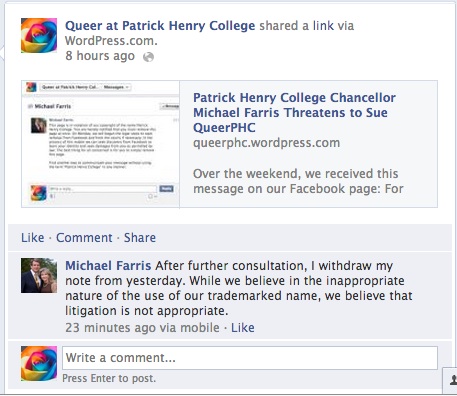
Of course, as soon as the controversy started (and probably once the PHC board realized what a bizarre and inappropriate action Farris had undertaken), Farris recanted — this time through a public comment on Queer PHC’s status:
Photo from Queer PHC.
But it was too late. The PR damage had begun.
When I heard about Farris threatening a perfectly legal Facebook group with an unfounded, frivolous lawsuit, I was floored. What better way to damage the credibility and reputation of not only PHC, but the homeschooling movement, by using abusive techniques like threatening fellow professed Christians with erroneous legal action? Not only fellow professed Christians, but your own former students?
But something about what Farris did to Queer PHC didn’t feel surprising. In fact, it felt familiar.
I couldn’t quite put my finger on it. But I was having a sense of deja vu.
Eventually, it struck me. And I went searching through my vast archive of saved emails from my old Hotmail account. And I found it.
In the early 2000s, when all of us homeschool speech and debate alumni were either still in high school or just beginning college, we socialized on Xanga. Xanga is to social media what Grandmaster Flash is to rap: really, really old school.Created in 1999, Xanga was around before Facebook, even pre-dating when most of us were on Myspace. Xanga was kind of like an public online diary: you could make posts, like other peoples’ posts, and subscribe to other people to stay connected. And that was about it.
(And yes, if you’re morbidly curious, my Xanga is still up. So feel free to search my teenage angst and amateur attempts at poetry, philosophy, theology, and public diary-writing for evidence you can use against me in the future.)
I created my Xanga profile on March 18, 2004. Most of my close friends from NCFCA and CFC had Xanga accounts as well. As this was really the beginning of social media, there weren’t really any parents using Xanga. It was primarily a teenage activity.
After a few months, two separate individuals created parody Michael Farris accounts. One was created on May 28, 2004. The other was created on July 26, 2004. (As you can see from these links, the accounts have since been scrubbed clean.) I don’t really remember much from the later account that was created, but I remember the first one because a friend of mine made it. It was clearly marked as a parody account, did not attempt to impersonate Farris to deceive anyone, and wasn’t even “offensive.” While a lot of us debaters were “punks” in one sense or another, we were still conservative Christian homeschoolers. So my friend’s parody account of Michael Farris did not involve things like dick jokes. I remember Fake Farris’s posts being along the lines of “I AM MICHAEL FARRIS AND OMG HOMESCHOOLING WILL SAVE THE WORLD!!!”
You know, immature attempts at ironic comedy that failed miserably. But again, nothing that even came close to slander. Nor identity theft. As it clearly stated it was a parody account, it didn’t even violate Xanga’s technical terms of use.
In 2004, on Xanga, you could “subscribe” to other peoples’ accounts. This would be the equivalent of “liking” or “following” a Facebook page today. Since I was one of the only people that used my real name on Xanga, and I was subscribed to the michael_farris parody account, I was the only person that Farris could recognize to contact about the account.
Oh yes, he contacted me about the parody account! Perhaps I just got ahead of myself. In 2004, Michael Farris — President of Patrick Henry College — was apparently monitoring what high school homeschool debaters were doing on a social media site. And as soon as he saw a parody account of himself, he went into militant mode.
On Wednesday, July 28, 2004, nearly a decade before he employed erroneous legal threats against Queer PHC, Michael Farris emailed me. In another way that this parallels the QueerPHC debacle, Farris contacted me with his official “PHC Office of the President” email address. The following is a screenshot of what he said, along with the text:
Text is,
From: “PHC Office of the President” <president@phc.edu>
To: <suavedrummerboy@hotmail.com>
Subject: Ryan is this you?
Date: Wed, 28 Jul 2004 17:17:34 -0400
Ryan,
This is Mike Farris–the real one from Patrick Henry College.
I see you as a subscriber to a xanga website named Michael_Farris. Your posts there seem to indicate that you know who this is who is running this.
I just went through a difficult time shutting down another xanga site called “michaelfarris”.
I am prepared to take civil and criminal legal action against this person. Identity theft is a crime. It is also subject to civil action (if for no other reason) than it violates Xanga’s terms of use. I want your acquaintance to save himself a lot of legal grief.
Here’s what he needs to do. Delete absolutely everything from the site. Then, send me the password to the site so that I can take control of it so that neither he nor anyone else can ever steal my identity in this manner again. If he does this I absolutely promise I will take no action of any kind against him. If he does not do so (and do so promptly) I will go after him with vigor.
It may seem funny to some, but it is not funny in the least to me. I will turn this over to the FBI if I have to. But seems it seems pretty obvious that this person is or was an NCFCA debater I wanted to try to quietly end the problem without the need for drastic measures.
Can you help?
Mike Farris
Yes, almost a decade before Michael Farris tried to bully and threaten Queer PHC with a frivolous lawsuit because he didn’t like what they were doing, Farris also threatened a Christian homeschool kid with civil and criminal action — even going so far as to invoke the FBI. As if the FBI would’ve given a @#$% about some kid’s Xanga account in 2004. But we were young. We had no idea. I was terrified. I immediately told my friend. He was terrified as well. What Michael Farris hoped to accomplish — using inaccurate legal concepts to coerce a highschooler into turning over the account information to a perfectly legal parody account — was successful.
A decade later, Farris apparently still uses the same tactics.
The funny thing is, this email I received would’ve likely slipped away into oblivion, covered by the dust of my long-forgotten memories. But in the same way that Queer PHC’s existence occurred to me because of Farris’ threat against the group, my remembrance of the email was likewise resurrected. To some, the very fact that I am bringing it into the open might seem petty and vindictive. But I do not reveal it for those purposes.
I am publicizing this email because of the trend I have repeatedly seen from the leaders of the Christian homeschooling movement. I am remembering the censorship employed by NCFCA leaders when forensics alumni, coaches, and students attempted to protest BJU’s history of institutionalized racism. I am remembering a personal censorship, which I will talk about next week during our Resolved: series. I am remembering how Farris went after Queer PHC. I am remembering how HSLDA chose to block former homeschool students from its Facebook page for speaking up about abuse during our #HSLDAMustAct campaign.
What I experienced a decade ago, what Queer PHC experienced last year — these are not isolated incidents. They are symptoms of a problem: the problem of how this movement chooses to interact with its whistleblowers. It has groomed us to “take back the culture.” Yet when we try to do so, the movement suddenly realizes “the culture” we want to take back is not the Evil Candyland of Liberalism, but our very own home — homeschooling itself.
If you are not toeing the line, if you question the movement’s assumptions, if you even dare to make parody accounts — the movement wants to shut you down and silence you. And Michael Farris led the way, is leading the way, by the choices he made and continues to make.
Considering Farris’ railings against Obama’s “tyranny” as of late, I cannot help but wonder: how exactly does bullying and censorship of young people demonstrate the ideals of freedom?
Mental Health — From Shame to Seeking Help, Part Two: Learning Shame in Childhood
HA note: This series is reprinted with permission from Lana Hobbs’ blog, Lana Hobbs the Brave. Lana describes herself as “an aspiring writer and a former religious fundamentalist” who currently identifies as “post-Christian.” She was homeschooled in junior high and highschool. Part Two of this series was originally published on June 7, 2013.
(trigger warning: depression and suicide shaming and suicidal thoughts)
I don’t believe we are born believing that our negative emotions are wrong, i think this shame is something that we learn. I believe we can learn to use our emotions as guides to show us warning signals and lead us towards the next healthy steps (of course, with clinical depression, those emotions might be liars, i’m not sure how that works).
But many of us learn that normal emotions like sadness, anger, fear, and distrust are things we need to repress, for the sake of keeping the peace around us, being ‘godly’, and making our parents and others happy.
I struggle with depression. For years, probably for most of my life, I have struggled with depression and physical pain caused by depression and stress.
I never would have recognized it as depression though. I would have called it ‘feeling a little stressed’ or ‘having a bad attitude but working on it’, when secretly I felt like there was no hope and if I loved everyone around me, I would kill myself and rid them of the burden of dealing with me. I remember being around eleven, after doing something that upset my mother – i didn’t even know the word suicide yet – crying on my bed, believing that I was a major screw-up and a terrible daughter no matter how badly i tried to be good. If I weren’t so scared I might go to hell for murder (I was a christian who was afraid of losing her salvation at that point), i would murder myself so my parents wouldn’t be disappointed by me anymore.
I was twenty-three before it occurred to me that these are not the normal thoughts of a healthy preteen child.
I brought it up once – only once that i remember – in childhood.
It wasn’t something i could talk about, because I quickly learned suicide was a taboo subject.
I don’t remember what I said, I didn’t say that I was thinking of it but tried to bring up the idea of killing oneself. My mom declared suicide very evil and nothing to be considered or talked about, and that was that.
I was afraid my selfishness kept me from doing it, but others considered suicide the ultimate expression of selfishness*. I felt most of my life that I was damned if i did and damned if i didn’t.
I also had unexplained pains and aches, and periods of ‘attitude’ where I just couldn’t feel happy and cried for no reason. I was sad that i was such a poor example of Jesus’ light to the world** My parents lamented once that i wasn’t even PMS (i wasn’t sure what they meant). I frequently had trouble making friends at school, my teachers once said i wasn’t adjusting well, and i went to the office to be checked for sickness regularly because of tummy aches – i still get stomach aches and joint pain when i am very stressed or depressed.
In retrospect, I believe a lot of this was partially because of undiagnosed childhood depression. now that I know what depression feels like, I can remember that I did feel this way many of those times, all the way back to age 7.
In 7th grade, I was homeschooled for the first time. My homeschooling continued through graduation, and while there were some benefits, one cost was that I lost any of the ‘psychobabble’ from school counselor classtime that might have taught me how to cope with anger and that sadness was okay and how to deal with it. Also my family ventured deeper into fundamentalist Christian teachings, where we believed we would find out how to live and all turn out faithful because we trusted God and served him. My parents wanted very badly for their children to grow up to be strong soldiers for Christ, and I wanted that for me too. I wanted God to be happy with me, and not sad because of me. I wanted to hear ‘well done, good and faithful servant!’ when I died.
When I was sixteen, I took a great interest in the human brain, staying away from psychotherapy because that was ‘psychobabble’ by people who denied God could heal. I was actually very interested in psychology, and learning how the brain worked. I had an old college textbook I read in my spare time.
I also dreamed of being a christian counselor, to help people. Maybe even to help myself with my very big negative feelings I couldn’t seem to control – and by control I meant get rid of.
My parents encouraged me by buying a me a course on mental health from a respected Christian teacher. I ‘learned’ that suicide was the ultimate expression of ‘self love’ (which means ‘selfishness’ in the language i learned as a fundamentalist christian), and depression was either a failure to trust God, guilt, or an evil spirit that god visited on you for sinning – like Saul after God disowned him as king.
I had heard somewhere that depression was a medical problem, but this was generally dismissed as a lie perpetuated by people wanting to drag others away from God, while medicines that ‘supposedly’ helped with mental illness – depression especially – were even called witchcraft by a pastor at my church – who used bible verses to support this claim. I cannot find an article arguing this right now, but the general claim is that the word translated ‘witchcraft’ is pharmokopeia, which they say refers to psychotropic medications. By this logic, taking any medication that might help mental illness is actually trusting to ‘witchcraft’ and sin, instead of trusting God, forgiving, asking forgiveness, and living right.
I would like to point out that I am not saying the bible is against mental health care, simply that I was taught it was, and the Bible was used to teach me this. I no longer agree with these interpretations or usages of the Bible.
By the time I was done with high school, I didn’t admit I’d ever had depression (I believed I didn’t have repressed guilt and I knew I did pray and trust God, so how could I be depressed?), but I did believe that if I trusted God ‘enough’, he would give me peace and mental health in my life, and that if I worked hard, I would be such a good christian I wouldn’t have to wrestle with the dark sadness and suicidal thoughts again.
Unfortunately, I was never ‘made perfect’, although I had many long periods of happiness in my childhood and young adulthood (and probably periods of hypomania), the emotional difficulties, attitude problems, and unexplained sickness came back the worst they had ever been, when i was in college….
*****
(disclaimer: my whole childhood was not depression and repressed feelings. there were many good days and fun times. but this post is about my history with depression, and mental illness shaming, and the warped beliefs i held about mental illness)
*the link to a reb bradley PDF is a note taking guide/companion to the tape set The Biblical Path to Mental and Emotional Health. the section on suicide as self love is striking. My parents got the set for me when I was about sixteen because I was interested in becoming a therapist to help people. I didn’t listen to all of it, the suicide and depression shaming filled me with very uncomfortable thoughts, and led me to put the tapes away until i trusted god enough not to be depressed. That day never came.
** I ‘got saved’ at age 5. I felt a great pressure to ‘be salt and light’ so that people around me would love Jesus and not go to hell. This ‘burden for souls’ and pressure to be Christlike added extra guilt onto me my entire life. For many reasons, both of reason and heart – and hurt – I no longer identify as Christian.
Kathryn blogged [a few weeks ago] about homeschool children who are asked to defend homeschooling to strangers who want to know if they’re well educated and well-adjusted. What does it look and feel like when our parents and homeschooling community expect us to be apologists for homeschooling?
This kind of upbringing can lead to 2 results:
1. You grow haughty about your own superiority and stand at a distance from your peers
2. You don’t learn to be self-reflective, and you end up a crippled version of yourself because you don’t change the things you need to change to become a fully developed adult and.
I know this, because I’ve both seen it in others and lived it myself. As a homeschool student from K-12, I too was asked by many strangers and friends to defend my experience as a homeschooler. But the same expectation existed within my own community.
My homeschooling experience started in the early days of the homeschooling movement. I was often asked by my parents to describe the benefits of my homeschooling experience because they were proud of me, but also because homeschooling still required defense in a lot of circles. At my graduation, the unwritten expectation of my homeschool community was that I would speak about how my experience was superior to that of my peers.
This expectation exists for most homeschool graduations I’ve been to—parents expect their children to stand as apologists for their homeschool experience. I once attended a graduation where the two speakers talked about the superiority of their educational upbringing—they were confident, articulate, and very convincing. Except that I’ve known one of the two speakers since she’s a baby, and I can say quite confidently that she is poorly prepared for the world and hasn’t been given a foundation of independence or critical thinking about her experience or the experiences of other 18 year olds preparing to step into the world.
I went on to college, completed a master’s program, and am a successful young professional. However, it was only when I was able to objectively look at my homeschool experience and see the good and the bad of it that I was able to grow into a mature adult and shake off the fears of others that kept me from growing into the most complete version of myself.
The problem with those 2 results of being a homeschool apologist?
1. When you’re haughty about the superiority of your homeschool education, you hold all others at arm’s length and rich relationships are impossible.
2. When you continue to insist on the perfection of your own experiences, you are blind to your imperfections and you stay in a static state.
No person is perfect, but inflexibility and a closed view of those who aren’t like you are often a byproduct of becoming a haughty homeschool apologist. The opposite characteristics – flexibility and openness – are two characteristics that make good friends. If you can’t be open and flexible in your understanding of the experiences of others, you won’t be a good friend.
Any parent who homeschools their children should give them the freedom to live within their homeschool experience without having to be a homeschool booster. If you tell people that your children are intelligent and capable of having intelligent discussions, allow them to be a part of the dialogue about the educational choice you’ve made. Let the discussion be real, and let them tell you why the homeschooling is or isn’t working for them.
If your children really do love and buy into the homeschooling choice – then – they will be the best booster.
HA note: The following is reprinted with permission from Libby Anne’s blog Love Joy Feminism. It was originally published on Patheos on June 5, 2013.
The homeschool literature that my parents read promised them that homeschooling would create perfect sibling relationships among us children, and make us all especially close and really good friends with each other—unlike those public school kids’ distant relationships with their siblings, and rivalries rather than friendships, of course. I want to take a moment, then, to talk about sibling to sibling relationships in my family. This is kind of embarrassing, to be honest—I’m not going to come off so well here.
It’s true that we kids played together all the time growing up. We sort of had to—there wasn’t usually any other option. I mean sure, we had people over, but most of the time it was just us, and so we were each other’s playmates. I have so many memories of exploring creeks, building lego cities, and chasing each other across the pond. I could go on and on—we really did have great times. But here is my first caveat—I’ve found that most of my friends today who were public schooled also had great adventures with their siblings. Sure, they weren’t around each other for quite as many hours of the day, but it’s wrong to think that they didn’t also explore creeks together, build lego cities together, and chase each other across a pond or pool. In fact, come to think of it, I had cousins growing up who went to public school (and lived far away so we very rarely saw them), and I know for a fact that they did all of those things regularly.
Now, anyone who thinks that homeschooling magically eliminates sibling rivalry is sorely, sorely confused. I’m having troubles thinking of how to easily describe it, but we had sibling rivalries, and lots of them. There were literally three years when one of my brothers and I fought every time we had to spend more than half an hour together (which meant it happened multiple times a day, of course). We just set each other off, somehow. One of my sisters and I just had such completely different outlooks that we ended up permanently at odds—she resented me for being a goody-goody, and I resented her for not being the picture perfect Christian homeschool kid. There were several sisters in a row at one point, and this didn’t always work out that well—there were plenty of times when some of them tore down the others, continually, and with no real explanation. But beyond all this, as I’m going to explain, I actually think that in our case homeschooling served to exacerbate sibling rivalry.
For one thing, we kids fought over friends. See, rather than having individual friends our family generally got together with other like-minded homeschool families as families. So, say, the Smiths and their five kids would come over, or the Joneses and their nine kids, and we’d just play with whoever was somewhere around our age. In this process, I stole friends from my close-in-age-sister. Twice. And once I took a friend who by age probably should have been hers, but I got to her first and monopolized her. And no, this didn’t make for much happy-making between my sister and I. But, well, there were a limited number of friends available to us, so we fought with each other over them, and I usually won. If we’d been in school, we would have been in separate classes and had our own individual pools of friends.
In addition, because we were homeschooled we siblings had to spend 24 hours a day together. Sometimes this worked out great, but sometimes we got on each other’s nerves. A lot. A very, very lot. I suspect that if we had had more time apart from each other we might have grated on each other less. It would have given us a break. It would have meant that we could each have our own space and our own things—something we didn’t really have, and something we often sorely needed.
Next, bullying. Talking about bullying is rather difficult because, well, I was the bully. My parents followed the Pearls’ child training methods, which they came to after another homeschool family recommended them. Based on these methods, they gave us older kids the authority to spank the younger ones. I was never sadistic or anything, but I sure wasn’t very nice about it, and I learned after coming of age and leaving home that many of the younger ones saw me as a bully and had come to hate me. Only, in this case I had been a bully they couldn’t get away from. Normally, kids who are bullied at school have a respite at home. Not so my siblings. Sadly, I’ve seen this same pattern copied by others of my siblings, and even today, among those of my siblings still living at home, the older ones are authorized to spank the younger ones. In some ways, it’s rather like parent-approved bullying. As I’ve written before, I deeply regret my involvement in this. Sure, this pattern can exist without homeschooling, but in our case it was a pattern my parents implemented based on the literature and teachings of the homeschool movement, and not something I think they would have adopted had they not homeschooled.
There’s another issue I should probably discuss as well—as junior mom, I had my favorite among the younger kids. I favored her, and the other kids knew it. In fact, more than once when I was presiding as judge over an altercation the other children accused me of taking my favorite’s side just because she was my favorite. And it was probably true. What’s saddest to me about this is actually what happened after I left home—that special relationship didn’t last. My favorite felt I’d abandoned her when all I’d done was left for college—but she was too young at the time to understand. And then things blew up between myself and my parents and there was a long gap when I didn’t visit home at all, and was afraid to have too much contact with my siblings for fear of risking my parents’ disapproval. I wish I still had a special closeness to the girl I mothered as a teen, but it’s gone now and rebuilding it is hindered by a lack of trust. Perhaps this is something specific to me, but I think it suggests that the junior mother-favored little sibling dynamic common in so many homeschool families I knew growing up wasn’t really so healthy as we thought it was.
And now we come to today.
Today, I’m extremely close to several of my adult siblings—but I’m close to them not because of being with them 24/7 growing up but rather because we were bound together by adversity as young adults. These specific siblings also went through problems with my parents when they became adults and started making their own choices, and during this time we cried on each other’s shoulders, blew off steam in long phone conversations, talked about out our backgrounds have affected us, and just generally were there for each other—and we still do this today. The interesting thing is that these aren’t even necessarily the siblings I was closest to as a kid. As for the kids still at home, my relationships with each of them are weird because if I actively try to undermine what my parents are teaching them, my parents will likely limit my contact with them, and avoiding things that will undermine what my parents are teaching them means avoiding talking about basically everything I’m interested in.
I don’t think homeschooling enhanced sibling to sibling relationships in our family. I’m not saying there weren’t some good things—I did spend more time playing with my siblings than public schooled children do, and I have lots of positive memories from these times—but rather that I think the downsides outweighed what we gained. So when I read the following quote by homeschool pioneer Mary Pride, I just had to laugh. With this background, let me offer the quote and some thoughts I had on reading it.
However, in one respect these books do get it right. In school, kids learn to segregate themselves by age. Older kids learn to be embarrassed about spending time with younger kids. Schoolkids also quickly learn the art of the putdown, and all about “ganging up” on the victim of the day. When all these social fighting skills – which clueless folks refer to as “socialization” – are brought home, it can take sibling rivalry to a new level of meanness.
Does she seriously think sibling rivalry only turns mean when kids attend public school and thus learn bullying techniques and bringing those techniques home? Or, conversely, that public school kids naturally have troubled sibling-sibling relationships? Or, to ask a third question, that homeschooling can’t in certain ways serve to increase sibling rivalry? Because my experience and the experiences of friends I now have who were public schooled very much suggests otherwise.
Does she seriously think that homeschooled kids don’t learn how to put each other down or gang up on each other? Goodness, don’t get me started on the ganging up on each other bit—for a long time, my siblings and I were split into two groups and automatically took opposite sides when there was a fight. Sometimes one faction would gang up on one kid in the other faction, and the rest of that child’s action would rush to her rescue. Each faction viewed the other with some degree of suspicion.
Does she seriously think that homeschooled kids never get annoyed by kid siblings and, yes, even at times come to resent them? Let me tell you right now—they do! I wouldn’t say I ever felt actual resentment—though the same cannot be said of all of my siblings—but I did find some of the younger ones quite annoying at times. And sometimes we older ones—some more than others—wished we could get the little kids out of our hair so we could have some space, but when the little kids share a room with you, it’s rather hard to do that.
When it comes to sibling to sibling relationships, my parents would have done better here if they had sought to read about and learn techniques for fostering positive sibling relationships rather than simply assuming that the act of homeschooling would turn us all into singing cherubs. But then, they bought what Mary Pride was selling hook line and sinker.
I want to be clear that I’m not trying to generalize from my experience—while there may be some similar patterns, I think the dynamics of sibling relationships will vary greatly from homeschool family to homeschool family (just as they vary greatly from public school family to public school family). I’m simply saying that the promise my parents were given that homeschooling would create close and blissful sibling relationships—and also would mean that none of us would face bullying—turned out to be false and grossly misleading. And yet, homeschool speakers and organizations are still out there making this same promise to unsuspecting homeschool parents today. Perhaps, in some small way, my story can help.
If you were homeschooled, I’d like to invite you to use this space to talk about how sibling relationships went in your family. And if you weren’t homeschooled, feel free to talk about your own experiences with sibling relationships and how they compare and contrast with the things I talk about here.



 Homeschoolers Anonymous