Adult Homeschoolers Speak Out: Part Five, The Highschool Experience

Adult Homeschoolers Speak Out: Part Five, The Highschool Experience

HA note: The following series is reprinted with permission from Brittany’s blog BAM. Part Five was originally published on May 30, 2012.

*****

Also in this series: Part One: Why I Wanted To Write This | Part Two: Survey Stats and Large Families | Part Three: Top 3 Reasons Parents Homeschool | Part Four: Academic and Emotional Experiences, K-8 | Part Five: The Highschool Experience | Part Six: College? Prepared or Not? | Part Seven: What About Socialization? | Part Eight: The Best Thing vs. What Was Missing | Part Nine, Do Former Homeschoolers Want to Homeschool? | Part Ten: Are the Stereotypes Better or Worse?

*****

Part Five, The Highschool Experience

Isn’t it funny that when you are going through an experience you can think, “Wow! This is awesome!” and then looking back you can think, “umm….wow. That could have been a lot different/better.” (Maybe that is how most of us feel about our adolescence….?)

This is kind of how I feel about my homeschool experience in high school. During those 9th-12th grade years, I loved being homeschooled. But now that I am 10 years post high school graduation (with a BA and MA under my belt), I have different feelings about what was good and what could have been better.

Many of the adults who participated in my survey felt the same way as I did but, as a majority, had a “good” experience academically and emotionally. However, the numbers were not as positive as when people looked back at their elementary/Jr. High years.

Here’s a little comparison:

Academically:

Here is what some of them had to say about their positive academic experience in high school:

Beka R. 25 from KS: Good – I finished my high school curriculum somewhere around age 14 and then was able to do extra studies and college classes on political science and English to help prepare me for college. 

Jonathan M. 30 from TX: Here I know that I (in many ways) received a better education to prepare me for the real world. 

Elizabeth J. 24 from VA: We had the Abeka video classes, and we watched all of our classes on DVDs. Mom had researched the core classes of most high schools and what was required for colleges and we took, Math, English, Health, Science, History, Bible, Spanish, and my mom was in charge of PE. We has all of these classes every day. However, for the most part it seems very easy. I had a lot of control over my education because I was the one who was mostly in charge of studying and finishing assignments. Mom just graded everything. Other than that we were pretty much left to ourselves.

Nara N. 30 from NC: Academically: I was still above grade level. I graduated 2 years early at 16 and probably could have graduated at 15 except what would I have done then, too young to have my driver’s license even?

Bradley H. 23 from VA: Academically it was superb, from what I can remember . . . I was able to pursue science in a more rigorous fashion being homeschooled, and so I was able to prepare for college well.

Stuart G. 29 from VA: One of the best parts about my high school years was that it brought out an initiative to teach myself. My mom just gave me the books and the rest was up to me. For me, that was an important tool for me to learn, because I was learning self-discipline that would prepare me for higher level education and my career later down the road. I also began to help out with the education of my younger siblings, particularly in math. Perhaps this exercise was helping me better grasp fundamental concepts of certain subjects as well as challenging me to succinctly explain ideas, events, rules, etc. to my siblings. 

Many responders mentioned being taught high school subjects from other homeschool parents in a co-op setting; everyone thought this was a good experience. Also, many also said that they dual enrolled in college in their later high school years, giving them a head start on college classes.

As you can see from the statistics and these testimonies, many homeschool students felt that they had an excellent high school education.

However, here are the statistics for the “other side” of the story

  • 31% (13) of responders said their high school education was “not good” or “could have been better.”

Here are a variety of reasons they gave for these answers:

  • Felt under educated*
  • No guidance from outside adults (like a guidance counselor) concerning education*
  • Did bare minimum to get by
  • Could have been challenged more*
  • Parents not involved in education /  no accountability from parents / parents were too busy
  • Realized they could have achieved more
  • Difficulties and frustrations in math / science / English
  • Not as many opportunities as in a traditional school*
  • Didn’t try hard
  • Laziness (parental or personal)

In looking at all these reasons, I realize that the majority are not unique to the homeschool experience (the ones I marked with * are, perhaps, more related to homeschooling inadequacies than others). I wanted to put a star by “parents not involved” etc. but I realize that this is a gray area for many reasons:

1. If a parent is not involved in a child’s public or private school education, this could and may be a detriment to the student’s overall education

2. Many (if not most) homeschool parents encourage their high school children to be independent learners, and many students flourish in these opportunities (as seen in some of the quotes above).

3. I, myself, took charge of my own education from 8th grade-12th grade (picked my own curriculum, planned my lessons, was very independent of my parents in my education) and I turned out “fine.”

But.

Lack of parental involvement is, I feel, one of the main reasons that my high school education could have been better, though at the time, I thought I was “amazing” for being “so responsible”! I’ll talk about the pros and cons of independent learning for homeschoolers when I write about homeschooling and the college experience.

If I was going to give any “take-away” advice on this point, I would say, “Kids still need their parents to be very involved in their education (pushing, encouraging, guiding, advising) in high school, maybe even more than in the elementary years.”

Emotionally, the stats between being happy homeschooling in younger years vs. high school are only 8 points apart.

19% (8 adults) said that they had a very negative emotional experience for these reasons:

  • Felt like they missed out on a lot
  • Lack of friends / no friends
  • Lack of social experiences
  • Family problems / Bad relationship with parents
  • Felt trapped by parents decisions
  • Wanted to fit in w/ others
  • Felt intense academic anxiety (not good enough)
  • Difficulty socializing w/ others (I’ll be covering this topic in a future post!)

23% (10 adults) had mixed emotions, meaning “I liked some things, but…”

Here are some reasons they gave for having difficulty emotionally (Some of the answers are the same as above. The difference between the two groups is that the above group had a decidedly negative emotional experience for the reasons given; the group below said that their experience had some good parts but also difficulties):

  • Difficulties w/ parents,
  • Lots of teasing from non-homeschooled peers
  • Felt awkward
  • Difficulty finding friends
  • Felt something was missing from high school experience
  • Difficulty w/ curriculum (more of an academic issue but for several students, this cause emotional problems as well)
  • Struggle with shyness
  • Really wanted to go to public school

It is great to see that, overall, homeschooled high schoolers have had good experiences both academically and emotionally. Somehow though, I wish the satisfaction rate was higher for both academics and emotions (even personally). As I stated in my very first post, everyone [in my survey] “turned out fine” and, at best, have worked through their limitations that came from homeschooling or, at worse, learned to accept this part of themselves.

The truth is, everyone goes through “crap” during the high school years, either in public, private or homeschool. The struggles for public/private school students are often very different — and not just the “unholy trinity” of sex, drugs and alcohol. Like it or not, homeschooled high schoolers still experiment sexually and are tempted by drugs and alcohol. But homeschool students often go through personal struggles that their non-homeschooled peers do not have to deal with.

What do you think? 

Were you homeschooled in high school? How was your experience academically and emotionally?

Do you homeschool (or plan to homeschool) your high school student? Do any of these results surprise you?

Please share your comments below! And feel free to share this post with others that may be interested or may benefit from this series.

*****

To be continued.

Adult Homeschoolers Speak Out: Part Four, Academic and Emotional Experiences, K-8

Adult Homeschoolers Speak Out: Part Four, Academic and Emotional Experiences, K-8

HA note: The following series is reprinted with permission from Brittany’s blog BAM. Part Four was originally published on May 28, 2012.

*****

Also in this series: Part One: Why I Wanted To Write This | Part Two: Survey Stats and Large Families | Part Three: Top 3 Reasons Parents Homeschool | Part Four: Academic and Emotional Experiences, K-8 | Part Five: The Highschool Experience | Part Six: College? Prepared or Not? | Part Seven: What About Socialization? | Part Eight: The Best Thing vs. What Was Missing | Part Nine, Do Former Homeschoolers Want to Homeschool? | Part Ten: Are the Stereotypes Better or Worse?

*****

Part Four, Academic and Emotional Experiences, K-8

Welcome (or welcome back!) to this series about the experiences of Adults who were homeschooled! Today we will look at what former homeschoolers thought about their schooling experience from Kindergarten through 8th grade and how they remember feeling emotionally (liked it, didn’t like it, etc).

I thought this post was going to be pretty simple to write. I had read through all the surveys once and was thinking, “Oh, everyone had such a good experience in these grades and they all loved it!”

However, after reading through the surveys for a second time and crunching some numbers, I realized that my first impression was a little (too) rosy.

Here’s the short version:

  • 91% or 39 adults said their Academic experience was good (“Great!” “Awesome!” etc).
  • Only 9% (or 4 participants) said that it “could have been better.”

Emotionally, the numbers were a little different.

  • 65% of adults (or 28 people) said that their emotional memories were good (“I loved it!” “I really enjoyed it.” etc) or that they had no memory of how they felt (2 participants or 4%).
  • 30% (13 participants) of adult homeschoolers said that they struggled with negative emotions concerning this time in their lives. (To see survey demographics, click here).

Here are some of the Academic testimonies from the survey:

Kelly C.; 29 from VAI have really pleasant memories of my homeschooling experience as a child. My mom only has a high school education and I feel like with the curriculum she had and the homeschool community we were a part of that I was not slighted in the least from receiving a good education.

Elizabeth J., 24 from VAI loved it! . . . We only had three formal classes: Math, Spelling, and Grammar. And the rule was, once you finished the set assignments for the day, you were finished from school. So most days we would start around eight in the morning and be finished by 9:30 or 10. There were other things that we did sometimes: Handwriting, phonetics, field trips (we visited probably every important or historical site in Virginia). Also my siblings and I read like crazy. We would go to the library every Friday and get as many books as we could carry and my sister and I would read each other’s books. But we all had to get one science and one history book and write a report on it.

Nara N., 30 from NCAcademically: my Mom always chose curriculum from all kinds of places and at whatever grade level was appropriate for us in each subject. My brother and sister (twins) did not even always do the same curriculum for each subject. I was basically always above grade level and never knew what “grade” I was in.

Matthew W., 30 from OHFor the most part everything was good. I enjoyed the benefits of homeschooling and we had a lot of friends that were also homeschooled. We were in some pretty good homeschool groups and took some cool field trips. 

Christine M., 31 from  KSIt was a good, very positive experience. There were times I wanted to try out public school, but I loved knowing I could be done with my schoolwork before lunch and spend the rest of the day creating, exploring, playing, and just enjoying being a kid instead of dreading the homework that would follow me home. I had lots of time with friends at church, co-op, and in my neighborhood. I also had lots of time to foster my interest in piano.

Stuart G., 29 from VAAcademically: Admittedly, in these first years of home-schooling there was some frustration because my mother was trying to navigate the new waters of schooling at home, and being teacher for all eight of her children. On the positive side, I was given the freedom to more seriously pursue subjects I was personally interested in. My curriculum therefore, was tailored to my needs and natural inclinations, which in turn, made learning more enjoyable for myself, and (I believe) all of my siblings.

Corinna R., 35 from VAAcademically I did much better than I would have otherwise as my parents were able to cater to areas where I had a harder time (like math) and also push me and provide extra opportunities where I was gifted (like music).

Kellan A., 23 from KS:  I really enjoyed it. I feel like I learned a lot and got an extremely good groundwork for the future.

O. G., 29 from KSI thoroughly enjoyed being homeschooled. I think we had a great support group and I had a great relationship with my mom and sister. Academically I probably could have been challenged a bit more…

Emotionally, no one [in my survey] had a completely “bad” emotional experience. However, the ones whom I placed in this category indicated that they had struggled with negative emotions for about 2 years, usually starting around 5th grade. Others noted that Jr. High was a hard time emotionally (which is often a hard time for kids whether they are homeschooled or not).

Reasons cited for negative emotions:

  • Wanted to go to public school
  • Felt like he or she was missing something
  • Felt different
  • Didn’t feel “normal”
  • May have lengthened struggle with shyness
  • Was angry about being taken out of school
  • Felt like parents had too much going on to help
  • Lack of social activities

Interestingly, many participants tied their emotional experience to the availability of social experiences. (A note concerning interpretation: I had to use my personal judgement in determining the emotions behind the words/experiences in some of the surveys. For example, see academic results above where many just said, “I really enjoyed it.”).

I have included both positive and negative testimonials below:

Kelly C., 29 from VA:  [T]he community that we were a part of was wonderful for me as far as socializing. I think there is a big misconception (among the non-homeschooled) that homeschoolers do not socliaze and for me that was not true. We were involved in many activities with other homeschoolers; I participated in 4-H, we had weekly get-togethers at the park or skating rink as well as field trips to various historical/educational facilities.

However, while Kelly noted feeling “wonderful” about these experiences, M.V. relates more negative feelings toward very similar experiences. This just shows that different students had different emotional needs.

M.V., 27 from KSEmotionally, I had friends and social opportunities . . . I don’t feel like I was deprived of social events. At the same time, I don’t think I had much in the way of developmental activities. Sometimes kids this age get involved in a sport or a musical instrument: I had choir, 4-H and long walks through the pastures around our house, none of which were really conducive to developing my future skills and personality as an adult. I think the lack of developmental activities here contributed to more problems in high school.

Here is another contrast between experiences, this one concerning personality:

Nara N., 30 from NCEmotionally: I think I did just fine. I’m naturally quiet/introvert. Sometimes I wonder if public/group private school might have brought me “out” more, but I think it probably would actually not have been good for me as a young child, and would have created a lot of extra stress in my early life.

E. H., 21 from DEEmotionally, it may have lengthened my struggle with shyness, but it meant I was able to unfold in my own time and with invaluable personal/family/spiritual growth in the mean time.

S. M., 29 from WV shows a good contrast between someone who had a good academic experience but who struggled emotionally:

I was full of anxiety because I felt I was getting less of an education that my peers. I always felt educationally and intellectually inferior the entire time. Academically, I did well.

M.L., 26 from NE and M.D., 19 from KS both had positive experiences in earlier grades but struggled emotionally as they got older:

M.L., 26 from NEThe younger years I really enjoyed it, I loved being with my brothers while doing school, I felt challenged to always keep up with them . . . However with life changes, baby, sicknesses/health conditions in the family I felt that my education wasn’t as important as other things going on. Whenever I had questions about school, I felt like my mom had too much going on to help me. In 5th grade I really struggled with school, I felt like all of a sudden it was really hard, I didn’t understand it, it took me forever, I didn’t feel challenged to do well because my brother who had always been a year ahead of me was now behind me and the others were too far ahead so I had no motivation to do well it school. It was the first time I begged to go to public school, I thought, “even if I hate school, at least I would be with my friends. 

M.D., 19 from KS: My view of homeschooling up to [5th grade] was fairly accepting. I remember a few moments of jealousy toward other kids my age who got to spend their days with their friends in public school, but for the most part homeschooling was normal for me, and I didn’t question it. 

I remember middle school being the time when I really started questioning whether I wanted to be home schooled. I was becoming more involved in my church youth group and less involved in the home school group and because of this I was surrounded by kids who attended public school. 

On the other hand, other adults recorded strong, positive emotions in looking back on these years:

Stuart G., 29 from VAEmotionally: I was happy and enjoyed strong relationships with my siblings due to the fact that we were schooling together. Furthermore, my bond with my parents became stronger because of the increased time we were spending together. Especially effective was my father’s involvement in my education, which had not existed prior to home-schooling. 

There was also a noted lack of turmoil that many of my peers in public/private atmospheres experienced. Because we missed out on much of the “drama” middle-school and high-school atmospheres cultivate, we were more at peace with ourselves (choosing things we were truly interested in without regards to what was “popular” at school, etc), and amongst ourselves.

Overall, homeschoolers [in my survey] looking back at their elementary and Jr. High years remember being satisfied academically and happy emotionally (though I think some of the responses concerning emotional satisfaction are very thought provoking).

What about you? 

If you were homeschooled, what do you think about your academic and emotional experiences looking back at K-8th grade?

If you homeschool your children, what thoughts or concerns do you have about their academic and emotional lives?

Please feel free to comment and ask questions!

Also, feel free to share these posts on Facebook or other social networking sites if you feel that others would benefit from or be interested in this series!

*****

To be continued.

Adult Homeschoolers Speak Out: Part Three, Why Parents Homeschool

Adult Homeschoolers Speak Out: Part Three, Top 3 Reasons Parents Homeschool

HA note: The following series is reprinted with permission from Brittany’s blog BAM. Part Three was originally published on May 25, 2012.

*****

Also in this series: Part One: Why I Wanted To Write This | Part Two: Survey Stats and Large Families | Part Three: Top 3 Reasons Parents Homeschool | Part Four: Academic and Emotional Experiences, K-8 | Part Five: The Highschool Experience | Part Six: College? Prepared or Not? | Part Seven: What About Socialization? | Part Eight: The Best Thing vs. What Was Missing | Part Nine, Do Former Homeschoolers Want to Homeschool? | Part Ten: Are the Stereotypes Better or Worse?

*****

Part Three, Top 3 Reasons Parents Homeschool

While growing up, I heard my mother describe homeschooling as “a lifestyle” countless times to curious inquirers who wondered why anyone would embark on such an endeavor. In the late 1980s, when my family started homeschooling, the question of “why” was very apropos, considering that homeschooling was illegal or newly legal in many states.

Keeping in mind these historic details, I was very intrigued to discover the answers to the question “Why did your parents choose to homeschool, from your understanding?” from first generation homeschoolers. (To learn more about why I decided to explore these questions, click here!)

(While reading, please keep in mind the last part of the question: from your understanding. All of these responses come from the adults looking back on their experiences and to understand why their parents decided to homeschool).

An example from my own family might give insight into the wide variety of answers I got:

My oldest sister, (Amberley, 33 years old), gave this answer:

Well, homeschooling was not legal in Nebraska when I started school, so I don’t know if Mom would have homeschooled me from K or not… But she said I was a brat and wanted me to get along better with my siblings. But I think there was also the religious aspect of things, where they wanted me to be able to study the Bible and learn about things from a Biblical perspective (ie. Bible as a subject, creation).

My second oldest sister, (Chelsea, 30 years old) also mentioned the “getting along with siblings” part, as well as religious reasons.

I, personally, don’t remember my sister being “a brat” (that just makes me laugh a bit). However, the following story is what I remember my parents telling us about why they started to homeschool:

My oldest sister was in the AWANA program (a church based Bible memory club) that met on Wednesday nights. Amberley was so tired in the morning that she had a very difficult time getting up for school. My parents decided that Biblical education (like the AWANA program provided) was of greater value that academic education that required my sister to get up early in the morning. These circumstances greatly influenced my parents’ decision to start homeschooling. 

My younger brother (Kellan, 23 years old) gave this reason:

Well, all of you guys were homeschooled so by the time I rolled around I guess they just had to.

My brother’s answer, of course, is very tongue-in-cheek, but I think it gives a good example of how siblings can have different perceptions of the same event.

Most of the homeschoolers who took the survey cited multiple reasons that influenced their parents’ decision. But the # 1 reason for homeschooling on the surveys mirrored my own family’s reasons for homeschooling: Religious Reasons or Convictions. 

Here are some direct quotes from the survey:

(To see Survey Statistics, Click here)

Melissa Ann G., 26 from VA:   Parents decided to homeschool us for religious reasons.

Christine M., 31 from KS: [My parents] wanted us to have a religious foundation to our education

Jeremy D., 18 from VA: My parents didn’t like “ungodliness” of public school . . . they felt God calling them to homeschool us.

Emily M., 26 from FL: I believe it was primarily because they are very conservative and strong christians and they felt that public schools taught things they didn’t believe and they also thought that it opened up a lot of room for temptations and misguidance.

Elina C., 25 from KS: They didn’t like the evolution stance that was being taken in the school system and wanted to have the freedom to teach us creation.

Jenna C., 28 from KY: [My parents homeschooled] to keep us sheltered from many of the negative influences of the world, and to instill a love of God in our hearts.

And many others:

  • 12 people (myself included) specifically mentioned “religious conviction”as a primary reason for homeschooling
  • 6 people said that their parents wanted to protect them from “worldly,” “ungodly,” or “bad influences
  • 3 people stated that their parents “wanted to teach the Bible”

While religious convictions was the # 1 answer, the next highest response was related to Academics or dissatisfaction with Public or Private Schools.

Stuart G., 29 from VA mentions academic reasons along with others:

My parents were unhappy with the public school environment and the quality of education we were receiving. The straw that broke the camel’s back was an incident in which my sister was being bullied and the administration was ineffective in dealing with the perpetrator. After this incident, my parents decided to try homeschooling on a trial basis. After the first year, it was clear that homeschooling was the right way to go for our family.

Elizabeth J., 24 from VA stated:

My mother wanted to protect us from the negative influences found in public schools, and later (after my sister spent 3rd grade at a private Christian school) to give us a more personalized, at-our-level, education. My mother taught us at the level that we were capable of, not holding us back or going on ahead of us. She also wanted to avoid the bullying and cliche-ishness that were in the schools. 

Kaitlin G., 22 from KS explained that “My brother and I needed more 1 on 1 attention in certain subjects and we were not getting that in public school.”

  • 7 people stated that their parents believed “they could do a better job” than public/private school
  • 5 mentioned that parents “didn’t like the public schools”
  • 2 cited that the parents wanted to have more control over their child’s education
  • One mentioned being “bored” in school
  • One family had a child who was academically advanced

Finally the third highest response after Religious Convictions and Academics was because parents did not want their children being taught Sex Education (5 people mentioned this, though this reason was primarily coupled with religious convictions).

One participant saidThey believed it was God’s will for parents to take active responsibility for their children’s education. This was precipitated by early sex-education in my older brother’s second grade class.


Kelly C. 29 from VA also gave this reason: [My mom] did not want the public school system’s influence (in particular evolution and sex education) on my education. She preferred being able to teach me with a godly influence.

I found these top 3 reasons for deciding to Homeschool fascinating. Other reasons included:

  • Military/ lived overseas (4)
  • Bullying (3)
  • Private/ Christian School too expensive (3)
  • Family closeness (3)
  • Flexibility (3)
  • Disagreement w/ school
  • Thought it would be fun (I particularly liked this answer!)

In closing this very long and informative post, I wanted to share what, I believe, is is a uniquely insightful response for why parents decided to homeschool.

Christy L., 28 from CA said:

My mom started out homeschooling (I am the oldest) and did it for my first two years of school. Before I started second grade she decided to put my brothers and I into public school for two reasons 1. She does not enjoy teaching kids how to read 2. My brother was chronically ill and it was getting to be too much to homeschool and care for him. My parents then decided to homeschool all 5 kids during 6-8th grade. They wanted to ensure that we had a good bible education and felt that middle school is the time that kids really pull away from their parents and they didn’t want that. 

I so enjoyed this response because I believe it shows wise parent(s) who knew her likes and dislikes (nothing wrong with not enjoying teaching kids to read!) personal limitations (having a child who was chronically ill), and their own personal convictions about teaching the Bible and their faith, as well as developing family closeness. Christy eventually went back to public school from 9-12 grade and felt prepared and grateful for this new experience as well.

What about you?

If you were homeschooled, why did your parents choose to do so (from your understanding)?

If you homeschool your children today, what are your primary reasons for doing so?

Please feel free to comment on the above responses, or ask questions! I will do my best to answer them and provide what insight I may.

*****

To be continued.

Brainwashed Shock Troops

HA note: The following is reprinted with permission from Libby Anne’s blog Love Joy Feminism. It was originally published on Patheos on July 17, 2013.

Michael Farris, founder of the Home School Legal Defense Association and probably the most visible Christian homeschool leader, is fond of calling his generation the Moses Generation and my generation the Joshua Generation. Christian homeschooling parents, he says, removed their children from the perils of Egypt (aka the public school system) and educated them in the wilderness (aka homeschooling them) in order to send them forth to conquer Canaan (aka take America back for Christ). This really is the entire point of Christian homeschooling (as opposed to homeschooling done by those who may or may not happen to be Christian but do not have religious motivations for homeschooling). This is also why Farris’s daughter started NCFCA—to train Christian homeschool youth in argumentation and debate in an effort to prepare them for their assault on “the world.” In that light, I recently saw an interesting comment left on a Homeschoolers Anonymous post:

The idea that someone thinks that they can find really bright young people, teach them exceptional skills of debate and argument, and then unleash them upon the world as adults while still controlling their thoughts and attitudes is nothing short of insane. Young people have been growing up into adults who reject the authoritarian views imposed upon them for literally centuries. Why does this group of fundamental Christians – who often behave abusively to that self-same group of bright young people – think that they are exempt from the questioning and breaking away process that all young adults do as they grown into independence?

Because they believe they have completely brainwashed their young people into absolute loyalty to The Party as part of their training/indoctrination. Like the Uruk-Hai coming from the spawning pits below Isengard, they were raised and indoctrinated to be living weapons and nothing more.

Why do they think they are exempt from their best and brightest living weapons breaking away? Divine Right, of course.

My father spoke at my graduation. It was a homeschool graduation held at a local church, of course, and each father presented his son or daughter and gave a short speech. I was preparing to begin university the following fall. In his speech, my father said that many people had questioned his wisdom in sending me off to a secular university, asking whether I was ready for that. His response, he said, was that the real question was not whether I was ready to attend that university, but rather whether that university was ready for me. His confidence in my performance disappeared over the following years as I did indeed become “corrupted” by my time at university, and halfway through college my father launched into a tirade against me in which he brought up his remarks at my graduation and told me, his voice full of emotion, that those who had warned him against sending me off to a secular university had been right, and that he wished he could go back and undo that.

What happened?

Put simply, the commenter quoted above is right.

It is completely unreasonable for Christian homeschool parents to think that they can train up ideological clones whom they can train in debate and argument and then unleash upon the world without at least some of them going rogue or asking questions they shouldn’t. If these parents limit their children’s interaction with the world outside of their religious communities and avoid teaching their children critical thinking skills, creating ideological clones is simpler. But if you’re going to train them in argumentation and debate and then send them out into the world to wage ideological war on your foes, well, that’s more complicated. My parents equipped me with the very tools that ultimately led me to think my way out of their mindset, and meeting and getting to know people in “the world” meant that I realized the portrayal of “the world” my parents had given me growing up was wrong and extremely backwards. The system my parents constructed around me, in other words, was built with an internal weakness.

Why, then, did my parents have so much confidence? The commenter quoted above does have a point when referring to divine right—my parents believed that they were right, that their ideology was sound and true and demonstrably so. They therefore assumed that if they equipped me with Truth, that would be enough.

That I might grow up to disagree with them on what is true and what is not wasn’t really a concern, because they believed that the truth of their beliefs was completely obvious to anyone with eyes. When they would talk about people who “left the faith,” they would always attribute it to some sin—the person just wanted to have premarital sex, or to be able to be selfish and not care about others, or what have you. In their conception, it was never a disagreement about fact that led people once saved astray, but rather fleshly desires—because the truth of their beliefs, they were certain, was manifestly obvious to anyone and everyone.

There was something else, too, something more related to Christian homeschooling. My parents believed they had hit upon the perfect formula for raising children who would never fall astray. They believed this because this is what they were told by the books, magazines, and speakers of the Christian homeschool world. And they had done everything on the list from keeping me from friends who might be bad influences to teaching me with curriculum that approached each issue from a Christian perspective. This, quite simply, is what I consider the number one reason my father said what he did at my graduation. He was convinced that he had produced a culture warrior, following the proper formula and all of the proper advice, and that I was, in a sense, infallible—that I couldn’t possible go wrong.

But what was I, really?

I was chock full of apologetics arguments and conservative talking points, but utterly without lived experience or any real understanding of the arguments against the ideas my parents had taught me. After all, I’d never really interacted with people with different ideas or beliefs and my parents provided me only with straw man versions of opposing arguments in order to then knock them down. I’d grown up in an echo chamber and was happy contributing to that echo chamber, but I had no experience stepping outside of it.

I wasn’t a culture warrior. I was a teenage girl who thought she knew everything and wanted very much to please her parents.

Adult Homeschoolers Speak Out: Part Two, Survey Stats and Large Families

Adult Homeschoolers Speak Out: Part Two, Survey Stats and Large Families

HA note: The following series is reprinted with permission from Brittany’s blog BAM. Part Two was originally published on May 24, 2012.

*****

Also in this series: Part One: Why I Wanted To Write This | Part Two: Survey Stats and Large Families | Part Three: Top 3 Reasons Parents Homeschool | Part Four: Academic and Emotional Experiences, K-8 | Part Five: The Highschool Experience | Part Six: College? Prepared or Not? | Part Seven: What About Socialization? | Part Eight: The Best Thing vs. What Was Missing | Part Nine, Do Former Homeschoolers Want to Homeschool? | Part Ten: Are the Stereotypes Better or Worse?

*****

Part Two: Survey Stats and Large Families

Here are the demographic statistics from the survey I conducted about the experiences of adults who were homeschooled.

To better understand the following data, here is my own demographic information:

  • Name: Brittany Arpke Meng
  • Born in: Nebraska
  • Grew up in: Kansas
  • Currently live in: Virginia
  • Age: 28
  • Number of siblings: 4
  • Number of years homeschooled: 12 (1st-12th)
  • Marital status: Married; spouse was not homeschooled
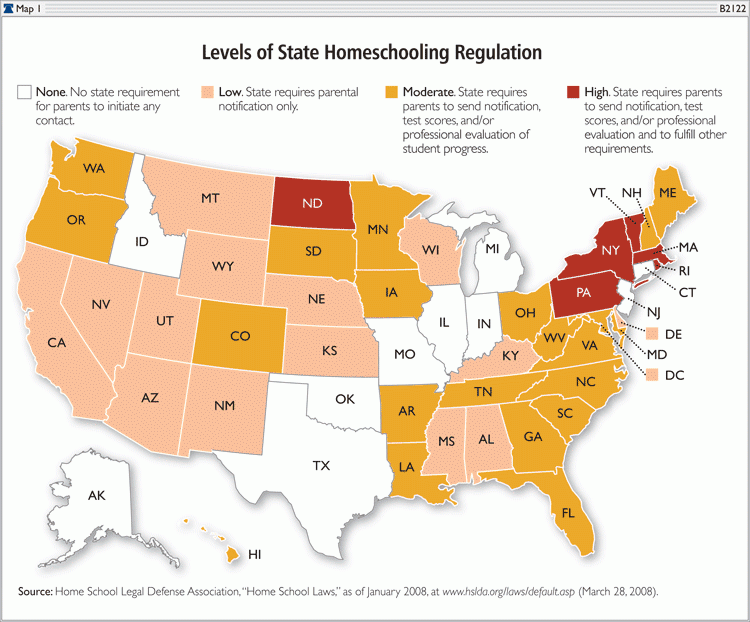
Current info about levels of government regulation for homeschoolers per state.

Total number of surveys: 44

Women: 34

Men: 10

(Sadly, the results are a little estrogen heavy, but the male perspective I received was excellent!)

These homeschoolers grew up in:

  • Kansas (16)
  • Virginia (7)
  • South Dakota (3)
  • New York (2)
  • Nebraska (2)
  • Florida (2)
  • Wisconsin
  • Illinois
  • New Mexico
  • North Dakota
  • Washington
  • Texas
  • California
  • Georgia
  • South Carolina
  • North Carolina
  • Ohio
  • Colorado
  • Illinois
  • Military family (3)
  • Overseas

These adults now live in:

  • Virginia (13)
  • Kansas (6)
  • Mississippi (2)
  • Georgia (2)
  • Florida (2)
  • California (2)
  • Oklahoma (2)
  • Iowa
  • Texas
  • North Carolina
  • West Virginia
  • Delaware
  • Missouri
  • Kentucky
  • Ohio
  • Nebraska
  • Washington
  • France
  • Japan (2)
  • Germany
  • Cayman Islands
  • Turkey

Age range: 18-37 (my minimum requirement was for the participant to be out of the house for at least one year)

Average age: 26

Fun fact: this means that earliest these families started homeschooling was around 1980!

Number of siblings range: 0-13

Average: 3 siblings

Number of years homeschooled range: 5-13

Average: 11 years

Marital status:

  • 22 married (4 spouses had homeschooling experience)
  • 16 single
  • 2 Divorced
  • 2 Engaged
  • 2 in a relationship

I included the sibling information because, in my own experience, homeschooling families tend to have large families. As you can see, the range of siblings in each family is pretty dramatic (from an only child to a family of 14 children!) The average of 4 children in a family seems pretty “normal” to me. Many homeschoolers talked about relationships with siblings in the surveys so that is why I included this information.

I also wondered though, “Does the “largeness” of a family affect the homeschooling experience positively or negatively?” I didn’t receive overwhelming data on this point but I think that two examples may provide a good contrast to answer this question.

M. M. a 29 year old from CA was the oldest of 8 children. She describes a negative experience related to family size:

My mom didn’t seem to be involved very much in my individual learning or invested in only my education since there was so many kids. I felt this was a disadvantage to me . . .My mom would start at the youngest child and work her way up to the oldest in going over their homework, teaching, etc. I don’t think she got to me very often.”

In 12th grade, M. M. did her homeschooling with another family where the other mother kept all of the young people accountable for their work.

This is just one example, of course. But in this case, family size seemed like a detriment to M.M’s homeschooling experience.

Contrasted with this is Beka R’s story, a 25 year old from Kansas and the 2nd oldest in a family of 14 children. Though Beka came from the largest family in survey group, she implied that academics were a very strong focus and stated that family relationships were the most positive part of her experience:

“One of the best things homeschooling did was allow for strong family relationships – we had school on Saturdays and had Thursdays off because that reflected my dad’s work schedule, and those Thursdays with my dad are something I’ve always cherished. I think that the primary influencers of my foundational years were my parents and grandparents, and that is something that has always shaped my values.

Most responders had a very strong family and the number of children did not seem to negatively affect the homeschooling experience (or they didn’t mention it). I think it is interesting that homeschoolers have large families though and, in my own experience, homeschooling helped make relationships with my family stronger.

What do you think? 

Did you come from a large family who homeschooled? Did it enhance or take away from your education?

Please comment or ask any questions!

*****

To be continued.

Adult Homeschoolers Speak Out: Part One, Why I Wanted to Write This

Adult Homeschoolers Speak Out: Part One, Why I Wanted to Write This

HA note: The following series is reprinted with permission from Brittany’s blog BAM. Part One was originally published on May 24, 2012.

*****

Also in this series: Part One: Why I Wanted To Write This | Part Two: Survey Stats and Large Families | Part Three: Top 3 Reasons Parents Homeschool | Part Four: Academic and Emotional Experiences, K-8 | Part Five: The Highschool Experience | Part Six: College? Prepared or Not? | Part Seven: What About Socialization? | Part Eight: The Best Thing vs. What Was Missing | Part Nine, Do Former Homeschoolers Want to Homeschool? | Part Ten: Are the Stereotypes Better or Worse?

*****

Series Preface for HA

** In the introduction to my blog series in 2012 about Adult Homeschoolers I wrote that “everyone turned out fine.” This phrase may seem odd and may even seem hurtful to some HA readers and writers due to the fact that many of the stories on HA deal with the painful past of many adult homeschoolers. The purpose of sharing that “everyone turned out fine” was to state that everyone who participated in my series is now a strong, functioning adult who has worked through or is working through any struggles from their homeschooling background.

The purpose of my series was to look at the “good, bad, and ugly” issues of homeschooling in an honest and fair way, with the underlying thread of hope by sharing the experiences of many adults from all around the USA. I hope that, as you read, you will be able to identify with the stories of these men and women as they share the reasons their parents home schooled, their elementary and high school years, the “best” and “worst” thing about homeschooling, adjusting to college, socialization issues, and if they plan to homeschool their own children.

I hope that as you read, you will also feel hope; know that you are not alone.

*****

Part One: Why I Wanted to Write This

I was a first generation homeschooler.

…meaning my parents starting homeschooling in in the late 1980s right after it became legal in Nebraska (where I was born). In my elementary years, when someone asked where I went to school, 99% of the time my answer would produce a furrowed brow and the question, “What is homeschool?”

Nowadays, everyone knows someone who is homeschooling or who was homeschooled. First generation homeschoolers have grown up, gone to college, and have started families of their own.

My own children are now almost school age (I have twins who will be 5 in October) and in recent months I have been contemplating my own schooling experience.

I wondered:

  • Do former homeschoolers want to homeschool?
  • What do they think of their homeschool experience?
  • Were they happy and satisfied? Did they wish for more?
  • Were they prepared for college academically and socially or were they scared, unprepared and awkward?
  • Are they stereotypes of homeschoolers true? (homeschoolers are brainy/stupid/socially stunted/well rounded/fill in the blank?)

I spent hours on the internet, trying to find articles, blogs, anything written by former homeschoolers about their homeschool experience. I was disappointed by what I found (or the lack there of). Either I found stats about how homeschoolers are successful (with no personal testimony involved) or personal testimonies that I distrusted because I thought they were too “Pollyanna” in nature. I wanted to read about the honest experiences of adults homeschoolers, the good and the bad, the advantages and disadvantages, their thoughts on their academic experiences and the issue that homeschoolers everywhere never seem to escape:

“What about socialization???”

So I put together a short survey and and used the wonderful world of social networking to launch this blog series. I received 42 responses from adult homeschoolers from all over the USA (childhood friends, people I went to college with, friends, and friends of friends).

I am excited to share the data I have collected with you: adults who were homechooled, parents who are homeschooling their own children (and may be wondering, “Am I doing the right thing? Am I messing up my kid? WHAT ABOUT SOCIALIZATION????”), or anyone else who is curious about the lives and experiences of homeschoolers.

Here is a little sneak peek at the end of the story: Everyone [that took my survey] turned out fine. **

Not always “happily ever after” and not without some bumps, awkwardness, struggles, and obstacles on the journey to adulthood.

But, really, everyone [that took my survey] turned out fine.

[Some] parents, breathe a sigh of relief.

And keep reading.

You can look forward to personal testimony about topics such as:

  • Why first generation homeschool parents decided to homeschool
  • The academic and emotional experience of homeschoolers in grades K-8
  • The academic and emotional experiences of homeschoolers in grades 9-12
  • Do homeschoolers pursue higher education?
  • Were they truly prepared academically?
  • Were they truly prepared socially?
  • What is the best thing about homeschooling (so many people said the same thing! amazing!)
  • What former homeschoolers wish was different about their experiences
  • The inside perspective about the advantages and disadvantages of homeschooling
  • Do former homeschoolers plan to homeschool their own children?
  • The homeschoolers perspective on society’s thoughts and opinions about homeschooling

This series will be honest in every way, exploring the good, the bad, and everything in between. While my posts will primarily be focused on the results of the survey, I will also share my thoughts and experiences as they relate to the survey results.

I hope that this series inspires conversation, stirs up memories (for former homeschoolers), incites conversation, provides insight and information, and ultimately encourages those who read. Please feel free to comment, ask questions, and share your own thoughts and experiences.

*****

To be continued.

The Space To Be Human: Jayni’s Story

The Space To Be Human: Jayni’s Story

I was fourteen when I was introduced to CFC/NCFCA. The mother of another large home schooling family approached my mom with the “great opportunity” to provide all of the meals for a CFC conference she was coordinating. “If you make all of the meals the conference fees are waived for your family and I thought of you, since you have so many children.”

The conference was terrible. There were very clear expectations of what each attendee should look like and how they should act.  The conference was full of bright, happy, perfect home schoolers with impeccable manners. They all looked like they had stepped out of a Lands’ End catalog. (Lands’ End: the modest J. Crew) I was embarrassed to have to re-wear the only two skirts I owned for a full week. I was ashamed to be a “scholarship” kid.  I inwardly raged at the attitude that you were a bad Christian if you were not a good speaker. Naturally shy and introverted, I balked at the idea of ending the week by giving a short public speech.

It was very clear to me that I was an outsider. But by the end of the conference my mother was sold: her kids needed to do this NCFCA thing. And by the end of the conference I was hesitantly intrigued by debate: my mother would support me verbally fighting with people? Awesome.

Looking back at the few years I spent in NCFCA, I am struck by the contrast I experienced. On one hand, every organized experience (both in and out-of-state conferences, CFC, and Masters) were terrible. On the other hand, I met people who saved my life.

The first year I partnered will my unenthusiastic older brother. Wisconsin was very new to NCFCA and there was only one in-state tournament. We were warned ahead of time that all of the “community” judges were biased towards the hosting debate club. We were assured that if we lost every single round it was not an indication of our debating ability. We went 2-4 and I was devastated. I saved every ballot and poured over them incessantly, trying to find the key to my failure. For a league that touted Communicating for Christ there was very little grace for the losers.

The next year my brother went to public school. I was partner-less in a rural area with no club. I turned to everyone’s favorite online phorum to find a partner and debate coaching. It was extremely intimidating: apparently I was the only one who had not spent every waking moment since I was 12 obsessed about debate. I began spending upwards of six hours a day researching (I’ll admit, now, often without a clue about what I was looking for.)  I found an out-of-state partner and began pushing my parents to let me attend more tournaments. This meant expensive out of state travel; something my mother had not planned on. My birthday present that year was attending a practice tournament in Indiana.

The comments on my ballots that year were evenly split between admonishments of “have more confidence! =)” and “you are too intimidating and forceful, try to be more lady-like.” The capstone was at that year’s aforementioned state tournament. In a semi-final round my partner and I were debating against the tournament coordinator’s son. Before the round began when we all filed into the room to introduce ourselves to the [impartial] judges and shake their hands, one of them leaned over the table to give this guy a hug and mentioned something that happened at church last Sunday. I shook it off; I knew this team relied on smooth talking for the win, but nobody could ignore my heavy box of evidence. They were affirmative and the case was weak.  I jumped out of my chair to cross examine him after the 1A. There was a huge hole in the case and I dived right in. He talked around the question. I asked it again. He changed the subject. I rephrased and asked the same question. It got heated.

I doubt I even have to tell you that we lost the round because I was “rude.” The kicker? The timekeeper was the guy’s younger sister. My father was in the room watching the round and said afterward that when it was clear that I “had him,” the girl stopped the clock and called time.

Losing that round prevented me from going to nationals. Knowing my season was finished, I decided to focus on the friendships I had built through the online phorum instead. The phorum became a huge outlet for me. Thinking about this is still hard, and it’s hard to put into words. Looking back, the largest flaw I see in the home school debate world was the propensity to radiate perfection in everything. Because, obviously, if we’re Christians, we’re perfect.

I was envious of those “perfect” debators, and the more popular and perfect they were, the more I hated them, knowing I could never be them. I was fifteen the first time I typed over AIM that I was depressed. It took a long time to type those words because it took a long time to realize them. My closest friend, the one I had chosen to tell, responded by saying he didn’t think depression was a real thing. As my reputation grew on the phorum, I was increasingly known as the crazy girl, the rebel, the one who took things too far. Outwardly I embraced it. Inwardly I was embarrassed and ashamed. That reputation had a bright side, however. Asking questions like “Why do you believe in God?” sparked deep friendships with the girl from a single-parent home, the boy who was bipolar. These were the friends who supported me when I very shockingly announced I would no longer be a part of NCFCA because I was going to public school.

I was assailed with comments like, “you’re going to the dark side!” People were genuinely appalled; some genuinely thought this was a clear indication that I was no longer a Christian. The truth was that being home schooled in a heavily patriarchal home with an abusive father had led to suicidal depression.

The very fact that Homeschoolers Anonymous exists is a testament to the emotional trauma endured by many, and it’s very important that we have an open dialogue to ask why. Home schooling and debate are entwined worlds for many, and the individual answers will vary.

I rarely think back to my years in the NCFCA.  For the most part I prefer to forget it ever happened. When I do think back, I regret that façade of perfection we all felt pressured to adopt. Time has taught me that’s all it is: a façade. I wish that teaching us to change the world with our radical communication skills was not NCFCA’s sole focus: there was no space given to teach us to be human.

Resolved: An Index

Resolved: An Index

*****

Call for Stories

By Nicholas Ducote: Resolved: That We Should Talk about HSLDA Debate, NCFCA, STOA, and CFC/ICC, Part One

By Bethany: “Resolved: That We Should Talk about HSLDA Debate, NCFCA, STOA, and CFC/ICC, Part Two”

***

Debate History and General Topics

By R.L. Stollar: “A Brief History of Homeschool Speech and Debate”

By Nicholas Ducote, “A Letter of Gratitude, A Call for Dialogue”

By Luke: “Debate As Socialization: Luke’s Thoughts”

By Andrew Roblyer: “Angry Emails And Thoughts On Why They Happen: By Andrew Roblyer”

By Alisa Harris: “The Shining City’s Superman: By Alisa Harris”

***

NCFCA/STOA

By Libby Anne: “The Heritage Foundation and the Cato Institute: NCFCA and Growing Up in a Conservative Bubble — Libby Anne’s Thoughts”

By Finn:

“Sailboats And The Spirit: Finn’s Thoughts, Part One”

“Sailboats And The Spirit: Finn’s Thoughts, Part Two”

By Philosophical Perspectives:

“Of Love and Office Supplies: Philosophical Perspective’s Thoughts”

“How NCFCA Taught Me to Fight Sexism: Philosophical Perspective’s Thoughts”

By Andrew Roblyer: “The Lessons I Wasn’t Supposed to Learn: Andrew Roblyer’s Thoughts”

By Kierstyn King: “Teenagers Taking Over the World: Kierstyn King’s Thoughts”

By R.L. Stollar:

“The Most Controversial Thing I Ever Wrote, Part One: By R.L. Stollar”

“The Most Controversial Thing I Ever Wrote, Part Two: By R.L. Stollar”

By Jayni: The Space To Be Human: Jayni’s Story

***

CFC/ICC

By Krysi Kovaka:

“I Was A Problem To Be Ignored: Krysi Kovaka’s Story, Part One”

“I Was A Problem To Be Ignored: Krysi Kovaka’s Story, Part Two”

By R.L. Stollar: “I Was The Original CFC Fuck-Up: R.L. Stollar’s Story”

By Marla: “Competence, Not Character: Marla’s Story”

By Michele Ganev: “CFC Gave Me Confidence: Michele Ganev’s Story”

By Renee: “Sharing the Burden of the Pedestal: Renee’s Story”

***

Great BJU Protest of 2009

By Joe Laughon: “Engaging the World — Debate and the BJU Protest: An Interview with Joe Laughon”

By Ariel: “The Embarrassment of Protesting Racism: Ariel’s Thoughts”

By Krysi Kovaka: “When I Recanted What I Truly Believed: Krysi Kovaka’s Thoughts”

Angry Emails And Thoughts On Why They Happen: By Andrew Roblyer

Angry Emails And Thoughts On Why They Happen: By Andrew Roblyer

This past week, Homeschoolers Anonymous has been featuring articles written by former students about their experience in competitive forensics.  These articles have mostly focused on the National Christian Forensics and Communication Association (NCFCA) and Communicators for Christ/Institute for Cultural Communicators (CFC/ICC), but many of the concerns raised in those posts can be found throughout the site, not just in this series.

The legalism, the double standards for men and women, the focus on controlling external appearances and behavior, the desire to appear as put together and perfect as possible to the outside world and especially to other homeschoolers; these are all common threads throughout this tapestry of stories we are weaving here on HA.

And I have some thoughts about why that is.

As I was reading Ryan’s excellent duology about a controversial article he wrote (you should take a moment to read both posts if you haven’t already), I found myself asking why so many people were and are so terrified of criticism within the homeschooling community.  More specifically, why are so many parents scared to hear someone suggest that maybe, just maybe, we should think about things in a different light?

Because in reading Ryan’s article, I saw nothing that attacked or demeaned individual parents, leaders, or students.  I saw nothing that advocated for the dissolution of the competitive NCFCA environment.  I saw nothing that assigned motives beyond that which all the parents I knew in the NCFCA would have willingly reminded students: we are all sinners and fall short of the glory of God.  What I saw was a young man imploring a group of people he knew and loved to be compassionate.  To be understanding.  To live out the love of Christ towards those students that they lauded as representing the epitome of what they hoped their children would be.  It was a criticism of perfectionism and of the very real danger that perfectionism brings.  One would think that conservative Christian homeschooling parents would have eaten that stuff up.  So…why didn’t they?

To find an answer, I turned to the public school system (blasphemy, I know).  Critiquing the public school system in this country does not yield the same percentage of outraged responses from educators as criticism to institutions like the NCFCA yields from parents, in my experience.  I know plenty of teachers who will join with you in listing the flaws of the public school system and their frustrations with the things that prevent them from doing what they love: teaching students how to think.  So why is homeschooling any different?

The difference is that the public school system is separate from the teachers who make it up. The teachers are not the system, they are but one piece of a greater whole, and so, for the most part, criticism of the system is something that they can at least tolerate and even share without any cognitive dissonance.

Homeschool parents, on the other hand, are their own educational system.  They are their schools.  They are entirely responsible for their children’s education, and so it is much harder to separate the teacher from the parent from the education.

I think I first started to realize this a few months ago when I was discussing my public accounts of coming out with my mom.  She told me that she felt like I had painted my “education” and “childhood” with such broad strokes that, for a reader who didn’t know me, it would be easy to assume my parents had contributed to many of the problems that I perceive with both.  And, as she felt that she and my father had tried very hard not to be the cause of problems like my negative self-worth and depression/anxiety, she felt hurt by what I had written.  I quickly tried to reassure her that I didn’t blame her or dad for any of that, and have since tried to do a better job delineating between the loving, supportive home life that I had growing up.

This, I would imagine, is not a unique situation.  I would imagine that, for many of our parents who have poured so much energy and time into us as children, fretting over curriculum and wanting us to be good, Godly people, their methodology is all-too-easily conflated with their intentions and personal character.

I spoke about this exact phenomenon in my article for the Homeschoolers Are Out series, when I struggled to separate the structure of homeschooling from the conservative Christian religious community I was raised in.  To me, homeschooling and NCFCA and CFC/ICC are all structures first and foremost, but I realize now that they are structures informed by a very personal passion of our parents.

As I told my mom, it was true that they never spoke negatively about gay people at home, but we never really discussed it at all.  This meant that I was hearing one message denigrating my self-worth from external sources and silence on the subject at home, so the external message was the one I internalized.  I don’t blame her for this, nor am I in any way upset about it, but it’s something I have to recognize and process as I become more self-aware.  And while it was easy for me to see that this was not a personal failing or character flaw of my parents, I think it was much harder for them not to see that criticism as such.

I say this not to suggest that we should cease criticism of these institutions and structures; quite the opposite in fact.  We should continue to offer thoughtful criticism and tell our stories in full, with the hope of provoking thought and change to those institutions.  However, I think that we must be cognizant of the ease with which a structure like homeschooling or the NCFCA can be conflated with the hearts and souls of those parents who created them.

After all, most parents are not bad people with evil intentions (though as the stories of abuse on this website show, some of them can be), and by working to differentiate between the people and the system(s) we are criticizing, we strengthen our message and, in the process, help ourselves on our journey to self-awareness.  It may be difficult to parse out what criticisms we have about the system and what criticisms we have about individuals, but I think it is worth the effort.

Let me close by saying that this is not a criticism of HA or any of its authors.  Their/our stories need to be heard and I am honored to be a part of a group that wants to tell them.  In addition, I would love to know if you (readers/authors/critics) agree with my thoughts on the conflation of the system with personal character.  Let me know in the comments!