I can remember people commenting on a quotation I used in one of my policy debate cases. The quotation dealt with some random technical aspect of immigration policy — the content of which wasn’t an issue. The issue was that the card was from someone who worked at the Ayn Rand Institute, and Ayn Rand was an atheist. Therefore (these people said), I needed to be careful about using this card. I remember being concerned by these comments at the time, but now I see no foundation for them. Instead, I see a byproduct of the somewhat insular community which Christian speech and debate creates.
Because the community is distinctly conservative and distinctly Christian, and because the community is centered around the ability to communicate a message, some of the most popular messages are those that create a group mentality (Jonathan Haidt has some important research about the importance group loyalty plays in conservative groups; give his works a read if you’re interested). In other words, the messages that get to the top are those that create an us vs. them mentality: Christians in a culture war, liberals trying to destroy the Constitution, America becoming increasingly immoral, etc. Regardless of whether or not you believe these messages are true, it should be clear that the combination of these narratives with the homogenous nature of the speech and debate community creates a very real possibility for students to develop a fear of outside ideas.
I can remember the first time I met an openly gay person. I can remember watching his hands to make sure he didn’t have a knife.
I listened carefully as we were talking, lest some underhanded message corrupt me. I did my best to stay polite, yet slightly gruff and on my guard (I was 14 with a somewhat squeaky voice – a funny picture, no doubt). I was confused for a while after he left. I didn’t see any attempts to undermine my faith (we talked mostly about the weather), and he was phenomenally well-spoken. This reaction wasn’t just because I thought “gay” was bad – it was because I had created an “us vs. them” narrative in my head and begun to fear people along with the idea. I had prevented myself from engaging with a human person because of a narrative I had created as a result of my fear of an idea.
But there’s a deeper reason why a fear of ideas is bad. To illustrate it, I need to introduce the concept of Hegel’s dialectic.
Hegel, a German philosopher who lived between 1770 and 1831, taught that knowledge was achieved through a threefold process: the thesis, the antithesis, and the synthesis. Essentially, you begin with one idea, contradict it with another idea, and then get a result (the synthesis) which is closer to the actual truth than either of the originals. In other words: every set of ideas has something to teach us.
Action items:
1. Students: you’re in high school. You have barely completed a fifth of your average life. You haven’t figured things out; you don’t have a perfect conception of God. That’s not a bad thing as long as your conception of God changes. If your faith and beliefs are not changing and developing, look carefully at speech and debate to ensure the insular community is not inhibiting the process described above.
2. For judges and parents: recognize that your kids are growing up. They’re going to be evaluating ideologies that you’re not comfortable with regardless of how much your try to shelter them. Competitors may advocate for ideas in debates that are contradictory to your own. That’s perfectly fine. Debate (particularly in the NCFCA and Stoa) is a safe environment. Your decision in a debate is feedback about the comparison between the two teams — not implementing a real philosophy or policy: occasionally you may vote for teams that you disagree with personally. Again, that’s fine.
In fact, one of the worst things you can do is to take a competitor aside in one of the infamous hallway conversations and tell them that the ideas are “dangerous” or discourage further interest in them. If you really believe that what you believe is true, then you should be comfortable with people exploring the arguments in a safe environment. Be their partner in discovery, not someone that holds them back from developing a broader understanding. Otherwise you may be surprised at what was suppressed when you are no longer there to restrain their intellects.
My time in the NCFCA was incredibly positive. I learned to speak professionally. I learned to analyze topics and arguments with an acuity that I couldn’t have achieved through any other method. I’m still involved in the homeschool debate scene because I want other people to experience this tremendous growth and development and get the maximal amount of benefit from it.
It was the beginning of December last year when the words lit up my computer screen like lights on a Christmas tree:
“PATRICK HENRY COLLEGE CHANCELLOR MICHAEL FARRIS THREATENS TO SUE QUEERPHC!”
I had no idea what QueerPHC was. But I knew Patrick Henry College. It was that college I thought about going to back when I competed in NCFCA. Honestly, apart from a few friends from my debate days going to PHC, I hadn’t given as much as a passing thought to PHC in the years since.
In fact, I probably would still be unaware of happenings at PHC — still unaware of the existence of QueerPHC — if it were not for Michael Farris.
So in a sense, I need to thank Michael Farris for bringing QueerPHC to my attention. If Farris never threatened to sue the group, I — like a lot of people, probably — wouldn’t have known anything about it.
But threaten to sue he did. And that is why I am writing this story.
A little background information:
In July of 2012, a group of Patrick Henry College alumni got together and created a blog. Their very first blog post was on July 3, where they said:
“This is a collaborative blog produced by several Patrick Henry College (PHC) students, current and former. We, being a group of people, do have varying opinions and beliefs, but one thing we do share in common is our desire to help and encourage other Patrick Henry College students, current and former, in any way that we can.”
The purpose of the blog was to provide education and information about LGBT issues, because PHC itself did not offer such education and information:
“Patrick Henry College does not offer courses in Queer Studies, Sex Ed, or Gender Equality. However, these are issues that are of pressing importance in our culture today and are of importance to us personally. We hope to use this blog to provide information on those topics that are taboo at PHC.”
But then the proverbial shit hit the metaphorical fan.
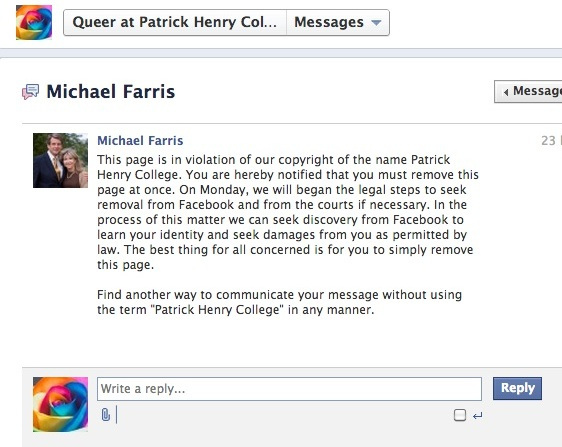
Over the first weekend in December, Michael Farris, the college’s chancellor, used his own Facebook page to contact Queer PHC and threaten them with a lawsuit:
Photo from Queer PHC.
Text is,
This page is in violation of our copyright of the name Patrick Henry College. You are hereby notified that you must remove this page at once. On Monday we will began [sic] the legal steps to seek removal from Facebook and from the courts if necessary. In this process of this matter we can seek discovery from Facebook to learn your identity and seek damages from you as permitted by law. The best thing for all concerned is for you to simply remove this page.
Find another way to communicate your message without using the term ‘Patrick Henry College’ in any manner.”
The problems with what Farris said and did are astounding. Not only is this a completely nonsensical interpretation of copyright law, not only is it slightly outrageous that Farris would pretty much threaten to “out” the individuals behind the group, but Farris used a personal Facebook page to communicate a legal threat on behalf of an entire college. Did he consult with the college’s board before making a legal threat on behalf of the college? Did they approve of the Facebook message? (Were they even aware of it beforehand?) These are important questions, especially considering what happened next.
What happened next was the Streisand effect. So incomprehensible was Farris’ strategy of internet bullying and censorship based on false legal issues that his threat suddenly exploded — Gangnam style — across the Internet.
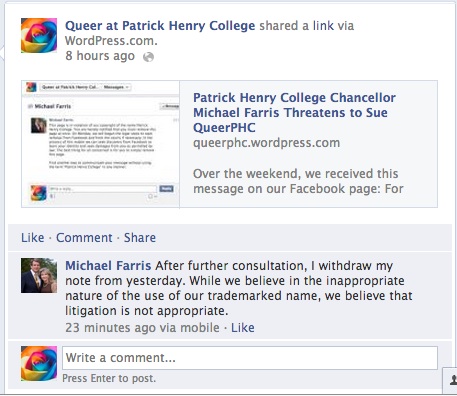
Of course, as soon as the controversy started (and probably once the PHC board realized what a bizarre and inappropriate action Farris had undertaken), Farris recanted — this time through a public comment on Queer PHC’s status:
Photo from Queer PHC.
But it was too late. The PR damage had begun.
When I heard about Farris threatening a perfectly legal Facebook group with an unfounded, frivolous lawsuit, I was floored. What better way to damage the credibility and reputation of not only PHC, but the homeschooling movement, by using abusive techniques like threatening fellow professed Christians with erroneous legal action? Not only fellow professed Christians, but your own former students?
But something about what Farris did to Queer PHC didn’t feel surprising. In fact, it felt familiar.
I couldn’t quite put my finger on it. But I was having a sense of deja vu.
Eventually, it struck me. And I went searching through my vast archive of saved emails from my old Hotmail account. And I found it.
In the early 2000s, when all of us homeschool speech and debate alumni were either still in high school or just beginning college, we socialized on Xanga. Xanga is to social media what Grandmaster Flash is to rap: really, really old school.Created in 1999, Xanga was around before Facebook, even pre-dating when most of us were on Myspace. Xanga was kind of like an public online diary: you could make posts, like other peoples’ posts, and subscribe to other people to stay connected. And that was about it.
(And yes, if you’re morbidly curious, my Xanga is still up. So feel free to search my teenage angst and amateur attempts at poetry, philosophy, theology, and public diary-writing for evidence you can use against me in the future.)
I created my Xanga profile on March 18, 2004. Most of my close friends from NCFCA and CFC had Xanga accounts as well. As this was really the beginning of social media, there weren’t really any parents using Xanga. It was primarily a teenage activity.
After a few months, two separate individuals created parody Michael Farris accounts. One was created on May 28, 2004. The other was created on July 26, 2004. (As you can see from these links, the accounts have since been scrubbed clean.) I don’t really remember much from the later account that was created, but I remember the first one because a friend of mine made it. It was clearly marked as a parody account, did not attempt to impersonate Farris to deceive anyone, and wasn’t even “offensive.” While a lot of us debaters were “punks” in one sense or another, we were still conservative Christian homeschoolers. So my friend’s parody account of Michael Farris did not involve things like dick jokes. I remember Fake Farris’s posts being along the lines of “I AM MICHAEL FARRIS AND OMG HOMESCHOOLING WILL SAVE THE WORLD!!!”
You know, immature attempts at ironic comedy that failed miserably. But again, nothing that even came close to slander. Nor identity theft. As it clearly stated it was a parody account, it didn’t even violate Xanga’s technical terms of use.
In 2004, on Xanga, you could “subscribe” to other peoples’ accounts. This would be the equivalent of “liking” or “following” a Facebook page today. Since I was one of the only people that used my real name on Xanga, and I was subscribed to the michael_farris parody account, I was the only person that Farris could recognize to contact about the account.
Oh yes, he contacted me about the parody account! Perhaps I just got ahead of myself. In 2004, Michael Farris — President of Patrick Henry College — was apparently monitoring what high school homeschool debaters were doing on a social media site. And as soon as he saw a parody account of himself, he went into militant mode.
On Wednesday, July 28, 2004, nearly a decade before he employed erroneous legal threats against Queer PHC, Michael Farris emailed me. In another way that this parallels the QueerPHC debacle, Farris contacted me with his official “PHC Office of the President” email address. The following is a screenshot of what he said, along with the text:
Text is,
From: “PHC Office of the President” <president@phc.edu>
To: <suavedrummerboy@hotmail.com>
Subject: Ryan is this you?
Date: Wed, 28 Jul 2004 17:17:34 -0400
Ryan,
This is Mike Farris–the real one from Patrick Henry College.
I see you as a subscriber to a xanga website named Michael_Farris. Your posts there seem to indicate that you know who this is who is running this.
I just went through a difficult time shutting down another xanga site called “michaelfarris”.
I am prepared to take civil and criminal legal action against this person. Identity theft is a crime. It is also subject to civil action (if for no other reason) than it violates Xanga’s terms of use. I want your acquaintance to save himself a lot of legal grief.
Here’s what he needs to do. Delete absolutely everything from the site. Then, send me the password to the site so that I can take control of it so that neither he nor anyone else can ever steal my identity in this manner again. If he does this I absolutely promise I will take no action of any kind against him. If he does not do so (and do so promptly) I will go after him with vigor.
It may seem funny to some, but it is not funny in the least to me. I will turn this over to the FBI if I have to. But seems it seems pretty obvious that this person is or was an NCFCA debater I wanted to try to quietly end the problem without the need for drastic measures.
Can you help?
Mike Farris
Yes, almost a decade before Michael Farris tried to bully and threaten Queer PHC with a frivolous lawsuit because he didn’t like what they were doing, Farris also threatened a Christian homeschool kid with civil and criminal action — even going so far as to invoke the FBI. As if the FBI would’ve given a @#$% about some kid’s Xanga account in 2004. But we were young. We had no idea. I was terrified. I immediately told my friend. He was terrified as well. What Michael Farris hoped to accomplish — using inaccurate legal concepts to coerce a highschooler into turning over the account information to a perfectly legal parody account — was successful.
A decade later, Farris apparently still uses the same tactics.
The funny thing is, this email I received would’ve likely slipped away into oblivion, covered by the dust of my long-forgotten memories. But in the same way that Queer PHC’s existence occurred to me because of Farris’ threat against the group, my remembrance of the email was likewise resurrected. To some, the very fact that I am bringing it into the open might seem petty and vindictive. But I do not reveal it for those purposes.
I am publicizing this email because of the trend I have repeatedly seen from the leaders of the Christian homeschooling movement. I am remembering the censorship employed by NCFCA leaders when forensics alumni, coaches, and students attempted to protest BJU’s history of institutionalized racism. I am remembering a personal censorship, which I will talk about next week during our Resolved: series. I am remembering how Farris went after Queer PHC. I am remembering how HSLDA chose to block former homeschool students from its Facebook page for speaking up about abuse during our #HSLDAMustAct campaign.
What I experienced a decade ago, what Queer PHC experienced last year — these are not isolated incidents. They are symptoms of a problem: the problem of how this movement chooses to interact with its whistleblowers. It has groomed us to “take back the culture.” Yet when we try to do so, the movement suddenly realizes “the culture” we want to take back is not the Evil Candyland of Liberalism, but our very own home — homeschooling itself.
If you are not toeing the line, if you question the movement’s assumptions, if you even dare to make parody accounts — the movement wants to shut you down and silence you. And Michael Farris led the way, is leading the way, by the choices he made and continues to make.
Considering Farris’ railings against Obama’s “tyranny” as of late, I cannot help but wonder: how exactly does bullying and censorship of young people demonstrate the ideals of freedom?
“I realized there was no way to fix this. He couldn’t be who he was with me, and it wasn’t fair to either of us to stay together.”
I grew up as the oldest of ten children. My parents were a part of ATI and the Quiverfull movement. My father was very controlling and my mother was neglectful and withdrew herself. We had to ask my father to go anywhere. He would say to clean something or weed the garden first and then he would say no many times.
I was the “second mom” the one who listened to what my dad said and took care of the house, the other kids, stayed home as a highschooler to cook dinner while the younger kids got to play sports. I had a really good guy friend who was the oldest of ten children himself and also played the violin. We used to write to each other all the time until the letters just stopped. This guy, Jacob, would give me butterflies and make my hands sweaty and I would dream of being with him. My mom came to me and said that we were the oldest kids, so a relationship would just not work. I was confused what she meant. But, I continued to “wait” for him.
Then, at the age of 19, I went to EXCEL, which I paid for by babysitting. There, I sought God each day and somehow ended up with the exact opposite beliefs as I was taught. There, I cut my long hair, stopped wearing skirts all the time, stopped arguing with everyone, decided I needed to go to college to become a nurse and I decided I was done with waiting for Jacob. I came home and signed up to start classes. I also looked for a job, which I got in a deli.
My parents were supportive until I actually started classes and then it was, “Rachel, come home and watch the kids,” and, “Rachel, come and take the kids to their games.” I, being a girl who did give everything to god and believing I had to obey my dad, would, but this jeopardized my grades. Here I am, a girl who has no understanding of any of my classes (all I knew how to do was read really well and basic math; I didn’t even know how to write a paper), looks very strange in mostly skirts, and thinking about sex all the time.
Then Ben entered my life.
A friend of mine told me of a homeschool debate site. I decided to join and decided to have a “gender neutral” name of “His child.” There was a guy there who wanted someone to do a bible study with him. I knew instantly that he was suicidal and I had to do it. So, I led a bible study and he eventually started asking me questions about myself.
We talked for an entire year before he decided to come to WA state to work at a camp and meet me. His parents tried to prevent him, since they ran a camp themselves, but then they found out the reason was there was a girl there and they excitedly let him go. He got me a job there as a store manager. I worked it out with my deli manager so that I could do it for the summer, but my father put his foot down and refused to let me do it. I had told him about Ben several months before which made him pretty upset. He unplugged the internet many times so I couldn’t talk to him.
I obeyed my father and did not go to camp. I picked him up at the airport with my parents and a very talkative me. But he was lost for words. The poor guy was so nervous and just grunted all the time. My father and I dropped him off at camp and my dad said, “Oh, you should exchange numbers.” We hadn’t even talked to each other on the phone at this point. We started to have phone calls during which I talked a lot and he said nothing.
I saw him again during that summer when he had a weekend break. He played with my siblings and this is when I knew that I would marry him. He had already told me I was the girl for him before I met him. I thought he was smoking hot and very excited that a guy this attractive would be interested in me. I was sad to see him go home on the final meeting when we dropped him off at the airport.
My father, realizing that I liked this guy, put a lot of pressure on me to get him to ask permission to court me. So, I did and Ben called up my dad and asked his permission to court. I got in front of our church and announced with my father that I was courting, which in my group of people meant we were getting married. We continued talking on the phone (which was awkward for us cause he barely talked) and mostly talking online.
Six months later, he flew to see me again. We were ready to hold hands and cuddle which freaked out my parents. My father gave him 50 questions to answer by hand and said we could not talk until it was finished. I was supposed to go and work at his family’s camp as a cook for that summer. This was his reaction to that. Instead, I threw myself into working 80 hours a week. Eventually, he finished the questions over that summer. I decided I should do nursing down in Mississippi because I could take a test and get into the program. (I struggled a lot with school because my father was constantly trying to get me to come home and babysit my siblings or take them to practice and I was balancing working full time and taking classes for which I had zero knowledge, so my grades weren’t that good). Extra bonus was that I was two hours away from him.
Our plan was that I would stay there six months and we would get married and I would go to nursing school on the same campus as his seminary. We spent a few hours together in person every other weekend or so.
Finally, it came to the wedding.
Our first kiss was at the wedding alter. Bad idea… I had no idea how awkward that would be and how it just felt…wrong, like it was meant to be shared in private. Then of course, to go further, my husband was incredibly scared and nervous. I thought the bride was supposed to be the nervous one!
It puzzled me why he seemed never to want to have sex. I thought this would be a phase, but it wasn’t. This went on for years — in fact, our entire marriage.
I had always heard that men liked a woman’s body, that it turned them on. I tried that.
It didn’t work.
We talked about this and both came to the conclusion that it was cause he was a lifeguard for years and was just used to seeing almost naked bodies. He always seemed depressed about everything. He would withdraw and not talk to me or even seem to want to be around me. This would frustrate me but I was busy with work and school. I just gave him space and hoped he would show interest in me. I worked hard to try to please him and to try to motivate him. But, he always seemed unhappy, no matter what we tried.
I put my energy in trying to become pregnant. (Believe me, that took a lot of work!). We had our child and I — doing what every other mother I knew did — stayed home with him. Our problems became stronger since now I had nothing to distract me, no school or work. We were trying to become missionaries. He got ordained and we were in the application process. I was highly involved at our church.
He seemed to withdraw yet again, like he didn’t want to do it.
I had been talking to my best friend who had just come out to me. She described how she felt — in a marriage with a man — being gay herself. I asked a lot of questions and realized she sounded exactly like my husband! I approached him and asked him if he was attracted to men. He said he was but tried not to think about it.
Everything made sense!
He was repressing who he was, which was causing the depression and the withdrawing. This is why nothing seemed to work or motivate him. We continued on, wondering what we should do next. He had already been having issues with god for years but also tried to ignore that as well. I began to question the bible as well. If it is wrong about homosexuality, what else is wrong with it?
I realized it was incredibly cruel to expect a homosexual person to either be single or to be in a relationship with someone of the opposite sex. I know what that is like. This led to a spiraling amount of questions which I could not find answers to. I guess this was important to me being able to leave the marriage — and then divorce.
A couple months later, I realized there was no way to fix this. He couldn’t be who he was with me, and it wasn’t fair to either of us to stay together. So, the next six months, we made plans to separate and help each other be financially stable.
We are still friends, share custody of our son and live about a mile and a half apart.
Resolved: That We Should Talk about HSLDA Debate, NCFCA, STOA, and CFC/ICC, Part One
By Nicholas Ducote, HA Community Coordinator
I was introduced to the world of speech and debate by Communicators for Christ in 2003. From that moment, I was obsessed with speech and debate. For four years, I competed in tournaments across the country, even interning and touring with CFC.
For me, as a child raised in a fundamentalist homeschooling cult, the Advanced Training Institute (ATI), speech and debate was a welcome diversion. It emphasized critical thinking, research, and discussion about issues. All of these concepts were relatively foreign to me, despite my inclination to argue at an early age. Debate gave me the tools to deconstruct my fundamentalist worldview. Most of my highschool “network” consists of students I met through NCFCA or CFC. Some of my closest friends are the other CFC interns I toured with.
So everyone is clear, CFC was a non-profit ministry that held conferences around the U.S. teaching public speaking and debate. When it began, it acted as a sort of feeder for NCFCA, but has since evolved its own purpose (and changed its name to the Institute of Cultural Communicators). NCFCA is strictly a competitive forensics league, only open to homeschooled students, that sanctions local qualifying tournaments for an annual national tournament. While NCFCA and CFC are not the same organization, in the 2000s there was much crossover in people and ideas.
While my experience was liberating and empowering, I was surprised to hear many of my female peers from NCFCA/CFC complaining about the sexism they experienced first-hand in these environments. The patriarchal attitudes also lead to discrimination against any males that did not conform to the dominant ideal of “Godly masculinity.” The male youths were given leaderships roles in worship (before the tournaments), while women sang or played an instrument (usually piano). I can only imagine the torment of being homosexual in such an environment. I know many of my former NCFCA friends now openly identify as homosexual and they have dealt with other NCFCA friends saying they should be stoned to death.
As a high school student, I remember noticing that everyone seemed preoccupied with the way women dressed and looked, but as an ATI student this was nothing new. ATI discouraged women from wearing pants and a strict dress code was enforced at all the events. I remember some of my female friends complaining about the strict enforcement of dress codes at events like formals and awards ceremonies, but it seemed normal to me at the time.
As I became more aware of my own patriarchal inclinations in college and became more of a feminist, I remember thinking “wow, if all these ideas about gender messed me up, I bet they really did a number on my female friends.” One moment that stood out from the rest was a regional banquet I attended after touring with CFC (during a gap year before college). The regional coordinator, Jan Smith, was literally standing at the entrance to the event passing judgment on each woman’s modesty. Always the provocateur, I decided to enter the banquet with my arms locked with another guy’s. As the banquet had a nautical theme, Mrs. Smith informed me that there were “no gays allowed aboard this ship!” and we were told to stop.
My conversations in the last few months have identified some troubling themes from our collective experience in the NCFCA. (Caveat: I am six years removed from the league, but I’m sure some of these attitudes are still prevalent in some regions.) It seems that, as a whole, men were given a sense of entitlement and women were held to an impossible standard of “Godly modesty” and submission. The arbiter of all competitive rounds in the NCFCA is the judge (or judges), who are trained and informed by the NCFCA prior to their judging. A mix of community volunteers, competitors’ parents, and alumni judge the events. Often, sexist ideas about gender influenced a judge’s decision and they commented on ballots about girls’ appearance of modesty. These sort of critiques of personal hygiene and “modesty” were encouraged usually before every tournament, if not every competition day, by tournament representatives.
All of these misogynistic themes are underscored by the fact that, in reality, women ran the league, coordinated the tournaments, and did much of the coaching of speeches and debate clubs. In my experience in the Deep South, women would speak and lead public assemblies, but a man would always pray. There was a certain sense of women in leadership having to defer ultimate responsibility and authority to a man, even if she was more qualified and informed.
Ultimately, the standards of modesty promoted a rape culture (which is not to say that they promoted rape), where women would be “at fault” for dressing immodestly if they turned a man on. The purity culture’s inversion of guilt can be detrimental to some young women. Fundamentally, a binary is constructed where the “good girls” wear modest clothes, don’t lead boys on, and get happily married at a young age, whereas girls who dress in pant suits or develop friendships with male competitors are “slutty” and will not be “desirable for marriage.” In a culture that extols “godly motherhood” as the life purpose of females, not being desirable for marriage is an affront to a person’s intrinsic worth. Recently, Elizabeth Smart discussed how the purity culture influenced her negatively to feel worthless like “an old piece of gum” during her captivity.
Now that I’ve established that this problem is somewhat systemic and promoted in a top-down manner, I’ll provide some examples of this sexism in action (these examples are from eleven different women). In debate rounds, young women were often chastised (or given a loss) if they took an “aggressive tone” with male debaters. If young women wore pant suits, they would be criticized for looking slutty, or even lose the round because they wore pants. Female debaters were expected to prove their points in a submissive, womanly way, while males were given more leniency with tone. In many cases, a young woman’s confidence in “looking good” would be smashed by a snide criticism of her modesty. One young woman who struggled with an eating disorder and body dysmorphia would have comments about her “immodest appearance.” Young women with natural curves faced the most potential for trouble and they were ordered to hide their body’s shape.
Sexual contact at tournaments (usually kissing) was strictly forbidden — and those restrictions were enforced. On one occasion, a young woman kissed a boy at a tournament and her parents told their host family. As a result, the host mother approached the young woman and told her that she did not “feel safe” allowing her son to be around her slutty behavior. Some young women were barred by their fathers from even participating in competitive debate, instead being forced to participate only in speech. To be sure, any insecurities a young woman faced about her appearance would be challenged and highlighted at a speech and debate tournament. Despite often spending hours picking out “appropriate” attire, they still faced criticism.
*****
I sent the above to a close friend from NCFCA to have it proofread. She responded with some reflections about her own time in NCFCA — my essay stirred some memories. I asked for her permission to post her thoughts alongside my essay because I wanted a female voice on this topic and her response was very sincere, visceral, and empathetic. Read Bethany’s post here.
****
Contribute your story or thoughts to homeschool speech and debate week!
Is this a healthy or unhealthy environment for young people to grow up in? What are your stories and experiences with the homeschool speech and debate world? Were they positive, negative, or a mixture? These organizations were a vital part of many of our experiences with homeschooling in high school and no subject or institution is off limits here.
As always, you can contribute anonymously or publicly.
If you are interested in participating in this series, please email us at homeschoolersanonymous@gmail.com. The tentative deadline for submissions will be Saturday, June 29.
Crosspost: When Fred Butler Thinks Abused Kids Deserve A Beatdown
HA note: The following is reprinted with permission from Julie Anne Smith’s blog Spiritual Sounding Board. It was originally published as “Christian Homeschool Dad Takes on LGBT Former Homeschooler” on June 11, 2013.
“Why is Fred Butler proposing Pastor J.D. Hall do a ‘beatdown’ of a group of kids who are really struggling with life right now and trying to come to grips with some real abuses?”
It’s not always easy growing up in a Christian fundamentalist homeschool environment. I have been seeing an increasing number of homeschool graduates “coming out” in more ways than one. Speaking as a Christian homeschooling mom of over 20 years, we didn’t think about our own kids coming out sexually. That just was not an option that was discussed in our fundamentalist circles. A lifestyle other than heterosexual was not a consideration. Well, it’s happening. Some former homeschool kids (HKs) are in fact coming out. Some are doing it quietly, others are more bold and telling their stories publicly or online. They are experiencing responses from their Christian fundamentalist parents, some not so positive.
Some background for consideration: I am a homeschool graduate, now in college. I identify (right now) as queer and [transgender]. I no longer practice my parents’ religion, but I grew up in a conservative-evangelical Christian community. Certain aspects of that culture have not only made it difficult for me to understand and accept myself, but also deeply harmed my relationship with my parents.
I realize that Christian/homeschooling parents may not be eager to take parenting advice from someone like me, someone who turned out very differently than my own parents expected and hoped I would, but…my parents did their best to give me a Christian education. To raise me to serve Jesus. I became who I am anyway, in spite of their efforts to control my future. I hope that parents in this culture can try hard to listen to the stories my peers are bravely sharing, so they can learn healthier ways to love and parent their kids.
As a Christian homeschooling parent, I understand it would be a challenge to read those words. Out of our brood of seven, three are adult children. We have seen our adult children make mistakes that sometimes make us cringe. This parenting thing is tough. One adult daughter has spoken publicly about leaving her faith and walking away from her conservative Christian upbringing. Does this bother me? You bet it does. It’s difficult to see a child abandon the faith/morals/convictions we as parents tried to instill in our children. Do her choices make us love her any less? Of course not. Is it difficult to maintain a relationship with someone so different from us? Yes, it can be.
How do we bridge that gap? In Theo’s article, he speaks directly to parents. He is attempting to give us insight into what will draw homeschool kids like him to us. Don’t we want our children to be able to have a relationship and connect with us? After our children become adults, that concept is not a given, it is a privilege. I repeat – it is a privilege and a gift to have our adult children be a part of our lives.
Here are a few of the ways Theo mentioned that we can support LGBT adult children:
• Create an environment of approachability.
• When you tell us that you love us “no matter what,’’ prove it.
• Treat other LGBT people in your life with kindness and respect.
• Don’t interpret any point of divergence as a personal attack.
Those ideas seem reasonable, don’t they? Actually, they would line up with Jesus’ basic command for Christians to love. This seems almost too basic. Parents should be able to handle these suggestions, shouldn’t we?
Well, sadly, this is not so obvious or important to others. I was disappointed to read an article written by a homeschooling father who did not have kind words to say about Theo’s ideas. This article comes from Fred Butler. Butler’s Hip and Thigh blog is rated #244 in Jared Moore’s yearly top 250 Christian blogs. Here is Fred Butler’s bio:
My name is Butler. I’m a graduate of Arkansas State University and The Master’s Seminary. I currently live in the LA area and work at Grace to You, the radio ministry of John MacArthur, where I have the honor of coordinating and directing the volunteer ministries. My wife and I have five kids and we are all actively involved at Grace Community Church.
I began this blog in 2005 to have an outlet for my opinions both theological and secular. I don’t have any particular emphasis with my blog except for promoting a high view of God, the authority of Scripture, and a biblically grounded worldview.
I have another website called Fred’s Bible Talk where you can listen to some of my devotional teaching I give to my volunteers and I have a secondary blog called Biblical Premillennialism.
If you must get a hold of me my personal email isfivepointer (@) gmail (dot) com.
Butler begins his article by saying he is responding to Theo’s article. When reading the following quoted paragraph, try to pretend you are Theo, an LGBT former homeschool kid who was raised in a fundamentalist Christian environment. Tell me if you’re feeling the love from this Bible teacher and homeschooling parent. Butler describes Theo’s article:
It’s one of those cathartic rants dripping with emotion that complains about how “my life has been ruined because I was homeschooled by crazy Fundamentalist parents.” The Homeschool Apostates, I mean, Anonymous blog also cross-posted it at their place. I thought I would use it as a spring board to offer a rebuttal and response to the author.
and then this:
Look it. We all understand that you were raised in a wacky, Fundamentalist atmosphere. You’re ashamed and embarrassed about your past. Now that you have freed yourself from the shackles of your Fundy upbringing, you believe you have ascended to a fuller life. We get it, okay.
Apparently in an attempt to build a bridge between himself and the LGBT author, Butler then gives his religious background from childhood to adulthood, saying he started off in the United Methodist church and then in high school, moved to Arkansas where he attended a Baptist church. All niceties come to an abrupt stop there.
Here is the new tone:
You seriously need to keep in mind that your so-called new found “faith journey” is just as warped and twisted as your parents[sic] Fundamentalism.
If I may, let me offer seven truths I think you need to seriously ponder. I warn you now that they will sting; but you need to read them.
Butler condescendingly shares with Theo seven truths of his own. Here is a quick sampling:
• Consider the fact that you may be wrong – fatally so.
• If you are actively involved with a “faith community” now, you are blindly being led to the destruction of your soul.
• Treat the Evangelical Christians in your life with mutual love and respect.
• Don’t interpret any pointed criticism as an ignorant, bigoted attack against you.
You get the idea of the tone. Did he say treat Christians with love and respect? Ok. Just checking. Here’s more love and respect from Mr. Butler. Oh wait, I forgot, Butler wasn’t talking about himself loving and respecting, but the LGBT kid.
You believe your shunning of your parents and their ways is sophisticated, so if they shun you in return, then the feeling is mutual.
Maybe Butler doesn’t realize that many of these fundamental homeschool parents actually shunned their adults children long before their kids shunned them. How do I know? I have read their stories online.
It is nothing new for adult children in their late teens and early twenties to separate from their parents physically, emotionally, and spiritually, and begin to question how they were raised, what they believe, and question what the future holds for them. But I question the heart and attitude displayed by Butler, a current homeschooling father. By the tone reflected in the article, it does not appear that Butler is really trying to build any relationship or reach anyone’s heart. His attitude would probably push any homeschool kid further away. We’ll know more in a few years, if/when perhaps some of Mr. Butler’s grown children eventually distance themselves from their dad.
But that doesn’t seem to matter to Butler. As long as the truth is told, that’s love, right? Butler forgets that these adult kids already know the truth. They have the scripts memorized. Remember, their parents taught them the way in which they should go spiritually. This is nothing new to them. They have all the verses still memorized from childhood. The old scripts aren’t going to work for them anymore.
But then again — is Mr. Butler really interested in souls after all? Maybe that list of seven truths is just all talk. Why, you ask?
In the first tweet at the top, there is the hyperlink to a website (bit.ly/109CVyu) that Butler refers to as asking for a “beatdown.” The link takes you to a blog called Homeschoolers Anonymous — a blog community interested in “sharing our experiences growing up in the conservative, Christian homeschooling subculture.”
If you spend some time reading some of the former homeschool kids’ stories there, you will probably read some heart-wrenching personal accounts of abuse and neglect by Christian homeschool parents. Many of the stories are not pretty. Up until now, there was no specific gathering place for former HKs to share their experiences, so this may be the first time HKs have come to realize they are not alone in their challenging and sometimes painful upbringing. Connecting with other with shared backgrounds can begin the process of healing for some. This community is an attempt to do just that.
So what do you suppose this tweet means? Why is Butler proposing that PulpitAndPen aka Pastor J.D. Hall do a “beatdown” of a group of kids who are really struggling with life right now (some even having attempted suicide) and trying to come to grips with some real abuses? You tell me, but it sure doesn’t sound appropriate for a Bible teacher and popular Christian blogger to treat hurting people in such a manner. I really can’t picture Christ behaving in such a way. I just cannot.
I’ve come to the conclusion that those seven truths may have some element of truth in them, but I seriously question the heart behind the entire article. Yes, Mr. Butler, what you did was a “snarky beatdown,” and this homeschool mom is calling it as she sees it: R.U.D.E.
Some background for consideration: I am a homeschool graduate, now in college. I identify (right now) as queer and trans*. I no longer practice my parents’ religion, but I grew up in a conservative-evangelical Christian community. Certain aspects of that culture have not only made it difficult for me to understand and accept myself, but also deeply harmed my relationship with my parents.
I realize that Christian/homeschooling parents may not be eager to take parenting advice from someone like me, someone who turned out very differently than my own parents expected and hoped I would, but — my parents did their best to give me a Christian education. To raise me to serve Jesus.
I became who I am anyway, in spite of their efforts to control my future. I hope that parents in this culture can try hard to listen to the stories my peers are bravely sharing, so we can work together to build healthier, respectful relationships.
Speaking as a member of the LGBT community, a child of evangelical Christians, and a homeschool grad, the best advice I can give parents struggling to come to terms with their child’s differentness is to listen without condemning. Even if it goes against what you’ve been taught. If you want to maintain a relationship with your kid, you’re going to have to learn how to let go of your expectations for them. They’re going to be who they are anyway, with or without your acceptance.
This is in no way an exhaustive list of things you can do as a Christian/homeschooling parent to actively support LGBT youth in general and your kids specifically, however they identify — just a few things that would have dramatically improved my self-image and my relationship with my parents.
(2) When you tell us that you love us “no matter what,’’ prove it.
Don’t undermine our trust by simultaneously expressing hateful views of others. If we catch you lining up at Chik-Fil-A to protest federal protection of LGBT employees or cracking transphobic jokes, we will determine that your love for us is very conditional indeed.
(3) If you want to raise us with a knowledge of Christianity, do some research into textual criticism.
If it’s not consistently encouraging you to love more, if it’s sending mixed messages or advocates a systemic hierarchy wherein queer people are “rightly” treated as subpar humans, even in subtle ways, it’s not a safe community for us.
(5) Thoroughly research Christian textbooks before you purchase them.
(6) Treat other LGBT people in your life with kindness and respect.
Make our home a safe zone for our queer friends. Stand up for us. When we’re bullied, when we’re discriminated against, when “authority” figures in our world act with arrogance and hate. Be proactive in supporting political policy, at all levels of government, that seeks to protect LGBT people from discrimination and hate crimes.
(7) Don’t interpret any point of divergence as a personal attack.
We love you, but we are not you, just as you differ from your own parents. Everyone has the right to express themselves and make their own life choices. If we grow into happy, healthy, functioning adults, you should see that as a sign of success! You’ve done your job well.
HA note: The author’s name has been changed to ensure anonymity. “Christine” is a pseudonym.
I am an asexual. This means that I feel the same amount of sexual attraction for men that a straight man does, and the same amount of sexual attraction to women that a straight woman does. I remember that the conservative community denied the existence of asexuality, but I can’t remember the exact reason. I think it was something along the lines of ‘they’re just celibate’ or ‘they’re just abstinent’. However, many celibate or abstinent people feel sexual attraction, and many asexuals are not celibate or abstinent. To learn more about what asexuality is and is not, this is a great informative video:
I don’t know whether I was born this way or whether it has roots in my upbringing. All I know is that this is the way I am and the doctors say it has nothing to do with my hormones.
You’d think that asexuality would be a good fit for someone raised in a purity culture. However, due to the ignorance some are deliberately kept in about our own bodies, feelings, reproduction, and sexuality, asexuality and purity teachings can be a toxic mix.
Many homeschoolers try to ‘protect’ their children from knowledge about sex, sexuality, and reproduction. My parents fit into this category. As a result, I didn’t learn about human reproduction until I was in college, and didn’t learn that other people experience sexual attraction. Or rather, I misunderstood what sexual attraction was. I thought ‘being attracted’ to someone meant thinking they were smart, or good looking, or fun, because those were the kinds of attraction I experienced. As a teenager, I developed crushes based on those attractions. I did not know that other people experienced the world a different way, so I did not know that my experience was different or that I was asexual.
Due to the way my mother covered the TV screen when a couple would begin to lightly kiss in the 1940s comedies we were allowed to watch – and in the rare other shows and movies we were able to watch – I received the impression that all affectionate touching between a man and a woman was ‘sexual’. After all, sexual lust was supposed to be a desire that we all feel, and the desire I felt was one for affection. I wanted to be hugged, long and firmly. I wanted to lie with my head in my crush’s lap while he stroked my hair. I desired these things so badly it hurt, but I believed that they were obscenely sexual thoughts that I must, and did, repent of in tears. It wasn’t helped at all by the fact that our pastors and community leaders taught that the slightest amount of affectionate touch between a man and a woman was sin, must be avoided at all cost, would sully us for our future spouse, and would lead to procreational intercourse. “Don’t heat up the oven if you’re not going to put something inside” they said – and completely missing the sexual reference of that statement, I thought it meant ‘don’t touch someone if you’re not ready to procreate with them’.
There was also the problem that having a crush on someone was called, a la Josh Harris and his book ‘I kissed dating goodbye’, ‘giving away a piece of your heart’. Someone went further than this and said that having a crush on someone you weren’t married to was being an ’emotional whore’. So I had a huge amount of guilt about my crushes, even though they weren’t sexual (which I didn’t know). As a teenager, my best friend told me that ‘girls like us’ don’t have or respond to crushes on boys. My mother told me that homeschooled girls who talked to boys ‘are the ones they like now, but not the kind of girl they’ll marry.’
The long and the short of it is that a lack of information about sex and sexuality combined with the sexual-attraction-blindness of my asexuality led to many, many painful hours and tears over very innocent matters. It also led to ignorance of my orientation, which is not helpful when you hope to meet a compatible spouse, and which caused a lot of complications in my relationships.
There was another toxic teaching that reacted badly with my asexuality. There’s a letter in Paul’s epistles that was taught by our pastors and leaders as follows: A wife must allow her husband to have sex with her whenever he likes. This teaching is obviously toxic by itself. But for an asexual who doesn’t know she’s asexual and for whom this is the entirety of her sex-ed, this is what I thought sex was. Sex was something a man does to a woman. “It’s clear from nature, from very human biology” said Douglass Wilson, author of “Her Hand in Marriage” and the Credenda Agenda, “that men are for initiating and women are for responding.” (my paraphrasing) After leaving my family and starting into the world on my own, I decided that I didn’t think premarital sex was sinful, but that I personally didn’t want to have sex until after marriage (due to my desire for sex being tied very closely with reproduction). When my boyfriend raped me, I felt horrible but thought it was sex. I thought to complain about it to a friend would be to say that sex was wrong. So I stayed with my boyfriend and tried, futily, to convince him to ‘not have sex with me unless I wanted it.’
The above story wasn’t helped by the fact that I had not been taught about ‘good touch’ and ‘bad touch’. As a child, I was taught that I must always put my own interests and feelings aside and serve other people, and not argue. My body had never been my own – not when my parents coerced me to hug someone (‘to make them feel loved’) or when they’d told me to pull down my pants so that they could give me more spankings, or walked into the room while I was getting dressed, or had to go to a homeschool class when I had a 104 degree fever. So I was unused to being in touch with what my body told me, which made it even harder to recognize the full extent of what was happening to me. When touch felt bad to to me, I didn’t know to name it ‘uncomfortable’ or ‘undesirable’ or ‘repulsion’ or ‘fear’. I described the feelings to my boyfriend. He told me it was arousal and excitement. I didn’t know enough to know that he was wrong.
So, ironically, the teachings that my parents thought would keep me abstinent and make me a ‘good girl’ actually ended up putting me in unwanted sexual situations.
I sometimes wonder if some of the other things I was taught helped make me asexual. Not having a name for my vulva until college except for “pee pee thing’. Being taught that my vulva’s function was only for ejecting pee and babies (I was taught that pregnancy began when a man and a woman stood too close to each other.) Being taught that my ‘pee pee thing’ was very dirty and must never be touched. The close companionship each of my parents had with me instead of each other, called by some psychologists ’emotional incest’. As a young girl, I saw older girls mocked and derided by my parents, friends, and role models for being interested in boys. When I got my period, its function was not explained to me, but my mother cried and wished I wasn’t growing up. As my body began to develop, I was mocked and shamed. My breasts were a shame to me. My periods were a shame to me. Other maturing features of my body were a shame to me. The more I kept them hidden, the less I would be mocked. I never dared to mention a crush I might have on a boy because I could not bear the mockery and shame I knew was due to come.
Did this crazy upbringing ‘make’ me asexual? I don’t know. I do know that there was never a time when I felt sexual attraction, so if it’s due to my upbringing, that upbringing took affect before the time when sexual attraction would have normally developed. I’m still clueless about some things: As I’m writing this, I’m wondering when that time is for other people.
To all the LGBTQ kids out there I want to tell you something: It’s okay. Things will get better. They will. Life may be confusing and hard right now, but this is your storm. Weather it. Stand strong. You know what they say — “What doesn’t kill you makes you stronger” — and, as cliché as that may sound, it is true.
Sometimes I think back on the hardships I have endured just because I am gay and it feels like I am telling someone else’s story. I have come so far. It may feel like you have no control over your life right now. It may feel like you’re a victim of your own circumstance and in many ways you are. But I am no quitter and I do not believe in ever being the victim, ever. But what do you do if you’re LGBTQ and you’re in this conservative vacuum with what seems to be no way out?
You find a way. You find your voice. You find your inspiration and you take control. Even if you have no control, you take command. Steer your vessel. Dream. Dream big. One of my favorite quotes is about innovation. Innovation you say? What does that have to do with being persecuted for being LGBTQ? Well nothing, at least not on the surface. Just read it…“Innovation is the fabric upon which I create the tapestry of my life. Threads of Vision and Determination sewn with the needle of Strength.” Did you catch the keywords in that quote? This is YOUR LIFE. YOURS! Do not let anyone tell you what you can or cannot do. It is your life to live, your judgment to be had and they are NOT the judge. Get a Vision for your life. Find your Determination and use your Strength to make things happen.
When I was sitting on the floor in a room that was not my own in a city that was unfamiliar to me with only $7 to my name, I could have given up and many would have. I could have focused on how bad things actually were. I could have chosen to give up, give in and “repent” so that I could go home and lead a life that was not true to myself. And for some in my situation death would have been a viable option. But for me, none of those were options. The fact that I had $7 meant nothing to me. I knew my family was in the wrong and I knew I was going to make it and that someday what they had done to me would make for an incredible story.
You cannot give in or give up. You are a fighter. How will you use the current situations in your life to make you a better person?
And remember, God does love you just as you are. God made you and when the Creator was done making you, s/he smiled because s/he knew they had done well. Lastly, always, always, always remember Jesus never condemned homosexuals. Jesus never spoke out against homosexuals and Jesus never cured a homosexual of their sexual orientation. Paul was not Jesus, nor was he the mouthpiece of God. You are enough. You are good enough. And you will get through this.
Oh, and I love you. I’m rooting for you. Go be a winner!
HA note: The following is reprinted with permission from Libby Anne’s blog Love Joy Feminism. It was originally published on Patheos on March 21, 2012.
I was (probably unwisely) perusing the conservative Catholic blogosphere, and it has started to get to me. I’ve read numerous blogs talking about the “homosexual agenda” that is taking over the country and oppressing everyone else. I remember being taught this growing up, to the exact minutia. Reading about it now, though, it makes me angry.
You know what the “homosexual agenda” is? Gay people want to be able to live their lives without threat, hold jobs without fear of being fired for their sexual orientation, and be legally allowed marry people they love. Right now, they can’t do that. The “homosexual agenda” is not about “oppressing” Christians, it’s about letting gay people be full human beings. It’s not about giving gay people more rights than everyone else, it’s about giving them the same rights as anyone else.
I think the reason reading about the evils of the coming “homosexual agenda” has been bothering me is that I have numerous gay friends. They’re great friends who are always ready to help me in a pinch, they have their own dreams and ambitions, and they have crushes and relationships just like anyone else. And so when I hear about the “homosexual agenda” and then think of my friends, I get mad. Mad, because those who speak with fear of the “homosexual agenda” want to deprive my friends of the right to hold a job without fear of being fired for who they are and the right to marry who they love. I feel mad because in some parts of this country my friends might still find their lives under threat, simply because they are sexually and romantically attracted to members of their own sex
I remember believing the whole “homosexual agenda” thing. Back then, I was afraid of gay people. They were different and scary. They were pedophiles who should not be trusted around children. I wonder if that’s how the people writing the blogs I was reading feel when they talk about the “homosexual agenda” – fear of something different, scary, and “unnatural.” But that fear does not excuse the actions anti-gay activists take, actions that seek to deprive my friends of their basic rights and to relegate them to second class citizens.
I was willing to change my views when confronted with actual gay people, and in response to additional information (for example, the fact that gay people are statistically less likely to be pedophiles than are heterosexual people). I rather suspect, though, that the individuals whose blogs I read probably aren’t ready to change their views when confronted with contrary evidence.
When reading predictions of the takeover of the “homosexual agenda,” the common theme seems to boil down to “gay people want to force us to accept them as normal.” Well yes, yes they do. Because they are. But in actuality, the actions gay activists tend to take are directed not so much at personal beliefs as at physical actions that harm them.
Remember when I said that “religious freedom is not a get out of jail free card“? Well that’s what’s going on here too. Your religious freedom is violated if someone forces you to believe that gay marriage is okay or forces your church to perform gay marriages, but it’s not violated if gay people are allowed to get married. Your religious freedom is violated if someone tells you what you have to believe about God’s view of gay people, but it’s not violated if teachers are required to stop students from bullying gay kids and to explain as school employees that being gay is not considered a disorder by the scientific community, or if people are not allowed to fire someone just for being gay just as they are required not to fire someone just for being black. What’s at stake here is people’s actions, actions that do real harm to gay people, not their beliefs. You are free to believe as you like, but if your actions will do actual harm to others, you are not allowed to act as you would like.
Now sure, I’d really like to change people’s beliefs too. I don’t like beliefs that see some people as lesser than others, especially when these beliefs are based not on any evidence but simply on specific interpretations of a stone age text. I seek to oppose misogyny and homophobia both through fighting actual discrimination and through working to change people’s minds. Wanting to change people’s minds, however, is not the same as legislating what people are allowed to think or putting people in jail for their views, though those decrying the “homosexual agenda” don’t seem to realize that.
I’ve decided not to browse the conservative Catholic blogosphere. It’s not good for my blood pressure. But I will continue to fight for LGBTQ rights and I will continue to work on countering homophobia by changing people’s minds.
I was homeschooled until my grandparents forced my parents to put my siblings and I in public school. I landed smack into the middle of 9th grade and big time culture shock. It wasn’t that my high school was some liberal bastion of anything (being in the suburban Deep South, it definitely wasn’t), it was simply that I was around a ton of people my own age for the first time in my life and most didn’t seem to care about or hardly even notice me at all. I was that unsocialized homeschool kid, the only one like me, alone in the crowd, awkward, lonely, and vulnerable.
I tried hard to adjust and at the end of sophomore year something amazing happened – I finally, for the first time in my life, made a close friend. He was smart, so we competed for who got the higher grade on assignments, and he made me laugh with his mischievous sense of humor. We lived in the same neighborhood and soon became official “best friends.” This meant that we sat by one another in every class we could where there wasn’t assigned seating, passed notes, and got together to ostensibly help each other study for tests, then mostly sat around listening to music and talking instead. He really helped my transition into public school get better and made me feel much more normal. I finally, for the first time in my life, did not feel socially alone. It was awesome.
We generally got along well except for a couple serious arguments on faith and morality. The first was after he’d convinced me to go to church with him and ended up trying to pressure me to “get saved.” The fact that I was agnostic really bothered him. “I just want you to go to Heaven, Heather,” he’d said. He’d also once told me (when unsuccessfully trying to skip an extra credit event and convince me to just sign his name to the attendance sheet) “Come on…please? You don’t believe in God, so what does lying bother you?” It was such a hurtful comment that I remember my reaction to this day. I’d started crying and explained that just because I didn’t pray didn’t mean I didn’t have a decent sense of right and wrong! I had rebelled against some things, but still kept a lot of the morals I’d been taught as a homeschooler. Lying was wrong. Cheating was wrong. Stealing was wrong. Being gay was wrong.
Looking back, I guess one reason my friend and I bonded is that we both had painful secrets. I never told him, not even once, about the patriarchal violence, supposedly based on Christian values, that I still endured at home. After all, the only thing worse than it happening was people knowing about it. Sometimes I called him up and asked to come over though, not telling him why I needed to get out of the house. During one of those hangouts late in our junior year, as we idly sat around listening to Eryka Badu, his new favorite singer, he’d said “would you be my friend no matter what?” “Yeah,” I’d responded, “Why?” “Nevermind,” he said. “I’m not ready to say yet.”
He didn’t say until the beginning of senior year. We were painting set pieces for our senior play behind the cafetorium (yes, a cafeteria/auditorium combined) and he told me he was in love with “Jay,” another high school guy. They had kissed and he felt so happy and he also hated himself, figured God would hate him, that his grandmother would hate him. I told him that I was shocked to hear this but I loved him no matter what and he was my best friend no matter what. We changed the subject to other things.
I kept my composure until I got home and then I got in the house, dropped my backpack on the stairs, sat down next to it, and bawled my eyes out. My Mom came out of the kitchen to ask me what was wrong and when I blurted out that my friend had said he was gay, the horrified look on her face made me cry even more. I felt so confused about everything. This was the same mother who, in a lecture to me once on how I was “so disobedient and disrespectful,” had said “at least you’re not a lesbian.” Like most homeschool kids, I was not raised aware of the fact that both gender and sexuality are a spectrum rather than a dichotomy, some either/or. I was instead taught it was all black and white and being gay was just a really bad choice, terrible in fact, made by messed up people. Fact is, while I’m pretty straight, I have occasionally found other girls attractive before, so at the time my Mom had made that comment, I’d felt silently guilty for that.
I was now quite heartbroken for my best friend. I cried for the “disorder” he had, the wife he’d never have, the babies that would never look like him, the unhappy, shunned life I imagined he would always lead, and then, after I was done crying, I had to think about homosexuality in a light I’d never done before, not as I’d been taught to view it, as something done by disgusting and warped people, but as the seemingly innate orientation of a loved one. It made me feel very confused and start to reconsider my beliefs.
The next day at school my friend passed me a note, a letter he’d written. It said that if I told him to stop being gay that he would, that he wanted me to tell him if I thought he should stop, convince him out of it, that because I was his best friend, I could. Now, as an adult, the answer to such a letter seems easy but back then it wasn’t. It was while writing him a response by flashlight in my bed late that night, thinking the situation and my response through for hours, that I realized that being gay was obviously not a choice, like I’d been told. It was just how he was and it was society that was hurting him, not his orientation. He would not be risking everything for this if he could help it. He found guys attractive like how I found guys attractive and he always had. I thought about the tone in his voice when he said Jay’s name and then the answer was clear. He had to be himself and he also needed to avoid emotional abuse as much as possible. I wrote him back a note saying that I loved him no matter what, that he was my best friend, and if he loved Jay and wanted to be with him, that I would keep his secret, wouldn’t say a thing, so no one would be mean to him about it.
I kept my word and was fiercely protective of him when rumors started, but another friend he confided in wasn’t. She told people he was gay. Word spread fast in our small southern high school. Suddenly social life became harder for him, and my friend, the stellar student, always put together, always chatting with everyone in the hall, started getting lower grades and seeming to hate school. I was worried about him. Being a marginally popular guy had always mattered to him and now he endured all this social judgment and it was a huge weight on him. I could see it. His boyfriend Jay had it even worse. Jay’s father found out about the relationship, called Jay a faggot, threatened to kick him out of the house, and forbid him to speak to my friend. My friend and Jay’s newfound love did not survive the stress and they were over before the senior play happened.
Soon afterwards, my best friend and I were in cap and gown, walking across the stage at graduation. Southern graduations are loud affairs, often with airhorns, whistling, and stomping involved, but it seemed like hardly anybody around me even clapped for my friend as he walked (although personally I yelled like a banshee because hey, that’s how it’s done). None of the football players, baseball players, or basketball players (and my high school was a sports-first, academics-second kind of place) wanted to be seen as being too heartily enthusiastic for a gay guy though. After all, then someone might suspect them. My friend was the exact person he had been before – smart, dedicated, competitive, good looking, fun to be around, and yet because of who he had loved he was now seen as tainted and dangerous. It was hard to watch this unfold, but I imagine it was considerably harder to endure. I can definitely see how homeschooling (in the right kind of non-fundamentalist environment) could help protect a kid from the pain of that sort of anti-gay culture.
Thankfully things have changed a lot since that graduation day in 2001 and my friend and I, who still keep in touch, have very different lives now. When they say “it gets better” I suppose that’s what they mean. I have a graduate degree and nobody has laid a hand on me since I was 17, and he has an accountant boyfriend and a good job today.
It wasn’t a conscious decision to come out as an “ally” and I actually never officially have before now, but I will say that this friendship definitely changed my perspective and I have been one ever since, just in quiet ways. After all, this friend was my ally at a key time in my life, the very first best friend I’d ever had. Once I saw the truth about how toxic and false the anti-gay worldview that I had been taught really is to people like him, I had to stop perpetuating it myself.
Shame on those parents who think that their children are an “arrow” in this “fight for traditional marriage.” Nobody, gay or straight, deserves to be another casualty in this “culture war,” and nobody deserves to be shamed or prevented from being honest about their romantic and sexual desires because it shakes up someone else’s little world of black and white thinking. Today I am proud to say that I am no longer anti-gay and I strongly feel that gay people deserve equal respect, equal love, equal opportunity, and equal honor for their love and relationships.




 Homeschoolers Anonymous