Why Christian Homeschooling Culture Is Not a Safe Space

Screen Shot 2014-05-27 at 1.39.09 AM

HA note: The following is reprinted with permission from Libby Anne’s blog Love Joy Feminism. It was originally published on Patheos on May 26, 2014.

Some months ago I stated in a blog post that I was becoming increasingly convinced that Christian homeschooling culture is not a safe space for young women and girls. A reader objected in the comments section, misunderstanding I think both what I meant by “Christian homeschooling culture” and “safe space.”  Regardless, reading various figures’ responses to the Doug Phillips scandal, and how they discuss Lourdes Torres, Phillips’ victim, has made my assessment only more firm.

There’s this from Doug Wilson’s recent blog post, Vice, Victims, and Vision Forum:

But if his attentions were entirely unwelcome to her, and she was freaked out by the creepster, then we have to ask why she wasn’t down the road at the first opportunity — that night or the next morning — with Doug Phillips receiving notification of her opinion of what transpired via the sound of sirens. That’s not what happened, on anyone’s account, and so I don’t think we should identify her as a victim.

For someone who makes his livelihood counseling his parishioners, Wilson shows a stunning lack of understanding of any of the dynamics of abuse. He reiterates his statement in the comments section:

In other words, according to Wilson, if an abuse victim does not get out of the situation at the very first opportunity, she (or he) cannot be identified as a victim. We might as well ask this of every case where a male partner is abusive: “If his abuse was not welcomed by her, then we have to ask why she didn’t leave at the first opportunity, say the first night or the very next morning.” But of course, this is ridiculous. There are a million reasons abused women do not leave the moment their abuse starts. For one thing, it usually begins little by little, and not all at once. But beyond that are plenty of reasons both physical and psychological.

If someone who is a leader and an influential figure in this culture is so clueless as to the dynamics of abuse, how much hope is there that more local leaders will be any less ignorant?

But let’s stop and ask ourselves a question Wilson doesn’t think to ask—what would have happened if Lourdes had come forward about Phillips’ actions? What if she had told other leaders in Phillips’ church, as Wilson would probably prefer, given his propensity for preferring the Matthew 18 approach over civil courts?

First of all, if Lourdes had gone to her church elders they likely would have suspected her of lying. After all, Phillips was a very well respected leader. When the scandal broke several months ago, there were many that had trouble believing it even then. How much more unbelievable would it have been without a paper trail of sorts stretching back for years? Further, Phillips was one of the church elders. These would have been his friends Torres would have been going to. In all likelihood, they would have called him in and asked him what happened, he would have explained it away as nothing, they would have believed him, and that would have been the end of it.

After all, that’s exactly what Gothard did over and over and over again. Someone would say something, some rumor would surface, and Gothard’s board of directors would talk to him about it. He would assure them it was nothing, and they would tell him to be more careful in the future, and everything would go on just as before.

Second, even if Lourdes had gone to her church elders and they had believed that some level of impropriety was going on, they likely would have placed some of the blame on her—even if she went to them immediately. They would have asked her what she had done to lead him on, what she had said or worn or done. They would have asked her if she had fought him off, or if she actually wanted his overtures, and so on. And they very likely would have seen her as tainted herself.

After all, that’s exactly what has happened when female victims have gone to the authorities at Bob Jones University, and Patrick Henry College, and Pensacola Christian College. They’ve been told they must have been asking for it, they’ve been questioned about their clothing or their behavior, and so on.

I also have very little faith in the local church authorities Lourdes would have approached had she followed Matthew 18.

After all, we know that the other leaders in Doug Phillips church knew full well what was going on over six months before Phillips issued his public apology, and over six months before the Vision Forum board of directors decided to shut the ministry down. In February of 2013 Phillips was removed from his position as elder at his church because of his actions, but he was allowed to go on speaking and serving as an influential public figure, even though he had in his personal life made a lie of everything he said from his public platform.

In this culture, the criteria for being a victim is very narrow. If you are among the few who fit the criteria, you receive all the support they can give you, and your abuser alone is condemned as guilty. However, if you don’t fit the criteria you stand guilty and implicated in what happened alongside your abuser. What, you didn’t leave him the first time he raped you? And you say you’re a victim?

It is because of these sorts of narratives and beliefs that I said what I did about Christian homeschooling culture not being a safe space for girls and young women. Yes, this very culture claims to care very much about protecting girls and young women, and many leaders find justification for patriarchy in just that. But while their words say one thing, the systems they create and beliefs they embrace create something very different altogether.

And if my saying this upsets readers, they should focus their energies on combatting these narratives, not on expressing their shock that I could say such a thing.

Doug Wilson and the “Gaylag Archipelago”

Doug Wilson

HA note: The following is reprinted with permission from Libby Anne’s blog Love Joy Feminism. It was originally published on Patheos on May 19, 2014.

When a federal judge struck down Idaho’s gay marriage ban last week, fellow blogger Kathryn Elizabeth tweeted the news at Christian pastor and author Douglas Wilson. Wilson is well known for his anti-gay views, and he and Kathryn Elizabeth have sparred over the issue before. Wilson’s response won’t be a surprise to anyone familiar with his work, but it illustrates a problem among religious opponents of LGBTQ rights.

Tweet-Doug-Wilson

Yes, you read that right—Wilson is worried about being sent off to “Gaylag Archipelago.” But don’t let the obvious hyperbole lead you to miss the point—it is mainstream within evangelicalism today to speak of being “persecuted” or “hated” for being anti-gay. A WORLD magazine article titled “‘Haters’ and the Hated” made this point last year:

The word has come down a lot. Once it applied to Adolf Hitler; now to Chick-fil-A. The “haters” of today, as defined by popular rhetoric, are those who argue with current wisdom. . . . It’s easy to attach the hate label to opponents of the issue du jour, and only a slight stretch of the imagination to picture today’s haters stringing up the issue du jour to lampposts in the devilish light of bonfires. This is convenient: If all your opponents are haters, righteous indignation is a valid response. Haters barely deserve to live, much less shape public policy. They must be defeated, by any means necessary.

But let’s talk about the real thing. “If the world hates you, know that it has hated me before it hated you” (John 15:18). . . . To the extent that you abide in Christ, the world will hate you. It will even project its hatred on you.

Bryan Fischer of the American Family Association was even more clear:

We’re hearing a lot about the reinstatement of segregationist Jim Crow laws these days, as homosexual activists fling this accusation at the state of Arizona. They argue that SB1062, a bill which simply protects religious liberty in the Copper State, is tantamount to the reinstatement of discriminatory laws.

As so often is the case, the situation is actually the reverse. It is in fact the bullies and bigots of Big Gay who are reinstating Jim Crow laws, only this time the marginalized and segregated Americans are Christian businessmen. Faith-driven vendors are being told that unless they submit to the owners of the liberal plantation, they will be punished by their homosexualized overlords and sent to the margins of society.

Hence the “Gaylag Archipelago.” I was a child in the 1990s, before marriage equality took the center stage it has today, but even I remember hearing that with the direction the country was heading Christians would eventually be put in jail for believing that homosexuality is a sin. The “Gaylag Archipelago” fits this mentality perfectly—it imagines a world where gay people are the oppressors and evangelical Christians are being robbed of their rights and will ultimately be rounded up and put in internment camps.

Wilson has put it like this:

The same sex marriage crusade has nothing whatever to do with what people can do sexually in private, and it has everything to do with what you will be allowed to say about it in public. We are not talking about whether private homosexual behavior will be penalized, but whether public opposition to homosexual behavior will be penalized.

But you know what? I’ve been involved in the movement for marriage equality for some time now, and I have yet to hear a single person call for those who believe homosexuality is sin to be jailed or sent to work camps. I also haven’t heard anyone calling for banning people from stating that they believe homosexuality is a sin. In actuality, the belief that homosexuality is sinful will go the way of the belief that black people and other minorities are lesser than white people. No one is put in jail for being racist, or even for publicly airing their racist sentiments (unless those sentiments involve threatening physical harm). There are no gulags where racists are rounded up and imprisoned.

But let’s take a look at what these self-prescribed “victims” have in store for their “oppressors,” the LGBTQ community. This from the same Bryan Fischer I quoted above:

We do not believe that homosexual behavior out to be normalized. We don’t think—I don’t think it ought to be legalized. It should not be promoted, it should not be endorsed, it should not be sanctioned, it should not be subsidized. And, in fact, this is the way it was in America for the first 342 years of our existence, well the first 357 years of our existence, from Jamestown in 1607 until Illinois in 1962, the first state in the union to lift sanctions, criminal sanctions, against homosexual behavior. It was still sanctioned in 49 states until 1972, it was even sanctioned according to Antonin Scalia in about 24 states in 2003 when the Lawrence v. Texas ruling came down I counted up about 12 or 14 but somewhere in that neighborhood still had public policies that prohibited homosexual behavior, did not give it legal sanction, it was prohibited, it was against the law under their state code. And so, we believe, I believe, I’ll just speak for myself here, I believe that homosexual behavior should again be contrary to public policy, to put it bluntly it ought to be against the law.

So then the question comes in, what sort of sanctions are you prepared to impose? If it’s going to be against the law, and the law is going to be applied, somebody is apprehended in a way that calls into play this law, this public policy against homosexual behavior, what should be done? What should be done with those defenders? And that’s a legitimate question. Do you put them to death, like they did under the Mosaic law, do you lock them up, do you fine them, what do you do?

Well I want to suggest something, and this just absolutely ticks off homosexual activists, but it makes perfect sense to me. Remember, we’ve talked about this before, but according to the CDC . . . 91% of all of the males in the history of the [AIDS] epidemic either contracted HIV aids through having sex with other men or through injection with drug abuse. Now we have policies in our culture to deal with injection with drug abuse. . . . So here’s my suggestion, very simple, very straightforward, that our sanctions for homosexual conduct should be the same as they are for drug abuse. In other words, whatever we decide are appropriate public policies to deal with drug abuse, those ought to be the same policies that we use for dealing with homosexual behavior because the risks are the same. If we’re concerned about the health of people involved in injection drug abuse, we want to protect them, we want to liberate them from this, and we’re going to have certain policies in place to deal with that, it could involve fines, it could involve incarceration.

We’re seeing a real trend for people who deal in the drug issue to move away from incarceration for nonviolent drug offenders toward rehabilitation. Let’s put these people in therapy, let’s get them in a drug treatment center, rather than lock them up let’s get them help. Now frankly, I am sympathetic to that. . . . Here’s what I’m getting at. . . . What I’m talking about is taking the same policies that we use for drug offenders, because we know it destroys people, it hurts them, it damages them, and since the same health risks exist with homosexual behavior, then it seems to me that we ought to take the same policies and apply them to homosexual conduct, that we ought to direct people toward rehabilitation as an alternative to incarceration. Let’s not lock them up, let’s get them therapy, let’s get them help. I mentioned Nicolas Cummings, former president of the American Psychological Association, he says look, it works, conversion therapy, reparative theory, whatever you want to call it, if people are motivated, they can change, they can redirect their sexual energy. . . . This approach fits with conservative principles.

Sometimes I wonder if the reason people like Bryan Fischer are convinced that LGBTQ activists want them stripped of their rights and imprisoned is that they are projecting what they in fact want on their opponents. In other words, Bryan Fischer wants to make “homosexual behavior” against the law, and wants to give “offenders” a choice between prison and reparative therapy, so he assumes that his opponents want to make “true” Christianity against the law, and to imprison or “reeducate” offenders.

And what about Doug Wilson, of “Gaylag Archipelago”? Wilson has increasingly refused to fully nail down his position on what should be done with gay and lesbian individuals, among other. This may be in part because some of his earlier forays on the subject resulted in widespread outcry. For example, Wilson had this to say in a 2003 interview:

The Bible indicates the punishment for homosexuality is death. The Bible also indicates the punishment for homosexuality is exile. So death is not the minimal punishment for a homosexual. There are other alternatives.

Then in 2009 he put his position like this:

Wilson says he rejects the Reconstructionists’ political tactics and distances himself from the label, claiming that his view of Old Testament law is more subtle than theirs. But when I asked what he thought of the death penalty for homosexual acts suggested in Leviticus 20:13, he did not shy away from the theonomic hard line that disturbs many Christians. “You can’t apply Scripture woodenly,” he says. “You might exile some homosexuals, depending on the circumstances and the age of the victim. There are circumstances where I’d be in favor of execution for adultery.…I’m not proposing legislation. All I’m doing is refusing to apologize for certain parts of the Bible.”

There’s also the matter of Wilson’s magazine, Credenda/Agenda. Wilson is both founder and editor of the publication, and some years back he published an article titled Your Eye Shall Not Pity, by Greg Dickinson. This article is less ambiguous.

The civil magistrate is the minister of God to execute wrath on the wrongdoer (Rom. 13:4). God has not left his civil minister without guidance on how to exercise his office. The Scriptures set forth clear standards of judgment for many offenses. Capital crimes, for example, include premeditated killing (murder), kidnapping, sorcery, bestiality, adultery, homosexuality, and cursing one’s parents (Ex. 21:14; 21:16; 22:18; 22:19; Lev. 20:10; 20:13; Ex. 21:17).

In contemporary American jurisprudence, none of these offenses is punishable by death, with the occasional exception of murder. The magistrates have dispensed with God’s standards of justice. Some Christians believe this is an improvement. They would be horrified to think that the “harsh” penalties of the law should still be applied. Sometimes this is the result of the mistaken belief that the Old Testament has no further application after the advent of Christ. This is an exegetical problem. Too often, it is the result of a sinful view of the criminal. This sin is called pity.

. . .

Thus, the Bible teaches that pity is not an option where God has decided the matter.The magistrate, God’s minister, is to faithfully execute justice according to God’s standard, not man’s.

What the Bible does not teach is that the preaching of the gospel and repentance have no place on death row. Indeed, it is hard to imagine a place where there is a more immediate need of grace, and a presentation of the gospel should be the first response of Christians to those who are condemned. But condemnation still must come if we are to be obedient to God’s Word.

We must respond to the wrongdoer biblically in both judgment and grace. This means that we must return to an obedience which confines pity within the bounds which God has established for us.

It’s worth noting that no one has put either Doug Wilson or Greg Dickinson in jail for what they have said. Indeed, neither has been arrested for their comments, or fined. Just as there are no laws against racist comments, there are no laws against calling homosexuality sin—nor are there likely to be. Contrary to Wilson’s reference to a “Gaylag Archipelago,” Wilson and his friends are free to go on saying these things if they so choose. But while they are legally free to call down all the divine judgement they please, they do not get a free pass from popular outrage.

I suspect that Wilson’s references to a “Gaylag Archipelago” may stem from some of his recent experiences when speaking on college campuses. In 2012, Wilson was heckled and shouted over during a speaking engagement at Indiana University. I suspect Wilson blurs the line between popular anger over his views on homosexuality and legal oppression. Of course, that problem goes beyond Wilson. The WORLD magazine article I quoted above claimed that “The ‘haters’ of today, as defined by popular rhetoric, are those who argue with current wisdom.” In other words, the author is under the impression that evangelicals are “hated” simply because they disagree with the popular consensus. It’s as though she cannot see the very real pain and damage evangelicals cause by their opposition to LGBTQ rights and their belief that same-sex attraction is sinful, and the anger that pain might inspire.

I don’t want to give the impression that every evangelical Christian wants gay people to be executed, rounded up, exiled, or sentenced to reparative therapy. In 2013, 59% of white evangelicals said that homosexuality should be “discouraged” but 30% said it should be “accepted.”  Also in 2013, 49% of white evangelicals supported some form of civil union. But there seems to be a fairly high correlation between evangelicals who claim to be persecuted by the push for LGBTQ rights and evangelicals who believe homosexual behavior, as they term it, should come with legal sanction. And that correlation makes Wilson’s reference to the possibility of being sent to a “Gaylag Archipelago” incredibly disingenuous.

Not All Homeschoolers Are Religious (But Many Are)

Screen Shot 2014-05-15 at 4.23.15 PM

HA note: The following is reprinted with permission from Libby Anne’s blog Love Joy Feminism. It was originally published on Patheos on May 14, 2014.

Sometimes I feel like I have to play this thing from both sides.

When I and other bloggers talk about some of the problems in the conservative Christian homeschooling subculture, we are informed by secular homeschool parents that not all homeschoolers are religious, and in fact that religious homeschoolers are just a minority today and not really a problem to be worried about. Well yes, we know that not all homeschoolers are religious. However, it’s a simple fact that many—perhaps even the majority—are.

When I read comments on mainstream news articles about things like Clare being kicked out of her homeschool prom for her dress, I see individuals who assume that all homeschoolers are religious, that all homeschooling is about religious indoctrination, and that homeschooling should therefore be shut down plain and simple. This is not helpful and certainly not true. There are secular homeschool leaders, textbooks, support groups, and conventions. A significant and growing percentage of homeschoolers are not religious homeschoolers.

And here I am, caught in the middle of misperceptions on both sides.

There is a lot I could say here, but I think it might just be simplest to quote from information put out by the Coalition for Responsible Home Education. This passage comes from “Reasons Parents Homeschool,” a page on the organization’s website.

Sociological research on homeschool families and their motivations, practices, and characteristics suggests that, going back as far as the late 1970s and early 1980s, there have been two main groups of homeschooling parents. First are evangelical and fundamentalist Christians who want to give their children a Christian education, and second are progressives who believe that formal schooling stifles children’s natural creativity and that education takes place best outside of the classroom. Throughout the past three decades, these two groups have coexisted in what sociologists and historians have described as an often uneasy tension. While the two groups at times cooperated, they also each created their own local, state, and national homeschool groups, conferences, and organizations. Research suggests that those with religious motivations have been the larger group by far since the 1980s, and that this group has also been the more successful at networking and building organizations and infrastructure.

Recent work suggests that these two groups continue to exist with very similar motivations and characteristics as in the past. Many parents today continue to homeschool for religious reasons, and religious homeschool curriculum is common. Conservative evangelical speakers teaching the supreme importance of the family and the scientific reality of creationism make their rounds speaking at homeschool conventions and before homeschool audiences across the country. At the same time, progressive educational reformers such as John Taylor Gatto speak at “unschooling” conferences and gatherings, encouraging parents to forgo classrooms and textbooks and engage in radically child-led learning.

Even as many parents continue to homeschool for religious or pedagogical reasons, recent sociological work suggests that an increasing number of parents are choosing homeschooling for purely pragmatic reasons: because the academic quality of the local schools leaves something to be desired, or because of bullying or health problems. Some families homeschool in order to be closer as a family, or simply so that children may have access to an individualized education. While homeschooling in the past has often been an act of religious or pedagogical protest, homeschooling has today become mainstream and accepted as a valid educational option. In an era of increasing school choice, parents turn to homeschooling for a variety of practical reasons that are often very family-specific.

I also want to quote briefly from “How Have Scholars Divided Homeschoolers into Groups?“, which adds another dimension to this.

The most recent addition to scholarly literature on homeschooling is Jennifer Lois’ 2012 Home Is Where the School Is (Lois, 2012). In contrast to earlier scholars, Lois focuses specifically on homeschooling mothers. Perhaps the most notable thing about her work is that she categorizes these mothers slightly differently than previous scholars. Rather than dividing them into ideologues and pedagogues or believers and inclusives, she divides them into “first choice” and “second choice” homeschoolers. First choice homeschoolers, she says, are mothers who feel that they are called to homeschool, whether for conservative religious reasons or progressive pedagogical reasons. In fact, Lois’ work seems to suggest that both types of mothers similarly find root for their choice to homeschool in their common identities as mothers. Second choice homeschoolers, in contrast, are those who come to homeschooling after other educational methods fail their children. For these mothers, homeschooling is not an identity but rather a temporary educational options. Lois finds that first choice homeschooling mothers report higher levels of satisfaction and that second choice homeschooling mothers are likely to look forward to the day when their children are grown or back in school.

Feel free to read these entire pages if the excerpts interest you. The basic point I want to make is that, yes, religious homeschoolers make up a significant percentage of both the homeschool population and the infrastructure of the homeschooling world, and that, at the same time, there are many who homeschool for pedagogical or pragmatic reasons that have nothing to do with religion. It is wrong to assume that all homeschoolers are religious (or that all religious homeschoolers are extremists) and it is wrong to assume that religious homeschooling is a marginal or insignificant part of homeschooling as a whole. 

I want to finish with a chart from the National Center for Education Statistics. The data displayed was collected in 2011.

nces

When reading the chart, bear in mind that many scholars feel that sociological work may get at parents’ motivations more accurately than a survey of this sort. I tend to agree, as my parents might put academics down as their number one reason for homeschooling on a survey like this even though they are very clearly and solidly religious homeschoolers. Further, “a concern about environment of other schools” may mean a variety of things, religious or secular. Finally, some scholars question whether religious homeschoolers may be less likely to participate in a government survey of this sort, and whether that may skew the results.

If you want to read more, you may also find “A Brief History of Homeschooling” and “Homeschool Demographics” of interest.

What is Quiverfull?

Screen Shot 2014-05-11 at 7.35.42 PM

HA note: The following is reprinted with permission from Libby Anne’s blog Love Joy Feminism. It was originally published on Patheos on February 18, 2012. It has been slightly modified for HA.

Quiverfull: The Basics

The Quiverfull movement takes its name from this verse:

Psalm 127:3-5 – Children are a heritage from the LORD, offspring a reward from him. Like arrows in the hands of a warrior are children born in one’s youth. Blessed is the man whose quiver is full of them. They will not be put to shame when they contend with their opponents in court.

First is the idea that children are a blessing and always something to be welcomed. The more children a man has, the more blessed he is. Children should never been seen as a burden, but always welcomed with open arms.

Second is the whole arrow part. What do you do with arrows? You shoot them at your prey. The Quiverfull movement holds that these arrows, or children, are to be shot out into the world to win converts and make the world more Christian.

So, have many children because they are a blessing, and because you can shoot them out into the world to influence it for Christ. 

The Military Rhetoric

Now there’s quite a bit of military rhetoric involved here. Don’t let you throw that off. The whole “army for Christ” thing isn’t literal. The Quiverfull movement isn’t arming its children or sending them to jihad camps. It’s called a metaphor.

As an example, Prominent Christian homeschool leader and Quiverfull advocate Michael Farris likes to tell homeschool parents that they are the “Moses generation,” taking their children out of “Egypt” and training them up in “the wilderness,” and that their children will be the “Joshua generation,” who will go out and conquer the land of Canaan. (Or as he also phrases it, “retake America for Christ.”)

Now Farris doesn’t mean these children will retake America for Christ with guns and tanks. What he means is that they will retake it for Christ by winning converts and influencing the politics, law, education, and culture of our nation. And yes, there is dominionist influence at work here.

Ideological Uniformity

It should be obvious that implicit in all of this is the idea that Quiverfull children will share their parents’ beliefs, ideas, and values. After all, what good would it be to have arrows that go astray when you shoot them? Part of this metaphor is the idea that arrows are shaped carefully, whittled to the perfect size and balanced just so – and that parents are to do the same with children. If a child is raised properly, the Quiverfull movement holds, that child will become the ideological and lifestyle clone of his or her parents.

It should be obvious that this creates problems for children in Quiverfull families. It’s not just young people like me growing up in Quiverfull homes feeling stifled by the expectations of conformity who have noticed that there’s a problem. There are articles by Quiverfull leaders who talk about the problems of children “jumping ship” or children who “went wrong.” Of course, their solution is not to change their ideology, but to try different tactics to shape their children.

Birth Control

There’s one more thing to be mentioned, and that’s birth control. Hardcore Quiverfull families reject birth control entirely, believing that it subverts God’s plan for the family. They believe that if they follow God and go without birth control entirely, God will provide for them. God controls the womb, after all, and going without birth control allows God to choose a family’s size and timing.

But a family doesn’t have to go all the way and reject birth control to be influenced by Quiverfull ideas. There are lots of families who, influenced by these ideas, have much higher than average numbers of children and raise them to be “arrows shot out into the world” even as they use birth control to space the children out a little bit or to call it quits when they feel they can’t handle any more.

Conclusion

When I speak of the “Quiverfull movement” I really mean all of those who are influenced by Quiverfull ideas, not simply those who go all the way and reject birth control entirely. For me, the idea of raising children to be arrows shot into the world is a more important part of Quiverfull than is a complete rejection of birth control.

When people look at families like the Duggars, all they see is the “we don’t use birth control” and “we think every child is a blessing” part. Would that that were all. It’s the idea of raising up children to be a metaphorical army for Christ, miming their parents’ beliefs and lifestyle while winning converts and influencing America’s political and legal systems and its culture, that is more problematic.

Note: Remember that most Christians think this stuff is loony.

The Shell Game Revealed

Stacy McDonald and her husband James. Source: http://familyreformation.files.wordpress.com/2007/09/mediaphoto_large.gif

HA note: The following is reprinted with permission from Libby Anne’s blog Love Joy Feminism. It was originally published on Patheos on May 2, 2014.

I really didn’t expect to see Christian homeschool leaders out-and-out reveal that, in the wake of the Doug Phillips scandal, they’re dumping the word patriarchy but keeping the ideas behind it. I mean it’s pretty clear that a lot of them are doing that, but they’re generally doing it in a shell game sort of way as though no one will notice. But not all are taking that approach.

Commenting on her husband’s blog, homeschool author and speaker Stacy McDonald had this to say:

stacy1

Well then. That makes it easy, doesn’t it?

Stacy McDonald is right when she says “the term is not as important as the principle.” But she gets it exactly backwards. She is willing to drop the term but wants to keep the principle. Newsflash here—the principle is what I and so many others have a problem here.

stacy2I should be clear that Stacy McDonald is no marginal voice in the world of Christian patriarchy. She’s the author of Passionate Housewives Desperate for God and Raising Maidens of Virtue and Three Decades of Fertility. She runs the website Steadfast Daughters and blogs at Your Sacred Calling. She writes for Ladies against Feminism. Stacy McDonald is no stranger in the more general homeschool world either. She and her husband used to run Homeschooling Today magazine, and Stacy is a popular speaker at homeschool conventions.

So with all of those ties to the patriarchy movement within Christian homeschooling that Stacy McDonald writes of dropping the word patriarchy while keeping the principle because “we don’t have to use a word that provokes people or causes them to misunderstand us.” But what exactly is being misunderstood, here? If Stacy McDonald preaches patriarchy, as she very openly does does, we’re not “misunderstanding” anything at all when we call it out. As for “provoking” people, I’m pretty sure it’s the ideas that are doing the provoking, not the term. That is apparently lost on Stacy.

But I suppose I’m just glad someone is being honest.

What “Christian Patriarchy” Is Not

Screen Shot 2014-04-26 at 5.45.19 PM

By R.L. Stollar, HA Community Coordinator

“Patriarchy” has suddenly become a dirty word in the homeschooling movement. Whereas a short while ago it was a badge of honor, a symbol of pure righteous manliness, now leaders are scrambling to distance themselves from this word. They are swearing left and right that they aren’t “it” and they never were “it” and gosh, why are people saying they are? They have been so gracious about “allowing” their daughters the privilege of wearing pants — or the privilege to go to college — they, the men with the divine authority, have allowed this. How could anyone think poorly of them?

The sudden energy exerted by these leaders to claim they oppose Patriarchy has reached corners that are so actually patriarchical it has become almost humorous to observe. Kevin Swanson recently wrote a post on April 18 where he matter-of-factly declares, “I am not a patriarchal-ist. I have never been a patriarchal-ist, and I’ve never called myself a patriarchal-ist.” As evidence he offers the following statement: “It is no sin for a woman to take college level classes.”

Well, gee, that settles that. I eagerly await Bill Gothard’s declaration that he’s not a legalism-ist.

As news about the predatory conduct of Doug Phillips — one of the key figures in the Christian Patriarchy movement — and Bill Gothard — one of the most ardent advocates of Legalism — spreads into the mainstream media, this will become a more common occurrence. The problems plaguing the Christian Homeschooling Movement will be chalked up to “Christian Patriarchy” and “Legalism.” Leaders will swear they aren’t those things and therefore they’re safe. We will be tempted to become fixated on labels and forget that labels aren’t the problem. The problem, as Libby Anne points out, are “the beliefs [they’re] promoting.”

Furthermore, while I agree with Libby Anne that the beliefs should take central stage, I am mystified because few people seem to understand the words themselves. And I wonder whether that’s why the beliefs are getting the short end of the stick. We’ve turned “Christian Patriarchy” into this bizarre caricature — i.e., “not letting your daughters go to college” — that’s completely untrue. Go look at Vision Forum’s “Tenets of Biblical Patriarchy.” Not letting your daughters go to college is not on the list. We’re collapsing so many different categories — Quiverfull, Christian Patriarchy, general Patriarchy, Stay-At-Home-Daughter Movement, Complementarianism, etc. — that these words are becoming powerless.

A fundamental rule of communication is this: “The One Who Defines the Terms Controls the Argument.”

This is true.

But there is another fundamental rule of communication: “The One Who Employs the Definitions Sloppily Loses Control of the Argument.”

We’re at a point now where someone has claimed that Patrick Henry College is not patriarchical and “proved” it by describing the college in blatantly patriarchical terms. And the reason for that is simple: we’ve exchanged the phrase “Christian Patriarchy” for “Patriarchy,” when the former is simply a particularly extreme version of the latter. Patriarchy is any and every system based on male authority and dominance, one manifestation of which is Christian Patriarchy. We’re also at a point where Michael Farris is confusingly equating “Quiverfull” with “Patriarchy”: not only did he think “not sending your daughters to college” had something to do with “Quiverfull,” he also thought that “not sending your daughters to college” (a caricature of Christian Patriarchy) was the definition of Patriarchy (which is has nothing to do with whether or not your daughters go to college).

So I’d like to dispel a few myths about what Christian Patriarchy is. I’d like to emphasize that, by saying Christian Patriarchy isn’t these things, I’m not saying it cannot be. I am saying it is so much bigger than these things. To limit it to these things enables misdirection.

Myth #1: Christian Patriarchy is Patriarchy.

Christian Patriarchy is Patriarchy in one sense: insofar as Christian Patriarchy is a system based on male authority and dominance, it is a subset of Patriarchy. But as I stated previously, Patriarchy — being a system based on male authority and dominance — is huge. Any system grounded in male authority and dominance is Patriarchy. Thus even Complementarianism — however mild or extreme — is still Patriarchy because it still rests upon the foundational idea that males have a unique authority or right to dominance.

When we say that, “Oh, ____ isn’t into Patriarchy” — when we what we mean is, “Oh, ____ isn’t into Christian Patriarchy” — we are giving someone an opportunity to downplay the fact that they are still into Patriarchy. And the problem with the subset of Christian Patriarchy isn’t that its an extreme version of Patriarchy. The problem is that it is Patriarchy. Period.

So for example, Michael Farris does believe in and advocate for Patriarchy. Just observe any of the politicians he endorses or, simpler yet, read his 2004 book What A Daughter Needs From her Dad. Sure, Farris doesn’t believe in and advocate for the limited caricature of Christian Patriarchy where daughters can’t go to college. But again, as stated earlier, even that’s a caricature of Christian Patriarchy (as we’ll discuss shortly). Michael Farris agrees with Christian Patriarchy far more than he disagrees with it.

Myth #2: Christian Patriarchy is Quiverfull.

Quiverfull and Christian Patriarchy are often confused as the same thing. In fact, Michael Farris himself has confused these categories, when he said that he does “believe women should go to college.” Whether or not you let your daughters go to college has nothing to do with Quiverfull. Quiverfull is, more or less, a specifically Christian form of natalism — the idea of employing procreation as a tool of sociopolitical dominion and categorizing birth control as rebellion against God. Michael Pearl gave us a perfect embodiment of Quiverfull’s dominionist streak, when he recently stated,

“If you can’t out-vote them today, out-breed them for tomorrow.”

That is Quiverfull (albeit a distilled, intense version of it). And see, that sentiment could exist in a matriarchicial society. (In fact, Mary Pride — often considered “the Queen of Quiverfull” — personally insinuated that she believes in Matriarchy more than Patriarchy. Though she has a nonsensical definition of Matriarchy, she has harsh words for Christian Patriarchy advocates.)

Yes, there are many advocates of Christian Patriarchy who are Quiverfull. And by all means, speak out against the dehumanizing and toxic idea that your children are your weapons, and a woman’s vagina is a weapons-building factory.

But remember these are distinct, especially considering there are many advocates of Christian Patriarchy who are not Quiverfull. Take Doug Wilson, for example. Doug Wilson is considered one of the pillars of Christian Patriarchy but believes birth control can be useful to ensure you’re actually taking care of your current children. That’s outright heresy to the Quiverfull crowd.

Myth #3: Christian Patriarchy is Opposed to Daughters Going to College.

The Stay-At-Home-Daughter Movement rose out of Christian Patriarchy. Indeed, many of this movement’s advocates — for example, Voddie Baucham, Doug Phillips, and Geoff Botkin, who promoted or were featured in the film, “Return of the Daughters” — are giants in the Christian Patriarchy movement. But — and this is crucial — not all advocates of Christian Patriarchy believe daughters cannot go to college. In fact, the majority of them are okay with it, provided their daughters (1) are still at home while attending college, (2) do not go to a secular college, and (3) study something relevant to “domestic affairs.” There is plenty to critique about that criteria, but using this “can daughters can go to college” litmus test is a red herring. Case in point: Baucham’s daughter Jasmine — while still living at home — not only has a Bachelors degree but is currently pursuing a Masters degree.

And this isn’t a “new” development in Christian Patriarchy. John Thompson, writing in Patriarch Magazine (a cornerstone publication of the Christian Patriarchy movement during the 90’s), articulated over a decade ago that it was tolerable to let your daughter get college-educated provided that education is gender-oriented and via home study.

So, again — this college litmus test is a red herring.

Myth #4: Christian Patriarchy is two steps away from wearing a burka.

This myth was articulated a few days ago, and I couldn’t help but laugh. Seriously, let’s look at two images of the daughters of popular proponents of Christian Patriarchy:

Geoff Botkin’s daughters, Anna-Sofia and Elizabeth:

anna-sofia-and-elizabeth-botkin

Voddie Baucham’s daughter, Jasmine:

jasmine

Burkas? Seriously?

Look, there are many, many parallels and connections between Christian fundamentalism and Islamic fundamentalism that one can make. Likewise, there are many, many parallels and connections between Christian Patriarchy and Islamic Patriarchy that one can make. The parallels exist because fundamentalism and patriarchy as systems transcend people groups and cultures. Identifying and speaking out against those parallels and connections is important; it should be done frequently, passionately, and loudly.

However, to say that, “Christian Patriarchy is two steps away from wearing a burka” is an asinine argument. Christian Patriarchy is not defined by clothing. Yes, there are many people within the Christian Patriarchy movement who have swallowed Modesty Culture. In fact, the above two images do not disprove this. (“Modesty Culture,” like Christian Patriarchy, is not defined by how many “steps” it is away from wearing a burka.) But they do demonstrate that slapping Christian Patriarchy with “burka” confuses the issue.

Myth #5: Christian Patriarchy is Limited to Homeschooling.

This is the weirdest myth. Rumor has it that Christian Patriarchy advocates are only into homeschooling, whereas Christian Patriarchy opponents tolerate other forms of education — for example, classical education in a private Christian school.

This is pure nonsense. Doug Wilson adamantly and vocally prefers private classical Christian education to homeschooling. He personally founded a private school and did not homeschool his kids. In his 1991 book Recovering the Lost Tools of Learning, Wilson makes clear that he believes “classical private schools to be superior to classical homeschooling.” He states his case so strongly, in fact, that some say “he condemns home school as a viable option,” and one homeschooling parent demanded he “stop being asked to speak at homeschool events.” In his own words, though, it’s not so much homeschooling itself that he objects as much as it is “a radical home-centeredness” that “[insists] that the home can not only replace the school, but also the church and the civil magistrate.”

An appreciation of private Christian education among Christian Patriarchy advocates is not limited to Wilson. R.C. Sproul, Jr. — who co-wrote Vision Forum’s “Tenets of Biblical Patriarchy” with Doug Phillips — agrees to some extent with Wilson. In October 2011, Sproul Jr. said that, ultimately, what’s important is Christian education that teaches “day in and day out the Lordship of Christ over all things,” and thus “the real issue is the secular perspective of the public schools, more than the methodology of homeschooling versus Christian schooling.”

Similarly, Patriarch Magazine argued over a decade ago that, while homeschooling is “ideal,” “Christian schools are a commendable alternative to the degenerate state schools.”

*****

It is pretty amazing that “Christian Patriarchy” as a specific concept — and Patriarchy as a general system — is finally being widely discussed among Christian homeschoolers. Seriously. It is amazing. This is the first step towards wider awareness and change: our vocabulary is being adopted and we can point to that vocabulary to facilitate conversation.

However, we take a step backwards if we start equivocating between terms and diminish those terms’ potency. If you are new to this conversation, please take the time to educate yourself about what these words mean. Libby Anne has a great breakdown of what “Christian Patriarchy” is that she wrote in 2012. Read it. Think about it. Also read about what Patriarchy is and how it differs from the specific subset of Christian/Biblical Patriarchy. Educate yourself about how similar Christian Patriarchy and Complementarianism are (and arguably even identical), and why both are Patriarchy. (And while you’re at it, look up Kyriarchy, too.)

Then reassess this mass hysteria among homeschool leaders who are begging us to consider them anti-Patriarchy. Because they are not.

Sugar-coated Patriarchy is still Patriarchy.

What “Christian Patriarchy” Is

Screen Shot 2014-04-26 at 3.42.51 PM

HA note: The following is reprinted with permission from Libby Anne’s blog Love Joy Feminism. It was originally published on Patheos on February 19, 2012.

In a nutshell, Christian Patriarchy is the belief that God has ordained a specific family order, and that this family order must be followed. The husband leads, the wife submits, and the children obey.

There are two important aspects about Christian Patriarchy. The first is the belief in the importance of male headship or authority, and the second is the belief that men and women have vastly different roles to play. A third issue involves the role of children.

Male Authority

Christian Patriarchy holds that women must always be under male authority (or headship). A woman is never to be independent of male authority. First, she is under her father’s authority, and then under her husband’s authority.

(A widow would be under her son’s authority, or, if she had no sons or her sons were young, she would return to her father’s authority. If is not possibles possible, some argue that widow should place herself under the authority of a church elder or pastor.)

Many evangelicals use the rhetoric of “male headship” but see it as merely spiritual or figurative. For Christian Patriarchy, though, being under male authority includes obedience. This obedience is absolute; a woman is only excused from obeying if her male authority orders her to do something illegal and immoral (some dispute this, and argue that she is still required to obey, but that God won’t hold her accountable for any sins she commits at the order of her male authority).

I Corinthians 11:3 – But I want you to understand that the head of every man is Christ, the head of a wife is her husband, and the head of Christ is God.

Under Christian Patriarchy, the framework in this verse is extended to women in general. Every woman has a male authority, and that male authority looks to Christ as his authority. A woman is to obey her male authority, whether it is her father, husband, brother, or son, and he in turn is to obey Christ. By obeying her male authority, a woman is obeying God. This is seen as the natural and God-given order. 

Separate Roles

Christian Patriarchy holds that men are to provide and protect and women are to care for the home and the children. This is seen as the divine order for the family. The idea is that the two sexes are equal, but that they have different roles to play. Both roles are highly important, and neither sex can fulfill the role of the other. Men and women are simply different.

The man’s role is to hold a career and provide for his family, to protect his family, and to represent his family to the world in politics and in the church. The woman’s role is to bear children and raise them, to cook and keep house, and to support her husband, building him up as a man through her affirmation and obedience.

Hard core followers of Christian Patriarchy hold that women are never to work outside of the home in any capacity – even if their families desperately need the money. Yet just as with Quiverfull, there are plenty of families who are influenced by the ideas of Christian Patriarchy without being completely hard core. These families most often hold that married women, or married women with children, should not hold jobs outside of the home, and that it’s not women’s place to have “careers.”

Children 

Under Christian Patriarchy, all children are expected to offer their parents absolute obedience while they are minors. No disobedience is accepted, and children are taught that obeying their parents is obeying God, because God has placed them under their parents’ authority.

Daughters remain under their father’s authority until married to a man he approves of, generally through a parent-guided courtship. While under her father’s authority, it is the daughter’s duty to obey him and accept his will for her as God’s will. Many in the Christian Patriarchy movement reject college for girls, and the Stay At Home Daughter movement is growing.

Sons are under their father’s authority until they become men. The point at which this occurs isn’t so clear, but it definitely occurs sometime between when they turn eighteen and when they marry. Once he becomes a man, a son no longer need to be under male authority, and he becomes the male authority for his wife and children.

Some families in Christian Patriarchy have trouble completely letting go of their sons, however, and there is in some circles the idea that even an adult son should be obedient to, or at least highly respective of, his father’s desire. This is where you get Geoff Botkin’s 200 Year Plan (also known as Multigenerational Faithfulness).

Conclusion

The most important thing to remember about Christian Patriarchy is its emphasis on a hierarchical family order, which it regards as the natural order ordained by God. Men and women have different roles to play, the man as protector and provider and the woman as nurturer and homemaker. Women are always under male authority; daughters are to obey their fathers and wives are to obey their husbands. When everyone fulfills the role God has created for them, the family prospers.

The things I find most troubling about Christian Patriarchy are its emphasis on women offering absolute obedience to their male authorities – when you think about it, there is nothing really to differentiate this from slavery – and its emphasis on strict gender roles, which classes people by their sex rather than by their talents, interests, or abilities. Christian Patriarchy fails to recognize the huge diversity within each gender, and pushes people into prescribed slots based on their genitals rather than seeing people as individuals first.

The vast, vast majority of Christians do not hold to the teachings of Christian Patriarchy. In fact, many Christians actively fight against these ideas, arguing that they represent a fallen order of mankind and that Christ has ordained equality between the genders. However, it should be noted that even as some Christians fight these ideas others are unknowingly influenced by them, and that is what makes understanding the ideas behind Christian Patriarchy all the more important.

Is the Christian Homeschool World Really Changing?

Screen Shot 2014-04-22 at 5.31.34 PM

HA note: The following is reprinted with permission from Libby Anne’s blog Love Joy Feminism. It was originally published on Patheos on April 22, 2014.

Things are changing in the Christian homeschooling world. Vision Forum has fallen and ATI is shaken. People are talking, really talking, and the narratives are shifting.

Some are still resisting this conversation.

They claim that Doug Phillips’ fall had nothing to do with his patriarchal ideology. With both Phillips and Gothard, they argue, the problem was with the leader, not the belief system. These claims are dispiriting, because in some sense these leaders are interchangeable. Old ones will fall, new ones will rise, and if the ideology remains the same nothing will change.

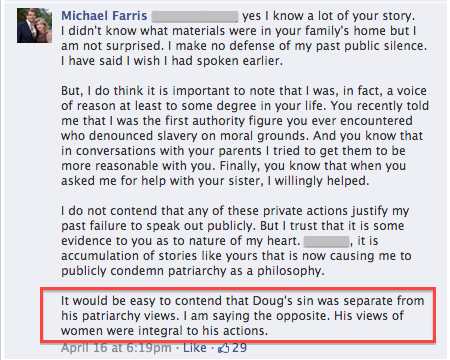
But other leaders are being more honest. They, Michael Farris and Chris Jeub among them, are connecting the dots and calling out a problem deeper than an individual leader. In this facebook comment, Farris responds to a homeschool graduate’s reiteration of her story (I’ve marked the relevant bit):

m1

When I read these things, I am reminded of evangelical attempts to soften toxic ideas so that they become more palatable, and that concerns me. For example, I heard evangelical leaders at the megachurch I grew up attending walk the idea of male headship back to spiritual leadership and breaking the tie when husband and wife cannot come to an agreement. While I appreciate that there are evangelicals who have moved away from an emphasis on total wifely obedience and submission, the idea of male headship itself is a problem, and softening it doesn’t change that. Is the walked-back view better? Yes, but it’s still a problem.

I wonder how far Christian homeschooling will change over all of this, and whether that change will be deep or surface-level. All Doug Phillips did was take ideas already out there—the idea of the Joshua Generation, the emphasis on male headship and wifely submission, the idea that girls should be encouraged to be homemakers and discouraged from having careers—and deepen each, using direct language, until his words and dictates became an embarrassment.

If Christian homeschool leaders see Phillips’ direct language and strident emphasis as the problem and fail to realize that it is at the core the underlying ideas that they themselves have long held that is the problem, change will be shallow indeed.

The word “patriarchy” is not the problem. The ideas that underly that word are the problem.

If the Christian homeschool leaders who are speaking out today reject the word “patriarchy” but hold onto the idea that a wife must submit to her husband, what have we actually gained? What is actually different?

Israel Wayne of Family Renewal wrote that:

In September of 2013, Michael Farris, founder of the Home School Legal Defense Association (HSLDA) spoke to state convention coordinators and other national homeschooling leaders, at the annual leadership conference they sponsor. He warned against the dangers of the excesses of extreme child discipline and a low view of women that has taken hold in some corners of the homeschooling community. He warned that unless homeschooling leaders actively speak against abusive and unGodly approaches to child discipline and unBiblical views of Patriarchal authority (that demean and devalue women), we risk losing our very legal freedom to homeschool.

From Wayne’s description, it sounds like Farris told other homeschool leaders that they needed to speak against child abuse and the devaluing of women or else homeschool freedoms would be at risk. The emphasis here appears sorely misplaced. Shouldn’t the primary concern be for the children who are abused and the women who are devalued rather than for the possibility that people will react to these abuses by turning against the legal freedom to homeschool?

I should note that I very much question what Farris means by “our very legal freedom to homeschool.” I suspect what he actually means is our freedom to homeschool without oversight or accountability. And here is a very real issue—Farris is now speaking out against “patriarchy,” and it appears that he may begin speaking against child abuse (though that remains to be seen), but he is still against legal accountability for homeschooling, accountability that would support children’s right to an education and their right to an upbringing free from abuse or neglect.

HSLDA’s current president, Mike Smith, will be presenting this keynote address at an upcoming homeschool conference:

Remembering the Reason, Renewing the Vision A general overview of the challenges, burdens and benefits of homeschooling from a veteran homeschool father and leader. Addressing the potential homeschooler, the new homeschooler, the veteran homeschooler and all homeschoolers in between, Mike outlines the success of homeschooling in academics and socialization, describes legal and legislative advances,and concludes that homeschoolers have earned the right to be left alone. 

This last bit is a serious problem. Whether or not Farris indeed intends to speak out loudly and publicly against patriarchy and child abuse, his organization will continue to work against legal reforms that help fight these problems, reforms that would bring homeschooled children into contact with mandatory reporters or ensure that homeschooled girls are not passed over educationally because of their gender. A change in culture is needed, yes, but the unregulated nature of homeschooling in many states both contributes to and is a result of that culture.

We need more. Homeschooled children deserve more.

But this is only the start of the things that concern me as I watch this current moment. Israel Wayne followed up on his discussion of Farris comments with these unfortunate paragraphs:

Mr. Farris has sounded a much-needed warning. My concern, however, is that when we over-react and swing to the other ditch, we end up teaching only love, grace and mercy (with no boundaries for children). By rejecting “Patriarchy” (abusive or domineering tendencies of men towards their wives and families), we may revert to the Feminism of the 1960′s, and all the problems that came with it, that led many women to react 180 degrees in the other direction by staying home and homeschooling their children. By rejecting rigid step-by-step rules about issues like strict clothing mandates and courtship procedures, we may revert back to the kind of sexual permissiveness that led to the legalism in the first place.

Do we really want to go back to families where mom is trying to pull that whole family uphill all by herself, while dad is off playing golf, letting mom run the family all by herself? Do want three-year-olds who rule the parents with an iron fist and parents who jump at their every demand? Do we really want teens who are groping their girlfriends in the back seat of a car because we don’t want to impose a legalistic standard on them? Do we really want to encourage the kind of American narcissism that says children are a nuisance and O.8 children is the goal, because we want to avoid the imbalance of policing bedrooms and imposing doctrines not clearly spelled out in Scripture?

This is not change, this is more of the same. What we need is change, real change. I think we’re at a moment of contingency where we might see such change, but to be honest. I don’t feel all that hopeful at the moment. I worry that the change will be more in gloss than in substance.

I can promise you one thing—I’ll keep pushing.

Michael Farris, Patriarchy, and Doug Phillips: An Expose

HSLDA President J. Michael Smith, Doug and Jubilee Phillips, and HSLDA board member Dick Honnaker at HSLDA's 2004 National Leadership Conference in Spokane, Washington.
HSLDA President J. Michael Smith, Doug and Jubilee Phillips, and
HSLDA board member Dick Honnaker at HSLDA’s 2004 National Leadership Conference in Spokane, Washington.

HA note: The following is reprinted with permission from Libby Anne’s blog Love Joy Feminism. It was originally published in a slightly longer version on Patheos on April 15, 2014.

Yesterday’s WorldNetDaily article on Lourdes Torres’s lawsuit against Doug Phillips quotes at length from Michael Farris’s reaction to Doug Phillips downfall. I thought it was worth going over that section specifically, and placing it within the context of other things I have written about Michael Farris, HSLDA, and Patrick Henry College, both to clarify the issues here and to reveal the serious dishonesty of Farris’s statements.

I will begin by quoting the section, and will then respond.

Before Phillips founded Vision Forum, he spent six years as an attorney for the Home School Legal Defense Association, or HSLDA, a nonprofit advocacy organization that defends the right of American families to homeschool their children.

HSLDA Chairman Michael Farris told WND, “The reason Doug left HSLDA is because [President] Mike Smith and I, who were his bosses, were growing more and more uncomfortable as he started developing his patriarchy theory. We started limiting his ability to speak on those things while traveling on our behalf. We basically made it clear that he could not pursue those things with his HSLDA hat on. So he eventually chose to leave us so he could do those things because we were not comfortable with where he was headed.”

As for the patriarchy movement, Farris said the teachings are not widely accepted in the broader homeschool community.

“It’s a minority of homeschoolers that believe in it,” he said. “But unfortunately, until very recently, they were getting a lot of visibility in certain places. We have sought to avoid inviting any patriarchy speakers to speak at our national conference.”

While state homeschool organizations run their own events and may choose to have such speakers, Farris said HSLDA has never promoted them.

“Doug has never been invited to speak at our national conference since he left,” Farris said. “We have tried, by example, to keep this stuff outside the mainstream of the homeschooling movement.”

He added, “Frankly, we think it’s time for us to stand up and publicly say this is just wrong.”

Background

And here we need some explanation. Within the Christian homeschooling movement, and by that I mean those Christians who choose to homeschool for religious reasons, whether in part or in whole, there is a range of belief on gender roles. In general, beliefs about gender roles fall somewhere on a spectrum between the following two camps:

Complementarianism: Many of those in the Christian homeschooling movement, including both Farris and my own parents, hold fairly conventional conservative evangelical views on gender roles. The wife’s role is to obey her husband, nurture her children, and serve ask a keeper at home. The husband’s role is to be the head of the family, provide for the family, and protect the family. Men are to be masculine and manly, women are to be feminine and womanly. God has laid out different and complementary roles for each gender, but all are equal before God.

Biblical Patriarchy: Some of those in the Christian homeschooling movement go farther. They proudly use the word “patriarchy” and teach that daughters are to be under their father’s authority until marriage, serving as “stay-at-home daughters.” They argue that daughters should not go to college, or hold jobs outside the home, and that daughters must obey their fathers even as adults. Only when daughters marry (through a courtship process controlled by their father) do they leave their father’s authority and transfer to their husband’s authority.

I don’t have numbers on how many Christian homeschoolers adhere to complementarianism versus how many adhere to biblical patriarchy, but I also don’t think it’s completely clearcut. Even those solidly in the complementarian camp will have noticed promoters of patriarchy speaking at homeschool conferences, will have seen their literature, and will have met those in its folds. My own family was fairly solidly in the complentarian camp, and yet they adopted some of the beliefs of the biblical patriarchy camp even as they rejected others (they sent me off to college, but believed I was still to obey my father, as an adult daughter under his authority).

Biblical patriarchy differs little from complementarianism except in its open embrace of the term “patriarchy” and its teachings about the role of adult daughters.

Michael Farris

So where does Farris fall, particularly? From what I’ve read of his writings Farris very much believes that wives must obey their husbands and that a woman’s role is in the home nurturing her children. But what of the rest? Farris’s strong rejection of the patriarchy movement as quoted above and his recent strong words for the stay-at-home daughter movement in a facebook comment would seem to indicate that he falls in the complementarian camp rather than the biblical patriarchy camp.

There is also this from a statement written in response to February’s article on sexual assault at Patrick Henry College and read aloud during chapel at Farris’s Patrick Henry College.

Some readers have wondered if the overall aim of the article is to associate PHC with a set of anti-women attitudes that we do not hold, and to insinuate that we are connected with outside movements that we positively reject (like the “Quiverfull/Christian Patriarchy Movement”). This philosophy, incorrectly attributed in the article to Dr. Michael Farris, Chancellor, espouses that college is inappropriate for Christians in general, and especially women. As his own life at PHC and with his own children reflect, Chancellor Farris has never agreed with such an offensive philosophy.

Farris rejects the word “patriarchy” and is not against daughters going to church. In fact, this statement from Farris’s Patrick Henry College indicates that Farris views biblical patriarchy as “anti-woman” and “inappropriate for Christians.”

But even as he rejects biblical patriarchy, Farris believes that wives should obey their husbands to the extent of not attending church if her husband so commands, and he believes that daughters, even as they go to college, should be preparing ultimately for motherhood rather than for careers. I think maybe this is why Farris’s continued refrain of “no no no, I’m not like him, he believes crazy things!” strikes so many as so odd. Farris is not as far removed as he would like us to think.

But there’s something else going on here too.

The Entanglement

Farris insists that he has long gone to great lengths to publicly distance himself and HSLDA from Phillips in particular and biblical patriarchy in general. Unfortunately for him, this is simply not true.

A quick search of HSLDA’s website reveals that the company was openly advertising for Vision Forum. From a 2010 email alert to HSLDA members:

—[ 20% Off at Vision Forum! 5 days left! ]————————–

Extra 20% Off at Vision Forum! Code: HSLDA. Toys, Books, Movies, More. Everything on sale for 5 Days only!

http://www.hslda.org/alink.asp?ID=282

Indeed, this sort of advertisement for Vision Forum has been a bit of a trend for HSLDA, complemented by positive recommendations of various Vision Forum products.

It’s also worth noting that Farris was at the very least being grossly misleading when he said of HSLDA that “Doug has never been invited to speak at our national conference since he left” and that “We have tried, by example, to keep this stuff outside the mainstream of the homeschooling movement.”

As R.L. Stollar wrote a year ago, before Phillips’ downfall:

1996 seems to be the last year that Phillips appears as an HSLDA attorney. But since then, HSLDA has made zero efforts to distance themselves from his viewpoints. In fact, almost a decade after Phillips left HSLDA to run Vision Forum, he was still featured by HSLDA as a peer. In 2007, HSLDA referred to Phillips as one of “the nation’s top leaders.” Also in 2007, Chris Klicka received an award from Doug Phillips and Vision Forum for his homeschooling advocacy. In 2008, HSLDA says of him that he is “one of the most popular conference speakers in the nation today because of his ability to encourage, inform, and inspire.” In fact, HSLDA proudly sponsored a reception at an event where he was the keynote speaker. The official relationship between HSLDA and Doug Phillips is thus one of continued mutual admiration.

I’m unsure of how Farris expected people to understand that HSLDA disapproved of either Phillips or biblical patriarchy when continually wrote of Phillips and his abilities as a homeschool speaker with such accolades. And this wasn’t the only time. HSLDA advertised Doug Phillips as a speaker at event after event. HSLDA member families were urged to attend. They also allowed Doug Phillips to advertise in their publication, the Home School Court Report, as recently as 2012.

Beyond this, HSLDA has also promoted other leaders whose teachings center on biblical patriarchy, including Voddie Baucham and Geoffrey Botkin. And to the best of my knowledge, HSLDA as an organization and Farris as an individual have never denounced any one of these leaders.

There was more, too. In 2007 Vision Forum published Passionate Housewives Desperate for God, by Jennie Chancey and Stacy McDonald. Jennie Chancey founded Ladies Against Feminism and Stacy McDonald founded Steadfast Daughters. Both are not just complementarian but fully embrace biblical patriarchy. Farris’s wife Vickie wrote a review of the book, which can be viewed on Amazon:

Jennie Chancey and Stacy McDonald have spoken the Truth with a capital ‘T’ in their wonderful book Passionate Housewives Desperate for God. Totally grounded in Scripture, this book winsomely presents the true picture of a godly homemaker. Prepare to be stimulated, challenged, and encouraged as a woman. This book is a real gem!—Vickie Farris, wife of HSLDA founder, Michael Farris, Esq.

Now maybe Chancey and McDonald tone it down in Passionate Housewives Desperate for God, or maybe Farris and his wife disagree here. But Farris has to be aware how these sorts of endorsements will come across to Christian homeschoolers.

My Question

Now I want to turn back to the recent article I began with.

After insisting that HSLDA has never collaborated with a supporter of patriarchy—an assertion I have here called into question—Farris added that ”Frankly, we think it’s time for us to stand up and publicly say this is just wrong.” And that is where I have to wonder—why didn’t Farris stand up publicly and say this prior to Phillips’ resignation and disgrace? Because he didn’t.

Further, Farris wrote that “Doug has never been invited to speak at our national conference since he left” and that “We have tried, by example, to keep this stuff outside the mainstream of the homeschooling movement.” Was Farris unaware that, regardless of whether he invited Phillips to speak at HSLDA’s national conference, if he spoke nary a negative word about Phillips in public and HSLDA wrote of Phillips only to promote him, the message that would come across to the homeschool community would be one of approval?

My sources tell me that Farris views Bill Gothard and Michael Pearl in the same negative light that he has long viewed Doug Phillips. Why, then, does he not publicly warn homeschool families against them? Why does he remain silent?

I think I know the answer. HSLDA operates off of membership dues. If Farris or HSLDA come out and publicly denounce toxic homeschool leaders, they will lose members. Farris has felt that Phillips was in error and dangerous for years, but only when Phillips was already defrocked and dethroned did he feel comfortable saying that out loud. Farris would rather tolerate patriarchy in the Christian homeschool movement than lose money for denouncing it.

Farris, it seems, is only willing to shoot patriarchy when it’s down.

Bill Gothard: When People Know… and Do Nothing

Screen Shot 2014-02-13 at 9.48.48 PM

HA note: The following is reprinted with permission from Libby Anne’s blog Love Joy Feminism. It was originally published on Patheos on February 13, 2014.

I’ll be honest: I’m more than a little bit upset right now.

I think it’s because I’m finally realizing the full impact of the growing Bill Gothard sexual abuse scandal. The real scandal is not that Bill Gothard sexually abused the young women placed under his authority. The real scandal is that it could go on for so many decades while leader after leader covered for him. This is the extent of the rot—that so many people knew what was going on and did nothing, including those who should have known better.

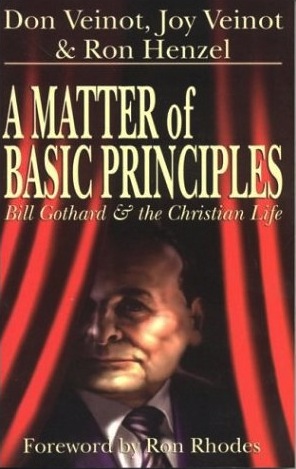
"In 2003, Midwest Christian Outreach president Don Veinot published a book called 'A Matter of Basic Principles: Bill Gothard and the Christian Life.'"
“In 2003, Midwest Christian Outreach president Don Veinot published a book called ‘A Matter of Basic Principles: Bill Gothard and the Christian Life.'”

I’ve had my eye on Midwest Christian Outreach for several years now. It is an evangelical organization dedicated to fighting heresy and cults. I generally find myself opposed to the group’s positions based on of their virulent anti-secularism and extreme political conservatism, but I have appreciated their longtime opposition to Bill Gothard. Back in 2003, Midwest Christian Outreach president Don Veinot published a book called A Matter of Basic Principles: Bill Gothard and the Christian Life. In it, Veinot detailed the history of Gothard’s ministry and accused Gothard of being legalistic and unscriptural.

In that book Veinot said nothing about concerns regarding Bill Gothard’s behavior toward the young girls sent to work at headquarters. Instead, Veinot focused only on Gothard’s theology. In the wake of Recovering Grace’s new revelations regarding Bill Gothard’s sexual molestation of young employees, Veinot has published a new article on the Midwest Christian Outreach website.

It turns out that he knew and intentionally chose to say nothing.

We also knew we had information about his behavior and sexual proclivities which we did not use or comment overly much about in the book. We knew, for example, that he is far too, shall I say, familiar with the young females he selects as his personal assistants. The reason we did not go into that too much was that we had spoken with the families of some of the former IBLP women and/or their families and realized that Bill had done so much damage, we did not want to subject them abuse to additional shame or possible embarrassment by making it more public. We decided that we could make our case that he is unqualified for leadership in a Christian ministry without having to describe his more prurient behavior toward those under his authority.

Veinot knew of the horrific damage Bill Gothard had done to the young women he made his personal assistants, and yet he chose to hide that information. It has been 11 years now since 2003. How many more girls have been subjected to sexual abuse at Gothard’s hands because Veinot covered for him? How could Veinot know what Gothard was doing and yet do nothing to warn the hundreds parents who so trustingly sent their daughters to work under Gothard’s authority? He knew—he knew—and did nothing.

Of course, Veinot is not the only Christian leader who has covered for Bill Gothard over the years.

According to Charlotte’s story, the IBLP Board knew that Bill was acting in appropriately toward her when she was a 16-year-old secretary at headquarters in 1992, and yet they simply sent her home and kept things quiet.

There were rumors going around about Bill and me. My brother started hearing things and asked me about it. Of course I denied everything. Bill had sworn me to silence with both guilt and fear. I was the one who was at fault because I was tempting him. If I told anyone, the future of the entire ministry could be compromised. Why would I want to hinder God’s work? He told me that this was our little secret, just between us. If I told anyone, he said he would kick my family out of ATI.

There was enough of a stir about how much time I was spending alone with Bill that my brother went to a higher-up in January and had him try to get Bill to send me home. As I understand it, the IBLP Board called Bill on the carpet for spending so much time alone with a young girl, and I was sent home in January. I believe my brother saved me.

When Bill knew I was being sent home, he called me into his office. He took me in his arms and ran his fingers through my hair. Hugging me tight, he told me never to cut my hair, that I was his inspiration. He then kissed me deeply on the lips and told me never to forget him. Then I was picked up and put on a plane, and I have never heard from him since.

And even before this, people knew and chose to cover for Gothard. There was a sex scandal in 1980 that involved Gothard’s indiscretions (it seems he made a habit of visiting the female staff in their beds at night), and yet people were willing to ignore, overlook, cover for, and outright lie about what happened.

Meanwhile, our team continued to receive emails and collect information that confirmed to us that these problems were not limited to the ATI era (1984–present) of Bill Gothard’s ministry. We learned that this type of behavior [toward young women] was commonplace in the early years of the Institute ministry, culminating in a public “scandal” that led to Bill Gothard’s forced resignation from the ministry in 1980, only to see him forcefully return to power shortly thereafter, decimating the financial and spiritual lives of dozens of Institute staff members in the process. The ministry nearly came to an end at that point, but Bill was able to revive it with a new group of leaders who were willing to overlook what had taken place. A few short years later, in 1984, the Advanced Training Institute of America homeschool program was created, and with it came a new generation of willing laborers … and young victims.

Bill Gothard’s behavior should never have been allowed to continue this long. It has only been allowed to continue for this long because people have covered for it. What’s really bizarre is the huge range of people willing to cover for Gothard, willing to overlook or ignore or not mention his indiscretions with the young women under his authority. Gothard’s board is most guilty of this, yes, but even Veinot writing against Gothard’s theology in 2003 chose to leave out what he knew.

How could so very many people know, and yet say nothing, do nothing, while it continued occurring?

This is why I can’t stand it when I hear Christians respond to this scandal with “What a good reminder that everyone is a sinner” or “More evidence that we live in a fallen world.” This is not just about one man. This is an entire system that collapsed on the heads of young girls it was supposed to protect as everyone else collectively turned their backs and looked the other way. This is about people conveniently not mentioning what they know, and for what? To protect a child molester?

The entire system is rotten, and I am angry.