I Was The Original CFC Fuck-Up: R.L. Stollar’s Story

I Was The Original CFC Fuck-Up: R.L. Stollar’s Story

R.L. Stollar, HA Community Coordinator, served as a Communicators for Christ conference instructor for three years, from 1998-2000. He wrote a book on intermediate debate theory, Beyond Baby Steps, that was published and sold by CFC. He created CFC’s very first website, too, and freely admits that, in retrospect, he sucked at HTML. 

*****

“Bottle it up, and the bottle goes crack.”

~Craig Minowa, “The Exploding People”

*****

I have a confession to make.

R.L. Stollar’s staff picture from his 2000 conference tour with Communicators for Christ.

I did not want to write a single post for this week.

I have spent over a decade carefully bottling up all my distress and rage, putting those bottles into reinforced cardboard boxes marked “Fragile,” and hiding those boxes in the deepest, darkest basements in my mind so I would never have to think about or feel them again.

This week hurts. It hurts a lot.

Honestly, I forgot just how much it would hurt. As I forced myself to slowly pull those boxes from my mental basement, unwrap the newspapers guarding the bottles, and uncork them and watch certain moments from my life flash before my eyes — I realized why I never wanted to remember those moments ever again. I had to re-live things I had literally blocked from my mind. My insomnia flared up. My appetite vanished. My heart rate accelerated. The blood of nervousness and self-doubt rushed to my head. I felt like that frazzled, insecure, and confused kid that I was, putting on an aura of self-confidence because the only confidence I had was the bit that forensics taught me to fake.

In a sense, I still am that kid. I don’t think I ever quite grew up. I think some important piece of my soul got lost on the side of a road during a CFC tour and maybe, someday, I will find it.

For this week, I had to feel those things that keep me wishing I could just re-live my life all over again. Wishing I could just have been a normal boy with a normal life.

Then there’s the persistent fact that, honestly, I wouldn’t change a thing. All my experiences, even the painful ones, make me who I am. They instill in me a fire and a fierce determination to stand up for my friends and the people that I love. It is my pain and sorrow and tears that drive me. It is the pain and sorrow and tears of my friends that inspire me to keep pushing, to keep doing my best to make the world — and our homeschool world — a better place.

Because this world is a very sad place. And for me, the homeschool debate world was likewise. It was a place filled with people who became my best friends, a place filled with some of my most favorite memories — but it is also a place filled with loneliness and confusion and psychological beatdowns and overwhelming hypocrisy.

Preparing for this week, therefore, was difficult. It only became more so as I heard the stories of others — in particular, the stories of former CFC interns, some of which we are publishing. These stories made me sad, because I could relate to what they said on such a deep level. But they also gave me peace, because for one of the first times, HA has helped me feel not crazy. Because their stories made me realize that I was not the only fuck-up.

See, I was the original CFC fuck-up.

I am the reason why CFC changed the structure of its internship program. Because CFC was determined that another me would not happen again.

I had a unique experience because, other than the Moons’ own children, I was the only student instructor who toured for so many consecutive years. When I think back to my high school years, I don’t have many memories of my own family. Between being uprooted from California as my family moved to Oregon, flying around the country to tournaments, and spending months at a time with the Moons, my high school years feel homeless. Most of my high school angst is directed not towards my parents but the Moons. They became surrogate parents of sorts, my adopted family with whom I traveled — circus-like — across the many and divided states of America, like Christian minstrels carrying our music of golden oratory to the untrained masses.

But as time progressed, as month after month of touring and teaching went by, as the months became years and I finally couldn’t take it any longer, my spirit began to twitch. I began to lose my ability to just shrug everything off like it was nothing. It was not nothing. It was something and there was a reason why I hurt. And when I began to lose control over my external placidity, when my soul split from years of parents looking down on me in my youth while I taught their youth to not be looked down upon, I snapped.

It happened at the very last conference, in Hawaii, during my third and final year of touring. It happened over something completely inane, something about going to a movie with friends after the conference. But it happened. And it was one of the only two times in my entire life when I yelled. I yelled at Teresa and she yelled back. And we kept yelling. And at some point we stopped talking to each other at all. She sent Wendell after me, to be our messenger because we were done talking with one another. And I refused to talk to Wendell then, too. I refused to talk to him and he was my best friend for the last three years.

I am not proud of that. I am not proud of my anger. I am not proud of the hurt I caused either my teacher or my friend. But I couldn’t control my psyche any longer. I had a full-blown nervous breakdown. Following that night, I would descend into a major depression marked by self-injury and consistent suicidal thoughts that I continue to fight to this day.

I don’t think I can summon a cogent narrative of how I got to that point. But I can relay some interesting stories to lighten the mood. Like how the very first time I got wasted was on a CFC tour.

The beginning of that story is that I didn’t get wasted with fellow CFC interns (not that time, that is; CFC interns did not start getting wasted together until the third year). I got wasted with the children of homeschooling leaders from around the country.

The second year I taught with CFC (I was 15 at the time), which was the first year we officially “toured” around the country in the Moons’ motor home, we stopped at Regent University. HSLDA was holding their National Leadership Convention. This convention was an invite-only event for recognized leaders in the conservative Christian homeschooling world: the directors of all the state homeschool organizations, for example. CFC was tasked with teaching the leaders’ kids about speech and debate.

So, pretty much our job was to babysit the kids while the parents got inspired. During the day, we taught our peers. During the evening, while the parents mingled together like God’s chosen socialites, the kids roamed the university, unsupervised. One of those nights I was offered hard alcohol by the son of a national homeschool leader. I accepted. I was too scared to follow up the shots with a prescription-level painkiller, but I watched as he and his friends — the children of some of the other leaders — all took shots and popped various types of pills. They commiserated with each other, and found solace in their mutual disdain for each other’s parents: “____ cares more about the idea of homeschooling than homeschooling his own fucking kids.”

I could name names that would shock you, but that is not the point of this particular story. The point of this story is that, the higher you climb the power structures of the homeschooling world, the more they resemble the power structures in any other world.

I can tell you other stories, like what it was like living in a motor home for months on end. How traveling in a motor home with David Moon was like traveling with Jekyll and Hyde. One moment he was the lighthearted, lovable counterpart to Teresa’s professionalism. Then he’d snap and turn into a completely different person — red-faced, terrifying, and raging — and Teresa would silently turn the other way until his “episode” subsided.

I can you about the occasionally strange and otherworldly host homes we would stay at. Like the home where my CD player got confiscated by adults I had only meet two hours prior, because I was listening to Newsboys and “Newsboys have a rock beat and rock beats are Satan’s mating call.” Or the home where I couldn’t fall asleep until past midnight because the dad was rotating between yelling at and spanking his own kids for hours in the room right next to where I had to sleep. Or the one that still feels unreal, the house up on that hill in the middle of nowhere that had no kids and thus no one attending the local CFC conference — that house where the woman kept “accidentally” coming into the bathroom whenever I was showering, the same house where Playboy and Maxim magazines were “accidentally” left out in prominent display right where I was supposed to be sleeping.

I can tell you how I’d modify our teaching material to ensure that we did not offend our increasingly conservative audiences, as we traveled further and further into the Deep South. And after my small group spent hours creating some skit based on Veggie Tales, Teresa would make me break it to them that our time was wasted, because some parent thought Veggie Tales were Satanic. That after so many moments like this repeated over and over, week after week, I would begin to show obvious signs of strain. That I would withdraw completely from social interaction and disappear for hours. That no one ever bothered to make sure I was ok. No one, except Wendell, who one night sought me out and sat next to me silently as my body shook itself to sleep.

That was one month before the breakdown.

I can tell you how, in spite of everything I just said, I will be forever grateful to Teresa Moon for the gifts of speech and debate she gave me, and I love her very much.

I could tell you other things, too. I could write a book, really.

But right now I do not have the energy.

Right now, I am just trying to write this little bit without all my soul’s pieces falling apart again.  Right now I just want to say that I am not alone.

I am not alone. 

I am not the only fuck-up.

I have waited over a decade to say that, though I wish I didn’t have to. But at least when I say it now, I can say it loudly, because there are others saying it with me. So even as I fall apart while I put these words together, I have a newfound sense of peace.

We are not fuck-ups. We are survivors of a mad, mad world.

There is hope in that realization. There is healing through our shared pain.

I Was A Problem To Be Ignored: Krysi Kovaka’s Story, Part Two

I Was A Problem To Be Ignored: Krysi Kovaka’s Story, Part Two

Krysi Kovaka is the 2008 recipient of the Institute for Cultural Communicator’s Raudy Bearden Community Speaking Award. She served as an intern for the 2008 Communicators for Christ conference tour.

< Part One

I was a problem to be ignored.

At a post conference party in Texas, I met a man who used to be part of the NCFCA/CFC scene.  He was well into his twenties and I was seventeen.  We talked for a bit and ended up exchanging numbers.  Our relationship happened mostly via text and IM, and it was a case of trouble attracting trouble.  We never dated, but our relationship was really creepy and weird.  One night after I had taken loads of my Xanax and other meds, he drunk texted me and over the course of several hours, ended up talking me into sending him naked pictures of myself.  Despite this creepiness, I ended up disclosing a lot of my life’s story to him and I told him about my father abusing me.  He really encouraged me to tell Mrs. Moon about the abuse.  A few weeks later we ended up sexting again – eventually my mom found out about him and threatened to have him put behind bars if he ever talked to me again.

Towards the end of tour, I really started to fall apart (as if I wasn’t falling apart before.)  I started to stress about having to return home.  Things got so bad that I did end up telling Mrs. Moon and several of the other interns about my father molesting me.  I don’t know what an appropriate reaction is when a teenager tells you that her father molested her, but what happened was far from a right response.  We were at a conference in TN when I told Mrs. Moon about the abuse, and she had me tell my two younger brothers about the abuse, and then she had me tell my mother.  My memory of this conference is pretty fragmented, but I remember crying a lot and feeling absolute horror about what was going on around me.

At the time, I really didn’t have words to describe the abuse.  People kept badgering me and asking me questions about exactly what happened, but I was in no emotional state to talk about it.  I felt like I was on the verge of having a mental breakdown.  My behavior got more and more erratic and shortly after I told my family about the abuse, Mrs. Moon kicked me off tour.

We were in Pigeon Forge, TN and Mrs. Moon told me that she had asked my mother to drive down to TN to pick me up.  I would not be able to finish the last two weeks of tour.  Apparently, she had finally realized that I was in no condition to be on tour.  The Moons had a goodbye breakfast for me at a little diner in Pigeon Forge.  At this breakfast, I said goodbye to all the people who had been like family to me.  The Moons promised that they would stay in touch with me and help me and that if I ever needed to talk about anything that I could call.

I was completely numb at that breakfast.  I cried a lot and I remember several of the other interns crying.  Very few of them really understood what was happening or why I had to leave.  I hardly understood why I had to leave – in a way, I felt like I was being punished for speaking up about the abuse.  I was on vacation last week, and I ended up driving through Pigeon Forge – to this day I hate that place.

After being kicked off the internship, I didn’t return home.  I went to live with some family friends until my mom decided to divorce my father.  Life got really rough after that.  I attempted suicide again just a couple months after leaving tour.  I also started drinking all the time and I started using more prescription drugs.  I felt like my whole world had crumbled.  The following is an excerpt from an email I wrote to Mrs. Moon the day I left tour:

“Saying goodbye to the team was the worst thing I think I’ve ever had to do.  Arriving in North Carolina was even worse.  It occurred to me that I might be stuck here for a long time.  I really, really, really hate it here.  I don’t know anyone.  I’m lonely, depressed, teary, and scared out of my head.  Life is so confusing right now.  I hate this….All I want to do is go home.  I have no clue what home is right now, but I know I want to be there.  I just wish I could be somewhere where I knew people and where I felt safe and cared about.  I’ve yet to see what that would look like in practice…”

I tried to keep in touch with the Moons and with the people I toured with, but shortly after leaving tour, one of the other interns told me that none of the people I interned with would be allowed to talk to me.  As it was explained to me, Mrs. Moon felt like it was best that they not be in contact with me.  I later contacted Mrs. Moon and received a similar answer from her.  I can’t even begin to explain how much this devastated me.  These people were my friends and support system and all of a sudden it was all yanked away from me.  The Moons stopped talking to me shortly afterwards.  On tour I was treated as a problem to be ignored – when that problem got too big to ignore, I was dismissed from tour.  Once again, I could be ignored, as I was now someone else’s problem.

Needless to say, I was not invited to the annual Masters conference.  A week before Masters I was diagnosed with meningitis and was hospitalized.  I was told later that when Mrs. Moon heard I had meningitis, she was relieved because she would be able to use that as an explanation for why I wasn’t at the conference.  When she heard I was in the hospital, I was told that her exact words were, “Oh thank God.”

Several months later, my mom emailed Mrs. Moon and asked if I could use her as a reference for another internship I was applying for.  I should have known better.  This was part of the reply she sent to my mom:

“I have not really had a chance to experience the Krysi that is dependable, trustworthy, honest, respecting of authority, a team player – many of the qualities I would expect an internship director to look for. I am optimistic that these character qualities can become a part of how Krysi is known.  I currently have no real frame of reference for making that type of recommendation.  I recall receiving only a few pieces of communication from Krysi shortly after she left the team complaining about her life and her options…”

The email to which the last sentence refers is the one I quoted previously.  As to the rest of it… what did she expect?  I was an emotionally traumatized teenager put in an impossible situation.  Tour was one of the most stressful environments I’ve ever been in.  Mrs. Moon knew I was unstable and she still allowed me to intern – when that didn’t work out, she took away the only support system I knew.  I’m really not sure what other outcome she would have expected.

Six months after I left the internship, I sent an email to a friend and tried to explain to her how tour was for me.  This was part of what I said:

“People put way too much pressure on 17 and 18 year olds.  This was what damaged me the most, I think.  Everyone expected all 13 of us to be absolutely perfect.  On the platform and at conferences, we did a great job of meeting those expectations.  After a while though, it become sort of soul killing.  I’d go to a conference and feel absolutely dead – no one really knew me.  They thought they did, but they had no idea about my life.”

That’s the thing, the one person who had an idea about my life (Mrs. Moon) accepted me to intern – being fully aware of my mental health problems – and then put me on a platform and expected me to act, look, and behave perfectly.  When I didn’t measure up to those standards, I was rejected.  I really don’t understand the reasoning behind any of it.

The last contact I had with the speech and debate world was during the spring of 2010 when I went to an NCFCA tournament to judge.  I showed up with an orange juice bottle full of vodka.  I was completely drunk and I gave alcohol to several of the competitors.  After that I never went back.

I’m definitely not proud of all my actions over the years.  I know I’ve made some mistakes, but then again, so have the responsible adults in my life.  What happened on my CFC internship definitely messed with my head – I learned that nothing in life is permanent, that people will eventually abandon you, and that talking about trauma is unacceptable (and even punishable.)

Post tour, I got into a decent amount of trouble and did some crazy stuff (I was a wild one).  I rejected Christian fundamentalism, in large part because of the hurt I experienced in the “Christian community.”  About a year ago, I started to work on my trauma and substance abuse issues.  It’s been a journey, but I’m finally in a good place.  I’m happier than I’ve ever been, I have a great job, and I have people in my life who don’t abandon or reject me when I act a little crazy.  It’s the first time I’ve ever known what stability looks like.  I’ve re-embraced spirituality; I don’t consider myself a Christian – I’m just trying to figure out what it looks like to follow Jesus.  I still screw up a lot and make mistakes, but I have people who love me through those mistakes rather than rejecting me.

I’m sure that there are people who will be angry for the things I’ve said about CFC/ICC, and I’m okay with that.  I’m past the point in my life where I feel like I have to pretend everything is okay.

End of series.

Sailboats And The Spirit: Finn’s Thoughts, Part One

Sailboats And The Spirit: Finn’s Thoughts, Part One

HA note: The author’s name has been changed to ensure anonymity. “Finn” is a pseudonym.

A few weeks ago, I ventured back into the depths of my Documents folder and found my apologetics cards. It wasn’t long before I started cringing.

My conception of God, though still distinctly Christian, has grown significantly since graduation from high school two years ago. A large part of this has been reading some of the greatest works in religion and philosophy in college; only a few years ago, I had read virtually no significant philosophical works and had virtually no knowledge of any religion besides Christianity.

I want to tell a few stories, and then I’ll close with a few action items for both judges/parents and students who may be reading this article.

When I first started speech and debate, I never did very well in impromptu because I simply wasn’t very good at talking about something random. Then, I noticed that I would get noticeably higher rankings when I would pick a topic which involved talking about God. So, naturally, I began connecting even the most straightforward topics to some spiritual-sounding stuff like grace, Jesus’s sacrifice, or our sin nature. I remember thinking during one round “alright, and for the third point I’ll just drop my voice really soft and sound all distressed about our depraved nature and then close with Jesus.” The topic itself had nothing to do with the Christian message, but by golly I was going to put some spiritual-sounding junk in there somewhere. And that’s exactly what it was: junk.

But it got me the rankings. 

I wasn’t glorifying God by using my soft, passionate voice to talk about the virtuous stuff I threw in there to get the judges to like me. I was literally only talking about God because I noticed the correlation between my rankings and the total amount of Christian spiritual content.

I tell this story because I want to warn students against doing what I did.

You might think that this phenomenon is rare. On the contrary, I’ve seen nothing but increasing numbers of competitors catching onto this. At nationals, I judged a round of illustrated oratory. Seven out of the eight speakers spent a sizable portion of their time talking about God despite the fact that only two or three of the topics were actually about spiritual matters. Some of the analogies and methods they used to tie in “God” were so laughable that I’m sure I just had a blank stare across my face for a good portion of the round. (As much as I’m tempted to share an example, I don’t want to call a particular speech out for doing exactly what I was guilty of.) A persuasive room was similar: this time, seven out of eight speakers spoke about some topic of spiritual importance or somehow tied in references to God without actually doing any real in-depth analysis of those spiritual matters. These people are discovering exactly what I did years ago: that judges evaluate speeches with spiritual content with a lower standard.

Now, the NCFCA and Stoa are Christian leagues. I’m not concerned that students are talking about God. I’m actually very glad that speakers are able to speak to religious matters in a Christian environment. Instead, I’m arguing that students should ensure that any reference to God advances the overall message of the speech. If your message is that “sailboats are really cool and interesting,” then make that point. Don’t leave me with a bunch of random spiritual concepts you threw out because they sounded good: leave me with knowledge about sailboats.

I’m also arguing that judges shouldn’t accept spiritual-sounding junk because it’s related to religion — more on this in a bit.

There’s a big gap between the NCFCA’s motto “addressing life issues from a Biblical worldview in a manner that glorifies God,” and “mentioning God every thirty seconds to get points.” To quote Lecrae: “I used to do it too,” but I count it as one of the greatest mistakes of my speech and debate career.

So, action items:

1. For students: speak carefully about God. What you say really does have power to change your audience. Don’t use it lightly. Don’t just parrot “spiritual-ese” in spiritual-ish tones. Say something profound. Make sure your judge learns something: write your religious-themed speeches and apologetics cards such that you can teach everyone something. This means research — not just rhetorical devices.

2. For judges and parents: start listening consciously for speakers that are only throwing out Christian-sounding stuff without any real thought or consideration. Don’t excuse weak analysis or lame metaphors just because the topic is somehow Godly. I know there are judges who do this (I’ve seen it happen on my ballots) because there’s a tendency to think that talking about God is far more important than talking about non-religious things. However, this perpetuates the divide between the sacred and the secular. Listen to speeches about missionaries and spiritual matters with the same intensity that you would apply to listening to a speech about sailboats. I don’t want to disclaim any responsibility for having done what I did, but it only happened because judges actually rewarded me for it.

So that’s half of what I want to say. The other half involves an openness to new ideas.

Part Two >

I Was A Problem To Be Ignored: Krysi Kovaka’s Story, Part One

I Was A Problem To Be Ignored: Krysi Kovaka’s Story, Part One

Krysi Kovaka is the 2008 recipient of the Institute for Cultural Communicator’s Raudy Bearden Community Speaking Award. She served as an intern for the 2008 Communicators for Christ conference tour.

I’ve spent a long time trying to figure out what I would say about my CFC tour experience if ever given the chance.  It’s a lot to try and put into words. CFC was one of the first places where I felt a sense of family and acceptance.  It was also one of the first places where I experienced the rejection and hypocrisy that seem to go hand in hand with conservative homeschooling groups.

Krysi Kovaka's staff picture from her 2008 conference tour with Communicators for Christ.
Krysi Kovaka’s staff picture from her 2008 conference tour with Communicators for Christ.

To give proper background to this story, I first have to explain a bit about my childhood.  I grew up in a conservative Christian middleclass family.  On the outside, everything about my childhood was perfect (albeit a bit unconventional.)  My parents chose to homeschool me and my four siblings.  I was given a great academic education, but school is really only a very small part of any discussion relating to homeschooling.  My father molested me while I was growing up, and given the insular community of which I was a part, there were very few people who would have been able to spot any signs of abuse.  Nobody found out about the abuse until much, much later.

When my public schooled peer group was playing sports, doing ballet, or marching band (or just being normal teenagers) I was busy doing competitive speech and debate.  I started doing speech and debate when I was eleven and I went to my first CFC conference.  After that, I spent the majority of my time going to NCFCA tournaments, researching debate resolutions, and attending CFC conferences.

The thing is, I never quite fit the mold of what a conservative homeschooled debater should look like.  I was a bit different; I liked to dress differently, dye my hair weird colors, and do anything else I could think of to stand out from my homogenous peer group.  I think part of this was personality (I’ve always been a bit quirky) and part of it was my attempt at a cry for help.  I was a very troubled teenager; despite (or maybe because of) my Christian homeschooled upbringing, I had problems with cutting, eating disorders, depression, and substance abuse.  Of course, when I was competing in NCFCA tournaments and attending CFC conferences, very few people had any idea about my problems.

To adequately explain what happened on my CFC internship, I have to rewind a bit and talk about the winter before I went on tour.  Christmas break of 2007 I was put in a behavioral hospital for attempting to commit suicide.  I was radically unhappy at home, so I tried to overdose on over the counter pain medicine.  I was in the hospital for nearly two weeks before I was discharged, just a few days before Christmas.

Several weeks later (January 2008) my mom was hosting a CFC Masters conference in my hometown of Louisville, KY.  Prior to my suicide attempt, I had been accepted to be an RSA (staff assistant/all-purpose slave) at this conference.  For reasons that still baffle me, the adults in my life decided that I needed to attend the conference and pretend that everything was okay.  While I should have been in therapy, I was busy cleaning bathrooms, setting up for banquets, and doing any other menial task that came my way.  Child labor laws where never even talked about.

During this conference I spent a lot of time holed up in bathrooms either cutting myself or making myself throw up.  It’s interesting now for me to look back at pictures of myself at that Masters conference – it was evident from looking at me that there was something deeply wrong.  Still, no one talked about it or asked about it.  Depression, suicide, and mental illness are not socially acceptable topics among conservative homeschoolers.

To illustrate the polarity that was my life, I was awarded the Raudy Bearden scholarship at this Masters; in one minute I would be in a bathroom trying to hold myself together and in the next, I would be up on a stage accepting an award or giving a speech.  Prior to the awards ceremony where I was awarded the scholarship, I was in the bathroom making myself throw up.

It was also during this conference that I decided I wanted to apply for a CFC internship.  It wasn’t so much that I loved CFC or that I loved public speaking – I just wanted to leave home and this seemed like a perfect opportunity.  The week after Masters I filled out an application to intern – I was pretty sure that getting accepted would be easy since my sister had interned twice.  Turns out that I was right.  I had a phone interview with Mrs. Moon, and despite the fact that she knew all about my mental health background (including my recent suicide attempt) she accepted me to intern just a few weeks after the phone interview.  I told her that I was on psych medication but that I would be fully competent to tour the country in a motorhome with a dozen other people.  To this day, I’m not sure why she took my word for it.

That spring and summer was a blur – I remember a lot of emails and writing a lot of classes.  I remember having to go shopping for tour clothes (all of us interns had to wear color coordinated outfits.)  I remember feeling a lot of pressure to perform well at that year’s NCFCA national tournament.

August rolled around and it was time to go to prep week and start tour.  Over that summer I had spent a lot of time at counseling and therapy, but I was still in no mental or emotional condition to be in such a stressful environment.  On tour you are expected to look perfect at all times, teach multiple classes in a day, give speeches, and function on very little sleep.  At this time I was still dealing with an eating disorder (which I tried to hide by saying I was a vegetarian), I cut myself regularly, I was very depressed, and I was starting to abuse alcohol.  I tried to hide all of these problems and put on a brave face as I got up on countless stages and spoke about the benefits of communication training and homeschooling.  I felt like a performing monkey.

My internship wasn’t all bad – I made some great friends and I felt a real sense of community with a few of my fellow interns.  I got to see the country and I got to get away from home.  I loved not being at home.

Tour was a very stressful environment though, and I started to crumple under the constant pressure to be perfect.  I would get up on a stage to speak and the second I got off stage I would run to a bathroom (bathrooms were the only place I found privacy) and hurt myself.  I started having really bad anxiety attacks during this time, so a doctor (who was a friend of the Moons) prescribed me Xanax over the phone.  I promptly started abusing this medication and nobody attempted to monitor my use of the pills.

What really amazes me about all of this is how few people took notice of my troubling behavior.  Of course, there were a couple of my fellow interns who knew that something was wrong, but they were only teenagers themselves.  None of the adults in my life took any notice.  I can only attribute this to the fact that I was in a homeschooled bubble – I assume that the people I was around were sheltered to the point where they didn’t know what to look for.  The other explanation is that the people I was around purposefully didn’t take notice of my behavior.

During the second half of my internship I began self-medicating with alcohol more frequently.  One night, me and one of the other interns separated from our group.  We were in Boston and we decided to strike out on our own to explore the city.  We found a couple of homeless men and we had a fascinating conversation with them about life and God.  During this conversation, I shared their vodka.  Yes, I did that.   I really didn’t see a problem with sharing vodka with homeless people.  When we got back to the group no one noticed that I was slightly inebriated (or they pretended not to notice.)

On another occasion, I and two other interns raided the liquor cabinet at our host family’s house.  We got black out drunk that night and ended up playing a risqué game of truth or dare.  That night was the first (but not the last) time that I got sloppy drunk with a boy and made decisions I regretted later.  The next morning we three were nursing hangovers, but we drug ourselves to the motorhome and tried to pretend that we were fine.  I’m sure that one or two of our fellow interns noticed, but no one said anything.  That was the culture we lived in – pretend that everything is fine, don’t make waves, and ignore problems.

I was a problem to be ignored.

Part Two >

Of Love and Office Supplies: Philosophical Perspective’s Thoughts

Of Love and Office Supplies: Philosophical Perspective’s Thoughts

HA note: The author’s name has been changed to ensure anonymity. “Philosophical Perspectives” is the author’s chosen pseudonym.

There are many things about the NCFCA that were… not awesome.

But as I’ve been remembering my years in the league, I’ve also been remembering the beautiful things – the friendships I gained with people around the country.

We were a strange bunch – “like-minded”, high-achieving homeschooled teenagers who liked to spend their spare time researching trade policy, arguing about Calvinism, and discussing the validity of resolutional critiques. We shopped for suits (at goodwill) and cooed over office supplies. We compared flow charts and rehashed debate rounds to figure out how we needed to boost our evidence boxes.

My church growing up hosted a New Year’s Eve party at a rec center every year which, as a tangent, I always thought was a dumb location – what were you supposed to do, if we didn’t want to play basketball?  Work out? Communally? Anyway, after several years of sitting there, bored, I hit upon the perfect solution – I brought my debate box and re-wrote my case.

I saw my friends in person maybe once a month, usually at tournaments.  Tournaments are weird places to hang out. We would be in rounds from 8am-10pm, if everything was running on time.  I remember once not finishing until midnight.  We grabbed moments when we could – during bye rounds or speech rounds if we weren’t competing. But we were exhausted, high on adrenaline and Red Bull, and most of the time competing against each other. We were also under the watchful eye of parents in every hallway.

Relationships may have been sparked at tournaments, but friendships grew and deepened online – mostly through Xanga, AIM, and HSD.

For the uninitiated, Xanga was an early web-blogging service, predating even MySpace. For us, it was facebook before there was facebook.  You could write articles or update your status, and friends would comment or give “eProps,” the predecessor of facebook’s “like”.

AIM stands for AOL Instant Messenger. It was the one way we could have unmonitored conversations, since most of us understood the internet better than our parents.

HSD stands for Homeschooldebate.com, a forum established to discuss debate, judging, and coaching – but also quickly became home to myriad conversations about anything and everything, from serious to silly.

All three of these became spaces of deep community for me. As I re-read one of my (now private) Xangas recently, I was struck by how normal so much of it seems. I talked about how awesome my friends were, re-hashed tournaments (mostly the social happenings and tournament outcomes), posted inside jokes, and, more often that I care to admit, “meaningful” song lyrics.

It was on my other (secret) Xanga that I remembered the other stuff. There I wrote journal entries – some public, some private, and some protected (only visible to specific readers). I wrote about my faith, reflected critically on the competitiveness of the NCFCA, and processed problems in my family. I wrote about boys, love, belonging, and identity. I wrote about beauty, about pain, about Jesus.

I shared my soul with my friends on that site. They responded with love, support, and friendship. They called me out when I was spiraling. They talked me through my depression, and nursed me through my neglect. They reminded me that I was loved.

I did the same for them. I remember friends thousands of miles away IMing me when they were depressed, on the verge of self-harm. I would send them a song, and we’d talk until they could fall asleep. We dealt with eating disorders, self-harm, depression, anxiety, addiction, and death. We were a rag-tag bunch who were just helping each other survive.

And survive we did. We even managed to have fun. One of my favorite memories of my time in the NCFCA was a tournament held at a university, where I did very well. While usually out-of-towners stayed with other homeschool families, this time, we were allowed to stay in the dorms, without parental supervision. So we stayed up all night, drank artesian root beer, and watched a U2 concert. I held hands with a boy I liked under the couch cushions. We giggled, we ate candy, we made fun of M. Night Shyamalan. I think it’s one of the few times I felt like a teenager.

There are many skills the NCFCA gave me – critical thinking, public speaking, how to argue well, and how to understand all sides of an argument. This online community was its hidden gift. I learned how to share my heart in writing. I learned that big ideas are ok, that asking questions is good. I learned that I was beloved, messy and depressed as I was. I learned about music, and movies, and art. I learned that I didn’t have to win to be loved. I learned that I didn’t always have to be mature beyond my years, that it was ok to be silly. I learned how to listen, and that not every conversation is a debate. I learned how to walk through suffering, and how to ask for help. I learned how to sit with someone in their pain. I learned how to love and be loved, unconditionally.

I work now as a campus pastor – and I remember all of these things, as I sit with people in crisis. My friends in the NCFCA taught me more about love and honesty than anyone else since.

So, I’m taking a minute to celebrate those friends – from Xanga, AIM, and HSD days. It was a beautiful (and I think, sacred) community that we formed. For all we weathered, I’m grateful. It was, strange as it seems, a place of calm, and sanity, in the middle of the storm.

A Brief History of Homeschool Speech and Debate

A Brief History of Homeschool Speech and Debate

By R.L. Stollar, HA Community Coordinator

******

“There is warfare. We are soldiers. We have weapons.”

~Shelley Miller, NCFCA Oregon State Representative, 2013

*****

As we embark on our Resolved: series, you will see a lot of acronyms being thrown around. I figured it would be helpful for those unfamiliar with the homeschool speech and debate world to see a brief summary of what those acronyms mean. The following history of the key organizations and individuals is important to keep in mind as a general context for reading the posts this week.

HSLDA Debate

Homeschool Legal Defense Association (HSLDA) began a homeschool debate league in 1996. Christy Shipe (then Farris), the daughter of HSLDA’s chairman and co-founder Michael Farris, started the league when she was a senior at Cedarville University. The goal of the league, according to Michael, was “to improve your child’s reasoning powers, clarity of thinking, and ability to stand for the truth of God’s word.” Whereas competitive forensics sees the skills of forensics as ends in themselves, homeschool debate sees them as means to a larger end: “to help homeschoolers address life’s issues biblically, with God’s glory, not their own, as the focus.”

The very first national tournament was held in October 1997 at Loudoun Valley High School in Purcellville, Virginia. Christy Shipe was the tournament organizer. The debate team from Cedarville, of which Shipe was a part, played a crucial role in the beginning. Deborah Haffey, Cedarville’s debate coach at the time, was influential in Shipe’s love for debate. HSLDA’s original debate teaching materials featured Haffey. And the very first homeschool debate summer camps — as far as I can remember — began at Cedarville, via the university’s Miriam Maddox Forum, led by Haffey, Jonathan Hammond, and later Jeff Motter.The final round of HSLDA’s first national tournament, by the way, took place a separate venue than the rest of the tournament. It occurred at the 1997 National Christian Home Educators Leadership Conference in front of 400 home school leaders from 44 states. It was judged by Michael Farris, Deborah Haffey, and Bob Jones University’s debate coach, Dewitt Jones.

NCFCA

After five years past, the homeschool debate league had grown significantly. HSLDA decided that the league should become a distinct entity from itself. So the National Christian Forensics and Communications Association was created in 2000, co-founded by Christy Shipe and Teresa Moon. The association’s original seven-member board of directors included: Shipe, Moon, Todd Cooper, Michael Farris, Skip Rutledge, Deborah Haffey, and Terry Stollar. NCFCA’s stated goal is “is to train students to be able to engage the culture for Christ.” From the very beginning, NCFCA had a significant amount of in-fighting, resulting in a rapid burning-through of its leaders. Todd Cooper, NCFCA’s original president from San Diego, was booted almost instantaneously. My father, Terry Stollar, became the second president, and resigned after significant disagreements with the board. The first two presidents — as well as Moon, who served as Director of Forensics — all hailed at some point from California, which is interesting considering what I will later mention about “Region 2” and its split from NCFCA. Mike Larimer took over the presidency after my father. Teresa Hudson is NCFCA’s current president.

While debate was primarily the focus when the league was under HSLDA, NCFCA branched out significantly in their more diverse inclusion of speech events. As of today, NCFCA includes two types of debate — Policy and Lincoln-Douglas — as well as a variety of speech categories — biographical narrative, oratory, persuasive, duo interpretations, humorous interpretations, apologetics, extemporaneous, impromptu, and so forth.

CFC/ICC

Crucial to the growth of both HSLDA debate and later NCFCA was Communicators for Christ (CFC). David and Teresa Moon began CFC in 1997. Teresa was also the personal debate coach of many of NCFCA’s original “legends.” In the early days, the Moons traveled around the country, from state to state in their motor home, with a team of student instructors — later termed “interns.” As CFC taught speech and debate to other homeschool parents and students, it served as a “feeder” of sorts into NCFCA.

As CFC’s popularity grew, Teresa expanded CFC’s focus from homeschoolers to Christian schools in general. She refashioned the for-profit CFC into the non-profit Institute for Cultural Communicators (ICC). Today, ICC continues its CFC tours, but also offers “a variety of programs, events and teaching materials designed to help all Christian students, from all educational backgrounds — public, private and home — [to] become ‘cultural communicators’ — people who can impact their culture through excellent communication of the truth.” ICC’s stated goal is “to provide support and guidance to Christian schools, churches, and community education programs as together we train well-rounded communicators.”

A crucial concept about ICC’s goal is embodied in their “Flood the Five” conferences. The premise of these conferences is that only 5% of Americans are “ready” and “willing” to command any sort of public platform. So ICC “is committed to coaching Christian speakers to flood that 5%.”

HSD

HomeschoolDebate.com (HSD) was created by Andrew Bailey, an NCFCA alumni. HSD is an online forum for competitors, alumni, parents, and coaches from all over the country to connect. HA’s Nicholas Ducote was a board administrator on HSD for four years, and also owned the site (after Bailey and McPeak moved on) for two years, from 2007-2009. I myself used HSD significantly to market Plethora, my research book series, from 2001-2005.

HSD features threads on the current year’s debate topics, on homeschool league politics, on ideas for improving debate skills, and — well, and everything else. Some of the most popular threads on HSD in the past had nothing to do with speech or debate. The most popular threads were the “Just For Fun” and “Controversy Corner” threads, where us homeschool kids would argue about everything from free will versus predestination to that year’s presidential candidates. We would also create role-playing games and fictional stories about each other, projecting fellow competitors into soap opera storylines or superhero graphic novel contexts. HSD was, and continues to be, extraordinarily popular. When competitors would actually gather in person at national qualifying tournaments or the national tournament itself, it was always a highlight to meet in person these people you would socialize with digitally for the year prior.

HSD became a microcosm of some of the speech and debate world’s important developments: the promotion of evidence and research books, the promotion of summer camps, the connecting of alumni with current competitors to pass on both competition strategies and life lessons, and a channel for graduates to help younger kids work through questions about faith and humanity. HSD was also the starting place for the Great BJU Protest of 2009.

The Great BJU Protest of 2009

In 2009, NCFCA announced that the National Tournament that year would take place at Bob Jones University. This caused an outcry from many competitors on account of BJU’s extreme legalism and history of institutionalized racism. Some competitors believed the board made a poor decision that could hurt the image of both Christianity as well as homeschooling. This issue was also exacerbated by two other issues: how NCFCA allegedly ignored California’s previous suggestion of Irvine as a location, and how the previous year NCFCA also held a national tournament event at a Shriner’s Temple. Going from a Shriner’s Temple to a place popularly conceived as racist and small-minded infuriated quite a few people. As early as March of 2009, months before the tournament happened, members of HSD were considering how best to address this — some suggesting a boycott of the tournament, others suggesting petitioning the board to change the location, and others suggesting wearing stickers or walking silently out of the opening ceremony when BJU would give their “come to BJU!” talk.

In the end, a petition was sent to NCFCA leadership to change the location. Mike Larimer, then-president of NCFCA, gave what one of the protest’s organizers called “an expected non-response.” But the petition picked up when alumni from all around the country started showing overwhelming support for the protest. (I myself proudly signed the petition, though I was long graduated from the league. Standing up for what you feel is just and right is what this whole training was about!) As support for the petition ballooned, and word got out that protestors were planning a “walk out” of the opening ceremony, the NCFCA regional coordinator of Region 8, Lisa Kays, did something highly controversial. Kays sent an email to all the other regional coordinators. In her email, she demanded (1) that any competitors from her own region that signed the petition must immediately remove their names, and (2) ban anyone that is unwilling to remove their name from competing at the National Tournament.

Yes, you read that right. Lisa Kays, one of the heads of NCFCA leadership and who is now on the board of ICC, wanted to ban people from the National Tournament for speaking up against legalism and racism. As one of the protest’s organizers said at the time, “I am incredibly saddened to see this. This is nothing less than strong arm tactics against a very legitimate and very respectful protest.”

As it turns out, this protest organizer was not the only one who was saddened by this tactic.

STOA

In 2009, after years of strained relationships between the leaders of Region 2 (primarily California) and the national leaders of NCFCA, secession happened. Due to differences in governance philosophy, the structure of tournaments qualifying students for Nationals, and allegedly how certain NCFCA leaders (mis)handled the BJU Protest, California broke from the homeschool forensics union. A new speech and debate league was formed, STOA — which is not an acronym but a reference to ancient Greek architecture. While there are several accounts discussing STOA’s split from NCFCA in 2009, and while the official date is listed everywhere as such, it seems that the original genesis of STOA as an organization began in 2008, as evidenced by STOA’s original blog post dating back to August of that year. This split was announced on HSD in July of 2009 with the title, “California secedes from NCFCA. NO JOKE!”

The original leadership for STOA were Lars Jorgensen, Scott York, Marie Stout, Jeff Schubert, and Dorr Clark. Lars Jorgensen, who was the NCFCA regional coordinator for Region 2 since 2004, was the one who officially announced the split on August 10, 2009. STOA’s goal does not differ significantly from NCFCA’s: “to train Christian homeschooled students in Speech and Debate in order to better communicate a biblical worldview.”

*****

As of today, there are two homeschool speech and debate leagues: NCFCA and STOA. HSLDA continues to sell speech and debate material geared towards these leagues. Many of the original movers and shakers are still involved. Christy Shipe is still on the board of NCFCA. Teresa Moon continues to run CFC and ICC. Lisa Kays, one of the key players attempting to shut down the BJU protest, is on ICC’s board. Scott York continues as president of STOA.

And most curiously, a lot of us competitors who frequented the HSD forums a decade ago still frequent that forum to this day. There’s something about HSD that feels like home.

A Letter of Gratitude, A Call for Dialogue

A Letter of Gratitude, A Call for Dialogue

By Nicholas Ducote, HA Community Coordinator

As this project has continued, I have challenged myself to analyze many of the institutions and cultures of my youth. (I wrote about an overview of my experiences and contemporary observations here.) I look very fondly on my time in NCFCA and CFC, but my female peers from high school (overwhelmingly) had a lot of criticism due to their experiences.

All of us believe in the mission of teaching kids to express themselves, think critically, and hone their verbal skills. But many of us have now realized that some of the toxic teachings of religious fundamentalism have negatively impacted many of the children in the league and Christian homeschool debate culture. This is not to say that NCFCA must abandon its Christian motivation and purpose. There are, however, simple steps that could be taken to lessen the negative impact of purity teachings and modesty doctrines.

I speak these words of criticism with a heavy heart because I know the tales of the suffering of many of my peers will be dismissed as atypical experiences or dramatic whining. Each and every one of us approaches this task of speaking about and criticizing Christian homeschooling debate with love, deep respect, and admiration for many of our dear friends from the league. Our criticisms are not a condemnation of NCFCA, CFC, STOA, et al (see here for an overview of the differences in these acronyms). Rather, consider our criticisms a call to “be holy for I [Christ] am holy.” I know perfection is impossible, but Christian homeschool debate taught me to fight for the impossible if I believed it was right.

We will publishing some pieces this week that are very critical of Communicators for Christ and the Moon family. I have fact-checked them and considered each one with an open mind. It is hard for me to comprehend how it could be so bad for some, when my experience was so positive.  I don’t say this to diminish others’ negative experiences because, as I read these stories, it all made sense. Yes, things like the pressure of competition or the Body Shaming/Modesty Police didn’t impact me negatively, but I support and defend all the stories that we publish here.

I wanted to include a letter I wrote to Mrs. Moon a while ago, before Ryan and I began this project. I had a feeling that we would eventually get around to NCFCA and CFC, if only because so many of us share that experience on common.

*****

Mrs. Moon,

I was chatting with Devin recently about how beneficial my time on tour was for me. He mentioned that a lot of former interns have written to you about their scarring, possibly traumatizing experiences, they had one tour (no details, just very generally). I was honestly very shocked! Devin said I should pass on the kind words to you. I certainly can’t speak for anyone else, but my experience was fantastic. Yes, I had to memorize a sign-language dance to Mary Did You Know, but it’s a great memory.

My adolescence was very troubled. My family got deep into ATI, which I now consider to be a cult. At the first CFC conference I attended in 2003, Caleb Smith’s charisma opened me up to really express myself. From there, I developed critical thinking skills in the networks fostered at your conferences. I remember one conversation I had with you, I think it may have been in Austin in the downstairs coffee shop (I don’t expect you to remember), and I asked you about why CFC operated for-profit instead of a non-profit. You said you had a vision and you didn’t want it to be lost. This really bothered me for a long time and I thought it was a sort of “pat” answer. In the last few years, I’ve come to appreciate the work you did on an entirely new level. You opened up thousands of sheltered homeschool kids to so many ideas and the ability [to] process new ideas. I can honestly say I probably learned more from CFC [about how to think logically and empirically] than I ever did about all the sciences combined in high school. Without CFC, I never would have found debate, which was my only way to process out all the cultist nonsense. I credit debate 100% with where I am now.

Not only did the conferences change me, but the tour experience itself was life-changing. For the first time, I was out of my parents house and given real responsibilities. Emotionally, I experienced the first few months without a sense of impending doom, constant anxiety, and other home problems. I will also never forget that you made some pretty big exceptions to your rules for alumni participation levels to even let me tour with the team. I remember a conversation we had sometime before I toured after a regional tournament. I waited away from all the people partying to try and talk to you, you made it clear that you thought I had a lot of potential, but I needed to focus and buckle down. You were one of the first people to give me any sort of self confidence and sense of purpose.

I thrived in that environment and I kindled my love for teaching. Never again have I had so much “class room” time simply teaching subjects I’m passionate about. The skills I learned coordinating tournaments, administering things, herding participants prepared me for being dropped into Afghanistan with three weeks to design a curriculum, teach it, practice debates, organize, run, and administer a tournament. I know without CFC there’s no way I would have been prepared for that. And now there’s a thriving debate league in Afghanistan – thanks to the determination of Josh McCormick. 

******

Many of us are where we are in large part because of Christian homeschool debate. Ryan and I have the tools to do this because we were trained to be counter-cultural warriors who fight the power in order to defend truth. It is unfortunate that criticism must be leveled at what many of us hold so dearly. Yet we would betray those life-changing lessons if we did not.

We want younger people in these groups to have a better experience, to have the “life-changingness” without the emotional trauma. I don’t know what that means exactly — but almost ten years ago, Ryan Stollar tried to start that conversation and he was punished for it. So we are going to have this damn conversation, whether it is comfortable or not.

When Michael Farris Threatened To Send The FBI After A Homeschool Kid

When Michael Farris Threatened To Send The FBI After A Homeschool Kid

By R.L. Stollar, HA Community Coordinator

*****

“Once upon a time, long before Instagram, Twitter, Tumblr and Facebook, there was a web blogging service called Xanga.”

~NBC, June 2013

******

It was the beginning of December last year when the words lit up my computer screen like lights on a Christmas tree:

“PATRICK HENRY COLLEGE CHANCELLOR MICHAEL FARRIS THREATENS TO SUE QUEERPHC!”

I had no idea what QueerPHC was. But I knew Patrick Henry College. It was that college I thought about going to back when I competed in NCFCA. Honestly, apart from a few friends from my debate days going to PHC, I hadn’t given as much as a passing thought to PHC in the years since.

In fact, I probably would still be unaware of happenings at PHC — still unaware of the existence of QueerPHC — if it were not for Michael Farris.

So in a sense, I need to thank Michael Farris for bringing QueerPHC to my attention. If Farris never threatened to sue the group, I — like a lot of people, probably — wouldn’t have known anything about it.

But threaten to sue he did. And that is why I am writing this story.

A little background information:

In July of 2012, a group of Patrick Henry College alumni got together and created a blog. Their very first blog post was on July 3, where they said:

“This is a collaborative blog produced by several Patrick Henry College (PHC) students, current and former. We, being a group of people, do have varying opinions and beliefs, but one thing we do share in common is our desire to help and encourage other Patrick Henry College students, current and former, in any way that we can.”

The purpose of the blog was to provide education and information about LGBT issues, because PHC itself did not offer such education and information:

“Patrick Henry College does not offer courses in Queer Studies, Sex Ed, or Gender Equality. However, these are issues that are of pressing importance in our culture today and are of importance to us personally. We hope to use this blog to provide information on those topics that are taboo at PHC.”

For the next few months, Queer PHC posted about a variety of issues, all without any public disturbance from PHC itself. The pseudonymous writing team of Kate Kane, Captain Jack, and Alan Scott wrote about growing up queer, people denying the existence of LGBT people, ex-gay therapy, and how the student newspaper, Patrick Henry College Herald, addressed homosexuality issues.

But then the proverbial shit hit the metaphorical fan.

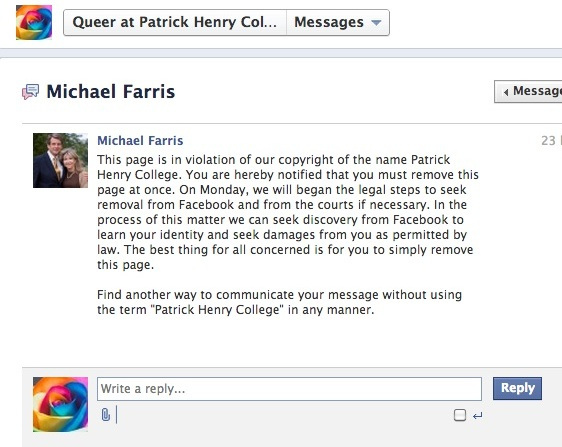
Over the first weekend in December, Michael Farris, the college’s chancellor, used his own Facebook page to contact Queer PHC and threaten them with a lawsuit:

Photo from Queer PHC.

Text is,

This page is in violation of our copyright of the name Patrick Henry College. You are hereby notified that you must remove this page at once. On Monday we will began [sic] the legal steps to seek removal from Facebook and from the courts if necessary. In this process of this matter we can seek discovery from Facebook to learn your identity and seek damages from you as permitted by law. The best thing for all concerned is for you to simply remove this page.

Find another way to communicate your message without using the term ‘Patrick Henry College’ in any manner.”

The problems with what Farris said and did are astounding. Not only is this a completely nonsensical interpretation of copyright law, not only is it slightly outrageous that Farris would pretty much threaten to “out” the individuals behind the group, but Farris used a personal Facebook page to communicate a legal threat on behalf of an entire college. Did he consult with the college’s board before making a legal threat on behalf of the college? Did they approve of the Facebook message? (Were they even aware of it beforehand?) These are important questions, especially considering what happened next.

What happened next was the Streisand effect. So incomprehensible was Farris’ strategy of internet bullying and censorship based on false legal issues that his threat suddenly exploded — Gangnam style — across the Internet.

On December 3, New York Magazine immediately scooped the story. Then the local newspaper. Then a flurry of bloggers, including Libby Anne at Patheos. Then Inside Higher Ed. Then the Chronicle of Higher Education. Even the New York Times picked it up.

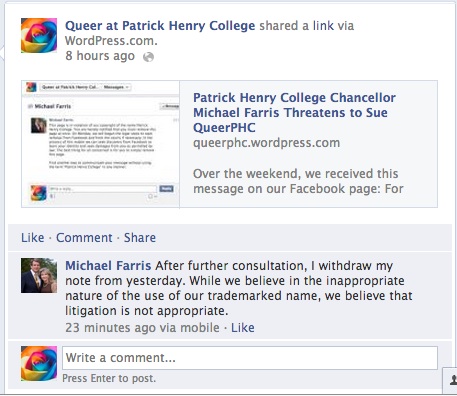
Of course, as soon as the controversy started (and probably once the PHC board realized what a bizarre and inappropriate action Farris had undertaken), Farris recanted — this time through a public comment on Queer PHC’s status:

Photo from Queer PHC.

But it was too late. The PR damage had begun.

When I heard about Farris threatening a perfectly legal Facebook group with an unfounded, frivolous lawsuit, I was floored. What better way to damage the credibility and reputation of not only PHC, but the homeschooling movement, by using abusive techniques like threatening fellow professed Christians with erroneous legal action? Not only fellow professed Christians, but your own former students?

But something about what Farris did to Queer PHC didn’t feel surprising. In fact, it felt familiar.

I couldn’t quite put my finger on it. But I was having a sense of deja vu.

Eventually, it struck me. And I went searching through my vast archive of saved emails from my old Hotmail account. And I found it.

In the early 2000s, when all of us homeschool speech and debate alumni were either still in high school or just beginning college, we socialized on Xanga. Xanga is to social media what Grandmaster Flash is to rap: really, really old school. Created in 1999, Xanga was around before Facebook, even pre-dating when most of us were on Myspace. Xanga was kind of like an public online diary: you could make posts, like other peoples’ posts, and subscribe to other people to stay connected. And that was about it.

(And yes, if you’re morbidly curious, my Xanga is still up. So feel free to search my teenage angst and amateur attempts at poetry, philosophy, theology, and public diary-writing for evidence you can use against me in the future.)

I created my Xanga profile on March 18, 2004. Most of my close friends from NCFCA and CFC had Xanga accounts as well. As this was really the beginning of social media, there weren’t really any parents using Xanga. It was primarily a teenage activity.

After a few months, two separate individuals created parody Michael Farris accounts. One was created on May 28, 2004. The other was created on July 26, 2004. (As you can see from these links, the accounts have since been scrubbed clean.) I don’t really remember much from the later account that was created, but I remember the first one because a friend of mine made it. It was clearly marked as a parody account, did not attempt to impersonate Farris to deceive anyone, and wasn’t even “offensive.” While a lot of us debaters were “punks” in one sense or another, we were still conservative Christian homeschoolers. So my friend’s parody account of Michael Farris did not involve things like dick jokes. I remember Fake Farris’s posts being along the lines of “I AM MICHAEL FARRIS AND OMG HOMESCHOOLING WILL SAVE THE WORLD!!!”

You know, immature attempts at ironic comedy that failed miserably. But again, nothing that even came close to slander. Nor identity theft. As it clearly stated it was a parody account, it didn’t even violate Xanga’s technical terms of use.

In 2004, on Xanga, you could “subscribe” to other peoples’ accounts. This would be the equivalent of “liking” or “following” a Facebook page today. Since I was one of the only people that used my real name on Xanga, and I was subscribed to the michael_farris parody account, I was the only person that Farris could recognize to contact about the account.

Oh yes, he contacted me about the parody account! Perhaps I just got ahead of myself. In 2004, Michael Farris — President of Patrick Henry College — was apparently monitoring what high school homeschool debaters were doing on a social media site. And as soon as he saw a parody account of himself, he went into militant mode.

On Wednesday, July 28, 2004, nearly a decade before he employed erroneous legal threats against Queer PHC, Michael Farris emailed me. In another way that this parallels the QueerPHC debacle, Farris contacted me with his official “PHC Office of the President” email address. The following is a screenshot of what he said, along with the text:

Screen Shot 2013-06-21 at 1.50.00 AM

Text is,

From: “PHC Office of the President” <president@phc.edu>

To: <suavedrummerboy@hotmail.com>

Subject: Ryan is this you?

Date: Wed, 28 Jul 2004 17:17:34 -0400

Ryan,

This is Mike Farris–the real one from Patrick Henry College.

I see you as a subscriber to a xanga website named Michael_Farris. Your posts there seem to indicate that you know who this is who is running this.

I just went through a difficult time shutting down another xanga site called “michaelfarris”.

I am prepared to take civil and criminal legal action against this person. Identity theft is a crime. It is also subject to civil action (if for no other reason) than it violates Xanga’s terms of use. I want your acquaintance to save himself a lot of legal grief.

Here’s what he needs to do. Delete absolutely everything from the site. Then, send me the password to the site so that I can take control of it so that neither he nor anyone else can ever steal my identity in this manner again. If he does this I absolutely promise I will take no action of any kind against him. If he does not do so (and do so promptly) I will go after him with vigor.

It may seem funny to some, but it is not funny in the least to me. I will turn this over to the FBI if I have to. But seems it seems pretty obvious that this person is or was an NCFCA debater I wanted to try to quietly end the problem without the need for drastic measures.

Can you help?

Mike Farris

Yes, almost a decade before Michael Farris tried to bully and threaten Queer PHC with a frivolous lawsuit because he didn’t like what they were doing, Farris also threatened a Christian homeschool kid with civil and criminal action — even going so far as to invoke the FBI. As if the FBI would’ve given a @#$% about some kid’s Xanga account in 2004. But we were young. We had no idea. I was terrified. I immediately told my friend. He was terrified as well. What Michael Farris hoped to accomplish — using inaccurate legal concepts to coerce a highschooler into turning over the account information to a perfectly legal parody account — was successful.

A decade later, Farris apparently still uses the same tactics.

The funny thing is, this email I received would’ve likely slipped away into oblivion, covered by the dust of my long-forgotten memories. But in the same way that Queer PHC’s existence occurred to me because of Farris’ threat against the group, my remembrance of the email was likewise resurrected. To some, the very fact that I am bringing it into the open might seem petty and vindictive. But I do not reveal it for those purposes.

I am publicizing this email because of the trend I have repeatedly seen from the leaders of the Christian homeschooling movement. I am remembering the censorship employed by NCFCA leaders when forensics alumni, coaches, and students attempted to protest BJU’s history of institutionalized racism. I am remembering a personal censorship, which I will talk about next week during our Resolved: series. I am remembering how Farris went after Queer PHC. I am remembering how HSLDA chose to block former homeschool students from its Facebook page for speaking up about abuse during our #HSLDAMustAct campaign.

What I experienced a decade ago, what Queer PHC experienced last year — these are not isolated incidents. They are symptoms of a problem: the problem of how this movement chooses to interact with its whistleblowers. It has groomed us to “take back the culture.” Yet when we try to do so, the movement suddenly realizes “the culture” we want to take back is not the Evil Candyland of Liberalism, but our very own home — homeschooling itself.

If you are not toeing the line, if you question the movement’s assumptions, if you even dare to make parody accounts — the movement wants to shut you down and silence you. And Michael Farris led the way, is leading the way, by the choices he made and continues to make.

Considering Farris’ railings against Obama’s “tyranny” as of late, I cannot help but wonder: how exactly does bullying and censorship of young people demonstrate the ideals of freedom?

Life With A Gay Husband: Rachel’s Story

Life With A Gay Husband: Rachel’s Story

"I realized there was no way to fix this. He couldn't be who he was with me, and it wasn't fair to either of us to stay together."
“I realized there was no way to fix this. He couldn’t be who he was with me, and it wasn’t fair to either of us to stay together.”

I grew up as the oldest of ten children. My parents were a part of ATI and the Quiverfull movement. My father was very controlling and my mother was neglectful and withdrew herself. We had to ask my father to go anywhere. He would say to clean something or weed the garden first and then he would say no many times.

I was the “second mom” the one who listened to what my dad said and took care of the house, the other kids, stayed home as a highschooler to cook dinner while the younger kids got to play sports. I had a really good guy friend who was the oldest of ten children himself and also played the violin. We used to write to each other all the time until the letters just stopped. This guy, Jacob, would give me butterflies and make my hands sweaty and I would dream of being with him. My mom came to me and said that we were the oldest kids, so a relationship would just not work. I was confused what she meant. But, I continued to “wait” for him.

Then, at the age of 19, I went to EXCEL, which I paid for by babysitting. There, I sought God each day and somehow ended up with the exact opposite beliefs as I was taught. There, I cut my long hair, stopped wearing skirts all the time, stopped arguing with everyone, decided I needed to go to college to become a nurse and I decided I was done with waiting for Jacob. I came home and signed up to start classes. I also looked for a job, which I got in a deli.

My parents were supportive until I actually started classes and then it was, “Rachel, come home and watch the kids,” and, “Rachel, come and take the kids to their games.”  I, being a girl who did give everything to god and believing I had to obey my dad, would, but this jeopardized my grades. Here I am, a girl who has no understanding of any of my classes (all I knew how to do was read really well and basic math; I didn’t even know how to write a paper), looks very strange in mostly skirts, and thinking about sex all the time.

Then Ben entered my life.

A friend of mine told me of a homeschool debate site. I decided to join and decided to have a “gender neutral” name of “His child.” There was a guy there who wanted someone to do a bible study with him. I knew instantly that he was suicidal and I had to do it. So, I led a bible study and he eventually started asking me questions about myself.

We talked for an entire year before he decided to come to WA state to work at a camp and meet me. His parents tried to prevent him, since they ran a camp themselves, but then they found out the reason was there was a girl there and they excitedly let him go. He got me a job there as a store manager. I worked it out with my deli manager so that I could do it for the summer, but my father put his foot down and refused to let me do it. I had told him about Ben several months before which made him pretty upset. He unplugged the internet many times so I couldn’t talk to him.

I obeyed my father and did not go to camp. I picked him up at the airport with my parents and a very talkative me. But he was lost for words. The poor guy was so nervous and just grunted all the time. My father and I dropped him off at camp and my dad said, “Oh, you should exchange numbers.”  We hadn’t even talked to each other on the phone at this point. We started to have phone calls during which I talked a lot and he said nothing.

I saw him again during that summer when he had a weekend break. He played with my siblings and this is when I knew that I would marry him. He had already told me I was the girl for him before I met him. I thought he was smoking hot and very excited that a guy this attractive would be interested in me. I was sad to see him go home on the final meeting when we dropped him off at the airport.

My father, realizing that I liked this guy, put a lot of pressure on me to get him to ask permission to court me. So, I did and Ben called up my dad and asked his permission to court. I got in front of our church and announced with my father that I was courting, which in my group of people meant we were getting married. We continued talking on the phone (which was awkward for us cause he barely talked) and mostly talking online.

Six months later, he flew to see me again. We were ready to hold hands and cuddle which freaked out my parents. My father gave him 50 questions to answer by hand and said we could not talk until it was finished. I was supposed to go and work at his family’s camp as a cook for that summer. This was his reaction to that. Instead, I threw myself into working 80 hours a week. Eventually, he finished the questions over that summer. I decided I should do nursing down in Mississippi because I could take a test and get into the program. (I struggled a lot with school because my father was constantly trying to get me to come home and babysit my siblings or take them to practice and I was balancing working full time and taking classes for which I had zero knowledge, so my grades weren’t that good). Extra bonus was that I was two hours away from him.

Our plan was that I would stay there six months and we would get married and I would go to nursing school on the same campus as his seminary. We spent a few hours together in person every other weekend or so.

Finally, it came to the wedding.

Our first kiss was at the wedding alter. Bad idea… I had no idea how awkward that would be and how it just felt…wrong, like it was meant to be shared in private. Then of course, to go further, my husband was incredibly scared and nervous. I thought the bride was supposed to be the nervous one!

It puzzled me why he seemed never to want to have sex. I thought this would be a phase, but it wasn’t. This went on for years — in fact, our entire marriage.

I had always heard that men liked a woman’s body, that it turned them on. I tried that.

It didn’t work.

We talked about this and both came to the conclusion that it was cause he was a lifeguard for years and was just used to seeing almost naked bodies. He always seemed depressed about everything. He would withdraw and not talk to me or even seem to want to be around me. This would frustrate me but I was busy with work and school. I just gave him space and hoped he would show interest in me. I worked hard to try to please him and to try to motivate him. But, he always seemed unhappy, no matter what we tried.

I put my energy in trying to become pregnant. (Believe me, that took a lot of work!). We had our child and I — doing what every other mother I knew did — stayed home with him. Our problems became stronger since now I had nothing to distract me, no school or work. We were trying to become missionaries. He got ordained and we were in the application process. I was highly involved at our church.

He seemed to withdraw yet again, like he didn’t want to do it.

I had been talking to my best friend who had just come out to me. She described how she felt — in a marriage with a man — being gay herself. I asked a lot of questions and realized she sounded exactly like my husband! I approached him and asked him if he was attracted to men. He said he was but tried not to think about it.

Everything made sense!

He was repressing who he was, which was causing the depression and the withdrawing. This is why nothing seemed to work or motivate him. We continued on, wondering what we should do next. He had already been having issues with god for years but also tried to ignore that as well. I began to question the bible as well. If it is wrong about homosexuality, what else is wrong with it?

I realized it was incredibly cruel to expect a homosexual person to either be single or to be in a relationship with someone of the opposite sex. I know what that is like. This led to a spiraling amount of questions which I could not find answers to. I guess this was important to me being able to leave the marriage — and then divorce.

A couple months later, I realized there was no way to fix this. He couldn’t be who he was with me, and it wasn’t fair to either of us to stay together. So, the next six months, we made plans to separate and help each other be financially stable.

We are still friends, share custody of our son and live about a mile and a half apart.

Resolved: That We Should Talk about HSLDA Debate, NCFCA, STOA, and CFC/ICC, Part One

Resolved: That We Should Talk about HSLDA Debate, NCFCA, STOA, and CFC/ICC, Part One

By Nicholas Ducote, HA Community Coordinator

I was introduced to the world of speech and debate by Communicators for Christ in 2003. From that moment, I was obsessed with speech and debate. For four years, I competed in tournaments across the country, even interning and touring with CFC.

For me, as a child raised in a fundamentalist homeschooling cult, the Advanced Training Institute (ATI), speech and debate was a welcome diversion.  It emphasized critical thinking, research, and discussion about issues.  All of these concepts were relatively foreign to me, despite my inclination to argue at an early age.  Debate gave me the tools to deconstruct my fundamentalist worldview.  Most of my highschool “network” consists of students I met through NCFCA or CFC.  Some of my closest friends are the other CFC interns I toured with.

So everyone is clear, CFC was a non-profit ministry that held conferences around the U.S. teaching public speaking and debate.  When it began, it acted as a sort of feeder for NCFCA, but has since evolved its own purpose (and changed its name to the Institute of Cultural Communicators).  NCFCA is strictly a competitive forensics league, only open to homeschooled students, that sanctions local qualifying tournaments for an annual national tournament.  While NCFCA and CFC are not the same organization, in the 2000s there was much crossover in people and ideas.

While my experience was liberating and empowering, I was surprised to hear many of my female peers from NCFCA/CFC complaining about the sexism they experienced first-hand in these environments.  The patriarchal attitudes also lead to discrimination against any males that did not conform to the dominant ideal of “Godly masculinity.”  The male youths were given leaderships roles in worship (before the tournaments), while women sang or played an instrument (usually piano).  I can only imagine the torment of being homosexual in such an environment.  I know many of my former NCFCA friends now openly identify as homosexual and they have dealt with other NCFCA friends saying they should be stoned to death.

As a high school student, I remember noticing that everyone seemed preoccupied with the way women dressed and looked, but as an ATI student this was nothing new.  ATI discouraged women from wearing pants and a strict dress code was enforced at all the events.  I remember some of my female friends complaining about the strict enforcement of dress codes at events like formals and awards ceremonies, but it seemed normal to me at the time.

As I became more aware of my own patriarchal inclinations in college and became more of a feminist, I remember thinking “wow, if all these ideas about gender messed me up, I bet they really did a number on my female friends.”  One moment that stood out from the rest was a regional banquet I attended after touring with CFC (during a gap year before college).  The regional coordinator, Jan Smith, was literally standing at the entrance to the event passing judgment on each woman’s modesty.  Always the provocateur, I decided to enter the banquet with my arms locked with another guy’s.  As the banquet had a nautical theme, Mrs. Smith informed me that there were “no gays allowed aboard this ship!” and we were told to stop.

My conversations in the last few months have identified some troubling themes from our collective experience in the NCFCA. (Caveat: I am six years removed from the league, but I’m sure some of these attitudes are still prevalent in some regions.)  It seems that, as a whole, men were given a sense of entitlement and women were held to an impossible standard of “Godly modesty” and submission.  The arbiter of all competitive rounds in the NCFCA is the judge (or judges), who are trained and informed by the NCFCA prior to their judging.  A mix of community volunteers, competitors’ parents, and alumni judge the events.  Often, sexist ideas about gender influenced a judge’s decision and they commented on ballots about girls’ appearance of modesty.  These sort of critiques of personal hygiene and “modesty” were encouraged usually before every tournament, if not every competition day, by tournament representatives.

All of these misogynistic themes are underscored by the fact that, in reality, women ran the league, coordinated the tournaments, and did much of the coaching of speeches and debate clubs.  In my experience in the Deep South, women would speak and lead public assemblies, but a man would always pray.  There was a certain sense of women in leadership having to defer ultimate responsibility and authority to a man, even if she was more qualified and informed.

Ultimately, the standards of modesty promoted a rape culture (which is not to say that they promoted rape), where women would be “at fault” for dressing immodestly if they turned a man on.  The purity culture’s inversion of guilt can be detrimental to some young women.  Fundamentally, a binary is constructed where the “good girls” wear modest clothes, don’t lead boys on, and get happily married at a young age, whereas girls who dress in pant suits or develop friendships with male competitors are “slutty” and will not be “desirable for marriage.”  In a culture that extols “godly motherhood” as the life purpose of females, not being desirable for marriage is an affront to a person’s intrinsic worth.  Recently, Elizabeth Smart discussed how the purity culture influenced her negatively to feel worthless like “an old piece of gum” during her captivity.

Now that I’ve established that this problem is somewhat systemic and promoted in a top-down manner, I’ll provide some examples of this sexism in action (these examples are from eleven different women).  In debate rounds, young women were often chastised (or given a loss) if they took an “aggressive tone” with male debaters.  If young women wore pant suits, they would be criticized for looking slutty, or even lose the round because they wore pants.  Female debaters were expected to prove their points in a submissive, womanly way, while males were given more leniency with tone.  In many cases, a young woman’s confidence in “looking good” would be smashed by a snide criticism of her modesty.  One young woman who struggled with an eating disorder and body dysmorphia would have comments about her “immodest appearance.”  Young women with natural curves faced the most potential for trouble and they were ordered to hide their body’s shape.

Sexual contact at tournaments (usually kissing) was strictly forbidden — and those restrictions were enforced. On one occasion, a young woman kissed a boy at a tournament and her parents told their host family.  As a result, the host mother approached the young woman and told her that she did not “feel safe” allowing her son to be around her slutty behavior.  Some young women were barred by their fathers from even participating in competitive debate, instead being forced to participate only in speech.  To be sure, any insecurities a young woman faced about her appearance would be challenged and highlighted at a speech and debate tournament.  Despite often spending hours picking out “appropriate” attire, they still faced criticism.

*****

I sent the above to a close friend from NCFCA to have it proofread.  She responded with some reflections about her own time in NCFCA — my essay stirred some memories.  I asked for her permission to post her thoughts alongside my essay because I wanted a female voice on this topic and her response was very sincere, visceral, and empathetic. Read Bethany’s post here.

****

Contribute your story or thoughts to homeschool speech and debate week!

Is this a healthy or unhealthy environment for young people to grow up in? What are your stories and experiences with the homeschool speech and debate world? Were they positive, negative, or a mixture? These organizations were a vital part of many of our experiences with homeschooling in high school and no subject or institution is off limits here.

As always, you can contribute anonymously or publicly.

If you are interested in participating in this series, please email us at homeschoolersanonymous@gmail.com. The tentative deadline for submissions will be Saturday, June 29.