Ready for Real Life: Part Four, Ready to Lead Culture

Screen Shot 2013-11-02 at 1.15.43 AM

Ready for Real Life: Part Four, Ready to Lead Culture

HA note: This series is reprinted with permission from Ahab’s blog, Republic of Gilead. Part Four of this series was originally published on October 14, 2013.

*****

Also in this series: Part One, Botkins Launch Webinar | Part Two, Ready for What? | Part Three, Are Your Children Ready? | Part Four, Ready to Lead Culture | Part Five, Science and Medicine | Part Six, History and Law | Part Seven, Vocations | Part Eight, Q&A Session | Part Nine, Concluding Thoughts

*****

In this part of their “Ready for Real Life” webinar, the Botkin family discusses the role of the arts in homeschooling, contending that parents must train their children to appreciate Christian-friendly art and music instead of worldly arts. The webinar amused me in its disdain for Bratz dolls, jazz, ragtime, Picasso, the Frankfurt School, and Jimminy Cricket, but disturbed me with its advice on constraining children’s tastes.

The Botkins’ approach to the arts struck me as a constricted and passionless, focused more on supposed Biblical principles than creativity, expression, and expansion.

Geoffrey Botkin began the webinar with a prayer asking for God’s wisdom, reminding his audience that they were living in “such a dark and crooked and confused and perverted and twisted generation”. As with previous webinars, Botkin depicted the modern world as a depraved place that Christians must resist.

A listener submitted a question regarding how much school work to do with children versus how much time to spend on skill-building for real life. Geoffrey Botkin replied that as young Christians, he and Victoria quickly realized that homeschooling parents cannot make a distinction between academic and real-world studies. If academic materials do not prepare children for the real world, parents should discard it, he said. The Biblical paradigm teaches that all of life is training for living in the world, he claimed.

Victoria Botkin chimed in, encouraging homeschool mothers to be flexible and take advantage of opportunities for their children to learn. Anything a mother does with children can be education, she claimed, as long as a parent is talking with them about it. She explained that real life offered her children learning opportunities that were sometimes better than the academic tasks she’d planned for the day. For example, one day she and the children found an injured lamb that fell off of a truck, and they spent the day butchering the lamb.

Geoffrey Botkin spoke at length about culture from a fundamentalist Christian perspective.

He defined culture as the “secondary environment” superimposed on nature by “man’s creative effort”. Another definition of culture he offered was activity by man (the image-bearer of God) that fulfilled the mandate to exercise dominion over the earth. Dominion involved bringing order to the world as God designed it, Geoffrey Botkin explained, adding that human activity must reflect a relationship with the divine. “Man’s essential being is expressive of his relationship to God, or it will be expressive of his relationship to rival gods like Satan,” he said at the 11:38 mark.

The purpose of humanity is to teach all the nations and obey everything Jesus commanded, thereby bringing order to the world and glory to God. He quoted Isaiah 9:7 (“Of the greatness of his government and peace there will be no end”), citing it as the essence for teaching culture to children.

At the 13:24 mark, he envisioned a goal in which God’s government and peace were everywhere, with no “enemies” to get in the way.

“If we’re doing our duty to obey Jesus Christ because we love him, and we’re seeing the increase of his government, we’re extending the reign of the king, then we are enculturating the world in a way that it need to be enculturated. Your children need to know how to do this. How do we increase his government and peace so that there’s no end of it, no interruption to it, no enemies who get in the way?”

Christians are called to impose order through culture, even while living in a “disorderly generation”, and even to the most “disrupted, degenerate places and corners on planet earth”. Children must develop zeal for their father’s business and for Jesus Christ, he insisted

All culture is religiously oriented, Geoffrey Botkin claimed. We can “dress” culture according to what God wishes, or conform to a world which “disintegrates” culture. Christians must “dress” culture with meaning, he stressed, rather than inject culture with meaninglessness or madness as many poets, musicians, and filmmakers do.

“Culture is being formed by people who are either on God’s side or working against his will,” he said at the 17:54 mark, dividing cultural contributors into godly and ungodly. Geoffrey Botkin described his son Isaac’s visit to Egypt, where he found “an irreligious people worshipping a false religion, and they’re tearing the order of the world down by what they do.”

Egypt’s Islamic religion shaped Cairo’s culture, he claimed, including its women’s dress and its dirty streets (!).

Culture is not neutral, he emphasized, nor is culture the mere “flavor” of a place or time. Words such as “diversity” and “multiculturalism” frame culture as different flavors of living, ignoring the role of culture in exercising godly dominion. He contrasted the art of Johannes Vermeer with that of Picasso, a “truly a degenerate man, an impure man” who cursed his father, ran away, and lived in a brothel which “deranged his mind”, Botkin insisted.

Victoria Botkin stressed the importance of talking to children about what they see and hear in the world. For example, Victoria sees a little girl feeling drawn to a Bratz doll in Wal-Mart as a “red flag”. Something in a child’s heart causes them to gravitate to the messages that a Bratz doll communicates, she explained, and parents must redirect their children’s hearts. Victoria added that the Botkin household had a constant running commentary on the outside world, and if one of her children gravitated toward the “wrong” parts of culture, the parents had a duty to redirect their tastes.

Geoffrey Botkin argued that a battleground exists in every discipline, including science. In every discipline contains people who worship and obey God, alongside others who present new, unbiblical theories. At the 30:22 mark, he elaborated on such battlegrounds, lamenting that Christians lost the battles for control of political science and government. 

“One of the great dramas that our children have really loved talking about is when we as parents … say here is a subject we’re going to study, biology or astronomy or chemistry. What is the battleground in this science and in this discipline? What is the battleground in the queen of the sciences, theology? What is the battleground on political science? Every single one of these disciplines, there has always been a raging battle, which is called the antithesis … It’s a battleground. There are people who will worship and serve the creator, and try to organize things and study things and proclaim things that are correct and true, and there will be others who say, ‘no, we have a new theory on biology, the origin of man. We have a new theory the way society should be run. Our political science is scientific secular statism, for example. It’s a new authoritarian organizational method that we’ve come up with and we think it’s better.’ And so, one of the greatest battles of the 20th century was in this sphere of political science and government and governance, and Christians truly lost this culture battle in America, in the 20th century.”

Geoffrey Botkin reserved special ire for Wilhelm Reich and the Frankfurt School, depicting them as ungodly forces that wanted to win battlegrounds in academia.

“They worked very hard, these Frankfurt school revolutionaries masquerading as academic to insert what they called … a complete social revolution to overthrow Christianity with decadence and cultural disintegration,” he said at the 34:21 mark, caricaturing Frankfurt School thinkers as anti-Christian libertines. Botkin preached that an overthrow of Christianity would culminate in tyranny. “”It’s such a simple formula. If you can eliminate the knowledge of God, then you have a perfect opportunity for tyrants of totally centralized regulatory government to rule,” he insisted at the 33:38 mark.

His depiction of Wilhelm Reich was equally hysterical. He accused Reich of wanting to rid the world of Christianity and replace it with behavioral control via mass psychology. At the 35:20 mark, he claimed that Reich wanted to reduce society to permanent adolescence by promoting “polymorphous perversity”.

“That’s what your children have been born into, and this polymorphous perversity means you just do what you want when you want to. You justify it any way you want, any kind of misbehavior but especially sexual misbehavior. You justify and rationalize according to the tools this modern culture is giving to young people.”

On the topic of music, Geoffrey Botkin caricatured early American music as devout, in contrast to modern music that he decried as chaotic and debauched.

At the 35:51 mark, he pined for an earlier era characterized by songs of God and nation-building

“For three-hundred years, Americans wrote music about nation-building, bringing order to a culture, building culture the way it should be built, honoring the Lord’s design, his architecture for it. The very first music sung in this country were Psalms … We fought a war over the freedom that we wanted to have so that we could continue building the foundations around proper Biblical culture, and we sang about them. We built music around it. We had lyrics around the Christian foundations of culture, both black and white. For four-hundred years, Americans have expressed themselves through music, and until the 20th century, the lyrics and instrumentation was very orderly and very Biblical. And so, you need to teach your children that music is theology, both externalized and internalized, because music is one of the most theologically influential arts there are.”

Music allegedly declined in the 20th century, Botkin claimed, when American culture succumbed to an “antithetical urge” that drew its music away from nation-building themes. As young people had more free time and disposable income to buy sheet music and records, music houses experimented with “uninhibited immaturity” in their craft.

Geoffrey Botkin held 20th century music styles such as jazz and ragtime in utter contempt.

He dismissed jazz and ragtime as “discordant, unplanned collisions of harmony”, calling them “sloppy” forms of “covert protest” against older European music traditions. Jazz in particular was “infantile”, he argued, as it allegedly celebrated moral dissipation and misbehavior.

Ragtime and jazz both emerged from the African American community, I recalled. Is Botkin making a veiled race commentary here?

Such music was part of a larger “dissipating culture”, Geoffrey Botkin maintained, arguing that Hollywood too was contributing to a changing moral tone in America. For instance, he cited the song “When You Wish Upon a Star” in the 1940 animated film Pinocchio as an example of the “superstition theology” taking over America.

Really? Duke Ellington and Jimminy Cricket contributed to America’s decline? I thought.

Victoria Botkin told listeners that she and her children listened to classical music at home, listing “Peter and the Wolf”, “The Nutcracker”, and “The 1912 Overture” as examples of pieces that her children enjoyed. Victoria trained her children to appreciate music that was good and “orderly”, she explained, discouraging any taste in “bad and ugly, chaotic, discordant music”.

This broke my heart.

By restricting her children’s exposure to different musical styles, Victoria Botkin denied them so many tastes of innovation and beauty.

I couldn’t imagine my youth without heavy metal, or summer vacation trips with my father without classic rock playing in the car. Not only were the Botkin children fed revisionist history and a rigid, fundamentalist worldview, but they weren’t even allowed to explore their own musical preferences. How can someone blossom as an emotionally mature person — fully alive, fully self-aware, fully engaged with the world around them — if they aren’t even allowed to explore their own tastes, to savor many kinds of paintings, photos, and songs?

Benjamin Botkin, son of Geoffrey and Victoria Botkin, argued that the world should come to Christians to learn about music, not the other way around. The assumption, it seemed, was that Christian values and aesthetics would create superior music. The idea that musical talent takes many forms, and that people of all belief systems can produce quality music, was not considered.

Geoffrey Botkin used the music discussion to expound on children’s gifts, arguing that gifts can become obstacles to serving God.

He argued that gifts are entwined with service to God, and that some gifts have to be put aside sometimes so as to best serve God. Botkin cited his daughter-in-law Audrey as an example, telling the audience that Audrey had been a gifted cellist, but understood that marrying Benjamin Botkin was far more important that playing cello.

How many other women in your movement have been forced to put aside gifts and dreams? How many were pressured into nigh-mandatory marriage and motherhood while their gifts atrophied? I thought.

At the 49:07 mark, Geoffrey Botkin warned against children using undesirable gifts, or allowing gifts to instill too much pride. His comments about cheerleading were very revealing.

“The two greatest spiritual battles that you and your children will face between the ages of 10 and 20 are related to parental authority and how your children respond to that, and the emerging gifts. And this is one of the widest gateways to sin in our generation, because of the gifts they think they have. And you know, little girl thinks she’s totally, absolutely gifted in the ability to be a cheerleader. That may not be a gift that qualifies her to conform to the ugly conventions of our time. It may not be a God-given gift. It may just be a lustful desire on her part to be seen and noticed as a performer. And so the ability to mimic fools and show off foolishness is not a gift, it’s a vice.”

Botkin transitioned from music to art, complaining that modern art is supposedly atrocious.

At the 51:21 mark, he divided art into Christian and anti-Christian categories, arguing that bad art instills vices.

“Your children are so completely surrounded by really bad art, and the ugly art in our generation, like Picasso, like the art they see on billboards, the art they see surrounding them all over the place, on taxi cabs, on the sides of buses, it inspires men to rebellion. Selfish art inspires men to childishness. Undisciplined art destroys standards of discipline. Meaninglessness, meaningless art robs men of hope and vision … Art will be either Christian or anti-Christian.”

The Botkin daughters discussed artistic standards at length, critiquing artworks. Anna Sophia and Geoffrey Botkin discussed different pictures, criticizing pictures that struck them as unrealistic or stylized.

At the 1:10:43 mark, Anna Sophia Botkin scoffed at the idea of art as a vehicle for emotional expression or spontaneity, calling works that draw upon these forces “sloppy” and “mediocre”. 

“The art world and the music world are both infected with the idea that the highest artistic expression is one that just comes from inside us, from our hearts, from our emotional impulses. They think it’s better if it’s more spontaneous, and less planned and worked out … Christian artists have taken this to a worse extreme by thinking that those emotional impulses are from the Holy Spirit, which makes their art inspired, and above rules and above criticism. And I believe this is why there is so much poor art and music and film-making coming out of the Christian community, and I believe that we take the Lord’s name in vain when we say that he or that his holy spirit is responsible for our sloppy, mediocre efforts.”

Elizabeth Botkin elaborated on her childhood, during which their parents frowned on “chaotic” forms of creative expression. At the 1:13:18 mark, she discussed the “discipline” and “good attitude toward reality” that her parents instilled in the Botkin children. 

“Mom and Dad knew that whether we became artists or not, all of our lives, we’d be building a culture of art around us. We’d eventually be creating art anywhere we went, which is actually exactly what’s happened … They wanted to be really, really careful that they were guiding us toward more disciplined efforts and better taste in all of our creative endeavors, from the little people we made out of Play-Do, to the pictures we drew. And so, if we did something in a sloppy way or with a bad attitude, they wouldn’t say ‘Oh great job! You are so talented!’ Or if we seemed attracted to things that were ugly …  or things that were smarmy or chaotic or had a bad view of reality, they wouldn’t say, ‘Oh, you’re just so unique, such a free spirit!’ They would keep trying to disciple our attitude back toward God, give us a Good attitude toward God’s created order, a good attitude toward reality, a good understanding of reality.”

Isaac Botkin joined the conversation from offsite, discussing photography as an art form. He used the photography discussion to preach against hobbies.

He warned that any activity performed purely for self-expression or self-gratification is selfish. 

At the 1:17:24 mark, he had this to say.

“At the moment, photography is a very easy hobby to get into because cameras are so cheap. Pretty much every phone has a camera on it now. And so, photography is an easy way to very selfishly pursue self expression … This is a good opportunity to talk about the concept of hobbies, and the idea that Christians really shouldn’t have hobbies. And I’m not saying that they shouldn’t do work for free, but the idea of having a hobby that you do purely for self-gratification or for self-expression is not something that a Christian should be doing. Christians should be learning skills and desiring to express their creator.”

Isaac Botkin’s comments floored me. Is the Christian Patriarchy Movement so resistant to individuality that purely personal hobbies are considered sinful? Enjoyment and self-expression are necessary parts of life, not sins, and denying oneself these healthy outlets is a recipe for repression.

In typical fundamentalist fashion, the Botkins transformed natural human impulses into sins.

*****

This part of the “Ready for Real Life” series contained many of the same themes as the previous two episodes, such as distrust of the outside world, binary thinking, and control over what information children absorb. However, this part also contained several themes related to the arts.

  • Art as servitude to God. In the Botkins’ eyes, artistic expression should always serve God. Art for self-expression, emotional outpouring, or pleasure was frowned upon, as was any aesthetic that deviated from Botkin-approved principles.
  • Antipathy toward anything deemed “ugly” or “chaotic. Art that deviated from the Botkins’ aesthetics was rejected as “ugly”, “chaotic”, or “sloppy”. First, such ad hominem attacks ignore the merits of art and music that the Botkins happen to dislike. In essence, the Botkins failed to recognize that art need not be realistic and perfect to express truths about the human condition. Second, real life contains things that are unpleasant and chaotic, and a refusal to countenance these things in art is a refusal to acknowledge all of reality.
  • Parents molding children’s artistic preferences. The Botkins repeatedly told listeners about how Geoffrey and Victoria trained their children to like certain paintings, music, and film. The Botkin children were discouraged from showing interest in the “wrong” kinds of toys, music, and art. While there’s nothing wrong with parents teaching their children about high culture, children also have the right to explore their world and develop their own preferences. Many art forms capture beauty and convey truths about life, and to deny people these art forms is to deny them new perspectives.

Stay tuned for the next part of the “Ready for Real Life” webinar series! In the meantime, I’ll be reading Alex Grey’s Transfigurations while listening to goth metal, out of spite.

*****

To be continued.
When I Recanted What I Truly Believed: Krysi Kovaka’s Thoughts

When I Recanted What I Truly Believed: Krysi Kovaka’s Thoughts

I was one of those renegades who affixed my signature (albeit electronically) to the Great BJU Protest of 2009.  The reasoning behind this protest is listed in a prior post so I won’t go into the logic of it all.  Suffice it to say, when it was announced that Nats 2009 would be held at Bob Jones University, there were quite a few dissenters; BJU is known for having a proud tradition of racism (among other things.)

When several NCFCA officials found out about the protest, there was a bit of a backlash. For me, this meant that I received an ominous email from Teresa Moon [of CFC/ICC] telling me that I should extricate myself from the protest.  My mother was also involved, and she made it very clear that I needed to remove my name from the protest if I wanted to attend the tournament.  Simply removing my name from the apology wasn’t sufficient though – Mrs. Moon emailed my mother and encouraged her to persuade me to write the following letter:

*****

Dear NCFCA board,


I’m writing to you under the most exigent of circumstances; I’m writing to you concerning my recent participation in the Facebook group protesting the location of Nationals 2009.  After much contemplation and lucubration I have come to the realization that my actions condoned discourteous, impertinent, and contemptuous behavior.  For this I would like to extend a full apology to the NCFCA board and Bob Jones University. 

In retrospect it occurs to me that my misdeeds were injurious not only to the NCFCA and Bob Jones University, but also to my reputation as a follower of Christ.  We read in Hebrews 13:17 that we are to, “Obey them that have the rule over you, and submit yourselves: for they watch for your souls, as they that must give account, that they may do it with joy, and not with grief: for that is unprofitable for you.”  This concept of respect for authority is further addressed in I Timothy 2:1-3 and Exodus 21:17. 

My conduct in no way exemplified a Christian attitude and I understand that I did a tremendous disservice to the NCFCA by participating in this Facebook group.

I take full responsibility for my delinquent actions and present myself to the NCFCA board contrite and in need of forgiveness for my transgressions towards the NCFCA board, Bob Jones University, and any other party I might have inadvertently injured with my calloused and unthinking misdeeds.  In future I hope to live up to the standards set forth in I Timothy 4:12 which reads, “Let no man despise thy youth; but be thou an example of the believers, in word, in conversation, in charity, in spirit, in faith, in purity.” 

I appreciate the opportunity to heed correction and guidance as outlined in Proverbs 15:32, “He that refuseth instruction despiseth his own soul: but he that heareth reproof getteth understanding.”

Please accept my apology for my actions.

Sincerely,

Kristen Alyse Kovaka

*****

I remember when I was told I needed to write the letter. I was furious.

I had spent years learning argumentation and how to think for myself, and when a situation occurred where I felt I needed to use those skills, I was reprimanded. I did my best to make sure my disdain and insincerity was evident in my apology, but that did little to make me less angry.  I felt stifled and controlled — and this from a community that allegedly encouraged free thinkers.

The Embarrassment of Protesting Racism: Ariel’s Thoughts

The Embarrassment of Protesting Racism: Ariel’s Thoughts

HA note: The author’s name has been changed to ensure anonymity. “Ariel” is a pseudonym.

In May of 2009, the following email was sent by Teresa Moon of CFC/ICC to myself and other current and former interns concerning the BJU protest.

*****

I received a note from BJU today that the administration is now aware of the NCFCA Facebook protest. If you have participated in the protest in ANY WAY you need to stop immediately and make every effort to delete all posts.

DO NOT post comments, concerns or even support for the location on any threads related to the National Championship. As you can imagine, it is quite an embarrassment that the Christian Homeschool League engages in such conduct.

If you believe you have already been a party to this, you should contact me right away. If I find that you are engaging in any of this communication, your internship is in jeopardy. It is that serious…

I hope that you are not connected to this in any way. If you are, you have 24 hours to remove yourself entirely from ANY communication, if you ever wish to be on a CFC or ICC platform again…

Teresa M. Moon
Institute for Cultural Communicators, Inc.

*****

As a politically active person these days, I look back and find this kind of response to be bizarre. I have signed many petitions to get better streets, protect small businesses, and stop bad policies from coming to my city. All of these were perfectly normal, expected ways of participating in the community- both my local community and my national community.

To see this response again is very disappointing. Voicing protest is an essential part of the democratic process, in preserving the integrity of an institution, and in applying critical thinking skills. To see an officially recognized non-profit organization silence protest, especially over a moral and social issue such as racism, is a great disappointment.

Engaging the World — Debate and the BJU Protest: An Interview with Joe Laughon

Note from R.L. Stollar: I had the honor and pleasure of asking NCFCA alumnus and coach Joe Laughon about his debate experiences as well as his role in organizing “The Great BJU Protest of 2009.”  We decided to present our interaction in an interview format.

HA: Talk a little bit about your experience in homeschool debate — how you got started, how long you competed, and if you did any coaching after graduating.

JL: I first got involved my freshman year. I was part of a small club solely comprised of first timers, including our coach. I competed all throughout highschool and eventually competed on junior college and four-year college level. I continued to coach my old high school team for roughly 4 years and also coached in a separate league for a year.

HA: Would you consider your experience in NCFCA to be positive, negative, or mixed? And mention a few examples of what makes you feel that way.

JL: I consider it overall to be positive. It was a huge growing experience for me. I started as a fairly awkward, very angry (my family had just split up) freshman and left someone who was miles away from where I had started. It wasn’t all debate, but debate played a huge role in it. I made friends that I am very close with to this day and it was a great outlet for me.

That being said, there were times that the experience took a turn for the negative. It was odd to see, like in any other activity, parent-coaches live vicariously through their students, even to the point of becoming borderline cutthroat, like manipulating who got what ballots. Furthermore I think there was a “squeakiest wheel gets the oil” mentality when it came to oversensitivity. Seeing people throw conniption fits over a ceremony at a Mason Lodge (Technically Shriners “Temple” but yeah), or disqualify one of my competitor’s IEs because it “promoted cannibalism” made me roll my eyes more than once. However, competitors weren’t above making it groan-worthy either, occasionally advocating for Southern slavery or saying fairly nasty things about LGBT people.

On the whole, however, it was positive.

HA: Before you started debate, you were a “conservative Christian.” Today, you are also a conservative Christian. Did debate inspire any evolution in how you would define that term and how you, as a conservative Christian, look at the world?

JL: Debate definitely changed how I view the term. It opened me up more so to other points of view beyond the very socially conservative/neoconservative “Bush republican” point of view that was so common then. By the time highschool ended I called myself a big L Libertarian. However when my debate career took me through college, my horizons really opened up. I came in contact with cogent and coherent defense of points of view from the left. Today I would call myself a moderate Republican, ideologically somewhere between libertarianism and conservatism but with a strong emphasis on pragmatism. I don’t really consider social conservatism all that important to me, though I remain pro-life.

I remain a doctrinally conservative Christian, but I am less concerned with Christian infighting over secondary doctrine than I used to be and more focused on how we present Christianity and the gospel to the rest of the world.

HA: In 2009, you and several other individuals from NCFCA started “the Great BJU Protest of 2009.” I was long graduated from NCFCA and high school — in fact, I was even graduated from my M.A. program at the time — but I heard about it almost immediately. It was a really big deal. Can you explain what the protest was and what inspired it?

JL: The BJU protest came on the heels of some major disaffection from Region 2 (CA) in 2008. We felt that we had been punished for not conforming to the Board and we felt the rug was pulled out from us in regards to Nationals.

Many of us in California, in particular coming from racially and doctrinally diverse families and clubs, felt that BJU did not represent who the NCFCA was. We saw BJU as still recovering from a racist and bigoted past, and is still intensely legalistic and fairly un-Christlike in how they present the gospel. We didn’t want the NCFCA to be associated with that name, as Christian homeschoolers get a bad enough rep as is.

However, by then the decision was made, so it transformed into overall disgust at how the Board ran things. Again the Board was secretive, rejecting transparency and had learned nothing from the ill will of 2008. Furthermore, some of us saw it as a regional coup as the last four nationals were held in the South. It began to represent everything that was wrong with the Board, but also it was a protest against racial indifference and insensitivity in the League.

HA: After your protest gained traction, and a bunch of competitors, alumni, and coaches had signed the protest petition, NCFCA regional coordinator Lisa Kays wrote an email that sent some shockwaves through the community. What did she say and how did you think about Kays’ email at the time?

JL: Her letter was fairly offensive not just because of how it proposed to deal with the protest but also how she characterized it. She functionally claimed we were all whiners, and we simply wanted attention (fairly common points). This was unfair and didn’t help dialogue.

But the worst was her policy for “dealing” with it. She used her power as a Regional Director to strip people from her region (or threaten to) of their Nationals slot and then used her position as a member of the Board to pressure other regions to do the same. I thought and think Mrs. Kay’s response to be frankly really unacceptable, immature and also another example of how bylaws that allow people to hold multiple offices can be abused.

HA: After the protest controversy happened, a whole section of the country split from NCFCA, thereby creating a second homeschool speech and debate league, STOA. Do you think how certain NCFCA leaders handled the protest was a catalyst for this forensics’ “civil war”?

JL: I absolutely think so. I think even the more timid among Region 2 coaches and parents were appalled with how the Board had responded to concerns in the past and even those who weren’t sympathetic to the protest didn’t like how the Board handled it. It wasn’t the only issue but it highlighted a lot of problems. I think a wide amount of people outside of CA clearly agreed due to the growth of Stoa at the expense of the old NCFCA.

HA: It’s been four years since the BJU protest. Looking back, are you proud of what you did or do you regret it? Also, four years after, what do you think about how Kays handled the situation?

JL: I am definitely proud of what we did. We highlighted the issues of racial indifference in the community and how the Board played a role in this. Furthermore, we highlighted major problems with how the Board and the League were set up, problems people had known about for awhile. The work that many people did — like Dr. Konrad Hack, Ryan Herche, Jon Chi Lou and others — is something to be proud of. I think Mrs. Kays’ response was unacceptable but also pretty typical response; malign, misdirect and then punish for different views. It’s too bad. I hope she looks back on the event with regret.

HA: Coming from a background of conservative Christianity, what do you think is the proper response to the sort of institutionalized racism that prevailed for so long at BJU?

JL: I think, first and foremost, the response should be found in Scripture. The Biblical worldview brooks no racism. God’s concern for all, our common ancestry, Jesus’ concern for those outside the House of Israel and the Church’s mission to all peoples should make us be abhorred at racial bigotry. While those who repent are to be forgiven, I think there is an immense difference from true repentance and simply begrudgingly saying you’re sorry and changing policy (piecemeal) when forced to by the federal government. One can forgive people, but people aren’t called to forgive an institution. If Bob Jones University was serious about purging the environment of racism on campus and its memory, they should change the name to something else and replace or phase out administrators that were around in that day.

Also what went totally ignored in the discussion of, “Is BJU still racist?” was the problem of legalism and violent anti-Catholicism. Calling the pope “a demon”, denouncing Billy Graham as an unbeliever, continuing to give an honorary doctorate to Ian Paisely, a violent, unrepentant bigot who promoted sectarian violence in Northern Ireland, are all actions that have yet to be apologized for at all. Probably because federal tax exempt status isn’t tied to it. Such a shame.

HA: Do you think participating in speech and debate shaped your perspective on responding to social ills like racism?

JL: Definitely. It opened up my eyes to experiences beyond my own and it also made me realize that racism isn’t a box that one checks, “Yes” or “No.” Unfortunately prejudice and privilege follow us all on some levels. I think it revealed to me that the biggest problem in many of our homeschooled communities (overwhelmingly white and middle-upper class) isn’t racism, like some fantasy KKK boogeyman, but rather simple racial indifference.

My experience in NCFCA, the protest, coaching in Stoa and debating at Concordia really opened me up to understanding the issue of race relations and I think I am a better person and Christian for it. Too often I think we have insensitive or insincere discussions of race because we’re afraid of being called a racist or because it may challenge our little bubbles. We need to move past it and debate can be a great vehicle to do so.

HA: One final question, prefaced by a statement: Pop culture likes to stereotype conservative Christians automatically as fundamentalists. Add homeschooling to the batter, and the cake goes from fundamentalist to crazy. Yet here you are, a conservative Christian homeschool graduate who protests racism and is unafraid of speaking up about injustices you see happening on your own side — even in conservative Christian homeschooling itself. What do you make of this stereotype and how do you think it can be defeated?

JL: I think part of it is media-perpetuated to an extent. It’s easier and it sells more (more of anything, newspapers, movies, episodes, books) to show a stereotype than it does a nuanced picture. I remember rolling my eyes at portrayals of homeschoolers and their families in sitcoms or shows (almost always crime shows for some reason), as unbalanced, cold, crazy, borderline fascists who are on their way from a cross-burning from their abortion clinic bombing planning session. I think as time goes on, more people homeschool and the demographics of homeschoolers change, I think you will see this change over time.

However, part of it is the responsibility of the community. I have met people who are fairly insensitive and dogmatic. These are the kind of people who are attracted to homeschooling because it is difficult, and thus have somewhat of a martyr complex about it. They are waiting to be insulted. The rest are issues I think are common to conservative white Christians (not that any of that is negative, it is simply descriptive) sometimes. It happens with every demographic. Free association turns into exclusive association and some borderline self-segregate themselves from others. Thus, viewpoints outside the group that may be valid and shake things up, are rarely heard. The ideological water thus can remain a little brackish. It’s pretty common outside the homeschooling community, but it doesn’t mean the homeschooling community shouldn’t take it on.

I think it can be dealt with by making an effort to join things outside church or homeschool activity. Don’t discourage friends made outside of this, friends that may belong to different denominations or may not be Christian at all. We’re not called to build up the Church by just outbreeding people (ok, that’s a joke but anyone who has said the phrase “homeschooling van” knows what I mean), we’re called to build up the Church by engaging in the world. It’s a complicated issue and sometimes it’s portrayed worse than it is, but it’s one that I think the homeschooling community is now facing.

A Brief History of Homeschool Speech and Debate

A Brief History of Homeschool Speech and Debate

By R.L. Stollar, HA Community Coordinator

******

“There is warfare. We are soldiers. We have weapons.”

~Shelley Miller, NCFCA Oregon State Representative, 2013

*****

As we embark on our Resolved: series, you will see a lot of acronyms being thrown around. I figured it would be helpful for those unfamiliar with the homeschool speech and debate world to see a brief summary of what those acronyms mean. The following history of the key organizations and individuals is important to keep in mind as a general context for reading the posts this week.

HSLDA Debate

Homeschool Legal Defense Association (HSLDA) began a homeschool debate league in 1996. Christy Shipe (then Farris), the daughter of HSLDA’s chairman and co-founder Michael Farris, started the league when she was a senior at Cedarville University. The goal of the league, according to Michael, was “to improve your child’s reasoning powers, clarity of thinking, and ability to stand for the truth of God’s word.” Whereas competitive forensics sees the skills of forensics as ends in themselves, homeschool debate sees them as means to a larger end: “to help homeschoolers address life’s issues biblically, with God’s glory, not their own, as the focus.”

The very first national tournament was held in October 1997 at Loudoun Valley High School in Purcellville, Virginia. Christy Shipe was the tournament organizer. The debate team from Cedarville, of which Shipe was a part, played a crucial role in the beginning. Deborah Haffey, Cedarville’s debate coach at the time, was influential in Shipe’s love for debate. HSLDA’s original debate teaching materials featured Haffey. And the very first homeschool debate summer camps — as far as I can remember — began at Cedarville, via the university’s Miriam Maddox Forum, led by Haffey, Jonathan Hammond, and later Jeff Motter.The final round of HSLDA’s first national tournament, by the way, took place a separate venue than the rest of the tournament. It occurred at the 1997 National Christian Home Educators Leadership Conference in front of 400 home school leaders from 44 states. It was judged by Michael Farris, Deborah Haffey, and Bob Jones University’s debate coach, Dewitt Jones.

NCFCA

After five years past, the homeschool debate league had grown significantly. HSLDA decided that the league should become a distinct entity from itself. So the National Christian Forensics and Communications Association was created in 2000, co-founded by Christy Shipe and Teresa Moon. The association’s original seven-member board of directors included: Shipe, Moon, Todd Cooper, Michael Farris, Skip Rutledge, Deborah Haffey, and Terry Stollar. NCFCA’s stated goal is “is to train students to be able to engage the culture for Christ.” From the very beginning, NCFCA had a significant amount of in-fighting, resulting in a rapid burning-through of its leaders. Todd Cooper, NCFCA’s original president from San Diego, was booted almost instantaneously. My father, Terry Stollar, became the second president, and resigned after significant disagreements with the board. The first two presidents — as well as Moon, who served as Director of Forensics — all hailed at some point from California, which is interesting considering what I will later mention about “Region 2” and its split from NCFCA. Mike Larimer took over the presidency after my father. Teresa Hudson is NCFCA’s current president.

While debate was primarily the focus when the league was under HSLDA, NCFCA branched out significantly in their more diverse inclusion of speech events. As of today, NCFCA includes two types of debate — Policy and Lincoln-Douglas — as well as a variety of speech categories — biographical narrative, oratory, persuasive, duo interpretations, humorous interpretations, apologetics, extemporaneous, impromptu, and so forth.

CFC/ICC

Crucial to the growth of both HSLDA debate and later NCFCA was Communicators for Christ (CFC). David and Teresa Moon began CFC in 1997. Teresa was also the personal debate coach of many of NCFCA’s original “legends.” In the early days, the Moons traveled around the country, from state to state in their motor home, with a team of student instructors — later termed “interns.” As CFC taught speech and debate to other homeschool parents and students, it served as a “feeder” of sorts into NCFCA.

As CFC’s popularity grew, Teresa expanded CFC’s focus from homeschoolers to Christian schools in general. She refashioned the for-profit CFC into the non-profit Institute for Cultural Communicators (ICC). Today, ICC continues its CFC tours, but also offers “a variety of programs, events and teaching materials designed to help all Christian students, from all educational backgrounds — public, private and home — [to] become ‘cultural communicators’ — people who can impact their culture through excellent communication of the truth.” ICC’s stated goal is “to provide support and guidance to Christian schools, churches, and community education programs as together we train well-rounded communicators.”

A crucial concept about ICC’s goal is embodied in their “Flood the Five” conferences. The premise of these conferences is that only 5% of Americans are “ready” and “willing” to command any sort of public platform. So ICC “is committed to coaching Christian speakers to flood that 5%.”

HSD

HomeschoolDebate.com (HSD) was created by Andrew Bailey, an NCFCA alumni. HSD is an online forum for competitors, alumni, parents, and coaches from all over the country to connect. HA’s Nicholas Ducote was a board administrator on HSD for four years, and also owned the site (after Bailey and McPeak moved on) for two years, from 2007-2009. I myself used HSD significantly to market Plethora, my research book series, from 2001-2005.

HSD features threads on the current year’s debate topics, on homeschool league politics, on ideas for improving debate skills, and — well, and everything else. Some of the most popular threads on HSD in the past had nothing to do with speech or debate. The most popular threads were the “Just For Fun” and “Controversy Corner” threads, where us homeschool kids would argue about everything from free will versus predestination to that year’s presidential candidates. We would also create role-playing games and fictional stories about each other, projecting fellow competitors into soap opera storylines or superhero graphic novel contexts. HSD was, and continues to be, extraordinarily popular. When competitors would actually gather in person at national qualifying tournaments or the national tournament itself, it was always a highlight to meet in person these people you would socialize with digitally for the year prior.

HSD became a microcosm of some of the speech and debate world’s important developments: the promotion of evidence and research books, the promotion of summer camps, the connecting of alumni with current competitors to pass on both competition strategies and life lessons, and a channel for graduates to help younger kids work through questions about faith and humanity. HSD was also the starting place for the Great BJU Protest of 2009.

The Great BJU Protest of 2009

In 2009, NCFCA announced that the National Tournament that year would take place at Bob Jones University. This caused an outcry from many competitors on account of BJU’s extreme legalism and history of institutionalized racism. Some competitors believed the board made a poor decision that could hurt the image of both Christianity as well as homeschooling. This issue was also exacerbated by two other issues: how NCFCA allegedly ignored California’s previous suggestion of Irvine as a location, and how the previous year NCFCA also held a national tournament event at a Shriner’s Temple. Going from a Shriner’s Temple to a place popularly conceived as racist and small-minded infuriated quite a few people. As early as March of 2009, months before the tournament happened, members of HSD were considering how best to address this — some suggesting a boycott of the tournament, others suggesting petitioning the board to change the location, and others suggesting wearing stickers or walking silently out of the opening ceremony when BJU would give their “come to BJU!” talk.

In the end, a petition was sent to NCFCA leadership to change the location. Mike Larimer, then-president of NCFCA, gave what one of the protest’s organizers called “an expected non-response.” But the petition picked up when alumni from all around the country started showing overwhelming support for the protest. (I myself proudly signed the petition, though I was long graduated from the league. Standing up for what you feel is just and right is what this whole training was about!) As support for the petition ballooned, and word got out that protestors were planning a “walk out” of the opening ceremony, the NCFCA regional coordinator of Region 8, Lisa Kays, did something highly controversial. Kays sent an email to all the other regional coordinators. In her email, she demanded (1) that any competitors from her own region that signed the petition must immediately remove their names, and (2) ban anyone that is unwilling to remove their name from competing at the National Tournament.

Yes, you read that right. Lisa Kays, one of the heads of NCFCA leadership and who is now on the board of ICC, wanted to ban people from the National Tournament for speaking up against legalism and racism. As one of the protest’s organizers said at the time, “I am incredibly saddened to see this. This is nothing less than strong arm tactics against a very legitimate and very respectful protest.”

As it turns out, this protest organizer was not the only one who was saddened by this tactic.

STOA

In 2009, after years of strained relationships between the leaders of Region 2 (primarily California) and the national leaders of NCFCA, secession happened. Due to differences in governance philosophy, the structure of tournaments qualifying students for Nationals, and allegedly how certain NCFCA leaders (mis)handled the BJU Protest, California broke from the homeschool forensics union. A new speech and debate league was formed, STOA — which is not an acronym but a reference to ancient Greek architecture. While there are several accounts discussing STOA’s split from NCFCA in 2009, and while the official date is listed everywhere as such, it seems that the original genesis of STOA as an organization began in 2008, as evidenced by STOA’s original blog post dating back to August of that year. This split was announced on HSD in July of 2009 with the title, “California secedes from NCFCA. NO JOKE!”

The original leadership for STOA were Lars Jorgensen, Scott York, Marie Stout, Jeff Schubert, and Dorr Clark. Lars Jorgensen, who was the NCFCA regional coordinator for Region 2 since 2004, was the one who officially announced the split on August 10, 2009. STOA’s goal does not differ significantly from NCFCA’s: “to train Christian homeschooled students in Speech and Debate in order to better communicate a biblical worldview.”

*****

As of today, there are two homeschool speech and debate leagues: NCFCA and STOA. HSLDA continues to sell speech and debate material geared towards these leagues. Many of the original movers and shakers are still involved. Christy Shipe is still on the board of NCFCA. Teresa Moon continues to run CFC and ICC. Lisa Kays, one of the key players attempting to shut down the BJU protest, is on ICC’s board. Scott York continues as president of STOA.

And most curiously, a lot of us competitors who frequented the HSD forums a decade ago still frequent that forum to this day. There’s something about HSD that feels like home.

When Michael Farris Threatened To Send The FBI After A Homeschool Kid

When Michael Farris Threatened To Send The FBI After A Homeschool Kid

By R.L. Stollar, HA Community Coordinator

*****

“Once upon a time, long before Instagram, Twitter, Tumblr and Facebook, there was a web blogging service called Xanga.”

~NBC, June 2013

******

It was the beginning of December last year when the words lit up my computer screen like lights on a Christmas tree:

“PATRICK HENRY COLLEGE CHANCELLOR MICHAEL FARRIS THREATENS TO SUE QUEERPHC!”

I had no idea what QueerPHC was. But I knew Patrick Henry College. It was that college I thought about going to back when I competed in NCFCA. Honestly, apart from a few friends from my debate days going to PHC, I hadn’t given as much as a passing thought to PHC in the years since.

In fact, I probably would still be unaware of happenings at PHC — still unaware of the existence of QueerPHC — if it were not for Michael Farris.

So in a sense, I need to thank Michael Farris for bringing QueerPHC to my attention. If Farris never threatened to sue the group, I — like a lot of people, probably — wouldn’t have known anything about it.

But threaten to sue he did. And that is why I am writing this story.

A little background information:

In July of 2012, a group of Patrick Henry College alumni got together and created a blog. Their very first blog post was on July 3, where they said:

“This is a collaborative blog produced by several Patrick Henry College (PHC) students, current and former. We, being a group of people, do have varying opinions and beliefs, but one thing we do share in common is our desire to help and encourage other Patrick Henry College students, current and former, in any way that we can.”

The purpose of the blog was to provide education and information about LGBT issues, because PHC itself did not offer such education and information:

“Patrick Henry College does not offer courses in Queer Studies, Sex Ed, or Gender Equality. However, these are issues that are of pressing importance in our culture today and are of importance to us personally. We hope to use this blog to provide information on those topics that are taboo at PHC.”

For the next few months, Queer PHC posted about a variety of issues, all without any public disturbance from PHC itself. The pseudonymous writing team of Kate Kane, Captain Jack, and Alan Scott wrote about growing up queer, people denying the existence of LGBT people, ex-gay therapy, and how the student newspaper, Patrick Henry College Herald, addressed homosexuality issues.

But then the proverbial shit hit the metaphorical fan.

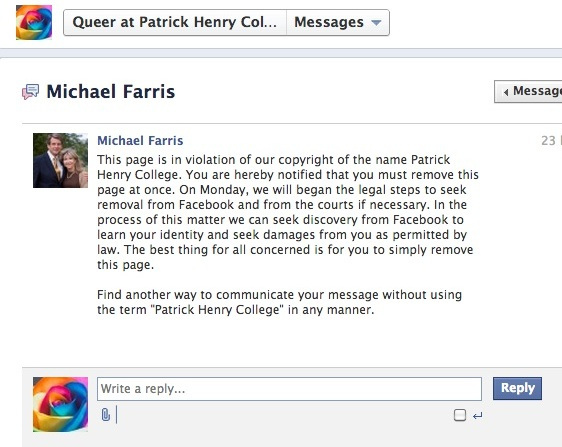
Over the first weekend in December, Michael Farris, the college’s chancellor, used his own Facebook page to contact Queer PHC and threaten them with a lawsuit:

Photo from Queer PHC.

Text is,

This page is in violation of our copyright of the name Patrick Henry College. You are hereby notified that you must remove this page at once. On Monday we will began [sic] the legal steps to seek removal from Facebook and from the courts if necessary. In this process of this matter we can seek discovery from Facebook to learn your identity and seek damages from you as permitted by law. The best thing for all concerned is for you to simply remove this page.

Find another way to communicate your message without using the term ‘Patrick Henry College’ in any manner.”

The problems with what Farris said and did are astounding. Not only is this a completely nonsensical interpretation of copyright law, not only is it slightly outrageous that Farris would pretty much threaten to “out” the individuals behind the group, but Farris used a personal Facebook page to communicate a legal threat on behalf of an entire college. Did he consult with the college’s board before making a legal threat on behalf of the college? Did they approve of the Facebook message? (Were they even aware of it beforehand?) These are important questions, especially considering what happened next.

What happened next was the Streisand effect. So incomprehensible was Farris’ strategy of internet bullying and censorship based on false legal issues that his threat suddenly exploded — Gangnam style — across the Internet.

On December 3, New York Magazine immediately scooped the story. Then the local newspaper. Then a flurry of bloggers, including Libby Anne at Patheos. Then Inside Higher Ed. Then the Chronicle of Higher Education. Even the New York Times picked it up.

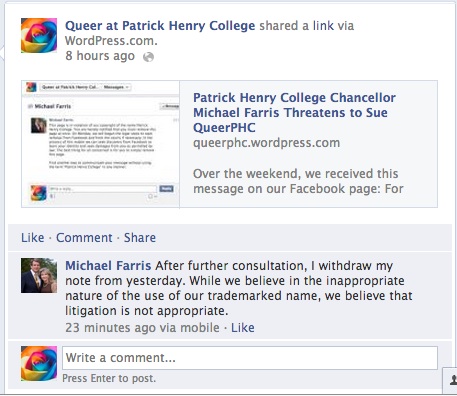
Of course, as soon as the controversy started (and probably once the PHC board realized what a bizarre and inappropriate action Farris had undertaken), Farris recanted — this time through a public comment on Queer PHC’s status:

Photo from Queer PHC.

But it was too late. The PR damage had begun.

When I heard about Farris threatening a perfectly legal Facebook group with an unfounded, frivolous lawsuit, I was floored. What better way to damage the credibility and reputation of not only PHC, but the homeschooling movement, by using abusive techniques like threatening fellow professed Christians with erroneous legal action? Not only fellow professed Christians, but your own former students?

But something about what Farris did to Queer PHC didn’t feel surprising. In fact, it felt familiar.

I couldn’t quite put my finger on it. But I was having a sense of deja vu.

Eventually, it struck me. And I went searching through my vast archive of saved emails from my old Hotmail account. And I found it.

In the early 2000s, when all of us homeschool speech and debate alumni were either still in high school or just beginning college, we socialized on Xanga. Xanga is to social media what Grandmaster Flash is to rap: really, really old school. Created in 1999, Xanga was around before Facebook, even pre-dating when most of us were on Myspace. Xanga was kind of like an public online diary: you could make posts, like other peoples’ posts, and subscribe to other people to stay connected. And that was about it.

(And yes, if you’re morbidly curious, my Xanga is still up. So feel free to search my teenage angst and amateur attempts at poetry, philosophy, theology, and public diary-writing for evidence you can use against me in the future.)

I created my Xanga profile on March 18, 2004. Most of my close friends from NCFCA and CFC had Xanga accounts as well. As this was really the beginning of social media, there weren’t really any parents using Xanga. It was primarily a teenage activity.

After a few months, two separate individuals created parody Michael Farris accounts. One was created on May 28, 2004. The other was created on July 26, 2004. (As you can see from these links, the accounts have since been scrubbed clean.) I don’t really remember much from the later account that was created, but I remember the first one because a friend of mine made it. It was clearly marked as a parody account, did not attempt to impersonate Farris to deceive anyone, and wasn’t even “offensive.” While a lot of us debaters were “punks” in one sense or another, we were still conservative Christian homeschoolers. So my friend’s parody account of Michael Farris did not involve things like dick jokes. I remember Fake Farris’s posts being along the lines of “I AM MICHAEL FARRIS AND OMG HOMESCHOOLING WILL SAVE THE WORLD!!!”

You know, immature attempts at ironic comedy that failed miserably. But again, nothing that even came close to slander. Nor identity theft. As it clearly stated it was a parody account, it didn’t even violate Xanga’s technical terms of use.

In 2004, on Xanga, you could “subscribe” to other peoples’ accounts. This would be the equivalent of “liking” or “following” a Facebook page today. Since I was one of the only people that used my real name on Xanga, and I was subscribed to the michael_farris parody account, I was the only person that Farris could recognize to contact about the account.

Oh yes, he contacted me about the parody account! Perhaps I just got ahead of myself. In 2004, Michael Farris — President of Patrick Henry College — was apparently monitoring what high school homeschool debaters were doing on a social media site. And as soon as he saw a parody account of himself, he went into militant mode.

On Wednesday, July 28, 2004, nearly a decade before he employed erroneous legal threats against Queer PHC, Michael Farris emailed me. In another way that this parallels the QueerPHC debacle, Farris contacted me with his official “PHC Office of the President” email address. The following is a screenshot of what he said, along with the text:

Screen Shot 2013-06-21 at 1.50.00 AM

Text is,

From: “PHC Office of the President” <president@phc.edu>

To: <suavedrummerboy@hotmail.com>

Subject: Ryan is this you?

Date: Wed, 28 Jul 2004 17:17:34 -0400

Ryan,

This is Mike Farris–the real one from Patrick Henry College.

I see you as a subscriber to a xanga website named Michael_Farris. Your posts there seem to indicate that you know who this is who is running this.

I just went through a difficult time shutting down another xanga site called “michaelfarris”.

I am prepared to take civil and criminal legal action against this person. Identity theft is a crime. It is also subject to civil action (if for no other reason) than it violates Xanga’s terms of use. I want your acquaintance to save himself a lot of legal grief.

Here’s what he needs to do. Delete absolutely everything from the site. Then, send me the password to the site so that I can take control of it so that neither he nor anyone else can ever steal my identity in this manner again. If he does this I absolutely promise I will take no action of any kind against him. If he does not do so (and do so promptly) I will go after him with vigor.

It may seem funny to some, but it is not funny in the least to me. I will turn this over to the FBI if I have to. But seems it seems pretty obvious that this person is or was an NCFCA debater I wanted to try to quietly end the problem without the need for drastic measures.

Can you help?

Mike Farris

Yes, almost a decade before Michael Farris tried to bully and threaten Queer PHC with a frivolous lawsuit because he didn’t like what they were doing, Farris also threatened a Christian homeschool kid with civil and criminal action — even going so far as to invoke the FBI. As if the FBI would’ve given a @#$% about some kid’s Xanga account in 2004. But we were young. We had no idea. I was terrified. I immediately told my friend. He was terrified as well. What Michael Farris hoped to accomplish — using inaccurate legal concepts to coerce a highschooler into turning over the account information to a perfectly legal parody account — was successful.

A decade later, Farris apparently still uses the same tactics.

The funny thing is, this email I received would’ve likely slipped away into oblivion, covered by the dust of my long-forgotten memories. But in the same way that Queer PHC’s existence occurred to me because of Farris’ threat against the group, my remembrance of the email was likewise resurrected. To some, the very fact that I am bringing it into the open might seem petty and vindictive. But I do not reveal it for those purposes.

I am publicizing this email because of the trend I have repeatedly seen from the leaders of the Christian homeschooling movement. I am remembering the censorship employed by NCFCA leaders when forensics alumni, coaches, and students attempted to protest BJU’s history of institutionalized racism. I am remembering a personal censorship, which I will talk about next week during our Resolved: series. I am remembering how Farris went after Queer PHC. I am remembering how HSLDA chose to block former homeschool students from its Facebook page for speaking up about abuse during our #HSLDAMustAct campaign.

What I experienced a decade ago, what Queer PHC experienced last year — these are not isolated incidents. They are symptoms of a problem: the problem of how this movement chooses to interact with its whistleblowers. It has groomed us to “take back the culture.” Yet when we try to do so, the movement suddenly realizes “the culture” we want to take back is not the Evil Candyland of Liberalism, but our very own home — homeschooling itself.

If you are not toeing the line, if you question the movement’s assumptions, if you even dare to make parody accounts — the movement wants to shut you down and silence you. And Michael Farris led the way, is leading the way, by the choices he made and continues to make.

Considering Farris’ railings against Obama’s “tyranny” as of late, I cannot help but wonder: how exactly does bullying and censorship of young people demonstrate the ideals of freedom?