Growing Kids the Abusive Way: Auriel’s Story, Part Five — The Aftermath of Childhood Abuse

Screen Shot 2013-08-12 at 3.13.05 PM

*****

Trigger warnings: references (sometimes graphic) to emotional, physical, religious, and sexual abuse; self-injury.

*****

HA note: The author’s name has been changed to ensure anonymity. “Auriel” is a pseudonym. Auriel blogs at Drying My Wings.

*****

Also in this series: Part One: Growing Kids the Abusive Way | Part Two: Isolation and Ideology | Part Three: Mini-Parents | Part Four: The Sound of a Sewing Machine | Part Five: The Aftermath of Childhood Abuse

*****

Part 5: The Aftermath of Childhood Abuse

Sometimes, I still marvel at how I survived, and am able to function. I threw myself into extra-curriculars, speech, debate, work, volunteering — anything to be out of the house.

I now have been diagnosed with Post-Traumatic Stress Disorder, Obsessive Compulsive Disorder, depression, and suffer from panic attacks. It’s hard to emphasize just how much stress, anxiety, and pressure I was under. For years, the only dreams I could have were nightmares, and I developed eye-twitches and frequent illness from all the stress. I lived in a constant state of dealing with adult stress, all as a child.

I remember that I wanted to die young as a saint.

Maybe then, people would appreciate my life. Fleeting thoughts like, “You could die,” “You could cut yourself,” “You could kill Mom,” “Life would be better if Mom died or committed suicide,” crossed my mind unwillingly. They were my mind trying to find solutions to an impossible scenario. Of course, they only compounded my shame.

I didn’t know sophisticated ways to self-harm. As a distraction, I’d pick at cuts and bruises, pick and tear off my finger and toenails, or pull out hairs from my head. Starting in elementary school, I decided to become tough so no one could hurt me. I pulled out my teeth too early so they’d hurt, and walked barefoot on gravel or on the blacktop in 100 degree weather.

One day in high school, after a particularly terrible day, I was working in the sweatshop. In my sweaty palm, I held a gleaming, sharp sewing machine ripper to undo hours of stitching. In that moment, I didn’t fear my parents.

I just wanted to hurt, to escape, to get away from it all.

Somehow, I didn’t do it, and managed to keep pretending for several more years that I was ok.

Suddenly, a year into college, some memories hit me. I was floored. Day after day, I would have flashbacks and nightmares. It was exhausting, waking up shrieking into the night, trying to stay awake to avoid the haunting terrors that stalked my dreams, only to be beset by a new round of flashbacks in my waking hours. There was no relief.

I felt like a walking shell, a skeleton.

I remember thinking, “I must be going crazy. I am insane.” The next thought… “Dying has to be better than this, right?”

As soon as I thought that, I kicked myself into counseling.

As an adult, I stood up to my parents and protected my siblings like a mama bear. My parents threatened many times to kick me out for undermining their “parental authority.” I reported to CPS several times. Now, the reportable abuse has ended, my siblings are thriving in private school, and after many years of splitting up and reconcilement, my parents finally legally separated. They are less dysfunctional when apart.

The effects of the abuse don’t leave though.

Among us 5 kids, 4 have been suicidal, 4 have been in counseling, 3 have depression, 2 have run away multiple times, 2 have distorted eating and body issues, and 2 have self-harmed.

And yet my parents still do not see what they did as traumatizing! If these incredible effects don’t convince them, then nothing will.

As for me, I am on track to get a graduate degree. I have a great counselor, am on anti-anxiety meds, and have many coping mechanisms.

I’ve actually grown in my Catholic faith as well.

Having a higher power than my parents or the homeschool community gives me hope. In my darkest moments, I draw on my faith to give me strength.

I know I’m going to be ok. I would tell anyone in a similar situation that it gets better. The memories stay, and the pain doesn’t fully leave, but there comes a time when the pain doesn’t control you anymore. The waves don’t wash you out to sea, and you learn to stand strong amidst the soft ebb and flow of pain and joy.

So, if you’re struggling right now, I know how you feel. It is going to be ok. You will make it through. Reach out and tell someone you trust. It’s ok to need help. You are worth the help.

You deserve the best.

*****

She shook her tresses that were now darkened and saturated with the glistening orbs. The air smelled sweet, as it does just after rainfall. Each inhale was refreshing, rejuvenating, breathing life into her deflated bones. Sliding her feet through the thick grass, she balanced between the property line and the open world. Swiftly, silently, her right foot slipped across the barrier, followed by her left. Her bare toes clutched the asphalt, toeing the grooves.

She felt lost. She was lost. But she had herself.

She had her life. Perhaps it was just a shell and this was all a mystery. Who cared?

The cosmos would go on in its cosmic cycle with all of its boring striped pageantry. All she had to do was breathe. The only important thing was the asphalt, the sweet smell of the rain, and the tug of that straight road.

So swiftly, silently, she stepped into the night.

*****

End of series.

Growing Kids the Abusive Way: Auriel’s Story, Part Four — The Sound of a Sewing Machine

Screen Shot 2013-08-12 at 3.13.05 PM

*****

Trigger warnings: references (sometimes graphic) to emotional, physical, religious, and sexual abuse.

*****

HA note: The author’s name has been changed to ensure anonymity. “Auriel” is a pseudonym. Auriel blogs at Drying My Wings.

*****

Also in this series: Part One: Growing Kids the Abusive Way | Part Two: Isolation and Ideology | Part Three: Mini-Parents | Part Four: The Sound of a Sewing Machine | Part Five: The Aftermath of Childhood Abuse

*****

Part 4: The Sound of a Sewing Machine

Staring at thread and machinery, she allowed her exhausted shoulders to slump against the hardback chair.

With each repetitive motion, her hands deftly cut cut cut cut cut across the stiff grey table. Tic tic tic tic the machines whir endlessly, in and out, in and out. Rip rip rip rip!

Hours of work are undone by hours more work. Half-completed items lie in growing heaps. Reds, greens, blues, salts and peppers, all become a muddy pile of blah. Daylight dims as the girl strains her neck forward. Red eyes betray stray tears that struggle down her face leaving a salty presence among the rows upon rows of pretty yellow prints.

Her hair falls tiredly across her face. The soft skin of her feet are pricked and pierced by the pins, needles, and scraps that litter the floor. Each calloused finger burns from the glue that cements itself to her fingertips. Of course she longs for freedom. But her owners need not chain her leg to the chair. The girl cannot escape. She has nowhere to go.

The poor child does not even know she is a slave. They have lied to her.

*****

I was trafficked into slavery for forced labor.

Yes, you read that right.

I was trafficked into slavery for forced labor. As a teen, my mother asked if I wanted to do a craft business with her. After the physical, sexual, emotional and spiritual abuse and neglect, obviously it was an offer I couldn’t refuse.

If I had, I knew there’d be hell to pay, and I’d still have to do it.

Boom. I found myself working in a sweatshop 13 hours a day sewing for two months straight, and then for weeks at a time afterwards. I was a literal slave. Mom would not let me do school while I sewed, saying that this was my school (never mind the fact that she called it a business when it suited her).

"I found myself working in a sweatshop 13 hours a day sewing for two months straight, and then for weeks at a time afterwards."
“I found myself working in a sweatshop 13 hours a day sewing for two months straight, and then for weeks at a time afterwards.”

I spent hundreds of long hours sewing, cutting cloth, embellishing each tiny item with complicated finishes. Furthermore, I was in charge of our website, web store and blog content, and all business records.

To add insult to injury, a person from the newspaper came, interviewed us, and made a story, with me smiling a painted story, telling lies, and gritting my teeth pretending it was fun.

Mom rarely lifted a finger to help me with “our business.” I cried so often. My nerves were shot. Even now, it’s hard to speak of. I wrote in narrative because somehow, that’s easier.

In between, I spent so much time trying to catch up on missed time for school. After hundreds of hours, I was never paid a cent. It broke at least 7 child labor laws in my country. Nevertheless, I was a passionate abolitionist. Through speeches, and human trafficking cases, I poured my soul into the hope that someday slaves would be free, even as I was a slave myself.

I finally escaped with the help of my dad at 16. Somehow, my pleading broke through to him, and he stood up to my mom, telling her it was over.

Even now though, I cannot bear to hear the sound of a sewing machine.

*****

To be continued.

Growing Kids the Abusive Way: Auriel’s Story, Part Three — Mini-Parents

Screen Shot 2013-08-12 at 3.13.05 PM

*****

Trigger warnings: references (sometimes graphic) to emotional, physical, religious, and sexual abuse.

*****

HA note: The author’s name has been changed to ensure anonymity. “Auriel” is a pseudonym. Auriel blogs at Drying My Wings.

*****

Also in this series: Part One: Growing Kids the Abusive Way | Part Two: Isolation and Ideology | Part Three: Mini-Parents | Part Four: The Sound of a Sewing Machine | Part Five: The Aftermath of Childhood Abuse

*****

Part 3: Mini-Parents

For both of my parents, I served as a surrogate spouse.

I mediated their fights, hoping they wouldn’t escalate to violence. They would come to me as their confidant. Dad would complain to me about Mom, sharing his quandaries, wondering how to deal with her.

He even consulted me as to whether he should divorce my mom when I was 14, or if he should take her to a psychiatric hospital when she was suicidal.

My mother, on the other hand, was a lonely soul. Many nights, she’d climb into my bed with me and spoon me. Then, she’d complain about my father, their sex life, how she was abused by her family and my father. At 13, my mother declared that my father raped her. My father denied it. I was so shocked and torn, not knowing who to believe. To appease her, I would sit on her bed daily, listening to hours long diatribes about her marriage problems.

She would expose her naked body to me, change in front of me, climb in the hot tub with just underwear, have me give her shoulder and feet massages, bring me into public restrooms with her, use excuses to see my body and make comments from the time I was a tot until I was 17 and more.

I had no voice, no way to say no.

She was my mother. I didn’t like it, but had no idea it was sexually abusive. I did not know females could be sexual abusers. I thought this was normal for mothers to do. I thought all girls knew what their moms looked like naked.

My mom was chronically and mentally ill, and slept most of the day, leaving us unsupervised. If she got up, it was to rage, dole out beatings, blame us for how terrible she felt, and then to sit in front of the computer screen. I’d sit with her, patiently watching her computer screen, hoping she’d appreciate me then. But normally, she’d ignore me.

So, I took over as parent and ran the house. Eventually, I was in charge of watching, caring for, and tutoring my younger siblings, cooking all family meals, picking up and cleaning our huge house, and doing dishes. I taught my youngest sibling to read, write, do math, use scissors, play, everything. At age 9, I was calling for all the appointments, hotels, stores, rides, and play dates for my family… everything an adult would do, I did. On top of this, I was my mother’s caretaker. I made her meals, checked on her hourly, and cleaned her room.

The best way to describe it is that I parented my mother and all of my siblings.

With the belief in the homeschooling community that teenagers don’t exist, my mom called me a “young adult” at 12. I was the oldest girl, the responsible one. I just wanted approval and respect, and to keep the peace as much as possible for survival. Indeed, it seems that our parent’s love was conditional on our love. Our value was tied to our obedience, to our service, to our usefulness, resourcefulness. But with so many adult pressures, so much fear of violence, and our worth conditional to reception of love, there was a terrible price to pay.

I was taught to abuse.

I was taught to beat my dogs…hit, kick, shock them with the shock collar, all while the poor dogs cowered and yelped in pain, struggling to escape. I hated it, but did not know it was wrong. If I refused, I would be in trouble. Either way, I was damned.

With my 4 siblings, I started raising them from the time I was 8. Growing up in such an isolated, violent environment, violence was one of the few ways I knew to handle problems.

Being taught Ezzo methods did not help.

Yelling or name-calling could keep them in line. If they didn’t cooperate, I would grab, push, drag, smack the back of their heads, slap them, or kick them (I always told myself it was a light kick, so it was ok). I thought all siblings did this. I thought all families acted this way. Due to my extreme isolation, I did not know I was a bully until I was 16 years old! When I found out, I cried bitter tears of guilt and shame. I apologized profusely, and made amends to them. It pains me to this day that I could not take back what I’d done.

We were trained to keep silent about the fights and abuse at home or face severe punishment.

Moreover, there was so much shame surrounding it. I made it my responsibility to be the guardian of outgoing words. Concurrently, I was my parent’s pawn. I believed them. They forced me to be an apologist for the very things I despised. Therefore, to preserve my sanity, my mind forgot the abuse. I told folks what great parents I had, and gave my parents cards saying “#1 Dad” and “Best Mother in the World!”

I stood up for spanking rights, parental rights, homeschooling rights, courtship, no kissing before marriage, and so many other things that I internally was at war with myself over.

*****

To be continued.

Growing Kids the Abusive Way: Auriel’s Story, Part Two — Isolation and Ideology

Screen Shot 2013-08-12 at 3.13.05 PM

*****

Trigger warnings: references (sometimes graphic) to emotional, physical, religious, and sexual abuse.

*****

HA note: The author’s name has been changed to ensure anonymity. “Auriel” is a pseudonym. Auriel blogs at Drying My Wings.

*****

Also in this series: Part One: Growing Kids the Abusive Way | Part Two: Isolation and Ideology | Part Three: Mini-Parents | Part Four: The Sound of a Sewing Machine | Part Five: The Aftermath of Childhood Abuse

*****

Part 2: Isolation and Ideology

 At 16 years old, I was not allowed to cross our property line without another human being with me.

Like a caged dog, I paced back and forth, crying at the injustice of it all. The bonds that held me weren’t physical. I was chained by my sheltered life. The isolation came from homeschooling.

Until high school, I only had three close friends outside of my siblings, and I only saw them once a month. Although I was involved with many extra-curricular activities, I was not allowed to be friends with boys, non-homeschoolers, nor kids whose families my parents did not know.

So, no friends.

Pop and rock ave evil beats, movies with kissing or language — let alone violence — will make you copy them, gyms make you compare people’s bodies, TV shows are so sexualized they’re evil, iPods hurt your spiritual life, and so on. At least, that’s why I was not allowed. My siblings and I snuck around, listening to Christian music here, pop music there, watching TV when our parents were gone.

I’m still trying to get caught up on movies, pop culture, and music references.

Courtship was introduced as the only method of finding a spouse. We read books like the Courtship of Sarah McLean, I Kissed Dating Goodbye, Boy Meets Girl, The Princess and the Kiss, and so many more. It was like my dad was supposed to own me, and any potential mate would have to ask for my father’s permission both to be near me and to eventually own me.

It’s so damaging to think of oneself as property.

Now, I want to date to find someone to marry, but my father does not own me. I do not need to be under his “vision” for my family. I have my own vision, which does not include abuse.

"Girls were to have babies, homeschool their kids, and be dominated by men."
“Girls were to have babies, homeschool their kids, and be dominated by men.”

Mom held a sexist view of girls: they should not work outside the home. Girls were to have babies, homeschool their kids, and be dominated by men. Many Vision Forum books cemented this view in her mind like So Much More, What’s a Girl to Do, the Beautiful Girlhood books, Mother, and Joyfully at Home. Mom taught me needlework like a good Victorian girl, but I hated these activities! Just because I’m a girl does not mean I have to knit and drink tea!

I’m a person! I’m not a gender stereotype.

I was taught to be afraid of gays, Islam, and black men. It’s tough to grow up in a homophobic, Islamophobic, racist, sexist environment and come out unscathed. While it’s a struggle, I have learned to love everyone as made in the image and likeness of God.

The modesty teachings were awful. Modesty was focused more on covering skin than on ensuring the dignity of each person. I learned to watch my back for guys who would lust after me.

I heard that what I wore made me a rape target.

At first, Mom dressed me in denim jumpers or Easter and Christmas dresses from the local stores. Eventually, she forced me to sew my own dresses and skirts. When I was 9 years old, she told me that having my hair down made me look like a “lady of the night.” Even though I was a shy, modest girl, Mom constantly told me that something I did or wore was sinful, displeasing to God, and might turn on my dad or my brothers.

I was so scared that I was going to lead my brothers or dad into sin for lusting after me.

If that’s not twisted thinking, I really don’t know what is. Bleh.

I cried so many tears over how ugly I thought my body was, thanks to the baggy clothes I wore. Looking back, I was a healthy weight and my body was great. But shirts had to have sleeves and couldn’t come below the collarbone. Pants were forbidden after age 6. Swimwear was culottes that puffed full of water. The lifeguards even chided me for not wearing appropriate swim attire. I wanted to scream, “It’s not me!” My skirts had to be several inches below the knee, or else I was “showing some leg,” and that would “give guys a little jolt.”

When I finally turned 18, I had to beg a friend to help me pick out my first real pair of pants since Kindergarten. Of course, Mom called me a “slut” and a “whore,” declaring she could see intimate parts through my pants that would have been impossible for her to see. It was just to shame me.

Oh boy, here comes the scary part.

Sex.

No one in my homeschooling community talked about sex. I got the talk at 12, earlier than any of my homeschooled friends. However, I only knew about one type of intercourse. I didn’t even know people did it lying down, lol. Because puberty, sex, and all related words were so hush hush, I stopped asking my mother questions.

The first time I heard another girl even mention her period, I was 16.

I stared at her in shock! “Did she just speak of her period?” I wondered. When I turned 18, I succumbed to searching dictionaries to learn the rest of the words and meanings.

I was also incredibly afraid of CPS. Through HSLDA and my parents, I learned that foster homes are terrible places that abuse children by burning their hands on stoves, and more. Well, it worked. I didn’t call hotlines, tell the speech moms who cared about me, or beg my few friends for help.

When CPS showed up at our doorstep, my siblings and I lied for fear of being separated from each other forever.

The community that attended our very conservative Catholic church supported the sheltered, so-modest-its-frumpy, sexist views of my parents. I even was bullied at church for failing to meet up to the standards of the kids my age. In the midst of all this, I got comments asking if I was part of a cult, Amish, or Mormon. It hurt deeply that people thought I was a freak. “IT’S NOT BY CHOICE!” I wanted to scream. But I couldn’t.

When people think you’re part of a cult, they tend to ignore you or avoid you.

The few people I told about the abuse after I escaped looked at me with shock and said, “I had no idea.” The isolation of homeschooling added with the isolation of a cultic appearance equals an ideal environment for abuse to continue.

*****

To be continued.

Relationships, A Series: Part Seven — The Five-Year Relationship Plan

Screen Shot 2013-07-29 at 9.52.55 AM

HA note: This series is reprinted with permission from Caleigh Royer’s blog, Profligate Truth. Part Seven of this series was originally published on June 9, 2013.

*****

Also in this series: Part One: What Is Courtship? | Part Two: We Were Best Friends | Part Three: The Calm Before The Storm | Part Four: To Lose One’s Best Friend | Part Five: To My Darling Clementine | Part Six: The Storm Starts Brewing | Part Seven: The Five-Year Relationship Plan | Part Eight: The Means To An End | Part Nine: We Made It | Part Ten: I Am A Phoenix | Part Eleven: Conclusion, Don’t Brush Off the Next Generation

*****

Part Seven — The Five-Year Relationship Plan

I have to keep moving with these posts or else I will lose momentum and it will become even more difficult to continue the story.

I want to explain a little bit about why this is so difficult for me to write, but also why I need to write our story. From that first devastating break in Phil’s and my friendship, I began losing a lot of friends, I faced opposition at home and from other parents, people I barely knew, and those who I thought were friends. I have always been sensitive to my heart, to my conscience, and it killed me when I couldn’t seem to get it across that my conscience was clear in my loving Phil and continuing to be in a relationship with him.

I was being accused of lust, idolatry, bitterness by my parents, I was called rebellious, disobedient, dishonoring of my parents by others around me. I was having friends question my heart, and asking whether or not I was being blind to wisdom just because I wanted to do what I wanted to do. I felt almost nothing but shame, false guilt, and pain from those moments on. Shame because I wasn’t doing what others wanted me to do and feeling guilt because my conscience was being used against me. I was also feeling pain because what I felt was right and felt at peace with wasn’t even close to what everyone else around me said was “right.”

I felt manipulated, like I was being used against myself.

I felt alone, I felt the few friends I could trust were my lifelines, and without them Phil and I probably wouldn’t have made it. I watched the people who used to “look up to me” look down at me in disgust as my parents told stories of my dishonorable actions.

Here are the reasons why I need to write our story. By writing our story, I am owning the story. I am spreading it out and accepting that it is our story; the good, the painful, the ugly, and the bad.

I am acknowledging that our story is amazing; amazing because we made it.

Amazing because Phil and I are married, very amazingly happily married. It’s amazing because we came out stronger and more in love with each other than before. It’s amazing because we stayed true to our hearts no matter how many people tried to break us apart.

That’s why I need to write this story.

That’s why it’s important for me to accept it.

The next year and a half that I will be covering in the next few parts are the ones that make the past few posts seem like a walk through the park.

*****

That week of talking after 6 months of silence was pure bliss.

We decided that we were going to write up relationship guidelines that at the end of the week we would try to present to our parents. We spent hours on the phone and online trying to work through what we thoughts our parents would approve of (incredibly strict talking guidelines, timelines, and so forth). We talked with the couple who were becoming mentors to me about what would be best to put into this five year plan that we were writing up.

We even started working on what would become roughly a year later our budget that is still in play to this day.

We talked about where we would want to live when we got married, we talked about how many kids we wanted, we talked about their names, we talked about the kind of house we’d want to live in.

We talked about everything.

I vaguely remember my grandfather being in town that week, but I wasn’t around very much. Phil was taking my time and I sure as heck wasn’t going to stop that. The week began winding down and we started figuring out what the game plan was going to be presenting this five year relationship plan to our parents.

We came to the conclusion that approaching my dad and asking for his blessing on our relationship was the first step.

And we decided that it was going to be on Sunday. Phil approached my dad at church, nervous as heck, and actually came across a little abrupt to my dad, asking if my dad could talk with him later that afternoon. Oh, the day started out bad from the start, and that should have been a sign for us to stop because we both got burned. The first sign was Phil’s car battery dying. He almost didn’t make it in time to meet with my dad. The second was getting questioned on the way home from church by my dad about this meeting with Phil.

The third sign that the day was going ridiculously wrong was when I watched my dad talking with Phil and saw the typical signs of my dad BSing Phil. The typical long drawn out speech that my dad gives when he doesn’t want to deal with something and is annoyed, but is going to keep the polite man face up. Sure enough, Phil left, I waited a few moments and then went inside, only to be met by two furious parents, one of them a mom I had never seen that angry with me. My parents talked and yelled at me about how disrespectful I had been to them, how I had dishonored my dad, how Phil was disgustingly disrespectful to my dad by asking him for his blessing on our relationship.

I have never been able to understand how a man asking to be in a relationship with me was a dishonoring thing.

Or how Phil asking in a very polite manner was disrespectful to my dad.

I felt ashamed of my “sin” of dishonoring my parents for wanting to talk with the man I loved. Both Phil and I were talked down about how sinful we had been to talk. I still feel anger and confusion over just why what we did was considered sinful.

The weeks that followed brought confusion, pain for both of us, and a tentative continuing of our under the radar relationship. We both decided that it was more important to stay true to our hearts than to continue a forced separation. Phil gave me thumb drives with letters to me, his favorite music, and class schedules, and I wrote him letters and we continued to talk about our future. Thanksgiving passed, Christmas was fast approaching. I gave Phil a little figurine made out of nuts and bolts who was a little man at a desk on a metal laptop. And I also made him a pair of half fingered mitts and a scarf. I think he gave me a chain mail medallion. New Year’s crept up on us and I was greatly looking forward to seeing Phil at a mutual friend’s party.

At this point, Phil knew almost everything that had to do with my family.

I told him about the nightmares I had of my dad beating me. I told him about how scared I was when my dad got angry, I told him about the depression I felt when I was home. Phil became more and more my rock as things continued to get worse between my dad and I. Ever since the year I had found out about my dad’s issues, I haven’t been able to talk with him without feeling some sense of uneasiness, discomfort, and distrust.

By the time the new year’s party rolled around, my dad and I weren’t really on speaking terms again. I have no idea why we weren’t this time, probably something I didn’t say that made him pissed with me. That happened way too often for me to keep track of anymore. I was planning on going to to the party, but mom told me I still had to ask dad. So I went and asked him. I already knew Phil was going to be there, but I sure as heck wasn’t going to volunteer the information. My dad told me I could go, but as I turned to walk away, he told me that if Phil was there, that I had to come home right away.

My heart sank.

I needed this party.

Outside of my job, I didn’t see anyone, like at all. I was incredibly isolated.

Besides seeing Phil sometimes after work, at single’s meetings at church, I rarely saw friends. I frantically emailed Phil and asked him not to come. I told him that I couldn’t ignore my dad’s command if he showed up. My conscience wouldn’t allow it.

Frankly, I have no idea what I thought, or was afraid, my dad would do if I didn’t do this stupid thing. I was being scared into doing what he said because he knew that he still had quite a few pulls over me. I was taken advantage of because of my sensitivity to what was put to me as the right thing to do. My mom told me that one day. I don’t know why she told me that dad could get me to do what he wanted because of my sensitive spirit. After finding that out I was even more wary of my dad. Rightly so, I believe. 

Phil told me to enjoy the party for him and that he would spend the evening thinking about me and working on some projects. Throughout our relationship, up till a big thing happened in January of 2011, Phil tried his hardest to pull the fire off of me when it came to my dad. He was too much of a good guy.

I am angry about how many times my dad took advantage of Phil’s genuine care for me and his desire to do what was right.

After the beginning of 2010 had passed, life at home and around my parents began to reach new heights of buttons being pushed and nasty responses to almost anything I did. Sometime around February, I met a new friend, and shortly afterward got an email from her saying that her and her husband would like to offer me a place in their new house. She knew that life was hard at home, knew about Phil and I, and her and her husband wanted to give me an escape.

I quietly, secretly, began planning to move out. I was freaked out half to death that my parents would kill me and forcefully keep me at home once I told them that I was going to move out. I was pretty set on doing it, and even went and separated my bank account from them because the last thing I wanted happening was my money being taken.

I didn’t put anything past them.

May came around and I found out that major building delays were happening with the house that I was supposed to have a room in. That was seriously pushing back my projected move out date. The end of May came, and I decided to tell my parents anyway that I was going to move out. I wanted to tell them I was moving out, not that I wanted to move out. I didn’t want to give them any room to shut me down.

Little did I know that that was futile. I sat down with both my parents and told them I was moving out in a few weeks.

They immediately used their biggest weapon against me: my siblings.

They told me how devastated my siblings would be if I moved out. They told me how much of a good influence I was on them, and how they would need a big sister. They, once again, took advantage of my sensitive heart and manipulated me into staying. And yes, I stayed. I could feel the despair settle in even deeper in my heart. Twice in the months that followed I had a bad breakdown and asked two different friends to come get me. I was gone for hours both times, and I wish I had had the courage to leave when I had originally wanted to.

But, I suppose there is a reason for everything.

I also got something really special at the end of May.

My aunt had been saving a gorgeous sapphire ring for me, and I called her when I knew she was going to be in the area to ask for the ring. She brought it out from CA that May.

The ring fit perfectly.

Now if I could only wear it as an outward sign of my commitment to Phil.

*****

To be continued.

Confessions of a Homeschooler: Iris Rosenthal’s Story, Part Two

Confessions of a Homeschooler: Iris Rosenthal’s Story, Part Two

Iris Rosenthal blogs at The Spiritual Llama. This story is reprinted with her permission.

< Part One

"I remember how hard it was for me to adjust to being outside of the homeschooling bubble and in some ways, eight years later I am still adjusting."
“I remember how hard it was for me to adjust to being outside of the homeschooling bubble and in some ways, eight years later I am still adjusting.”

Since my original post I have come to the realization that I have just scratched the surface on everything that I have to tell about homeschooling. One of the problems I have with home education is that there is hardly any regulation. During the time I was homeschooled, K-12, I never once had to take the SAT or ACT or any other sort of evaluation test.

As long as it looked like I was studying I was pretty much left alone. The only subjects my mother was constantly involved in were; math, spelling and english. Occasionally she would check my work in the other subjects, but for the most part I was left to fend for myself and once I reached the age of 15 any involvement from her pretty much came to a stop.

I often hear the argument that not all parents homeschool are like this and that my mom was doing it wrong. While that may be the case, I don’t think that this should be lightly brushed off. We are talking about the education of children here! It is my belief that whichever route you choose, it’s very important that your children receive the best possible education. Be involved, be a part of their lives, listen, be aware of what they are learning about and learn with them!

With the lax requirements in place for homeschooling it only flings open the door for cases such as mine to happen. So much for homeschooling being better than public school (for those who don’t know me, that was sarcasm)!

I know my story is not the only one, my brother & sister and close friends have also experienced the same lack of education and preparedness to function in the real world because of being homeschooled. However, I’m not here to tell their story for them, I’m here to tell mine.

My first full time job experience happened when I was 21 at a call center. Yes I’d had jobs previously, but they were just odd jobs and the people I worked for I already knew from either homeschool group, church or 4-H. So I was always within that bubble my mother had me living in.

While working at the call center I got to know people who *gasp* went to public school, it was then that I started to realize that there were holes in my education. I didn’t know any math beyond the basic add and subtract. I could barely multiply or divide. Forget fractions and algebra.

I also realized that I was spelling a lot more words wrong than what I originally thought I was. It’s pretty bad (not to mention embarrassing) when your manager brings back your vacation time off request (written in clear handwriting) and asks you to tell what words you meant to put down. I found myself sticking out a lot in all the wrong ways, and my judgmental attitude towards people who were different than me didn’t help with that at all!

I had never been around so many people from so many different backgrounds before, it was quite an eye opener and culture shock for me! I still remember the first time I heard someone swear. If I didn’t agree with something someone said or did I made sure to let them know that it offended me. If I knew someone was a Christian and I heard them say something that I didn’t believe a Christian should say I made sure to let them know how wrong they were.

Looking back, I was quite obnoxious and judgmental towards my coworkers at that job. It is no small wonder that barely any of them talk to me anymore and I can’t say that I blame them!

I am so thankful that I have learned since then and now at my current job I am known among my coworkers for being helpful and a team player. I no longer allow my homeschooling experience to define me, in fact I hardly ever bring it up. I don’t feel as though I should have to defend my education (or lack thereof) to anyone.

It is my desire that people know and define me by who I really am, and not as some “failed product of home education.”

I hope that by sharing my experiences I can somehow prevent them from happening to someone else. I remember how hard it was for me to adjust to being outside of the homeschooling bubble and in some ways, eight years later I am still adjusting.

If anyone is reading this and is going through that rough transition period from the bubble to the real world, just know that you aren’t the only one who has traveled that path. It may be rough now, but in the end you will be stronger and wiser for it!

Visualizing “The Myth of the Unsocialized Homeschooler”

HA note: The following is reprinted with permission from Heather Doney’s blog Becoming Worldly. It was originally published on July 7, 2013.

I googled “homeschool” to see what pictures came up. Many of them had to do with socialization and the messages that homeschool parents get and give about it. So I figured I’d talk about homeschooling and the issue of socialization today and use some of the cartoons I found in the process. Some of them are a little disconcerting in the way they point out issues I see, just maybe not quite in the ways the cartoonists intended.

What is This “Socialization Problem” You Speak Of?

So first a bit about what socialization is and how it relates to homeschooling. This diagram explains socialization pretty simply and it comes from a site that talks abut stopping cycles of discrimination that are often passed on intergenerationally.

soc1

I think the site the diagram comes from – Parenting for Social Change – makes an excellent point – that this is generally how socialization is done but socialization can sometimes be bad. You can absolutely be taught harmful things as well as positive things in the course of your socialization and most people are taught a mix. What homeschooling parents often become inclined to do though is try to eliminate or greatly reduce these “bad” things by winnowing their child’s socialization opportunities down to only parentally vetted and approved sources and quite often those approved sources are fellow homeschoolers, religious leaders, highly edited texts and media, other “likeminded families,” and sometimes, when the parent is particularly controlling or inept at socialization themselves, nobody at all except for the immediate family.

Yes, this last one is a real big problem because terrible things can happen when families get isolated like that and it is a big risk factor for all kinds of abuse, neglect, and poor mental and physical health. Thing is, this social isolation problem happens in homeschooling much more frequently than it should. In fact, even in Brian Ray’s wacky (and so methodologically unsound that I am stopping myself from going on a rant about how many problems it has) “Strengths of Their Own” study included something I found interesting about it. See if you can catch it.

soc2

That’s right. The third bar from the bottom. The yellow one. If 87% of the children in Brian Ray’s highly self-selective study play with “people outside the family” (and I will leave you to ponder right along with me as to why this wording is not “other children outside the family”) then that means that 13% of children in Brian Ray’s study do not play with others outside of their own family, which I would most definitely define as a socialization problem. If Brian Ray, excellent fudger, misconstruer, self-quoter, and ideological spit-shiner of homeschool data extraordinaire, has almost 15% of the kids in his rather cherry-picked study having this issue, how common must it actually be in real life and how do people in homeschooling react to this issue? Well, let’s see…

Socialization Sarcasm

This cartoon makes fun of the concept that socialization problems exist in homeschooling. To me it implies that socialization happens so naturally that it simply isn’t something a homeschool Mom could forget. Why? Well, I’m honestly not exactly sure. Socialization is a component that definitely can be ignored or accidentally left out and it has openly (and wrongly) been discounted as being unimportant by many prominent homeschool leaders. Because it has been ignored and dismissed as a necessary part of many homeschool curriculums is the main reason why homeschoolers have gotten the reputation for being unsocialized in the first place.

soc3

Most homeschool kids don’t like being stereotyped as unsocialized or feeling like they are unsocialized (I mean really, who would?). So there’s also some memes and jokes that have been spread by teenage homeschoolers implying how inherently dumb or inappropriate they think it is when people make socialization an issue. Most of these involve poking fun at the “myth” that socialization is a problem in homeschooling. There is this YouTube video by a homeschooled girl who is trying to do this by distinguishing “the homeschooled” from “the homeschoolers” and while I find it funny, I’m quite sure that her pie chart is wrong and she perpetuates elitist stereotypes she has likely heard throughout her homeschooling experience.

This blog had a post by a homeschool graduate complaining about people asking what’s become known as the “socialization question” and in her post she uses a picture I’ve seen fairly often. There’s even t-shirts with this printed on them that you can buy.

soc4

Socialization is Fishy

So what do homeschooling parents think about the socialization issue when theydo actually address it? Let’s start out with this cartoon, as it’s used a lot. It claims that a lack of socialization in homeschooling isn’t just a rare problem, but an outright myth. It implies that homeschool kids are not only actually in diverse environments as part of a natural ecosystem but are thrilled about it. It also implies that children who are socialized in public school are like half-dead sardines in a can rather than the school of likeminded fish they are expected to be.

soc5

This cartoon is a direct dismissal of there being any merit to the “socialization problem” and it is compounded with a public school counter-stereotype. This is unsurprising to me as the argument that homeschool socialization problems are an outright myth is quite often included with something disparaging about public school or insulting to teachers (and this cartoon is no exception). Notwithstanding how insulting it is to imply that most people who go through public school are like dead fish, is this depiction of homeschool versus public school in any way accurate? Well, I imagine for the occasional situation it is, but in general, certainly not.

Oddly this cartoon was actually almost the exact opposite of my experience. In the CHEF homeschoolers group I was in it was all white Christian families and our parents had to sign a statement of faith to join. It was absolutely a school of fish all swimming the same way and because we got together infrequently, I generally felt like that fish in the fishbowl. Also, when I went to public school in 9th grade I was certainly no canned sardine, even if I wasn’t exactly the manic fish thrilled at the ecosystem in the upper righthand corner. The teachers often tried to corral us into all doing things the same way but we didn’t make it altogether easy for them and generally I expect it was a bit like herding cats. We were all individuals, as were the teachers. I had favorite teachers and subjects and ones I didn’t like and I made friends of different races and beliefs and political persuasions, many of whom who are still my friends and acquaintances to this day.

The Dark Knowledge of Teen Degenerates

Here’s another cartoon about homeschool kid socialization from a slightly different angle, and this one does address the idea that kids don’t always do what you want them to do and by invoking the dreaded “peer pressure,” implies that its all bad. Which one is it – are they lobotomized sardines in a can or are they violent and rebellious ingrates? Make up your mind! Also, how realistic is this, do homeschool moms actually think public school kids are like this? Where are the public school kids who are not “at-risk” of being part of the school to prison pipeline? Why aren’t there any of those at the bus stop?

soc6

Also, in this little dystopian cartoon, gang members with knives read books on values (morally relativistic ones, no doubt), evolution, meditation, and “new age” religion (if that isn’t a culture wars, fearmongering buzzword, I don’t know what is) and pregnant girls read about sex ed and still don’t know what made them pregnant. This cartoon is crazy stuff. People don’t drink beer and shoot up heroin (yeah, there’s a needle on the ground in the cartoon) while waiting for the school bus (although some do smoke cigarettes). People who read a lot don’t typically join gangs. People who know about comprehensive sex ed aren’t any more likely to have sex than kids who don’t and they are much less likely to accidentally get knocked up. Honestly, if this is what anyone actually thinks the world is like then they are not fit to educate other human beings and they probably need some mental help themselves.

Sweet Homeschool Girl in the Ghetto

This cartoon is similar to the previous one in that it also indicates that public school socialization is all bad, but it depicts the expected reaction of the homeschool girl in the public school and implies that if your daughter goes to public high school (obviously radiating her feminine purity with a big hair bow and below-the-knee church skirt) that she will soon be shocked and horrified to encounter people dressed immodestly, young people openly dating, tattoos and piercings everywhere, vandalism and crime, blatant teenage rebellion, and big scary black boys that look more like grown men. So obviously the answer is to just have her at home not knowing that people who are different from her exist, and make most of the people her age out to be disgusting, immoral, and scary, right?
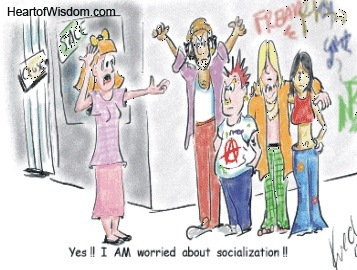
soc7

I followed this cartoon to its site, a blog called Heart of Wisdom, trying to get a higher resolution picture. The blog talked about how homeschool kids should only selectively socialize with other Christians and claims this is biblical. Yep, this is just the type of homeschooling “socialization” I am familiar with. It’s a form of social isolation and indoctrination called “sheltering.” This stuff is all about parental fear and desire for control and helicopter parenting to this extreme is very unhealthy for your child. It will mean that in adulthood that they won’t know how to function at an optimal level. You cannot shield your kid from all “bad influences” and indeed there is nothing in the bible that says your kids cannot play with the kids of people who have different beliefs. That is quite a stretch and it is insular, cultish thinking.

My Homeschool Kid is Smarter than Your Honors Student

That same Heart of Wisdom blog had this other cartoon about homeschooling, so I followed that link and it was to a page dedicated specifically to homeschool cartoons. When I see stuff like this cartoon I have to once again ask – is this supposed to be funny? Do these people actually think this is accurate? My main question, though, is why the elitism and negativity? Even if your kid is getting a much better education in homeschooling, why talk trash about children who through no fault of their own don’t have as good of an education? Why make it into a competition, act like homeschool kids in general are “better” than other kids? It shows me some immature and defensive parenting, really. If you revel in it when someone else isn’t doing as good as you it shows you are 1) being a jerk and 2) secretly worried that you’re no good at what you’re doing. Nobody should ever be excited about other kids having a sub-par education, thinking it makes them and their kids look better. That’s just gross.
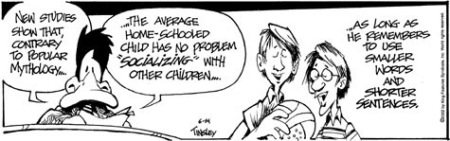
soc8

As it is, I find that there is a grain of truth in this cartoon but perhaps not quite in the way the cartoonist intended. I’ve known a lot of homeschool kids who do use big words in conversations and they soon realize that it comes across as awkward when they socialize with other non-homeschool kids. Admission: I was that kid myself. I read a lot of classic literature and became familiar with words that simply aren’t used in everyday speech anymore. Trying to use them in peer-to-peer conversations didn’t reflect on me being smarter. It reflected on me not having a modern day frame of reference as to what is appropriate. It reflected on me being socially backwards. Lots of public school kids who are bookworms like I was know many big words. They also know the right words to use for their audience. Context is everything. An unsocialized homeschool kid doesn’t have that context and very well might find that using 18th century literary terms in a conversation about basketball will indeed get people looking at them sideways. If homeschool parents want to be proud of that, think it makes their kid (and by extension them) “better,” it shows they truly don’t understand the issue at hand.

Parental Fear & Social Anxiety

That’s where I think we hit the crux of this whole thing. I think the main issue is parental angst and fearfulness. Too many homeschooling parents socially struggled in school themselves and/or got into drugs or unhealthy sexual relationships. Instead of taking a broader view today, they expect that they need to hide their kid away from these settings or the exact same thing will happen to their kid even though their kid is in a different school district in a different generation and *gasp* a different person. These parents become scared of or hurt by the society we live in, withdraw, and then use homeschooling as an excuse to be separatist, snooty, and helicopter over their kids. These are not positive reasons for homeschooling and these are the exact kind of fearful and overbearing attitudes that lead to socialization problems for homeschool kids.

soc9

Because people with strong views often find themselves in positions of leadership, those with exclusionary, separatist, and elitist attitudes often end up running things and then set this negative and divisive tone for the homeschooling group and the community it serves. It’s so pervasive that even some “second choicers” who start homeschooling simply because the other educational options in the area aren’t up to meeting their child’s particular needs (which is an excellent reason to homeschool, in my opinion), can get sucked into this culture, an “us versus them” mindset where homeschooling represents everything that is pure and good and healthy for children and public school and the people and structures that support it represents everything bad. This creates a parallel society of sorts and then you see people start calling public schools “government schools” in a pejorative sense. All this “us versus them” talk fans the fear that homeschooling parents are vulnerable (although still superior) outsiders who are or soon will be discriminated against and this in turn leads to easy exploitation of these scared people.

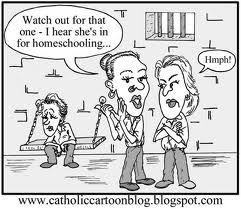
Why does widespread homeschool participation in things like the fundamentalist-led HSLDA, which capitalizes on these fears and requires dues money (that then goes into their cultish culture wars arsenal) for unnecessary “legal protection” exist? Because many these people are too freaked out to do anything more than cling onto a protector, ignoring all evidence that their “protector” just wants to use them – financially and for furthering a disturbingly anti-democratic agenda. This fear grows and leads to the kind of mindset that spawns ridiculous cartoons like the one below.
soc10

Put in prison for homeschooling – really? Of course in this cartoon there’s that same (expected) depiction of scary people with piercings, this time instead of a shocked daughter (projecting much?) it’s got a dejected homeschool Mom being shunned by hardened criminals who sarcastically note that her “crime” was homeschooling.

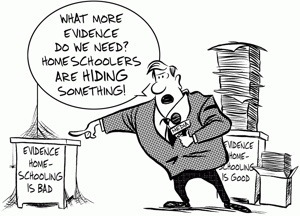
Homeschooling parents who follow these “leaders” (often starting because their local homeschool support group requires or recommends HSLDA membership) hear these divisive messages and become scared to death of being framed, exposed, persecuted, worrying that they will land in jail just for homeschooling. It may be a wacky and unrealistic fear given what’s actually going on, but if people hear it often enough they often come to believe it, along with the bogus stats and stories claiming that homeschooling is as close to perfect an educational option one can get in such a messed up society, and the myth that there is no evidence to the contrary because homeschooling is just so awesome.
soc11

Because homeschoolers test scores aren’t made public and often not even expected, registration isn’t even required in many states, and most people don’t pay much attention to homeschooling unless their kids are being homeschooled. Homeschool movement leaders have been able to get away with exhibiting the cream of the homeschooling crop as representative of all homeschoolers. This has painted an inaccurate picture and hurt the vulnerable kids by leaving them ignored as they fall through the cracks.

Saying “our homeschool kids are socialized but socialization doesn’t matter and in fact it generally sucks if it isn’t coming directly from parents” is a very unhealthy attitude to go into educating with. Responsible homeschooling parents really need to do a bit of soul-searching as to why they tolerate these inaccurate depictions of what socialization is and isn’t, why there is this the across-the-board maligning of all public schools within many homeschool communities, and why so many participate in this ugly (and frankly in my opinion undeserved) elitism, and contribute to such extreme (and inaccurate) stereotyping and putting down of children who have had to attend lower quality inner-city schools, all in order to inflate the merits of homeschooling.

Two big question:

(1) Does this kind of attitude help do anything beyond artificially boosting homeschool egos?

(2) Is there any need for this behavior if homeschooling is really so awesome?

Also, if there is no good data on the problems of homeschooling then instead of celebrating the cobwebs we need to be collecting more data. Every single education method in this world has problems and the places where the problems are denied is where child maltreatment can and does flourish.

The Truth Between “Stereotype” and “Myth”

I get the message that not all homeschoolers are cloistered and don’t know how to talk to people their own age, but the fact is that too many are and we need to recognize that it is a real problem affecting a sizable percentage of homeschool kids. Also, homeschoolers are simply not the most brilliant people in the world or inherently “smarter” than other kids, and as such they shouldn’t need to feel pressured to achieve perfection, perform as child prodigies, or that there’s a black mark on them if they mix up “asocial” and “anti-social” in a conversation.

soc12

This “myth of the unsocialized homeschooler” is an issue in homeschooling but the prevalent idea that the socialization problem is a myth is the real problem, not the legitimate questions and concerns about socialization that homeschool parents keep being asked. Those questions actually need to keep happening because social isolation and ostracism in any setting (including homeschooling) often follows a person into adulthood, and can leave people struggling with social anxiety, a small social network, low levels of social capital, mental health issues, and an unnecessary amount of sad and lonely memories.

The least we can do is stop making fun of people, stop being in denial, stop pointing fingers elsewhere, and acknowledge that it is real, it happens too often and it should be assessed and addressed as the serious problem that it is.

The Heritage Foundation and the Cato Institute: NCFCA and Growing Up in a Conservative Bubble — Libby Anne’s Thoughts

The Heritage Foundation and the Cato Institute: NCFCA and Growing Up in a Conservative Bubble — Libby Anne’s Thoughts

Libby Anne blogs at Love Joy Feminism on Patheos.

As I prepared my debate briefs, scouring the internet for evidence, there were two places I always looked first—the Cato Institute and the Heritage Foundation. A good quote or two that could be applied in argument against a given plan was generally sufficient for my purposes. I filed my briefs carefully in my box and prepared for competition.

I honestly think my participation in NCFCA, known colloquially as “homeschool debate,” was the best thing about my high school years. I participated for four full years, attending debate competitions across my region. I loved it—the buzz of people, the feeling of purpose, and the heady rush I got when stepping up to speak.

Homeschool debate was one of the social highlights of my high school career. At the time, my main socialization events were church, AWANA (bible club), and a weekly arts and music co-op. Homeschool debate gave me one more weekly opportunity to see friends (or at least, the ones who were also in our local debate club) and, wonder of wonders, an opportunity to meet people outside of our local social circle. Debate tournaments were amazing—they served as the gathering points of dozens or even hundreds of homeschooled teens just like me, comprising the largest gathering of young people I found myself in outside of our annual homeschool convention.

And here is where we come back to the Cato Institute and the Heritage Foundation. Homeschool debate was an approved activity for me and many other teens like me because our parents considered it safe. Homeschool debate was founded by Christy Shipe, the daughter of Michael Farris, founder of HSLDA. The goal of homeschool debate was to train up a generation of young people for public speaking and political involvement in an effort to restore America to its Christian foundation. We were those young people.

NCFCA was unabashedly Christian. To participate in homeschool debate, we had to sign a statement of faith. This meant that the teens filling the halls of a given debate tournament were, like me, growing up in Christian homeschooling families. They were there because they shared the mission and vision of NCFCA. They too were being trained to be culture changers—they too were being brought up to embrace their parents’ vision for the restoration of a Christian nation.

As I’m sitting here, all my memories from homeschool debate are pouring over me. There were the long car trips in which we carpooled with others in our club and spent hours singing, talking, and playing games. There were the hotel stays where we congregated with the other debaters late into the night, sipping hot chocolate in the hotel lobby and swapping stories about tournaments and life. There were the times when we stayed with host families and made new friends in the process. There were the tournaments where disaster struck—a car problem, an illness—and memories were made. There were the times I stood up without a shred of actual evidence and used simple logic to overturn the other team’s carefully laid plan, basking in the heady rush I felt as I did so. The conferences, the tournaments, it all comes rushing back, along with the time spent on the homeschool debate forum cracking homeschool jokes with other debaters (When can the principle kiss the teacher without facing a harassment lawsuit? When you’re homeschooled, because your father is the principle and your mother is the teacher!).

And once again I’ve lost track of where I started this essay—with the Heritage Foundation and the Cato Institute. My parents and the parents of the other students in homeschool debate thought they were preparing us to go out and take on the world, but they had a curious way of doing so. Namely, homeschool debate was like having pro-lifers debate each other about whether abortion should be legal. One year the topic was protectorates, and my partner and I created a plan to get rid of the D.C. gun ban. Watching the other team when we got up and presented our plan was always amusing. After all, how could they argue against the second amendment? They couldn’t! Not only would it be hard for them to argue against their principles, but also the judges were generally chosen from among homeschool parents and their church friends, meaning that the audience was one-sided as well. Generally, the other team would get up and argue that because of a case currently working its way through the courts, our plan was not inherent—in other words, the problem was real but was already being solved.

And beyond just this, we all knew that the best sources to use came from the Heritage Foundation and the Cato Institute. If you quoted one of them to back up a point you were making, you were golden. In college, I learned something I hadn’t known before—that those centers leaned right and were generally taken with a large grain of salt. In homeschool debate, no one was going to argue that. In homeschool debate, no one knew that. We accepted the Heritage Foundation and the Cato Institute as fair and balanced and objective—and our coaches weren’t about to challenge that. The same was true of just about everything about homeschool debate.

Homeschool debate took place in a bubble. Within that bubble, it was great—I learned a lot about rhetoric, logic, and argumentation—but it was still in a bubble. You can’t raise a group completely outside of a culture and then send them out into it expecting them to change that culture without even accurate knowledge about that culture. Individuals raised in a bubble like we were are simply not equipped to do that—and indeed, our understanding and perspective was limited because we were never encouraged to really question and think outside of the box.

It’s funny, I actually think homeschool debate is what started me thinking my way out of the entire belief system. The introduction to argumentation and logic that I received during my participation served me well once I got outside of the bubble and subjected it to questioning. It was that very foundation in argumentation and logic that kept me going, somehow naively unafraid of what I might find or where my questions might take me. I suppose I might say that homeschool debate gave me the tools I needed to think myself out of the bubble, but that I had to recognize the existence of the bubble before I could do that. But of course, none of this is what my parents intended when they involved me in homeschool debate, eager to train me as conservative culture warrior.

Of Love and Office Supplies: Philosophical Perspective’s Thoughts

Of Love and Office Supplies: Philosophical Perspective’s Thoughts

HA note: The author’s name has been changed to ensure anonymity. “Philosophical Perspectives” is the author’s chosen pseudonym.

There are many things about the NCFCA that were… not awesome.

But as I’ve been remembering my years in the league, I’ve also been remembering the beautiful things – the friendships I gained with people around the country.

We were a strange bunch – “like-minded”, high-achieving homeschooled teenagers who liked to spend their spare time researching trade policy, arguing about Calvinism, and discussing the validity of resolutional critiques. We shopped for suits (at goodwill) and cooed over office supplies. We compared flow charts and rehashed debate rounds to figure out how we needed to boost our evidence boxes.

My church growing up hosted a New Year’s Eve party at a rec center every year which, as a tangent, I always thought was a dumb location – what were you supposed to do, if we didn’t want to play basketball?  Work out? Communally? Anyway, after several years of sitting there, bored, I hit upon the perfect solution – I brought my debate box and re-wrote my case.

I saw my friends in person maybe once a month, usually at tournaments.  Tournaments are weird places to hang out. We would be in rounds from 8am-10pm, if everything was running on time.  I remember once not finishing until midnight.  We grabbed moments when we could – during bye rounds or speech rounds if we weren’t competing. But we were exhausted, high on adrenaline and Red Bull, and most of the time competing against each other. We were also under the watchful eye of parents in every hallway.

Relationships may have been sparked at tournaments, but friendships grew and deepened online – mostly through Xanga, AIM, and HSD.

For the uninitiated, Xanga was an early web-blogging service, predating even MySpace. For us, it was facebook before there was facebook.  You could write articles or update your status, and friends would comment or give “eProps,” the predecessor of facebook’s “like”.

AIM stands for AOL Instant Messenger. It was the one way we could have unmonitored conversations, since most of us understood the internet better than our parents.

HSD stands for Homeschooldebate.com, a forum established to discuss debate, judging, and coaching – but also quickly became home to myriad conversations about anything and everything, from serious to silly.

All three of these became spaces of deep community for me. As I re-read one of my (now private) Xangas recently, I was struck by how normal so much of it seems. I talked about how awesome my friends were, re-hashed tournaments (mostly the social happenings and tournament outcomes), posted inside jokes, and, more often that I care to admit, “meaningful” song lyrics.

It was on my other (secret) Xanga that I remembered the other stuff. There I wrote journal entries – some public, some private, and some protected (only visible to specific readers). I wrote about my faith, reflected critically on the competitiveness of the NCFCA, and processed problems in my family. I wrote about boys, love, belonging, and identity. I wrote about beauty, about pain, about Jesus.

I shared my soul with my friends on that site. They responded with love, support, and friendship. They called me out when I was spiraling. They talked me through my depression, and nursed me through my neglect. They reminded me that I was loved.

I did the same for them. I remember friends thousands of miles away IMing me when they were depressed, on the verge of self-harm. I would send them a song, and we’d talk until they could fall asleep. We dealt with eating disorders, self-harm, depression, anxiety, addiction, and death. We were a rag-tag bunch who were just helping each other survive.

And survive we did. We even managed to have fun. One of my favorite memories of my time in the NCFCA was a tournament held at a university, where I did very well. While usually out-of-towners stayed with other homeschool families, this time, we were allowed to stay in the dorms, without parental supervision. So we stayed up all night, drank artesian root beer, and watched a U2 concert. I held hands with a boy I liked under the couch cushions. We giggled, we ate candy, we made fun of M. Night Shyamalan. I think it’s one of the few times I felt like a teenager.

There are many skills the NCFCA gave me – critical thinking, public speaking, how to argue well, and how to understand all sides of an argument. This online community was its hidden gift. I learned how to share my heart in writing. I learned that big ideas are ok, that asking questions is good. I learned that I was beloved, messy and depressed as I was. I learned about music, and movies, and art. I learned that I didn’t have to win to be loved. I learned that I didn’t always have to be mature beyond my years, that it was ok to be silly. I learned how to listen, and that not every conversation is a debate. I learned how to walk through suffering, and how to ask for help. I learned how to sit with someone in their pain. I learned how to love and be loved, unconditionally.

I work now as a campus pastor – and I remember all of these things, as I sit with people in crisis. My friends in the NCFCA taught me more about love and honesty than anyone else since.

So, I’m taking a minute to celebrate those friends – from Xanga, AIM, and HSD days. It was a beautiful (and I think, sacred) community that we formed. For all we weathered, I’m grateful. It was, strange as it seems, a place of calm, and sanity, in the middle of the storm.

Confessions of a Homeschooler: Iris Rosenthal’s Story

Confessions of a Homeschooler: Iris Rosenthal’s Story, Part One

Iris Rosenthal blogs at The Spiritual Llama. This story is reprinted with her permission.

"I learned at a young age to keep my different opinions to myself and to let her have her say no matter what."
“I learned at a young age to keep my different opinions to myself and to let her have her say no matter what.”

I recently came across a blog called Homeschoolers Anonymous, it caught my eye since I was homeschooled for several years and never set foot in a public school.

As I started reading the blog, I found myself relating to things that were being said there more and more. And when I read the “About” section on their website, that is when I knew I had finally found a place that understood me and the struggles I have gone through to get where I am today, and wouldn’t just dismiss my misgivings about homeschooling telling me “Oh, not all homeschoolers are like that! You just weren’t homeschooled the right way!”

My mother homeschooled my brother, sister and I from K-12 grades. I’m not sure on her exact reasoning for homeschooling us since she was never homeschooled herself and also was a private school teacher for several years. I suspect she would have preferred to have us in a private school, however, living in a very, very very rural area of the state that wasn’t possible nor cost effective. So that left her with homeschooling or having her kids attend *dramatic gasp* public school.

The subject of our education was something that my mom and dad never could seem to agree on. My mom wanted to continue homeschooling us, while my dad wanted us to attend public school once we were older. This topic continued to be something that they both strongly disagreed on even after they divorced. My mom got custody of the three of us kids and we would see our dad every other weekend.

She continued to homeschool us and our curricula consisted of books she would find for us at yard sales and at the library, she also enrolled all of us in 4-H and told us that it was part of our schooling. Once I was in my 3rd or 4th year of high school she bought a computer program called Switched On Schoolhouse.

Once a week we would go to a homeschool co-op, once I was in high school it lost it’s appeal for me because everything was geared towards the younger kids and I was the only one in high school. It was very lonely and also frustrating at times because there were classes in the co-op that I wanted to take (such as the one where you were taught how to change the oil and other basic things on your car) but was told that those were only available for the boys. They had something called Contenders of the Faith (for the boys) and Keepers of the Home (for the girls), I don’t have much experience with either of those programs since they were (as I’ve said before) geared towards the younger kids.

There are times that I have huge doubts as to how intelligent I really am. At home my mother primarily focused on my brother and his education, while my sister and I got the leftovers. It was very tiresome to always hear all the time about how “smart” and “brilliant” my brother was, how well he always did on his schoolwork and how creative he was.

I suppose you must be wondering if my mother ever tried to pass a specific social, political and religious ideology on to us kids. Short answer, yes. She only ever had either conservative talk show, or the Christian music station playing on the radio. I grew up listening to Rush Limbaugh. She also made sure that we were very involved with the church we went to (even though it was a 45 minute drive one way) and was always volunteering us for things, while at the same time not letting us choose what we really wanted to do if it didn’t match her high ideals for us.

Being the oldest I was the first one to graduate of the three of us (even though my brother had skipped a grade or two). Two weeks after graduation I was taking college classes online, even though I had informed my mother that I didn’t want to start college right after high school. I wanted to take a year off and get a job (still hadn’t had a real job at that point, nor was I even driving on my own), work in an inner city church as a volunteer. I wanted to experience the world like I never had before being confined either to the secluded farm, homeschool group, 4-H or church. I didn’t even know what I wanted to go to college for, so it made sense in my 18 year old mind to not go to college until I knew what it was that I wanted to do. And I knew that when I did go to college I would want to stay in a dorm and not take classes online.

Of course that wasn’t good enough for my mom, who took it upon herself to enroll me in an online university to take classes to get an associates degree in business administration. It was her plan for me to eventually turn the farm into a “ranch for disadvantaged youth” and that’s why I had to take these courses.

After trying my very best in the first semester I came to her in tears wanting to drop out. I had toughed it out for a semester and that was enough to reinforce my belief that business administration wasn’t for me. I tried to tell her all of this, but instead got to hear a lecture about how she didn’t raise any quitters. I told her that I would rather have a job, and she told me that in order to have a job that didn’t involve “flipping burgers” that I would have to go to college. Disagreeing with my mother is near impossible if you want to be vocal about your differing opinion, she is very dead set on being right all the time so I learned at a young age to keep my different opinions to myself and to let her have her say no matter what.

I took online classes for eight more months before the university kicked me out because my grades had plummeted so low. It was a great relief for me even though my mother was constantly chewing me out about being a failure because now I could finally get a job.

Overall I would describe my homeschooling experience as negative. Now that I am close to 30 years old and about to have a child of my own, I know that I would not want my daughter to go through what I went through. I don’t want her to be as ill-prepared when it comes to functioning in the real world as I was. I understand parents wanting to protect their kids from all the bad stuff that goes on in the world…however, you have to have balance and know that eventually you will need to teach and equip them how to handle different situations that they will face once they get out on their own.

After all, doesn’t every parent (no matter what their religious or political standings) want their child to be an independent and self-reliant adult in the real world?

Part Two >