When Homeschooling Gets Crunchy: Darcy S.’s Thoughts

crunchy

Darcy blogs at Darcy’s Heart-Stirrings. Darcy is a wife and mother to two girls and two boys and lives in the mountains of central Montana.

So I’m a bit of a hippie.

I believe the popular term nowadays is “crunchy.” I’m a huge supporter of Attachment Parenting, I birthed my babies at home, breastfeed toddlers, harvest my own herbs, make my own house-hold cleaners, have lived off-grid, can milk a goat and make kefir out of the fresh milk. I don’t eat placentas, though. I have standards.

I’m a non-conformist, even among the non-conformist community.

I follow a lot of hippie/crunchy pages and blogs. I have many friends that live this lifestyle, including a great local Attachment Parenting group where I’ve enjoyed hanging out with other parents similar to me.

I’m seeing a movement, a push maybe, toward homeschooling and “unschooling” that is making me feel unsettled.

These are not religious people and most aren’t homeschooling for religious reasons at all.  I completely support responsible homeschooling and the right to homeschool, and I support the right for children to have the best education possible. But I’m seeing homeschooling completely and utterly romanticized by people in my generation who were not homeschooled, not a part of the culture of homeschooling pioneers that I grew up in and experienced firsthand. These people paint homeschooling as the best most awesome experience, many of them never having experienced it, and they all read each other’s blogs that only talk about how great it is and how bad and “unnatural” public schools are. I see people being drawn to homeschooling for reasons that seem…..off to me, and unrealistic and downright misguided. I often want to ask “Are you sure you know what you’re getting yourself into?” but many times from the sound of the conversations, it doesn’t seem like they do.

Many of my crunchy mom friends have expressed surprise that my own kids are in public school.

They just cannot fathom that someone who was so “blessed” to be homeschooled would not “give that gift” to their own kids.

I’m at a loss what to think or say because these are not the fundy homeschoolers of my past. They’re hip, tolerant, non-religious, very nice, educated people, who have been given a pretty picture of homeschooling from blogs that only paint half the picture. I realize that the concept of homeschooling is new and exciting for them while it’s old news to me. But I feel like the picture they have of homeschooling from all these blogs is very unrealistic, and they may be setting themselves up for a harsh dose of reality.

The ideas that are flying around on crunchy virtual hang-out spots about homeschooling also sound suspiciously like everything I was taught about homeschool versus public school. There’s a lot of fear and misinformation and lines being draw in the sand. I’m seeing our schools being demonized, painted as the enemy of our children, the enemy of education and free-thinking, “social experiments” — and don’t forget to throw in a few Hitler references to make it complete.

Then there’s the dogma.

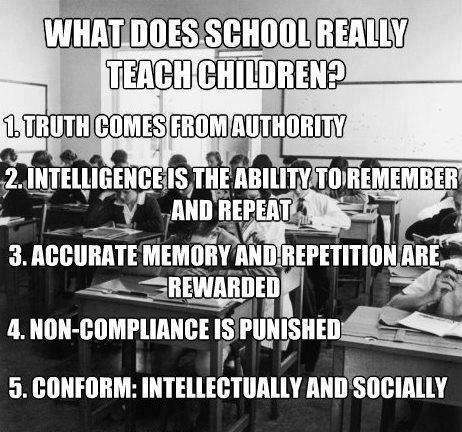
Which really baffles me because I’m used to dogma coming from religion. This meme was posted by a non-religious, progressive parenting page I follow on Facebook:

programming_conditioning

Now, this meme is old news for me.

My fundy homeschool buddies have been passing it around Facebook since Facebook began.

The fact that this is now being passed around by proponents of homeschooling and “unschooling” who are not religious and considered “progressive” is concerning. It seems that there is a new hatred of public school that is beginning to take root, and it has nothing to do with Christians. All the illogical, misinformed, sensationalist arguments against public schools that I’ve seen for years, is being repackaged, regurgitated, and spit out all over the websites of people who think they are some kind of pioneers, that this “rebellion” against formal education is all their idea. They ridicule other parents who put their kids in school, saying we must not love our kids if we send them to “government brainwashing centers” (sound familiar?). Which, of course, usually makes me laugh out loud because I’m pretty sure the homeschooling leaders of the conservative movement of the ’80’s invented that term.

Really though, all they’re doing is perpetuating the exact same dogma that has turned so many of us first-generation homeschoolers away from homeschooling.

You don’t have to be religious to be bigoted or to promote propaganda. A young child of non-religious home-schooling parents just told my daughter “Oh I don’t go to school. School is bad.” Now where have I heard that before?

I feel that I am in a unique position.

My past is colliding with my present. Alumni like me have a lot to offer to the conversation of “new wave homeschooling,” but I feel that often our concerns are brushed aside since “oh, well, we aren’t religious so we won’t have the same problems you did.”

But they already are showing signs of the same problems the original homeschoolers had, just from a completely different point of view.

Ultra-sheltering of children, polarizing, dogma, misinformation, and fear are present in this new generation as much as they were in the old. I’m worried about where this might be going, feeling like I’m watching history on repeat, a helpless bystander as some very familiar insanity is marching by me.

I guess what I want to communicate to my hippie homeschooling friends is this: by all means, homeschool your children. But let me tell you what kind of commitment that’s going to require if you want your kids to have a good education. Because all those blogs you’re reading aren’t telling the whole story. Your kids aren’t going to learn what they need to excel in the world by cooking and painting and playing outside all day. Let me tell you how my mom devoted 27 years of her life to doing nothing but educating us because in order to give us a good education, she had time for nothing else. Allow me to tell the story of how sheltering children in the name of “protection” can utterly backfire. Can we talk about what kind of attitudes surrounding homeschooling can damage the children you love and how to raise healthy kids? Perhaps I can offer the perspective of someone who was raised the way you’re dreaming of, only without the rosy glasses you seem to be looking through. And can we not hold to an “us versus them” mentality? Been there, done that, did its damage. Homeschooling can be awesome. But it can also be horrible. Can I tell you my story and the stories of my friends?

Maybe together, the alumni and the neo-homeschooler parents, we can keep some of the disastrous results of the first homeschooling movement from repeating themselves.

An Average Homeschooler: Part Eight, In Summation

Screen Shot 2014-01-06 at 12.38.16 PM

HA note: This series is reprinted with permission from Samantha Field’s blog, Defeating the Dragons. Part Eight of this series was originally published on December 17, 2013. Also by Samantha on HA: “We Had To Be So Much More Amazing”“The Supposed Myth of Teenaged Adolescence”“(Not) An Open Letter To The Pearls”,  “The Bikini and the Chocolate Cake”, and “Courting a Stranger.”

*****

Also in this series: Part One, Introduction | Part Two, The Beginning | Part Three, Middle School | Part Four, Junior High | Part Five, High School Textbooks | Part Six, College | Part Seven: Graduate School | Part Eight, In Summation

*****

“Common Myths about Homeschooling”

If you search for that term, you’re going to find a lot of articles and videos– some from homeschool kids, but most from homeschooling parents. Most of these articles tend to focus on emphasizing how homeschoolers aren’t strange weirdos, that not all homeschoolers are like that. These posts try to put as much distance between themselves and whatever they perceive to be a “fringe” group that they think make the rest of us look bad. Usually, what gets identified as the “fringe” group is the sort of homeschooling culture I’ve spent the last few days describing: conservative religious (they might say “fundamentalist”) homeschooling.

However, these groups are not as fringe as they’ve been portrayed, and the problem is, what’s “fringe” changes to suit whoever is talking. Kevin Swanson, probably one of the most extreme examples of conservative homeschooling, labeled the stories in the Homeschooling Apostate article fringe“. Fringe, in the sense that many homeschooling advocates use it, doesn’t really mean “peripheral, not in the mainstream”; it means “a position that I think is more extreme than my own.”

So, Myth #1:

Conservative religious homeschooling has virtually no or very little impact on the modern homeschooling culture.

I don’t want to spend a lot of time beating this one into the ground, but I’d just like to point the people who believe this in the direction of the major state homeschooling conferences. Who is coming to these gatherings– still some of the largest and best-attended events in homeschooling culture? Vision ForumInstitute in Basic Life Principles (ATI). Many of the state conventions invite conservative or fundamentalist speakers (like CHEO inviting the Chapmans, although they have apparently withdrawn).

Also, what’s still the most popular curricula? A Beka and BJUPress. Calling those “textbooks” anything but opportunities for fundamentalist indoctrination would be incredibly generous.

Who’s running most of the homeschooling culture media? Homeschooling World is probably still the most significant magazine, and their latest issues includes items like “4 spooky educational trends you should know about” and bemoaning girls who turn from “princesses” into “cowgirls,” articles on how to get your pre-schooler to memorize Bible verses daily, and other titles include words like “ominous” in reference to Common Core.

The Homeschool Legal Defense Association is one of the most powerful educational lobbying groups in America, and the agenda that they are constantly pushing represents an extremely conservative Christian position — in politics especially. Many of the avenues they pursue have nothing to do with homeschooling at all and are instead focused on keeping the US from ratifying the Convention on the Rights of Persons with Disabilities and making sure the Florida legislature stays homophobic.

Myth #2:

Homeschoolers don’t need to take socialization seriously; social interactions with siblings, churches, and co-ops is more than enough.

Or:

Homeschoolers have no reason to be concerned about socialization; you’re doing your children a favor by sheltering them from the influences of The World.

Hopefully I’ve talked about that particular one enough.

Myth #3:

Parents don’t need any form of higher education in order to be good teachers. You do not need training to teach your own children– concerns about high school level materials are misplaced. You can receive enough help to overcome any of the difficulties you might face teaching advanced subjects like chemistry and calculus.

Although many students successfully opt to self-teach or to learn together with an interested parent, the options for children extend well beyond the family. Some families choose to get together to form study groups around a particular subject and to hire a tutor. Some students opt for community college classes. Others barter help with one subject for help in another. Classes over the Internet or the television are increasingly available options for many families, as are videos and computer software.  Learning options are excellent and varied so there is something to meet the needs of every family. [source]

Yes, there are resources for parents who do not feel comfortable teaching the more difficult high school subjects. Personally, I feel that most intelligent parents are capable of homeschooling their child through the elementary grades– however, just because they’re capable doesn’t mean they should, and I think there are parents who should not be teaching even the elementary grades.

When their children hit high school, there are all sorts of opportunities to help balance out what parents might lack– dual enrollment at a community college, distance learning, etc. You might be able to tell that there is a gigantic however coming, and you’d be right:

Although many students successfully opt to self-teach …

Even this article that focuses on “debunking” homeschooling myths admits that self-teaching is the standard. I cannot stress this enough: with extraordinarily few exceptions, fifteen-year-olds are not capable of teaching themselves high school subjects. Yes, many of us are amazing readers and our language skills supposedly test off the charts (when we’re tested, and all of those numbers are self-reported, so, grain of salt). However, that does not mean that we are capable of teaching ourselves things like literary analysis and how to looks for themes and symbols. We are especially incapable of teaching ourselves math and science, however, and that is continually presented as an “acceptable” option for homeschoolers– even though math and science is a consistent weakness in homeschooling.

This does not mean that I don’t think that no one should be homeschooled through high school. I think even high school can be done successfully, but the problem is you have to go pretty far out of your way, and many of the resources available put too much financial pressure on families that were already having a hard time buying textbooks. If you can’t, realistically, take advantage of things like paying to hire a tutor or sending your high schooler to college, then do something else.

Also, since this came up in a discussion a few posts back, giving your child a supposed “love of learning” is not a replacement for giving your child an education.

I find that particular argument to be extremely frustrating. Yes, I obviously love learning, and yes, that could be tied to my homeschooling background. However, and this is anecdotally speaking– I don’t think it’s really connected to being homeschooled. My parents helped give that to me, and they would have done that regardless of whether or not I was homeschooled. I have interacted with many homeschoolers in the last eight years who either hate learning or are so incredibly handicapped that even if they “love learning” they have none of the necessary tools to actually learn.

This idea is usually connected to what is hailed as “self-directed learning,” and unschooling advocates tend to talk about this a lot. Somehow, in these conversations, your child being “interested” in subjects and “pursuing” those interests is painted as being better than your child gaining a broad awareness and basic high school-level education. Speaking as a homeschool graduate who was permitted to pursue my own interests– I don’t use any of those skills today and I would really rather prefer being able to do algebra.

And… that about wraps up what I have to say. At least, until you all comment and get me thinking about something else I haven’t thought of yet! I’d just like to leave you with this: 20 Ways not to Respond to Homeschool Horror Stories.

End of series.

Homeschool to Public School

school

HA note: The following is reprinted with permission from Heather Doney’s blog Becoming Worldly. It was originally published on December 23, 2012.

I figured since I am one of the rare former Quiverfull kids that was both homeschooled and public schooled, I’d talk about my experience. First off, though, I want to say that I find the debate about whether homeschool or public school is inherently better to be the educational equivalent of arguing whether Coke or orange soda is better. It’s utter foolishness when people act like their personal preference is the only one that counts. Overall I believe that human beings are resilient and adaptable creatures, capable of learning in many different environments if given the opportunity and some quality mentoring. If I was choosing how to educate my own kids, I’d want mixed methods, the best of both worlds.

I realize looking back that I have had two different kinds of homeschooling and two different kinds of public schooling, so figured I’d share my experience with each.

Neglectful Unschooling

The first kind of homeschooling I had was unschooling without the very necessary cultivation and introduction to resources aspect.

Basically it was educational neglect.

This is a pretty common problem in the unschooling world from what I understand. I also got intensive religious messages and was forced to submit to rigid and oppressive gender roles. The bits of educational instruction I got were often pretty abusive too because every now and then, when my Dad got it in his head to formally teach me something, the session would generally end with me getting a spanking, grounded, or having the papers thrown at me in disgust because I was “being stupid,” “obstinate” or “stubborn and difficult.” Unsurprisingly, all that did was leave me with a pretty decent math phobia and worries about my mental capabilities. My parents also often told my sister that she was just stubborn and didn’t want to learn to read.

Thing is, my Mom said she didn’t really teach me how to read. She just read me books out loud when I was small and soon I was reading them back to her. That pattern didn’t happen with my sister or any other siblings because it isn’t typical. Yet my parents expected it to work that same way somehow.

They had little understanding of how kids actually learn, or what motivates them, or that it simply isn’t the same for each kid.

I was a self-directed learner who ate up the few books that had been donated to us by other homeschoolers and the boxes full of classic literature that my Grandad sent me. I didn’t get to go to the library. I just read these books and sometimes when I got too absorbed and forgot to wash dishes or change diapers, my Dad came in, snatched my book from me, hit me with it, and yelled at me. My Mom went from claiming that my book reading was “constructive” to saying that it was “selfish.”

Classic Home Tutoring

After this first kind of homeschooling experience had been thoroughly put to shame by my grandparents and the Sylvan standardized testing they secretly got for me and my sister, I started the second kind of homeschooling. It generally involved sitting at a desk every day at the same time, working through problems, diagramming sentences, having problem sets to solve and a row of sharpened pencils, with regular interspersed “field trips.”

Now I had to answer to my tough, tattooed up old Grandad, a former Navy commander who’d never homeschooled anyone or previously had the desire to.

He had flown me out West to stay with them for a few months and to give an excellently intensive if sometimes harsh go of his brand of tutoring, motivated by his love and concern for me.

My Grandad and I drove each other crazy at times but ultimately bonded for life. He loved being a homeschooling grandfather. He would go on to do the same with my other school age siblings, and later told me that he found his role in his grandchildren’s education to be one of the most satisfying things he’d done in retirement.

He was not motivated by any sort of religious instruction goals, but rather valued and had respect for classical curriculums that connected history to current events, modern life, and a versatile skill set. He also said being cosmopolitan and well-rounded was the primary goal of education.

It wasn’t just about finding a job or about knowing stuff, but making yourself question and think, being a world citizen.

He introduced me to books on Native American history, and Greek and Roman mythology. He brought me outside at night to point out the Seven Sisters of the Pleiades among the stars and tell me the story, and recount what these constellations had meant to sailors of old. He and my Grammy took me to museums and national parks and to go try sushi, fried rattlesnake, and spanikopita. They brought me to see Phantom of the Opera. They got me once a week snow-skiing lessons with teens my age. I was encouraged to find pen pals among them and to practice penmanship, and so I did. I was told to keep a diary and a scrapbook where I wrote down my experiences and saved mementos from events.

I still have those things and they are some of my most valued belongings.

My Grandad continually said, “The world needs lerts, so be alert!”

At the end of our intensive tutoring sessions or a day walking in the redwoods, or a day learning about volcanic activity while swimming at Mammoth Lakes hot creek, my brain would feel tired in a satisfied sort of way. I knew without a doubt that I was learning and it made me much happier about life. I loved it.

When I went back home to my parents, my Grandad gave me a self-study schedule written out on a yellow legal pad so I could hopefully somewhat replicate this rapid rate of absorption. I wish I could say I kept up with the books like he’d had me doing at his house, but I didn’t. No one was pushing me at home, so I only studied what I liked, and what I liked were novels that I could become totally absorbed in and ignore the stressful reality of a family situation I now loathed even more.

Cliquey Public School

Because my parents still weren’t teaching us and my Mom had pretty much given up, the next year we all got sent to public school.

I was both excited and scared. The local high school was known as the “bad school in the good district.” Over a third of the kids (including me) got free lunch because their parents were poor, and it was about half white, half “people of color” — mostly black and creole, a few Hispanic and Vietnamese. My school did really well in sports, less so in academics.

At registration nobody checked to see if I was up to grade level or oriented me to what public school would be like, instead simply assigning me to 9th grade based on my age.

The first week of classes were absolutely overwhelming.

I got laughed at on the bus for handing the driver the paperwork and saying, “My Mom said to give you this.” After being isolated so much, now I was constantly surrounded by people my own age, hundreds of conversations going on in the lunchroom at once, but nobody wanted to sit by me. They already had friends. I was an unwelcome stranger. Someone even threw my backpack on the floor and told me to go sit somewhere else. Finally I got invited to sit at a lunch table by a guy who had a lisp and I gratefully shared eating space with him, a “super-senior,” a pregnant girl, and a tall skinny gamer who wore his backpack on one shoulder and ran to lunch when the bell rang in order to be first in line. They were nice to me, the first friends I made, and I will be forever grateful. They reassured me and gave me hints after I got lost going to my home room class, received a detention for lateness, and got glared at often because I apparently unknowingly stared at people. I’m sure I did stare.

These teenagers were fascinating and I’d never seen anything like it.

Then there was the weirdness of learning how to do homework and study for tests and figure out when and how you are or aren’t supposed to ask questions in class while surrounded by people who’d done these things their whole lives. Everybody assumed I should just know this stuff and was from another planet when I didn’t.

By the end of the first week I was pretty much singled out as a weird kid, by both teachers and students.

One teacher thought I might have a learning disability and scheduled a parent-teacher conference. Classmates made fun of my Walmart shoes. Some boy asked me for a blow job and got people laughing when it was obvious I had no idea what that was. A group of girls walked by and one put gum in my hair. A boy hit me in gym class, I hit back, and we both got suspended for fighting under the “zero tolerance” rules. That’s how for a short time I became one of the “bad kids.”

I had to attend three nights of “PM school” with other suspended kids from around the district, some who’d thrown chairs at teachers, had sex in the bathrooms, set things on fire, or brought vodka to school hidden in Sprite bottles. We all sat around in a circle and talked about what we did wrong and what we should do better next time. Most of them were pretty disrespectful and said school was stupid and they couldn’t wait to drop out when they turned 16.

I really hit the culture shock head on right there.

Why didn’t they want an education? I’d had to fight so hard to get mine and I had no intention of letting anything take it away from me.

Around that time I discovered that high school was two-tiered. There were the regular and remedial classes and then the honors classes and advanced placement classes. The kinds of people who took either of the latter were treated better. Honors and AP classes also had people who were more invested and were given more in-depth information, but nobody else in that classroom seemed to feel as enthusiastic about learning as me. I was absorbing everything all at one time — the coursework was only part of it. How to walk, how to talk to people, what were appropriate topics of conversation, what to wear, what not to say seemed even more crucial.

Often it seemed there were more important things I was missing in my education than book learning, and I just made social mistake after social mistake. I was made fun of ruthlessly about them, remembering even one of the coaches laughing when some boys threw balls of paper at me in civics class.

I told my parents about the bullying once.

When my Dad’s response was, “Well, it’s ok with me if you drop out.” I never said another word about it.

I didn’t want them to have any excuse to pull me out. I just soldiered through. I made up my mind I would not be one of the dropout crowd. Here’s the thing about bullying though — it often just happens to new kids. Once your quirks and social status have been thoroughly made fun of, then you start to become accepted. The hazing (however wrong it is) is over. Girls start to give you tips about how to dress and talk and ask if you want a cigarette (no thanks), and guys start to flirt and ask to copy your homework (um, no. Well…maybe an exception for that cute one).

The learning curve that first year and a half was quite steep and I was stuck between different educational worlds where I had to know very different things to get by. I failed my first algebra class (what on earth were those letters doing in the math problems?!) and so sophomore year I took remedial math and honors English and history. I got invited to work on the school newspaper and the literary publication due to my work in honors English, and I got suspended again for getting in another fight (in the middle of class, no less) in remedial Algebra. This time I knew what these school fights required, so when the girl called me out and threw a punch, I grabbed her by the hair and hit her in the head a bunch of times until some guys pulled us apart. Now I figured people would get the message and nobody was going to threaten or try to fight me again.

I was also going to make her pay for ruining my perfect attendance record.

After serving my suspension, I apologized profusely to my poor math teacher (she was this nice Pentecostal lady who patiently tutored me during free time in math class and at lunch), and about six months later I made peace with the girl I’d fought.

I’d listened to the principal talk to her Mom and realized her home life was harder than mine.

Still, what would have once seemed counterintuitive to me — fight harshly to avoid more fights — had worked. Nobody tried fighting me again and the bullying subsided.

College-Bound Academic Track

By the time junior year came around I pretty much had the high school thing down. I was now one of the “smart kids” due to being in honors and AP classes. I rarely got detentions and never got suspended again. I found myself being nice to new people and often befriending exchange students, giving them the same tips I’d needed myself. I made a number of good friends, had lots of acquaintances, got good grades, passed notes in class, had a couple short-term boyfriends, and went to a number of high school dances.

I was passing for normal, working at the local grocery store, and feeling like my life was headed in the right direction.

Except for how awful it often was at home.

Quiverfull Values vs. Public School Values

My parents were still ideologically attached to the Quiverfull stuff even though their marriage was disintegrating and it was plain to see that actively living it was no longer doable. I had thoroughly rebelled against all of it and my younger siblings were now oriented in a similar direction. According to my Mom I was a bad example — disrespectful, a negative influence, and I had a poor attitude.

When I was given a Good Attitude Award at school for all my Key Club volunteer work, I waved it at her as vindication.

It was ignored though. Her criteria were different. I faced one perspective at school and another at home. At home I had to help care for a bunch of younger siblings in addition to homework, and was still hit by my Dad as “punishment,” (even though I fought back) right up until I moved out at age 17. After that I tried to throw all of it in the past, start college, and successfully “pass as normal.”

So do I think homeschooling can be great?

Yes.

Do I think public school can be great?

Yes.

Can they each be mediocre and uninspiring? Yes.

Can they both be awful and hurtful and soul sucking and practically the worst thing ever? Yes.

Can you work to overcome the bad stuff? Yes.

It’s all about implementation and setting goals and neither can be successfully done in a vacuum, ignoring what else is going on around you.

When people just look at the labels and decide whether it’s good or bad based on only that, they are being incredibly shortsighted. Education has so much more to do with mentorship, respect, and access to a challenging and inspiring curriculum.

I loved the type of homeschooling my Grandad did, and I loved my AP high school classes and the friends I made (some of whom I am still close to).

But most of all I loved going to college. It was like the best of the homeschooling and public school worlds combined. I could choose my classes, topics, and schedule, yet I had people guiding and supervising my work, helping me improve it.

I value my education and expect to always be committed to lifelong learning, no matter the setting.

The Freedom From a One-Size-Fits-All Approach to Education: Apollos

positives

The Freedom From a One-Size-Fits-All Approach to Education: Apollos

HA note: The author’s name has been changed to ensure anonymity. “Apollos” is a pseudonym.

I loved being homeschooled.

Homeschooling gave me freedom. The freedom to explore my interests. The freedom to follow my heart’s passions. The freedom to study the things that I wanted to study.

It was an overwhelmingly positive experience that I would never trade for anything.

I was homeschooled all the way through. Starting in kindergarten through highschool graduation. Religion was a factor and I don’t mind that. My parents are Christians, we were in a Christian homeschool co-op, and I am still a Christian. I am not ashamed to say I love Christianity and I love homeschooling.

But what I love about my homeschooling experience was the lack of structure.

It’s not that there was zero structure. I had to learn the basics. Ya know, math, science, history, language arts. But there was no per se “curriculum.” We’d start with some general outline: read this book, or that book. My parents would assign me a book on U.S. history, for example. And when I read something interesting about William Jennings Bryan, I was allowed to focus on Bryan and progressive Christian politics. I wasn’t forced to only study the side of history (or the ideas on that side) that a particular group of people liked.

This freedom really fostered my creativity and my innate desire to explore new ways of thinking.

In a very true, deep way I was not taught what to think, but how to learn.

And again, my family was Christian.

But they didn’t let their ideas about religion get in the way of my education. In fact, their willingness to let me look at ideas they personally disagreed with ultimately led me to see that Christianity doesn’t have to be believed from a fearful, reactionary stance.

In the last few years, I’ve noticed a big push in homeschooling towards “Classical Christian Education.” (I’m just going to call that “CCE” for short.) Which is funny, in itself, because that push comes from Mr. Slavery Apologist himself, Doug Wilson; which, insofar as slavery is truly a classical institution, demonstrates that “classical” isn’t all that it’s cracked up to be. Wilson’s books, Recovering the Lost Tools of Learning and The Case for Classical Christian Education, have been credited by many people in the CCE movement as being inspirational. Lots of Christian homeschoolers I know are now moving in this direction; Classical Conversations is one such manifestation.

I find this odd. Key to the CCE movement is the radical integration of one particular worldview into all subjects and a reliance on Middle Ages pedagogy. Is everyone forgetting that these are the very things that Protestants did when they created the public school systems in the first place — the systems that us homeschoolers have tried so hard to break free from?

I don’t see much difference between the public school mentality and what CCE homeschoolers are now doing.

They’re both using the same top-down techniques and one-size-fits-all pedagogies which — when I was being homeschooled — were explicitly rejected by the homeschooling movement.

But I digress.

The main thing I wanted to say was how thankful I am that homeschooling, for me, freed me from a one-size-fits-all approach to education. It liberated me from a one-size-fits-all curriculum, too.

That freedom made me an enthusiastic student, as well as strengthened my relationship with Christ.

Not Well-Rounded, But Excellent: Sean-Allen Parfitt

positives

Not Well-Rounded, But Excellent: Sean-Allen Parfitt

HA note: The following is reprinted with permission from Sean-Allen Parfitt’s blog Of Pen and Heart. It was originally published on August 16, 2013. This is the second part of Sean-Allen’s three-part series for HA. Read Part One here.

My whole family has been homeschooled from kindergarten through high school. In last week’s post, I discussed how I was forbidden to learn anything that was “unapproved”. Though the effect was a deprived of a well-rounded education, I will stand by my opinion that my home education was actually quite excellent.

The base curriculum my family used was Rod and Staff. As is frequently the case with Mennonite education, the curriculum stopped at grade 10, so for grades 11 and 12 we used the curriculum by Bob Jones University Press. The BJU Press science curriculum was also used to supplement the lower grades, as was their math curriculum from 9th grade on.

The schoolwork we did was in fact quite vigorous, and Mom was a strict teacher.

We were far from “unschooled”, as some families are. Quite the opposite; we were not allowed to play until our homework was done. For many years we were required to complete every problem, question, and assignment in every lesson of every book. Every wrong answer was to be reworked and returned for re-grading until it was correct. Every reading lesson was read out loud to Mom, and any mistakes in pronunciation or inflection were to be corrected and the section read over until Mom was satisfied. Every essay was carefully scrutinized and marked up with red pen. All suggested class questions from the teacher’s manuals were duly asked, and answered. Every flash card drill was performed, with all speed times for each child written in the teacher’s book to be compared to previous work, both by the individual child, and to his or her siblings who had gone on before!

As you can see, this rigorous classroom method kept me working hard at my desk for much of my childhood. I studied math, English, science, geography, history, and other subjects. As the eldest, I did not have the competitive element that came from comparing the younger ones’ work with the older ones’. Nonetheless, the in-depth curriculum, along with Mom’s strict grading, kept me aiming for the highest grades possible. Every misspelled word was -1/4 point, and any other mistake was at least -1 point, if not -2, depending on the problem and the severity of the mistake. An A grade was 95% or higher.

I didn’t pick up as much in science and history as I did in English and math. But the education I did receive, and retain, was quite sufficient. In fact, it was superior to many public-schooled children in America.

Every 2 years our family took standardized tests, and we routinely ranked in the 99th percentile in many subjects.

When I took my SAT, even though my score wasn’t as high as I was hoping, it was still quite good. I took the entrance exam to attend Monroe Community College, which consisted of an English section and a math section. Afterward, when I sat down with the adviser, he told me that I had done so well… I had only gotten one question wrong on the whole test. They placed me in advanced composition, which in which I received an A, and when I took pre-calculus, calculus I and calculus II, I got A, A, and A-, respectively.

I believe that my academic education, though perhaps lacking in literature and humanities, was quite sound. My English skills gave me an advantage when learning Spanish, as I thoroughly understand how grammar works. My scores of essays written in school now serve me as I attempt to communicate with the world. Math was indispensable in college, and I even use it sometimes today. In fact, my career as a software engineer was born from the seeds my father planted, when he taught me how to program in MBASIC on an Osborne Executive when I was only 8 years old.

He nurtured this throughout my middle- and high-school career, and now I program for a living.

Even though there were some drawbacks to being educated at home, I emerged academically well prepared with a career path ready for me to follow. I am extremely grateful for the care my mother and father put into making sure I was ready for life. One thing I’m really not good at: speling.

*****

To be continued.

Children’s Rights and Homeschooling: Patrick Farenga’s Thoughts

Children’s Rights and Homeschooling: Patrick Farenga’s Thoughts

One of the reasons John Holt, a secular founder of the homeschooling movement, decided to fully support homeschooling was his hope that parents would be more likely to work patiently and differently with their children at home than teachers in school can, and would therefore learn from the children what is and isn’t working. Holt’s ideas about homeschooling are probably very different from what many members of Homeschoolers Anonymous experienced: Holt didn’t want to bring the techniques and concepts of school—which he showed in his books weren’t working in school anyway—into the home. “Don’t turn your home into a miniature school,” Holt advised in 1981 when he wrote his only book about homeschooling, Teach Your Own.

After years of working in schools Holt was appalled at the gross incivility, mindless activities, and outright meanness inflicted upon children in the name of education. One of the ways he imagined that things could be improved for children was to promote children’s rights, since his own efforts made him realize the futility of trying to make meaningful change within the school system (which is still reforming itself 32 years since Teach Your Own appeared). Holt wrote a book that describes how and why giving children rights makes practical sense: Escape From Childhood: The Needs and Rights of Children (1974; reprinted 2013). It was controversial when it was published, causing both liberals and conservatives to condemn Holt’s ideas that children should be allowed to do pretty much what any adult may legally do.

Up until 2012, 9 out of 10 of Holt’s books were still in print. Escape From Childhood is the only one of Holt’s books that I have never been able to interest another publisher in; all editions of the book have been published by HoltGWS since the original publisher let it go out of print. Clearly, this is not a topic mainstream people want to engage with but, as I’ve learned over the years, it is vitally important if we want to find other ways to help children and their families get out of bad situations besides creating more layers of child protective service agencies.

Many of the ideas Holt puts forth in Escape are to prevent tyrannies at home and in society, and they are based on our Bill of Rights, thereby grounding all people to the same rights and responsibilities. However, Holt adds a new dimension to the concept of rights to account for children’s inexperience and their need to learn from the choices they make over time. Rather than just give children the rights of citizenship all at once beause they have turned 18, Holt offers a framework where children are able to move in and out of the “walled garden of childhood” as they feel ready and able to, so they can test the waters of responsibility and swim, or decide to wait for another day if the responsibility is too heavy on them now. Holt felt the best way to get good at making choices is to make a lot of genuine choices and determine what worked best for you. Right now our society denies young people responsible choices, while expecting them to assume this same responsibility at an arbitrarily determined age. This is the essence of Holt’s argument, though I urge you to read his book and learn about the history of childhood and all the nuances about rights, children, families, and primary and secondary guardians that Holt presents.

The issue of children’s rights is large, but I want to focus specifically on child abuse and homeschooling. Holt deals with abuse from several angles in the book, including the adult points of view. For example, he discusses the burden of having children and how the authority of the old is diminishing, but Holt presses the case for why adults need to relinquish some of their authority in order to provide children the opportunity to grow independently.

. . . to expand protection against abuses of authority without diminishing authority, is impossible, a contradiction in terms. There can be no adequate protection against the abuse of authority, of parents or the state, except to give the victim the right to escape it.

The authority that Time has in mind when it talks about the “psychic benefits of parental authority” is not natural authority but only the power to compel, threaten, punish, and hurt. The fact is that children can be and are regularly punished, by parents and the law, for any of the reasons, and the same reasons for which slaves used to be punished—for talking back, for “disrespect,” for disobedience, for being at large without permission, for running away—in short, for doing anything that might imply that they think they have any freedom or rights at all. (p. 153)

Escape From Childhood is full of examples of how children, from the mentally challenged to compliant overachievers, are often hurt or neglected by adults who, “for their own good” force them to do things the children would rather not do, so I won’t labor the point here. However, it is important to note that Holt wrote this in 1974, not knowing anything about homeschooling as we know it; he saw all children in society as being mistreated. Holt was willing to take the chance that by supporting homeschooling some children will be raised by parents whose views of children and education are radically different from the self-actualizing vision of learning Holt supports. Holt hoped that most homeschooling parents would not be so obedient to the demands of modern educational theory or religious dogma and would instead learn directly from their children what was and wasn’t working for them, and make adjustments accordingly.

Unfortunately, many adults seem willing to sacrifice their relationship with their children upon the altar of education and dogma, so I’m not surprised that now, as adults, children whose lives were insecure and violent at home now want to sacrifice homeschooling upon the altar of education and dogma. However, I urge you to take a step back and reconsider strategy and tactics.

It is easy for me to imagine Homeschoolers Anonymous becoming a typical political group, uniting anti-homeschooling forces under the banner of regulating homeschooling to protect homeschooled children from abuse. This will certainly result in an increase of professional educators’ and government reach into people’s homes, which will lead to the exact opposite of what Holt advised: our homes will become miniature schools run by the state. Your anger at being physically and emotionally abused as children, and then, as adults, being outcast by the homeschooling community for publicly noting your suffering and wishing to ameliorate it for a new generation of homeschooled children, is perfectly understandable. However, homeschooling does not cause child abuse. Being a tight-knit or loose-knit family doesn’t cause child abuse; child abuse occurs in public and private schools, churches, sports, the entertainment field, in all professions. It is a problem that is much bigger than homeschooling and we should treat it as such.

I urge Homeschoolers Anonymous to recognize the fluid nature of homeschooling regulations and laws in the United States and how many of the court decisions that allow alternatives to compulsory attendance in public schools are based on religious exemptions that are tied to preserving traditional ways of life (Amish, Mennonite, and so on). It is unlikely at this time in our history that the courts are going to rule against religious freedoms. Further, many adults in the United States appear to support corporal punishment—paddling is explicitly allowed in public schools in 19 states—and its widespread, though no less punishing, variant:  time outs in closets, padded rooms, and so on. It also needs to be noted that invasive practices such as electro-shock therapy for “difficult” children are permitted in many private institutions in states that otherwise ban corporal punishment in public facilities, so the situation is not easily solved by changing existing laws.

Rather than battle homeschooling regulations head on, with the real danger of creating more regulations for secular homeschoolers and strengthening the religious exemptions that permit families to prevent their daughters from aspiring to high school or college and keep their sons in line with stern obedience to authority, Homeschoolers Anonymous can build on the do-it-yourself model that homeschooling embodies. The prospect of increased scrutiny by outsiders keeps many abusive situations from being publicly acknowledged, and homeschooling is no exception. However, I think Homeschoolers Anonymous is correct to sound the alarm now so we can create awareness and solutions about this difficult issue that is different than what we’ve seen to date from other institutions. Like the leaders in the Vatican, the BBC, Penn State, and numerous other institutions, homeschooling’s leaders can easily fall prey to the means (ignore or cover up the abuse) justifying the ends (the institution continues to flourish despite the ongoing abuse, which the institution says it is handling in its own mysterious way). Like you, I refuse to see homeschooling freedoms preserved upon the broken bones and dashed hopes of children, and I hope we can get others to agree to offer help and enforce existing abuse laws rather than accept the status quo as the only way to preserve homeschooling freedoms.

Child abuse is a major, ugly issue that is difficult to discuss, especially among homeschoolers who are fearful of government intrusions into their lives. We tend to dismiss child abuse in homeschooling circles because most of “us” are “good people” or “good Christians.” But the reality is there is some child abuse going on in homeschooling, just as it goes on in schools and homes all around the world. To have the courage, as Homeschoolers Anonymous does, to stand up and call out an injustice being done to an unrepresented minority, children, is an important first step. Showing how this injustice is perpetuated in practice can help parents and children see that their situation is not normal and they are stuck in a bad homeschooling situation. Homeschoolers Anonymous can then provide support for dialog within their family, healing, or escape routes, among other options. It is important to let children and spouses know they are not alone and that others have navigated this path. The Underground Railroad was built and functioning for many years before the Emancipation Proclamation was made law, and I think we need to remember that.

Building the moral and legal case for children’s rights should not be a single, high-stakes courtroom battle focused on homeschooling, but a tactical approach focused on helping children and spouses find ways to get out of abusive situations and a strategic one of uniting with other groups that seek to end corporal punishmentnot homeschooling—for children in society. We have a long tradition at HoltGWS of being against corporal punishment (scroll to the bottom of the page) and the list includes a Christian homeschooling group opposed to hitting children (Parenting in Jesus’ Footsteps).

I thank Homeschoolers Anonymous for the opportunity to express some of my views on children’s rights and homeschooling. There is so much more to say; I’ve only just scratched the surface with these remarks. However, I look forward to seeing the creative and powerful solutions you will make regarding children’s rights based on your collective experiences.

For further reading:

Escape From Childhood: The Needs and Rights of Children is available on Kindle: http://www.amazon.com/dp/B00B42K3LE

Escape From Childhood will be also available as a printed book from Amazon as of June 1, 2013.

About the author:

Patrick Farenga.
Patrick Farenga.

Patrick Farenga started work with John Holt in 1981 and published Growing Without Schooling magazine and numerous other publications related to homeschooling, unschooling, and learning outside of school from Holt’s death in 1985 until 2001. Farenga and his wife homeschooled their three daughters, who are now adults. He continues to keep Holt’s ideas alive by writing, speaking, and publishing through HoltGWS LLC and www.JohnHoltGWS.com.

I Can’t Tell My Story Without A Trigger Warning: Elizabeth’s Story

I Can’t Tell My Story Without A Trigger Warning: Elizabeth’s Story

HA note: The author’s name has been changed to ensure anonymity. “Elizabeth” is a pseudonym.

*****

Trigger warnings: this story contains graphic and detailed descriptions of rape, physical abuse, the physical results of abuse, and religious apologisms for both physical and sexual abuse of children.

*****

I can’t tell my story without a trigger warning. I try writing it without describing physical and sexual abuse and it just doesn’t work. It could get graphic.

I just spent the last half an hour sitting in the corner, hugging my knees, and bashing my head into my wall because I dared to post a link to the HSLDA petition. I’m nearly 40, but I’m terrified of getting into trouble.

I can’t use my name–call me Elizabeth. This name I write with isn’t mine. I picked a name that I think is the sort of name that a typical white, protestant American would have. I hope that some homeschooled kid with that name and a similar story won’t be tortured or shunned on account of my speaking out. I just hope that anyone who reads this and sees someone they know knows that it wasn’t really them. It’s just an eerie similarity. Please don’t punish them for speaking out, because I’m someone else.

I can’t tell my story exactly. I’m afraid my family will recognize that it’s me writing. I only feel safe writing anything at all, even vagueing up the details, after reading the lawsuit filed by survivors of abuse covered up by sovereign grace ministries. It’s sad when the text of a lawsuit reads like your biography, but there you have it. It made me realize that this culture of abuse is sufficiently widespread that my parents could just read my personal story of our nightmare family and assume it comes from any anyone anywhere.

It at least gives me some plausible deniability. Not that I need plausible deniability–I have no contact with my family or anyone from my childhood. I won’t even be setting foot in a church again. But I’m so terrified of repercussions that I need a crutch. The brainwashing runs deep. I know I’m safe intellectually, but the rest of me doesn’t believe that safety is possible.

What lets me comment on the differences between homeschooling and other kinds of schooling? I’ve done it all. We started in a religious homeschooling coop–we did PACES first, later A Beka. Then my parents homeschooled us by themselves in a Northern European country–the rest of my education was in the United States. When we homeschooled in Europe there was no curriculum: it was closer to unschooling. Then they sent us to a private fundamentalist Christian school. Then they sent us to public school.

My parents’  reason for homeschooling us was ostensibly religious. We never heard that we’d get a better education than in public school. That wasn’t the issue. The issue was that public school would corrupt us. There’d be peer pressure. We’d risk getting caught up in a bad crowd and imperiling our immortal souls.

This seemed plausible at the time. After all, our church was very isolationist. You know that Emo Philips joke about the Baptists on a bridge? That was us. Everyone else was wrong. We spent hours learning about other denominations and how they got it wrong. Maybe some other Christians would still get into heaven, if God was extra merciful, but we were the only ones who actually had it right!

Did I mention that I basically had zero friends?

We were taught that children had to obey all adults unconditionally and instantly. We were taught that good Christian children who don’t want to burn in hell submit to their parents. They submit to discipline from their parents, other adults, or older children. They submit to spankings. They do not talk back. And so on. If you are wrongly accused you should still accept your punishment because you are a worthless sinful being and the punishment is probably good for you anyway. If you don’t accept punishment when you’re wrongly accused, that’s a sin, so you need to be punished for that now. Catch 22.

And we were taught that good, Christian children do not ever let anyone find out that they aren’t completely thrilled with their lives. We should never complain to secular authorities (or anyone, for that matter, but especially secular authorities) about anything. It makes us bad witnesses. It makes us bad Christians. And we might also be selfishly risking the destruction of our families because CPS will come and take us away. And there isn’t anything better, so after CPS destroys our families, we’ll still be disciplined so destroying our families and our parents’ good names will have been for nothing. If your bottom is sore from a spanking, you’d better not wince as you sit down. If you’re in pain down there, you’d better not let it keep you from walking normally. Don’t talk about your punishment. Don’t let anyone see you cry.

And we weren’t taught about sex, or wrong touching, or children’s rights. Most kids would get this in public school. At a young age, they’d learn that there are things adults aren’t allowed to do to them. They’d learn that they have the right to say ‘no.’ They’d learn that if something is wrong they can tell their teacher or call the police or something. Later, they’d have sex education and learn what sex is.

Here’s what I thought the word “spanking” meant when I was a kid: if your dad is home, usually it happens right away in your bedroom or his. If your dad isn’t home, you get sent to the guest room, where there’s nothing to do in the meantime, to wait for him to get home. Then the spanking commences. Maybe he’ll go for the big wooden paddle. Maybe he’ll pull off his belt. Sometimes he gets them both out and makes you chose. If he makes you choose, he’s feeling particularly sadistic.

Just the paddle is better. Then he sticks to your unclothed bottom and thighs. The pain is excruciating, but it’s a good sign if he doesn’t take his belt off at all. He’ll probably just finger you a bit when he’s done. Ditto if he bends you over his lap instead of over the edge of the bed. If he just breaks out the belt, he’s lost his temper. You’ll get hit everywhere that can be covered by clothes. The individual strikes aren’t as hard as with a stick, but the beating goes on forever. Sometimes your body just shuts down. Maybe that’s better; if you wet yourself the spanking might stop there because you’re now too gross and dirty to rape. But usually he’s going to finish the “spanking.” The whacks stop coming and then he’s inside you, crushing you with all his weight and ramming into you over and over until he’s done with his business.

I was told that all kids got spanked. I didn’t understand that ‘spank’ meant a bit of a beating for most people and not an extreme beating followed by rape. I didn’t even know what rape was, as I knew nothing about sex. I had no idea what was going on.

Spanking was how my dad got access during the day. If he wanted it and I hadn’t done anything wrong, he would make up something wrong. Notably, he’d wait for me to look at the telephone. Mind you, I was too short to actually reach the telephone up on the wall, but he needed to make sure the message was ingrained. He’d wait for me to look at the phone then punish me for thinking about making a phone call. For thinking about lying to people that I was being abused. It was part of his way to drill into my mind that there was no way out. That this way of life was all there was or ever could be.

I only remember a few instances of explicit training. I remember a gruesome rape when I was too young. I can see my baby fat hands in my memory. I can taste blood. I wonder if that was the first time. I think the ripping might have caused some nerve damage. I can’t actually feel much on the surface, which might have made me the perfect victim in the future. He could do whatever they wanted and I wouldn’t react much. I remember one day when I was older–maybe 3ish–getting taught to relax properly, to stretch out, to be able to take in something larger. Being told that this is what big girls are supposed to do. This is what good girls are supposed to do.

Compared to a spanking, simple molestation didn’t mean much. There was a ‘monster’ that came at night and did his thing. I was told that I had nightmares. And I had to comply instantly with any demand made by an adult. I had to do whatever they wanted, whenever they wanted. So if I was running around at church and an adult said I had to come give him a hug, I had to. And if his hand slipped up under my skirt, I was supposed to relax like a good girl and ignore the uncomfortable pressure filling me up. I guess it got out to anyone who was interested that I was groomed for complete submission and wouldn’t make a scene. I don’t know if he shared me on purpose or if all the perverts attracted to the good cover of a patriarchal church found me independently.

The violence was most extreme when we were at the cooperative homeschool. The school and the church reinforced the message. We only came into contact with other kids in the same situation. The probably weren’t all being seriously abused, but some of them sported regular bruises–new dark blues and purples in a new pattern over the fading browns and yellows from last week. Even the ones who weren’t abused weren’t told that they had rights. None of us was going to compare notes and discover that rapes weren’t a standard part of spanking. It was Orwellian. We didn’t have the words or concepts to address any of it.

No one at church would question my dad’s authority. He was a well respected member of the community. He was all godly and stuff. The benefit of the doubt extended to someone in his position was endless. By homeschooling us through this crucial period, my dad normalized abuse and kept me from finding out that I had rights. I literally had no idea until I was an adult that there was anything else out there, that this was not the natural order of things, that everyone wasn’t raised with this sort of abuse. Insofar as I ever heard about child abuse, I was taught that abuse was something that happened to other people.

When we homeschooled in another country, the abuse stopped almost completely. My dad was away from the comfort and safety of being an established pillar of the community. The monster still came at night, but the daytime abuse was drastically curtailed. I spent huge amounts of time being free and happy. The only punishment I recall was being yelled at.

I was only punished for one thing: speaking the other language. Somehow I’d picked it up, although my parents and other siblings hadn’t. My dad could use English at work and didn’t need to know it. Everyone spoke English in the shops anyway. My mom didn’t have a problem with it, but my use of the other language outraged my dad. If I uttered a word in front of him, his face would turn red and he would explode with anger.

How dare I speak another language. I couldn’t know what I was saying if it wasn’t English. I could be insulting someone and not know it! Because I couldn’t possibly know what I was saying if he didn’t know what I was saying. I couldn’t guarantee to him that I wasn’t saying something inappropriate because he couldn’t speak the language. So the act of speaking the other language was deceptive: I was hiding things from my parents by not speaking English. I never knew that I wouldn’t be spanked after these outbursts; I only connect the dots with the illegality of spanking in the other country now, as an adult. Looking back, I realize that he was afraid of getting caught in a country that cared about its children. He needed to make sure that I didn’t trigger any alarm bells there and get rescued by their child protection agencies.

When we returned to the US, we went to a fundamentalist Christian school. The ‘spanking’ resumed but it was much less frequent. Partly the training had kicked in and I was a good little robot. It was very difficult to find a reason to spank me. Partly we now lived in a bigger house. I had my own room and was far enough away from my parents room that it was unlikely for it to wake anyone up when he came in at night. Partly he couldn’t assume that he’d get a free pass at the new school. Teachers were from other denominations who might be just as distrustful of us as we were of them. Some students were just there because their parents thought they’d get a better education at a private school. Some students were even there because they’d been expelled from every other school and their parents couldn’t find anywhere else to take them. While I was guaranteed to not get any sex education or get told I had rights by the school, it was less clear that I wouldn’t exchange information with peers who knew stuff.

The fundamentalist Christian school went bust over doctrinal differences (surprise, surprise) and I was allowed to finish out high school at the local public school. It was the most supportive and loving environment I’d experienced in my life. No one made fun of me, as they had at the Christian school, for having zero social skills. People, not just teachers but students as well, put up with horrific ideas from my upbringing and gently taught me tolerance. Even people who didn’t like me were still patient and cordial with me. And my dad had to stop the ‘spankings’ altogether.

He still came in at night. He suffocated me so I wouldn’t wake up. I only woke up to absolute terror a few times. Rape is a thousand times more terrified when you fade in and out of consciousness from lack of oxygen. When I asked the youth pastor at church he said it was a demonic attack. I tend to trust my gut; I don’t know if that’s good or bad. But he wasn’t the brightest bulb in the box. I think he was just gullible and never got any sex education himself either. He was a relatively young adult who had never dated. I don’t think he had any idea that he was passing on a lie used to conceal abuse.

Unfortunately, I got to public school too late to get sex education. It would have been covered in junior high. I’d learned about periods the day my first one started (I was at the Christian school at the time). A neighborhood girl who went to public school found out how little I knew about it and tried explaining the facts of life to me, but she was several years younger than me and hadn’t learned all the details herself yet. I am grateful that she noticed something was wrong with my complete lack of education and did her best to step in and fill in my educational gaps. But there was so much she couldn’t tell me.

So I didn’t know that periods were supposed to happen regularly, about once a month. I didn’t understand that it wasn’t normal to go months between periods. I didn’t understand that that much pain and that much blood was abnormal. I didn’t understand that something was very wrong if you had to spend several hours bleeding into the toilet and passing chunks. I didn’t put two and two together until I had my first miscarriage as an adult. Then it hit me that my period got regular after I got married. I wasn’t in so much pain. The flow was lighter – a pad was enough instead of having to spend time on the toilet because it was too much. And it hit me that while I’d had a few odd periods in high school, I’d mostly just had a succession of miscarriages. I still can’t have kids. I wonder if it’s from too much violence to my reproductive organs at such a young age. It’s not something I can face having a conversation with my doctor about.

I didn’t understand that I was experiencing rape until we had to read a short story in 12th grade advanced English about a girl being raped. That’s when I learned that that’s what rape was and, by extension, that’s what sex was. But I was too afraid to tell anyone. The programming to pretend everything was fine persisted. Teachers and counselors noticed and asked if something was wrong and I instinctually lied every time. I didn’t know how to do anything else. I didn’t believe anyone could help me, just that it would get back to my parents that I’d told someone. And then I’d be in for another spanking; I’d rather have died than risk another spanking.

I tried reporting my abuse to the authorities once as an adult but the law wasn’t on my side. If I’d been a minor, they could have gotten CPS involved. But as an adult, the law is written for specific instances. You can’t charge someone with years of violence and rape where there are so many memories jumbled together. You need a report of a specific instance. And remembering a specific instance with all its details when it happened all the time is like remembering what you had for dinner on March 12, 1986. What time was dinner? What did you eat? Did you have company? How was the food arranged on your plate? Who sat where at the table? Good luck with that.

Having been rebuffed, I tried getting out but it didn’t take. The economy was in shambles and I couldn’t find steady employment. The U.S. has a patchy safety net. One of the things that we as a society assume is that people’s parents don’t suck. If you’ve very lucky and your abuse is caught and you end up in the system, there are programs for young adults who have aged out of foster care. These programs aren’t perfect, but it beats the hell out of choosing between starvation and going back to an abusive family. After you’re an old enough adult (I think it varies by state), you are eligible for things on your own. But there’s an awkward gap between 18 and 20 something where your eligibility is determined by your parents income. Long story short, I ended up homeless. I had to go crawling back to my parents, tail between my legs, and enduring several more years of abuse before I married my husband and escaped.

I firmly believe that if public school teachers had gotten to me before the brainwashing set in that I might have told them the truth. I think the brainwashing would have been harder if I’d been getting a counterbalancing affirmation from public school that I was a human being with rights of my own. And you know what? Maybe my dad still would have found a way to abuse me, but he either would’ve had to pull me out of public school to keep the abuse hidden or he would’ve had to abuse me a heck of a lot less.

That’s what bugs me the most when homeschool parents bring up the fact that kids in public school get abused too. They act like that’s evidence that regulating homeschool is pointless. From where I’m sitting, that’s hogwash. I’d take rare beatings over frequent beatings. I’d take beatings severe enough to leave obvious marks during just summer vacation over getting those beatings several times a week around the year. I’d take just being raped over having the crap beaten out of me then being raped. I’d take being brutalized for the first 7 years of my life over being brutalized for the first 20 years of my life. I could go on down the line.

It’s clear to me how the abuse I received changed with the amount of control my parents had over the other adults in my life. When it was just them and church, the abuse was horrific. When it was public school teachers who weren’t going to give them a pass just for being Good Christians, the abuse was relatively minimal. I guess it reads as pretty extreme still, but that level of abuse required that they already have the prior controlled environment in which to make sure I never found out about my rights. And it’s way less than the baseline level of abuse they established when they had complete control of my environment.

But the more I think about my upbringing, the more I think the church and homeschooling were just convenient. In the wake of the ohio kidnap victims’ escape, an article in the guardian addressed the issue of girls and women being trapped in long-term situations where they were kept as prisoners and raped repeatedly. It quotes Prof. Sherry Hamby of Sewanee and journal editor of Psychology of Violence as saying “I don’t think there is any question there are other victims in similar situations. We are only catching the dumb ones.” It’s the first time in, well, ever, that I’ve felt like I wasn’t invisible. Usually situations like mine are invisible to mainstream media that is usually so desperate to maintain our societal illusion that abuse is a rare thing that is done to and by people we don’t know.

There are victims in similar situations. And we do only catch the dumb ones. My dad is extremely intelligent. It doesn’t matter what his personal beliefs might be: the perfect place to isolate his prey was in a patriarchal religious sect. The perfect way to avoid letting his kids encounter mandated reporters is through homeschooling. The perfect way to keep me from going to authorities was to lie to me about my rights and to surround me by other kids who didn’t know their rights. I don’t think I’m special. I don’t think I’m unique. I think odds are high that there are plenty of other people who grew up just like me.

Home Education Ideologies and Literature

By Nicholas Ducote, HA Community Coordinator

This is a review of academic literature regarding the modern homeschooling phenomena in America. The goal is to provide a sociological framework for discussing the diversity and homogeneity of the various branches of the homeschooling movement.

While many ideological models of homeschooling have been formulated and propagated over the past fifty years of the homeschooling movement, two have risen to prominence.  Founded by John Holt, the “unschooling movement” focused on removing children from the negative influences of a school’s hierarchical social structures which, according to Holt and his adherents, impeded a child’s natural creativity and prevented them from truly learning. [i] In contrast, Dr. Raymond Moore founded the “Christian Homeschooling movement,” which argued that public schooling was objectionable because of its corrupting moral influence. [ii] In the late-80s and 1990s, Christian homeschooling expanded rapidly, while the inclusive (unschooling) brand of home education grew slowly. Mitchell Stevens authored a ground-breaking sociological work on homeschooling, Kingdom of Children: Culture and Controversy in the Homeschooling Movement (2001), after immersing himself in many aspects of the movement for eleven years. [iii] He focused on these two main sub-cultures, or camps, of the social movement of homeschooling, their historical development, and how their core philosophies influenced everything from the method of instruction to the organization of institutions.

Any study of homeschooling faces serious limitations. There is no federal legal framework governing homeschooling and states’ regulations are a patchwork of different requirements. The lack of consistent regulation is uniquely American  In ten states, nothing is required of parents in order to homeschool. Thirteen states require a simple notification of a parent’s intent to homeschool their child. In Virginia and twenty-one other states, homeschoolers are required to take standardized tests, but even these requirements vary. The lack of even basic statistical reporting in most states makes the study of homeschooling problematic when attempting to use a social scientific methodology. Even the best studies have questionable validity. In 1996, the Homeschool Legal Defense Association published a study conducted by Brian Ray, who was himself an advocate of homeschooling. Because of this bias, the results of his research are questionable. In 1995, sociologist Maralee Mayberry distributed the most comprehensive survey to date of home educators, which included fifty-six questions ranging from occupation, educational attainment, religious affiliation, household size, etc. [iv] With fewer than 1,500 respondents from Nevada, Utah, and Washington, the demographics skewed towards those who identified themselves as very religious, white, and middle class. Most researchers have to rely on convenience samples (lists from curriculum suppliers, rosters of homeschooling groups, unofficial lists compiled by local school boards), and response rates to academic studies are notoriously low – only 25% of those Mayberry contacted responded. 

Because of these limitations, much of Stevens’ book is observational. Until states gather more data on curriculum, the educational attainment of parents, and consistent standardized testing of students, most studies of homeschooling will, of necessity, lack methodological rigor. Stevens focused his study in Illinois and on two main networks of homeschoolers: the “inclusive” unschoolers and the religious “believers.” He noted that the core difference between the communities was their view on how to motivate children. The unschooling inclusives believed in using solely intrinsic motivation, which is driven by the child’s enjoyment and interest in the task, whereas the exclusive Christian homescholers believed in using extrinsic motivation, which is driven by rewards and punishments that come from outside the child (i.e. the parents). From here, the communities diverge philosophically and pedagogically. He admits that his book does not adequately address groups that serve more specific constituencies, like Islamic or Mormon home educators, parents with special needs children, or the experiences of homeschooled children, but he sought to capture the “general flow” of the movement (8). Stevens refrains from criticizing either camp, merely detailing their differences, commonalities, and how that influences their pedagogy and organizational structures.

The first sub-culture, which he terms the “inclusives,” drew their philosophical inspiration from John Holt. Holt was involved in the alternative school movement in the 1970s, but eventually decided to create his own approach to child development. Holt’s philosophy and pedagogy is typically referred to as “unschooling.” Unschooling was strictly “earth-based,” meaning parents did not focus on spiritual issues, instead encouraging practical skills and creativity. Fundamentally, Holt and his ideological offspring believe in the intrinsic goodness of children and they strive to eliminate hierarchies that subordinate children to their parents.  Holt emphasized the importance of the child’s self-determination, which he claimed was a child’s inalienable human right to “control [their] own minds and thoughts” (37). Holt explained that his “concern was not to ‘improve education,’ but to do away with it, to end the ugly and anti-human business of people-shaping and let people shape themselves” (34-5). He refrained from using words like “teach,” “educate,” and “school,” instead relying on egalitarian rhetoric. Holt argued that “we adults destroy most of the intellectual and creative capacity of children by the things we do to them or make them do.” These unschoolers first organized under the Home Oriented Unschooling Experience network (HOUSE) network in the early 1980s. HOUSE included anyone who wished to participate in its support group meetings, not even adopting by-laws until 1992.

Both Mary Pride and Gregg Harris emphasized a strict hierarchy within the family.

The second sub-culture, which Stevens termed the “believers,” drew their inspiration from Dr. Raymond Moore. Stevens explained that this camp was an “explicitly Christian social movement” (7). Rather than giving children intellectual self-determination, like the unschoolers, Moore’s Christian homeschooling integrated Christ and the Bible into their education. For these Christians, “homeschooling is a fulfillment of God’s command that parents take responsibility for their children’s education in general” (18). A series of radio interviews conducted by Dr. James Dobson of Focus on the Family with Dr. Moore catapulted the Christian homeschool movement into national spotlight. In Illinois, Steve and Susan Jerome helped organize the ICHE and, in 1984, they held the first state-wide homeschooling conference. The event, held at Wheaton College (a prominent Evangelical college) outside of Chicago, featured Dr. Moore and Phyllis Schlafly. At the time, Gregg Harris served as Dr. Moore’s right-hand man.  In the late-1980s and 1990s, Greg Harris, Mary Pride, and Michael Farris became major national figure-heads and leaders in the Christian homeschooling movement. Stevens found that conservative Protestant Christians dominated the exclusive brand of homeschooling, termed “Christian homeschooling.” He used the term “Christian homeschoolers” because, in his interviews with members of this community, they frequently referred to themselves as “Christian homeschoolers” involved in a larger “Christian homeschooling movement.” Stevens noted that one of the first home education magazine, The Teaching Home, was explicitly religious. It even featured “God’s Plan of Salvation” in each issue, which instructed readers in the “Protestant Christian conversion” (121). Carol Ingram, the associate director of the National Center for Home Education in the early-90s, argued that there were no “neutral” homeschoolers. In her view of the homeschooling social movement, there was no balanced middle ground between secular homeschooling and Christian homeschooling. She explained, “We are either saved or we’re lost. We’re either in a Christian world reference or we’re in a non-Christian world reference, we’re not in a neutral world reference” (129).

Gregg Harris also focused on the importance of controlling the peer influences in your child’s life.

In the Christian, heaven-based pedagogy, children were sinners that needed to be “trained up” with Christian values and protected from “contaminants” so that they were better (spiritually and academically) than the average child in public school. Both Mary Pride and Gregg Harris emphasized a strict hierarchy within the family. Usually, Christian homeschoolers recite Proverbs 22:6, which reads “train up a child in the way that he should go, so that when he is old he will not depart from it.” In many instances, training your children properly meant protecting them from “multiple contaminants,” which could include secular humanism or the influence of children from “broken homes” (51-53). Gregg Harris also focused on the importance of controlling the peer influences in your child’s life, invoking language from Proverbs,

What would happen if our children were allowed to run around unsupervised with… other children? The companion of fools would suffer harm… The more our children have the opportunity to be the companions of foolish children, the more impervious they are to our counsel. And the more they resist the experiences that we’ve had, the more things we can offer to help them avoid so much trouble.

Moore argued that the contamination of peer pressure and the institutionalized secular humanism of public education tears children away from their parents. “But with the rare exception, when a child loses a sound value system, it is never regained. So peer dependency is a kind of social cancer. Humanly speaking, to try to heal it is like putting a Band-aid on a burned roast” (52). Christian homeschooling emphasizes obedience, respect for authority, and hierarchal social arrangements. Such language encourages families to be protective of their children, lest they fall prey to temptations and immorality and never return to their parents’ values. The Mckie family, Christian homeschoolers that run a blog, provided their explanation of homeschooling [v], which emphasized complete control over the child’s environment and stimuli:

Children are like tender young plants… [and] the gardener [i.e. parents] plants the precious seed in special seed cups in his greenhouse. He provides just the right soil, lighting, moisture, and nutrition so that the seeds have the optimum environment in which to grow. As the seed begins to sprout, the gardener tends to it with love and care…As the seedling grows, the gardener is able to transplant it into larger and larger containers to make room for its growth. The greenhouse allows the gardener to control all the elements of the environment so that the plant grows into a sturdy, mature plant with deep, well anchored roots, and a strong supportive trunk. Then the gardener makes the final transplant… by the time they complete the high school years they are finally anchored in GOD’S WORD, and have learned to stand against the world.

Unschoolers also have an aversion to the way public school impacts children’s minds, but they do not focus on philosophical and religious issues, like the secular humanism targeted by the Christian homeschoolers. Rather, Holt and the unschoolers argue that the public school system is too standardized to develop the innate curiosity and inquiry of young minds. In contrast, Moore argued that children are not “cognitively ready” to even understand why their parents make them do or believe certain things (39). This meant that parents should inculcate their children with a specific set of values and religious traditions. Moore wanted homeschoolers to insulate their children from “the world.” The Christian curriculum industry developed to meet the needs of parents wishing to educate their children with an explicitly Christian frame of reference. Stevens noted that “Evangelical and fundamentalist Christians have the most to choose from when shopping for homeschool curricula… continuing a long tradition of separatist education” (54).

The leaders of the Christian homeschooling were not satisfied to let the unschoolers peacefully co-exist and they attempted to hijack the entire social movement to fit their authoritarian ideologies. Mark and Helen Hegener, editors of Home Educators Magazine, argued that “a small group of individuals, their organizations, and associations” have actively divided the national homeschooling social movement and attempted to impose “an exclusive hierarchal order” (145). HEM named Michael Farris, Sue Welch, Mary Pride, Brian Ray, Gregg Harris, and “dozens of local and state leaders,” as the primary antagonists of this attempted take-over of the social movement. In 1994, Michael Farris and HSLDA created a panic over federal legislation and they spent enormous resources to inform their membership that they should contact their representatives against the legislation. Pat Farenga and Susannah Sheffer, administrators of Holt Associates, continually fought the HSLDA’s politics of panic in the early-1990s and attempted to combat the growing influence of the Christian homeschoolers. In contrast to the HSDLA, when the HOUSE network informed its membership of the legislation, they exhorted their membership to “follow [their] own conscience[s].”  Much to the chagrin of the unschoolers, the “leaders” of the Christian homeschooling movement wanted to impose centralization of “power and control” on the social movement, with the authority squarely in their hands. They acquired much of this authority by creating panic over legislation, scaring parents into thinking their civil rights to home educate faced an existential threat.  Even Raymond Moore spoke out against the rise of “Christian exclusivism” and the subversion of the greater homeschooling movement by Gregg Harris, Michael Farris, and Sue Welch (173). The public divide between Christian homeschooling and unschooling continues today.  Recently, Farenga blogged about Homeschoolers Anonymous, condemning the “extreme authoritarian ideologies,” like military school, boarding schools, and Christian homeschooling, that leads to damaging, sometimes abusive situations.

Despite unschoolers’ objections to extrinsic motivations and the inculcation of specific values or traditions to children, Michael Farris repeatedly attempted to position himself as an advocate for all home educators. The objections in the early-1990s continued to prove an adequate description and, in 2000, Michael Farris and Scott Woodruff published an article in the Peabody Journal of Education that highlighted the academic successes of homeschooled students. [vi] Their framing of homeschooling did not even acknowledge the existence of the unschoolers. His ignorance of, or blatant disregard for, the unschooling ideology is most evident under his section “Two Trends in Home Schooling.” Where every other scholar remarked upon the divergence between ideological/religious homeschooling and the child-centered/unschooling methods, Farris claimed the two trends were “classical education” and the rise of the internet.  Classical education consisted of memorizing large passages of scripture and reading Western cannon.  His article also focuses on why home educated students fare better academically than their peers.  He argued that part of the success is because “most home school parents emphasize the teaching of values that have been honored by time and tradition” and “because of this, most home-schooled children likely will enter adulthood with a set of personal values that closely conforms to that of their parents” (Farris and Woodruff 239).  Farris never specifies his article to Christian homeschooling, rather purporting to speak for all American homeschoolers. His own monolithic view of homeschooling demonstrates the self-perception that many Christian homeschoolers have – that they are the dominant, sometimes the only, relevant homeschooling movement.

Stevens observed that local support groups, national organizations, and literatures produced by the two campus mirrored their contrasting core philosophies on human nature. Local support groups of the HOUSE network always met in a circle, while Christian homeschoolers usually meet in a religious building in a lecture-style. Stevens noted that HOUSE meetings usually involved a level of chaos and children played loudly, interacting with one another, while a circle of adults discussed their experiences. Adults in HOUSE would rarely speak from a position of authority or expertise, instead sharing their experiences with one another as peers. HOUSE network members often lacked the terms to explain their pedagogy, instead relying on metaphors – partially because their membership was so diverse and they did not wish to feign a collective voice when there was none. Another national-level inclusive group, the National Homeschoolers Association (NHA) formed in 1988, espouses values of participatory democracy and refrains from denoting any leaders. Stevens emphasized that he “never” heard the “word leader used to describe anyone in NHA” (132). Their commitment to creating an egalitarian atmosphere meant that most meetings began fifteen minutes late because no individual was responsible for the session (131). NHA members joked about being on “homeschool time.”  For the believers, however, “homeschool time” carried a very different connotation – it meant being punctual and therefore deferential to those in leadership.

In contrast with the loose, egalitarian structure of HOUSE, the Christian homeschooling movement quickly adopted hierarchies and rigid rhetorical frameworks. Christian homeschooling events gave special attention and focus to what it considered the leaders of the movement, men like Michael Farris and Gregg Harris. Stevens found that even conferences, like the 1994 National Center for Home Education Leadership Conference, “were predicated on the idea that organizationally, the homeschool world is organized as a pyramid” (126). Even small, local speaking engagements were held in churches, with the parents all facing the assumed leader, or expert, who spoke from a raised platform or pulpit. Stevens noted that speakers often “bemoaned schedule delays and frequently encouraged participants to check their watches” (131).

Despite the major differences between the inclusives and the believers, Stevens noted that all homeschoolers shared some basic ideas — namely that “their children’s self-development was worthy of virtually any sacrifice” (28). Both camps believe that their children’s education and development was too important a task to delegate to the bureaucratic, standardized public school system. In this way, the evolution of homeschooling in America follows the “great American story, a story about freedom and possibility and skepticism of established authority” (8). In 1984, leaders from the two home education camps organized the Ad Hoc Committee for Illinois Home Education Legal and Legislative Matters. In 1987, they successfully lobbied the state of Illinois to drop legislation that would require reporting to the state. All homeschoolers shared a basic interest in the legal protection of their rights to remove their children from the public school system and apply their pedagogy of choice.

Endnotes

[i] John Holt authored a number of books n early-childhood development and his theory of unschooling: Escape From Childhood (1974), Instead of Education (1976), Never Too Late (1979), Teach Your Own (1981; revised 2003 by Pat Farenga), Learning All the Time (1989).

[ii] Dr. Moore and his wife Dorothy authored a series of book on homeschooling: Raymond and Dennis Moore, “The Dangers of Early Schooling,” Harpers, 1972, Better Late than Early (1975), School Can Wait (1979), Home Grown Kids (1981), Home-Spun Schools (1982).

[iii] Mitchell Stevens, Kingdom of Children: Culture and Controversy in the Homeschooling Movement (Princeton, NJ: Princeton University Press, 2001).

[iv] Maralee Mayberry, J. Gary Knowles, Brian Ray, and Stacy Marlow, Home Schooling: Parents as Educators (Thousand Oaks, CA: Corwin Press/Sage, 1995): In this sample, 91% said religious commitment was “very important” to their lives, 97% said “God lives and is real,” 84% believed the Bible was “literally true,” and 93% believed that “Satan is currently working in the world.”

[v] Csranet.com/vlmckie/green.htm, accessed 7/2/99 and 6/28/00.

[vi] Michael Farris and Paul Woodruff, “The Future of Home Schooling.” Peabody Journal of Education 75, (2000): 233–55.

Fundamentalist Homeschooling Is A Poison: Isaiah’s Story

Fundamentalist Homeschooling Is A Poison: Isaiah’s Story

HA note: The author’s name has been changed to ensure anonymity. “Isaiah” is a pseudonym. 

"Fundamentalist homeschooling is a poison. I say this from experience. It spreads like a virus, and not just among the conservative Christians who form its natural hosts."
“Fundamentalist homeschooling is a poison. I say this from experience. It spreads like a virus, and not just among the conservative Christians who form its natural hosts.”

I have mixed feelings about homeschooling, to say the least. While I find many, if not most, of the common criticisms of homeschooling to have some kind of validity, I still feel myself cringe when homeschoolers are caricatured as deranged fundamentalists since I know from experience that there is more to the story. My experience with homeschooling consists of extremely varied highs and lows — the highs of a dedicated and capable parent as a teacher, an education that fit with my self-motivated personality, and freedom from rigid schedules; and the lows of religious indoctrination and the personal struggles caused by living in an insular environment. If the good side of my homeschooling experience was very good — and it was — the bad side was very bad, and I still feel its effects to this day.

I was homeschooled for my entire lower-level education — kindergarten through high school — and in that time I knew homeschoolers from all sides of the social spectrum. I knew unschoolers, conservative Christians, liberal Christians, vaguely religious people, non-religious people, and even a Wiccan at one point (though I didn’t know what “Wiccan” meant until some time later). I knew people — or more accurately, the children of people — with a fairly wide range of beliefs and philosophies which had led them to homeschool, rather than just the evangelical families so well-represented in cultural tropes about homeschoolers.

But in spite of the diversity I was exposed to, my experiences have led me to be very suspicious of homeschooling in general, for a simple reason: in the homeschooling movement, the most extreme voices are the majority. There is a reason why the archetype of homeschoolers as fanatical morons is so popular. For every parent who chooses to homeschool for health reasons, extenuating circumstances, or educational philosophy (ie, that of unschooling), it seems like there are ten who homeschool because they are part of the fundamentalist or Quiverfull movements. Knowing what I know now about the history of homeschooling, this makes sense. After all, the Quiverfull movement openly says its goal is to produce large broods of future homeschoolers who will repeat the process over and over until they outnumber everyone else, and while the majority of Christian homeschoolers tend to be less brazen, they often only believe in milder versions of the same philosophies touted by Michael Farris and the other leaders of the Fundamentalist/Quiverfull movement.

Fundamentalist homeschooling is a poison. I say this from experience. It spreads like a virus, and not just among the conservative Christians who form its natural hosts. There are people of milder faith who get progressively sucked into more and more conservative elements of the homeschooling movement. Sometimes, through ignorance of fundamentalism’s real motives and philisophical underpinnings, a person can be lulled to sleep by the superficially attractive images of evangelical rhetoric and never notice the bigotry and delusion lurking right below the surface. I’ve seen it happen to people, and my mother was one of them.

As is probably typical for non-fundamentalists, many things contributed to my mother’s decision to homeschool me. Essentially, she believed — not without reason — that the public schools I would go to were dirty, violent, overcrowded, had poor curricula and bad funding. We couldn’t afford a private school, so she as a stay-at-home parent began to consider homeschooling.

By the time I had reached four my mother decided not to enroll me in preschool or kindergarten, and for the next three years did a wonderful job both educating me and socializing me with other children and adults. Even though I was an only child, I had a healthy and very normal social life, and was able to be educated above my age group, starting grade one at five years old. These were some of the best years of my childhood, and I still believe to this day that with sufficiently intelligent, caring and involved parents, early life education does not require formal schooling of any kind (although I see nothing wrong a with a good formal early education either).

After this successful start, when I had turned about seven, we decided to continue homeschooling through grade school. This marked the beginning of our brush with the conservative homeschooling movement. The HSLDA, which previously had been only an abstract form of social insurance to us, began to be a resource for our studies, and its sister organizations were used to help choose my formal curriculum. We spent a while before the start of my third grade school year deliberating on what system offered the best education, and ultimately decided on a hybrid approach. Other than the notoriously dry Saxon math textbooks, we chose a fundamentalist Christian curriculum called LIFEPAC and its digital equivalent, Switched-On Schoolhouse. This might seem incongruous, since we weren’t fundamentalists, but my mother was a religious conservative in the sense that she had a very hard time criticizing anyone who claimed to represent Christianity, and always gave religious individuals and organizations a great deal of respect even when her values were utterly opposed to their beliefs.  She never looked beyond the very thin religiously moderate veneers that the HSLDA and other conservative Christian organizations put up, and so she assumed the curriculum was merely a good Christian education, and nothing more.

If the thought had ever crossed her mind that the curriculum I used for ten years would progressively harm me intellectually, psychologically and spritually, she would have thrown it back on the shelf in an instant. But as it turned out, this curriculum would prove to be the central destructive influence of homeschooling on my life. It was from these textbooks and lessons that I was poisoned by fundamentalism, and they are largely responsible for the part of my homeschooling experience which stunted my development and left me struggling with extreme self-doubt, self-hatred and depression as years went by.

The lesson plan started off innocuously — even with a bible study textbook as one of the main subjects (right next to science, history, and English), the first few grades were of decent quality and generally avoided controversial material. Thanks to excellent teaching I excelled consistently in my studies and everything seemed to be going well. But as the years went by, little oddities started to present themselves when I studied my textbooks or took lessons on the family computer. Starting around the sixth grade — once biology and astronomy became serious subjects — science seemed to take a strange path, and as grades progressed upwards the tone of the text became more and more defensive, with the writers eventually resorting to actually mocking biology and astronomy (evolution and the big bang were the biggest targets) rather than merely promoting creationism. The extreme immaturity of using mockery in a textbook apparently never occured to the writers of the lesson plan.

History not only consisted of the standard American whitewashing, which strains a person’s grip on historical facts badly enough, but also a Biblically literalist whitewashing, an almost colonial view of non-Europeans, and to top it off, no acknowledgement that anything over six thousand years old could exist at all. It is not an exagerration to say that everything I actually know about history I learned outside of that curriculum, and that beyond certain parts about Rome, colonial Britain and early America, I have had to erase and relearn much of what I was taught to get an accurate picture of the world. As with the science curriculum, history lessons progressed in their deviance from standard textbooks over time, in this case by including slightly more biblical content in each grade level, marked as “history” right next to the founding of Rome or the pyramids of Egypt. Bible study, needless to say, was extremely focused on inculcating the “right” beliefs into students as quickly as possible and didn’t pull its ideological punches as much as the other subjects did. Although it did review the whole Bible (starting at about the 6th grade) it only did so in a literalist context, progressing in nastiness and pushiness by grade. All this time I had continued to use Saxon’s math textbooks — which I loathed, but did seem to work — and occasionally found myself welcoming their dry dullness near the end of the school day.

Saxon didn’t preach — it merely made you fall asleep.

The curriculum as a whole struck very softly with indoctrination, couching it in well-written and produced textbooks as well as computer applications that included media and games. The packaging was, as a whole, fairly slick, and if you weren’t looking it was easy to miss the poison that peppered the whole thing.

In addition to the other beliefs I described, all the subjects I studied promoted complementarian sexism, sexual abstinence, chastity, Edwardian/Victorian style gender roles, human exceptionalism, and of course Biblical Literalism, though they all did so in different ways. What strikes me now is how subtle some of this propaganda could be — it was even present in English class, not only in the books on the required reading list but occasionally written bluntly between otherwise unrelated text in the middle of a lesson. Now and then harsh Bible quotes would appear beside inspiring ones, as if in warning, and heaven, hell, angels and satan were all real characters in the context of the textbooks.

Before I make this look too bad, though, I have to say that I didn’t even notice much of this until the last years of my education, although I always noticed, ignored and then tried to forget all kinds of little doubts I had about what I was learning.  I read voraciously, including many science and history books that contradicted what I was taught, but until I became an older teenager I never really paid much attention to the contradictions, and through some kind of doublethink held that both ideas could be true. My mother remained an excellent teacher, I continued to hold a healthy social life, and I was otherwise quite whole as a person. Because fundamentalism only came from one part of my life and it was not promoted — though it was also never criticized — by my family, I had a lot more intellectual freedom than do most of the children who use this kind of curriculum. While some problems were simmering within me, my middle school life was overall a good experience even with my inane curriculum.

Personal issues during my high school years finally drove me to look back on, question and eventually discard the philosophy I was taught. A move to a faraway state had left my social life in tatters and it never recovered for the rest of my teenage years, I was forced to realize my own sexuality (both the existence of a sexual instinct itself, and that I was bisexual), I learned enough about real science and history to know that my education had not given me the whole truth, and I began to realize the terrible cruelty and undesirability of the world that fundamentalism sets out before people. All the little doubts and moral outrages I had repressed over the years came flooding back piece by piece, and after a long and hard struggle that included four years of constant depression I left both the fundamentalist part of my education and religion in general, becoming a happier and better person for it.

Only a couple of years after that last break from fundamentalism, my feelings on homeschooling remain mixed because my experience was mixed, and while the high points were great, the low points could be awful and intolerable. My mother’s dedication and inherently tolerant and empathetic nature gave me not only a good basic education, but a diverse and varied social life, ethical feelings I could seperate easily from religion, and intellectual freedoms that most homeschooled children never enjoy. But my curriculum, much of the media I watched or listened to, and the culture I grew up in contained no voices arguing actively against fundamentalism. Because of this, I became a host to the virus of religious paranoia and self-hatred, which I only recently managed to shake off enough to do things like write this essay. I was taught a much more warped perspective of history than even the average American middle-schooler, and my knowledge of useful science was very small until I studied real science for enough time to fix what my curriculum had broken. My relative intellectual freedom as a young child had left me well-prepared for this and I have managed to “catch up” without much fuss, but not everyone gets that opportunity.

Ultimately, I can’t say what my views are on what should or shouldn’t be legal in homeschooling. No matter what, I believe that there must be a strict basic code of regulations on homeschooling to prevent indoctrination and abuse, but I also understand the position of Germany and Scandanavia when they choose to simply ban it outright except in exceptional circumstances. I have met a few secular homeschoolers, unschoolers and other non-fundamentalist homeschoolers who have done well with their children’s education and have nothing to do with religion, let alone religious indoctrination. But the poison of religious fundamentalism is very potent, and the potential for even non-religious abuse within homeschooling is still high, regulated or not. I was a very loved and nurtured child in a relatively liberal household, and yet I suffered at least some of what children in deeply authoritarian Christian homes do.

I can’t imagine what I would be right now if I had grown up in a family of true fundamentalists, Quiverfull members, or right-wing evangelicals.

I can only say I’m glad that I didn’t.

Our Journey to Unschooling: Cindy Foster’s Story

Our Journey to Unschooling: Cindy Foster’s Story

HA note: Cindy’s story was originally published on her blog Baptist Taliban and Beyond. It is reprinted with her permission.

I was expecting my fifth child when I had to make the decision to either send my two school-aged children to school or to home school. They had been attending a tiny A.C.E. school where I worked as a supervisor/monitor two days a week to help pay their tuition, but it was closing, and I would no longer be able to work in another school in exchange for tuition since I would be caring for a newborn. This presented a dilemma.

There was an evangelist who had eight children, seven with which he traveled the country, preaching and singing at revival services and other special meetings. They were a home schooling family who testified of the merits of educating children in this way everywhere they went. Their children, several who were teen-agers, were impressive examples to the effectiveness of this strange, new alternative to conventional schooling. This was my very first exposure to the home schooling concept. It was a strange idea to us, but our life was already venturing a few steps *outside- the-box* of our earlier existence anyway, so this seemed the most valid option.

Neither my husband nor I had much confidence in public school since much of our own school experiences were negative. We could not afford to send the kiddos to a Christian school; public school was out of the question, so home schooling seemed to be the perfect solution. We took the plunge and started the very next semester.

I was charmed by the whole notion of a little one-room school in our home—complete with little school desks, teacher’s desk and school-room ambiance. I determined that I would give my student-children a one-on-one, tutoring-style education which I believed to be the very best method. Full of idealistic zeal and energy, I felt I was embarking on an exciting new adventure—one that included the challenges of a new career as well as the comfort and satisfaction of being at home, nurturing all my little charges to their full potential.

It was a new purpose beyond the youth ministry of the church, beyond just being a wife and mother—one that involved more of an intellectual pursuit. I liked the whole idea of being a ‘home educator’. Besides the many benefits this would provide for my children, it would also give me a greater sense of importance and significance.

And as for the kids?

What was there not to like for them? What kid would rather not have to get up at the crack of dawn, rush to eat, rush to get dressed, spend endless hours listening to boring lectures, do work at school, then come home only to do homework, day after day, month after month, year after year for twelve plus years of their youth?

Certainly not my kids.

Since their dad and I didn’t enjoy those things, they surely wouldn’t either. Surely, they would rather stay up later at night, wake up when they were ready to wake up, take their time getting dressed and eating, finishing all their work early making more time for fun things and not having to put up with bullies, mean teachers and all the rules. Surely, they would love being home schooled!

Well, I doubt they really loved it, but they didn’t seem to mind—at least not until they were older.

At the beginning of her teen years, my oldest began to wish that she, like some of her friends at the church, could go to “real” school. By this time, we were far too inflexible in our beliefs to even consider allowing that. We made it clear, early on, that “school of any kind” was a non-negotiable, so she did the only thing she could do—she complied.

Through all my years of home schooling, I read many books on the subject. As each child grew into their “school” age years it became obvious that my cozy, relaxed-but-efficient “school-at-home” vision was just not materializing. Imagine that!  There were hungry babies, noisy toddlers, a constantly ringing phone, and children who would rather eat worms than fill out workbooks or listen to me read from textbooks. I so wished that I could find some way to make learning as desirable to them as eating or playing.

All the books that I read gave glowing reviews of revolutionary materials and methods which promised to make hungry learners out of even the most disinterested children. So, I tried nearly everything. The girls would work pretty well on their own in the workbooks. But those little boys! There were four of them as well as four quieter, more compliant sisters and they ALL had a dedicated aversion to sitting in a chair for any reason!  I have memories of drilling spelling words and multiplication facts to the beat of bouncing balls, floor surfing, and headstands. Now, imagine trying to chisel “structure” out of that!

Thankfully, I never had to school all eight at the same time. My first two were ready to graduate by the time my last three were old enough to start, but I did have five to teach at the same time and three younger ones who needed attention also. We muddled through, somehow. A relaxed home schooling family we were indeed! ‘Relaxed’ was the only reality for me.

A little over a year after we left the Baptist Taliban, we sold the house that we built and lived in for eighteen years and relocated to another town forty minutes away. Our lives seemed to be spinning out of control, and we were constantly coping with issues resulting from the fall-out of being forced to leave everything and everyone associated with that life behind. Needless to say, that was a difficult time to maintain some semblance of school, but we hobbled along.

None of the five I was trying to teach had temperaments compatible with school-work, so, I was getting a bit disillusioned with the whole “school-at-home” model for educating them. I tried several different approaches—the literature approach (the boys hated reading), the video approach, the hands-on approach, the little of everything approach, hoping something would take hold. I tried sending them to home school co-op classes. I sent one to Christian school (which didn’t work), and even sent one to public school (didn’t work either) relaxing the expectations more and more with each failure.

Finally, I stumbled on the book, “the unschooling handbook-How to Use the Whole World As Your Child’s Classroom,” by Mary Griffith which led to much more research on the subject and eventually renovated my whole pattern of thinking and feeling about everything educational—especially as it pertained to my seemingly UNeducable kids.

Gradually, I felt myself letting go of the school-at-home paradigm and accepting a different set of ideals—ones that would free us all from societal expectations that were not a good fit for us and free us to embrace the intellectual freedom that life-led learning offered. Finally, an approach to learning that we could all be enthusiastic about; especially me! Somehow, they actually liked viewing every aspect of their lives as opportunities to learn!

Truth is, I had no other choice — unless you believe that mother/teachers should adopt the drill sergeant persona during school hours and force the little “maggots” to learn. Call me weak, call me negligent, call me a sissy parent or even a non-parent, but I didn’t want to trade in my nurturing mommy hat for the drill sergeant/teacher uniform no matter how many completed work-sheets that would accomplish.

Giving my younger (by now growing older) kids the responsibility for their own education back to them where it belongs was the best thing I ever did. It is a bit uncomfortable at times as it always is when you operate outside the norms and it may not be evident to outsiders that anything profitable has been gained by this, but my family has noticed very positive results.

They are:

• much improved relationships
• a return of natural curiosity
• livelier conversations
• opportunity for self regulation instead of parental controls
• choices not motivated by resistance to arbitrary rules and pressures to perform
• capacity to think much improved when focus on filling brain with facts for a test is removed
• value as a person not based on how one compares to *the ideal* student or even the *normal* one
• increased opportunities to discover one’s own unique gifts
• increased opportunities to specialize in areas of interest and ability as opposed to acquiring only surface knowledge in many areas
• sense of self respect and image not destroyed by the prejudices of unkind peers

And this….only to name a few.

Now, I am at the end of my 22 year career as home educator. As I look back and consider what I would change since retrospect always reveals what should have and could have been done better, I would do these things differently:

• Allow those who wanted to go to school, to go
• Trust my instincts concerning what is best for my kids instead of conforming to the consensus of my peers
• Trust my kids more to make choices about what they learn
• Spent much more time going, doing and playing with my kids to learn with them instead of trying to teach them from books and schedules
• Expecting them to do right instead of suspecting they are doing wrong
• Looking for the causes for their restlessness instead of making hasty judgments
• Being more available to them to support them mentally and emotionally instead of just physically and spiritually
• Really listening to their complaints and being willing to change what needed to be changed
• Encouraging and supporting their dreams and aspirations, even if different from what I dreamed for them
• Recognizing and respecting their need to try new things
• Allowing them to make mistakes without judging them
• Letting them go when appropriate in order for them to grow

This is not an exhaustive list, but it does summarize the predominate deficiencies.

It has been a long, winding road that led me away from educating to facilitating their learning. I do wish I had taken that route from the beginning, but I am so thankful that it is never too late to change. It has been a source of deep satisfaction to see my resistant-to-book-learning-kids return to the intense curiosity that they were born with so much that they are now seeking out the opportunities to learn themselves.

With that, there is no limit to what they can accomplish.