Why I Cannot Support Frontline Family Ministries’ Abuse Prevention Week: Part Two, Kalyn’s Secret

Screen Shot 2014-10-12 at 9.27.44 PM

By R.L. Stollar, HA Community Coordinator

*****

In this series: Part One, Introduction | Part Two, Kalyn’s Secret | Part Three, Kalyn’s Secret (Continued) | Part Four, Not Open | Part Five, Unmask the Predators | Part Six, Recommended Resources | Part Seven, Conclusion

*****

Part Two, Kalyn’s Secret

I need to begin this with a warning: today’s analysis of Kalyn’s Secret is awfully long. I apologize for this, but understanding Kalyn’s Secret is foundational to understanding the rest of FFM’s materials. So the length is necessary. I will be splitting today’s analysis in two posts: this first post will explain the background, context, and positive elements of Kalyn’s Secret and the second post will examine the negative elements. (So if you’re just interested in my critiques, skip to the second half.)

I promise the rest of the week’s posts will be much less tedious. But for today, grab a cup of coffee or tea and let’s get started…

Written in 2009 by Lisa Cherry and her daughter Kalyn, Kalyn’s Secret tells the story of how then-14-year-old Kalyn was groomed for sexual abuse via phone and online interactions with a 46-year-old male parishioner from their church. The book alternates between Lisa and Kalyn’s voices (with a concluding chapter written by Lisa’s husband Doug), though the majority of the book is written by Lisa.

I want to be clear at the outset that my heart goes out to not only Kalyn for the abuse she experienced, but also to Lisa, Doug, and the entire Cherry family for the trauma that the abuse brought upon everyone. While I am going to be expressing intense disagreement with the theological, ideological, and strategic views contained in this book (and others), that in no way lessens my compassion and empathy for this family. What they — especially Kalyn — experienced was and is heartbreaking. I wish the family continued hope and healing in their personal lives and interpersonal relationships.

I also want to be clear about something else: while I was expecting to find some disagreements as I read Kalyn’s Secret (the first of the FFM books I read), I was not expecting to be fundamentally disturbed by the ideas contained within it. I was honestly hoping to be able to find much good within its pages.

Before analyzing the book, I should give some background on what happened to the Cherry family. Beginning when she was 14, Kalyn — a homeschooled and pastor’s kid — sought the friendship and approval of a family in their church. She had a crush on the family’s 21-year-old son. That son eventually moved away to college and his parents separated. The 46-year-old father of the family was “a well-regarded, seasoned employee of a local Christian organization” (36). After the father separated from his wife, he began to groom Kalyn for abuse: through compliments and flirting at first, and later, through sexually explicit phone and online conversations. Due to her upbringing and all the responsibility placed upon Kalyn since a young age, she felt she was “maturing rapidly in all areas of my life” (34), and became an easy target for the older man.

Kalyn’s parents discovered this abusive relationship when Kalyn’s conversations with the man racked up an $800 phone bill — which fortunately happened before he was able to abuse her in any physical way. The Cherry family eventually decided to file a police report and press charges against him. A jury found him “guilty of aggravated criminal sexual assault—specifically, indecent solicitation of a minor” (237)—though later the case was re-opened and the charges unfortunately dropped.

Again, my heart goes out to Kalyn and her family. This was a tragic situation and easy answers are difficult.

1. About the Cherry Family

The first step I want to take in analyzing Kalyn’s Secret is to distill who and what the Cherry family is. This means I will be throwing out labels and adjectives as descriptors. I want to clear up front about three things when I do this: (1) I am not using these descriptors to stereotype, insult, or attack the Cherry family. Rather, I just want to help you as readers to understand the worldview from which they are approaching these issues. (2) Some of these descriptors could be positive or negative depending on the context. And (3) even if I believed all these descriptors were negative, that would not mean I would necessarily condemn the abuse prevention week simply because of its messenger. So again, I provide these descriptors simply for context.

To that contextual end, the Cherry family is/are:

Quiverfull

Lisa uses classic Quiverfull language to describe her and her husband’s procreative philosophy. She says that, “God began to talk to us about having another child. It really wasn’t a discussion with Him about that but about who would be Lord over all of our womb decisions” (59, emphasis added). Lisa and her husband have 10 children.

• A pastor’s family

Lisa and her husband founded a church and became known as a stereotypical Quiverfull, homeschooling family: “The whole Cherry tribe was known around town as that pastor’s family in the white 15-passenger van with lots of kids” (27).

• “Holy Rollers”

“Holy Rollers” is traditionally considered a derogatory term used to refer to Christians who adhere to the Pentecostal and/or Holiness movements. These movements are marked by charismatic theology, perfectionism, word-of-faith teachings, and faith healings. Lisa self-describes her husband as a “Holy Roller” (57) and proudly explains how she became one, too.

• Patriarchal

I will discuss this at length later. But for the time being you should know that Lisa vehemently disagrees with any semblance of egalitarianism or feminism. She believes such ideas actively block God’s blessing in families’ lives. She advocates for traditional male headship and authority.

• Into spiritual warfare

This goes hand and hand with the fact that the Cherry family are self-described “Holy Rollers.” They believe demons are active everywhere and one must continually pray them out of house and heart. Evil spirits are responsible for everything from depression to sexual abuse.

• Paranoid

I think this descriptor might be the most negative-sounding at face value. But obviously there are circumstances in life that necessitate paranoia. The question is under what circumstances it is healthy versus unhealthy. What I want to highlight here is that the spiritual warfare ideas of the Cherry family translate (in the book) into regular states of paranoia for Lisa. For example, when talking about Kalyn during her “rebellious” stages, Lisa says, “Every time the phone would ring for her, or I saw her talking to others, I would fight of panic that she would be sucked into a world of evil” (77). Lisa felt she had to be in a constant state of alertness and activation: “Inwardly my spiritual weapons were always in my hands, and my mind was always alert for trouble” (143). When some rebellious-looking teens pulled up into the Cherry family’s driveway one day, Lisa engaged in exorcism-sounding routines: “I commanded the forces of darkness off my property. I prayed for the protection of the blood of Jesus to descend upon my daughter and my home” (144).

• Demanding

As a large pastor family constantly engaged in ministry, Lisa and Doug’s children were constantly helping out and in the spotlight. Lisa states that, “Each of our children began to rise up at young ages and share in the work of the ministry,” and she admits that, “It was not an easy lifestyle” (61). At one point Lisa says Kalyn described the parents’ home as involving “oppressive parenting” (143), but Lisa states that this was Kalyn’s demonic rebellion speaking and not her true heart.

• Controlling

Throughout Kalyn’s Secret, Lisa describes numerous moments where she and her husband controlled Kalyn’s actions and behaviors. Some of these seem justified, others seem excessive. One particular moment stood out to me: Months after the abuse was discovered, Lisa started going to a fitness center. Kalyn wanted to join her mother — which should have been considered an amazing opportunity and development for Lisa and her family. However, Lisa only allows Kalyn to go under certain conditions such as, “You’ll have to drive” and “You’ll have to sit in complete silence” (190).

• Under pressure

Due to the Cherry family’s national ministry demands, the family was constantly under pressure to put on a good face and perform. This led to many situations where Lisa and her husband chose to not prioritize their daughter over their own careers. For example, mere days after the abuse was discovered, Lisa says “we were in Tulsa at the Leadership Conference trying to hold our family together in front of hundreds of observing eyes.” During the conference, Kalyn privately told her parents that they had “ruined her life by the way we had raised her,” that she was “never coming back,” and they were “destined to lose our other kids as well due to our parenting flaws” (104). Rather than cancel the conference and deal with the situation with their daughter, Lisa and her husband chose to double-down on their ministry commitments (105).

How Lisa and Doug responded to Kalyn

All of the above labels and adjectives are important for contextualizing the process by which Lisa and her husband Doug responded when they discovered Kalyn’s abuse. Namely, they responded horribly. (And I should note in advance that Lisa herself admits she later realized they did respond horribly, which I commend her for recognizing and being honest about.) They first responded (according to Unmask the Predators) with blaming Kalyn for ruining their family’s reputation. They then thought the the root of the problem was rebellion and not abuse: “We had became so distracted and consumed by the tyranny of her urgent problems of rebellion and depression that we were being distracted from understanding her root causes—the abuse” (198). They also expressed their love in triggering ways: “[Doug] would reach out and hug her defiantly stiff body. He wouldn’t let her go” (209).

It wasn’t until months after the discovery of the abuse that Lisa realized how horribly they were responding: “I was jolted to realize I had begun to view my precious, bleeding daughter like I might a common juvenile delinquent as I had been filled with disgust, scorn, disapproval, and anger towards her” (200). Lisa then realized that Kalyn had felt unloved by her: “She [Kalyn] had a weak immune system. Her love tank is low from Mom and Dad. She feels a root of rejection from Mom” (203).

This unfortunately did not translate over into the best responses. The Cherry family “made visits to three different professional counselors” “before the Lord led us to be Kalyn’s counselors” (214). (Neither Lisa nor her husband are professional counselors.) Prior to committing to this, they called Focus on the Family’s counseling services (205). The Focus on the Family counselor asked Lisa, “Have you considered that perhaps, for right now, you and your husband could be her best counselors?” (206). This greatly encouraged Lisa, because she was not wanting Kalyn to go to outside counseling. Kalyn, however, was upset by this: “When we told Kalyn about our decision, she responded by getting angry and running away.” (206). Lisa, however, was undeterred: “We…had to reject the pieces offered that were not a part of our solution” (215).

Kalyn’s mental health

These labels and adjectives are also important to contextualize how Kalyn reacted to her parent’s response to the abuse. Kalyn reacted intensely. She lashed out, had major mood swings, experienced depression, and found solace in rebellious and/or sexualized behaviors as well as eating disorders and self-injury. Some of these reactions reached alarming levels. Her self-injury, for example, was significant: “I got mad, threw a golf ball through my window, and used the glass to cut my arms and legs.” Kalyn says this is but one of several ““erratic, bizarre behaviors” (231). She fantasized about suicide, even creating a notebook titled “When Kalyn Dies” (215).

At the end of her recovery process, this is where Kalyn ended up: “God showed me that I was the rebel the Scripture talks about, and I was the harlot the Scripture warns about” (233). As I said before, my heart goes out to Kalyn due to the trauma she experienced. But that she would feel that she was either a rebel or a harlot for experiencing perfectly legitimate emotions, pain, and struggle in response to that trauma (and then an unsupportive home environment) breaks my heart in two.

2. The Good

When I coached high school speech and debate, I always instructed my students to first say what they liked about a fellow student’s performance before they gave suggestions for improvement. So I would be a hypocrite if I did not follow my own advice. So before I offer critiques of Kalyn’s Secret, I’d like to first point out the parts of the book that I believe are helpful. I will cover the positives below, and then will I cover the negatives in a separate post.

a. Some of the “Tools” sections (Tool 2, 3, 4, 6, 7)

At the end of the book, after the Conclusion, Epilogue, and Postscript, there is a series of sections called “Tools.” The Tools sections are outside source materials selected by Lisa that address specific issues: sexual abuse, adolescent depression, suicide, teenage rebellion, eating disorders, drug abuse, online safety, and cutting. In general (though not always), the information in these sections is grounded in accurate understandings of psychology and science as well as guided by the experience of professional counselors and practitioners.

There’s a catch, though: most of these “Tools” were apparently copied and pasted by Lisa from publicly accessible websites. So you don’t need to buy the book to get them. Here are the source links:

b. Calling Christian communities to help those in crisis

One of the action steps in Lisa’s “Victory Battle Plan” is to “Get Proper Support.” This step is important and something all communities — Christian, homeschool, and otherwise — should do when it comes to issues like abuse and mental health. Communities should create support systems to help individuals and families dealing with these issues in the same way that they would help individuals and families dealing with any other traumatic situation (take cancer, for example). “In the body of Christ,” Lisa urges, “we are to bear one another’s burdens as an expression of our love.” Lisa points out practical ways her church helped her family: “Some of our closest family and friends offered practical help—casseroles, babysitting, notes of encouragement. Others offered spiritual help by praying for us and offering us words of insight and counsel” (213). This is something we can learn from.

c. Understanding abusers are usually people you trust, p. 173-4

In Chapter 11, “An Ounce of Prevention…”, Lisa points out the difficulty of teaching children to come forward about abuse experiences when children are groomed by “a trusted friend or relative.” She highlights the fact that, “Over 95 percent of child molesters are not strangers. They are trusted adults with insider status in the child’s or teen’s world” (174). This is absolutely crucial to recognize, because the “stranger danger” myth can lead us to misdirect our attention away from those who pose the greatest threats to children.

Now, I wouldn’t normally commend anyone for acknowledging basic facts about child abuse. But the homeschool narrative about child abuse has been shaped for decades by books like Mary Pride’s The Child Abuse Industry, featuring such horrific lines as, “The major problem is that the public has been convinced that child abuse is a major problem” and “Isn’t it possible to organize a bridge party without staring at an abused woman across the table?”

So Lisa Cherry’s book — by simply being a book written by a homeschool leader who acknowledges basic child abuse facts — is a huge step in the right direction.
Read the second half of my analysis of Kalyn’s Secret here.

Why I Cannot Support Frontline Family Ministries’ Abuse Prevention Week

Screen Shot 2014-10-13 at 11.31.50 AM

By R.L. Stollar, HA Community Coordinator

*****

In this series: Part One, Introduction | Part Two, Kalyn’s Secret | Part Three, Kalyn’s Secret (Continued) | Part Four, Not Open | Part Five, Unmask the Predators | Part Six, Recommended Resources | Part Seven, Conclusion

*****

Part One, Introduction

Since launching Homeschoolers Anonymous last year, we have called for — and organizationally been working towards — a number of actions from within homeschooling communities. One of the actions we have been most outspoken about the need for is public awareness campaigns about recognizing and addressing child abuse. This is what we asked HSLDA to do when we created our #HSLDAMustAct campaign — and it’s something we aim to do through our non-profit organization Homeschool Alumni Reaching Out.

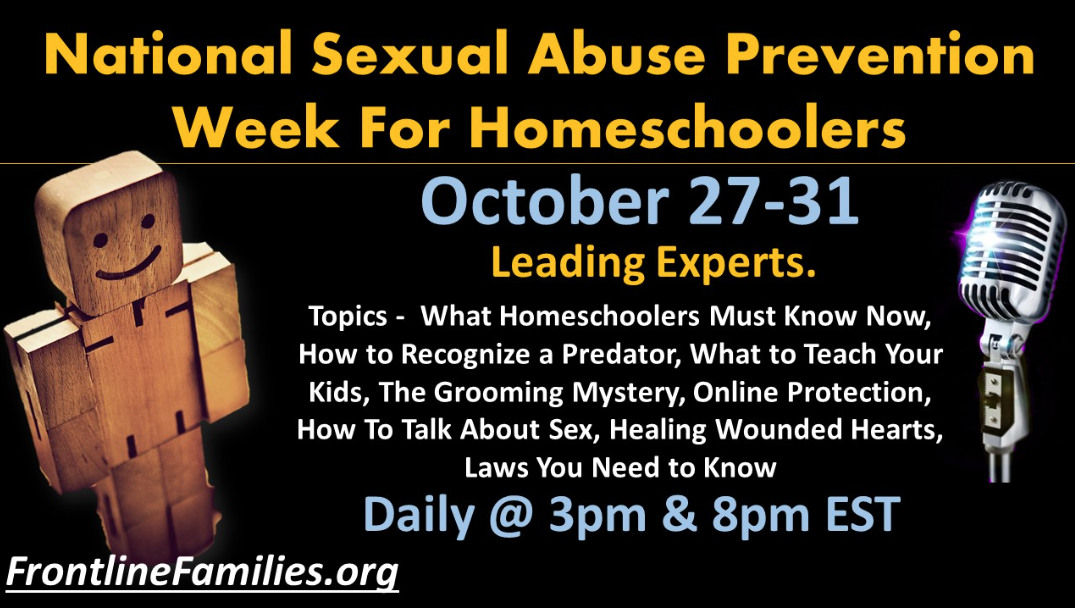
It would seem, therefore, that I would be ecstatic about the fact that Frontline Family Ministries (FFM) — a Christian organization led by homeschooling parents Lisa and Doug Cherry — recently announced their “National Sexual Abuse Prevention Week for Homeschoolers.” Not only is this a week intended to bring awareness to sexual abuse and prevention strategies, some of the speakers are people for whom I have immense respect. For example, Boz Tchividjian and Dr. Diane Langberg — both from Godly Response to Abuse in the Christian Environment (G.R.A.C.E.) — are featured speakers. Tchividjian and Langberg are doing vital and powerful work within Christian communities and organizations on behalf of abuse victims and survivors. I am grateful for their relentless efforts.

In spite of all these facts, however, I cannot personally support FFM’s prevention week. This decision has taken months to come by. I still to this day feel internally distressed by it. Feeling I need to oppose the first-ever “National Sexual Abuse Prevention Week for Homeschoolers” seems to fly in the face of everything I — and HARO — have worked towards. So that alone should tell you this decision was not made lightly.

I first became aware of FFM and the Cherry family when Lisa Cherry wrote her “Open Letter to My Fellow Homeschool Parents” several months ago. This letter — and FFM’s resources — were highly and repeatedly recommended by ThatMom’s Karen Campbell as well as promoted by HEDUA. While I had some reservations about Lisa’s open letter at the time (some of which were well-articulated by Libby Anne), and while numerous people shared the open letter with me and asked me my opinion, I chose to be silent for the time being. (My silence was unfortunately bothersome to some people.) My one comment was along the lines of, “Something doesn’t feel right, but I can’t put my finger on it.” I did appreciate Lisa speaking up and I wanted to give her and her ministry the benefit of the doubt. I also did not want to speak prematurely or ignorantly.

So for the last few months I have poured over the Cherry family’s ministry website, including all of its manifestations from the last few years via the Wayback machine. I bought and read 3 of their ministry’s books: Kalyn’s Secret by Lisa and Kalyn Cherry (2009), Not Open by Lisa and Lucas Cherry (2013), and Unmask the Predators by Lisa and (now) Kalyn Cherry Waller (2012). While this might seem excessive, I really wanted to support what FFM was doing but I could not shake the nagging feeling that something was off. So I needed to go the extra mile to be sure that, if I was to express a lack of support, that I did so accurately, fairly, and compassionately.

I have now completed the requisite research. And I have decided that my initial misgivings were indeed well-founded. In fact, I have come to the following conclusion:

To support Frontline Family Ministries is counter-productive and damaging to not only the homeschooling community in general but survivors of abuse specifically.

To explain why, I am going to take you through 4 sets of material: the 3 books I mentioned and then FFM’s website material. I’ll make each set its own post (or sometimes several) each day this week. At the end of the week I’ll also provide some concluding remarks.

Soul Tied: Harmful Spiritual Conclusions about Sexual Abuse, Purity Culture, and Abuse Survivors

HA note: The following is reprinted with permission from Julie Anne Smith’s blog Spiritual Sounding Board. It was originally published on October 8, 2014 and has been slightly modified for HA. The church has sometimes done a poor job on handling sex abuse and premarital sex. I was reminded once again this week. But let me back up and give other examples of how Christian leaders put their spiritual spin on this issue how they devalue young women in the process. You may recall the sex abuse allegations against Doug Phillips by Lourdes Torres-Manteufel. When news of this case came out, we heard from Doug Wilson. He did not want to call her a victim, but in his article, he expects a victim to behave a certain way in order for her to be validated as a victim, ie, she (Lourdes Torres) should have left Phillips’ house immediately. Further in the comments, we read from some who said that because Lourdes didn’t “cry out,” her story is suspect. This is one spiritual spin of sex abuse. There was no regard for the role Phillips played as her spiritual authority, her employer, long-time mentor, etc. The Christian community and Mormon community have similar teachings on purity. Mormon kidnap and rape victim, Elizabeth Smart, described the purity culture she was taught:

Smart said she “felt so dirty and so filthy” after she was raped by her captor, andshe understands why someone wouldn’t run “because of that alone.” Smart spoke at a Johns Hopkins human trafficking forum, saying she was raised in a religious household and recalled a school teacher who spoke once about abstinence and compared sex to chewing gum. “I thought, ‘Oh, my gosh, I’m that chewed up piece of gum, nobody re-chews a piece of gum, you throw it away.’ And that’s how easy it is to feel like you no longer have worth, you no longer have value,” Smart said. “Why would it even be worth screaming out? Why would it even make a difference if you are rescued? Your life still has no value.”

Samantha Field, blogger at Defeating the Dragons, was taught an object lesson by a Christian speaker to promote purity. She describe it as follows:

My sophomore year in college, another speaker shared a similar object lesson– ironically, in the exact same room, also filled exclusively with women. She got up to the podium carrying a single rose bud. At this point I was more familiar with sexual imagery, and I knew that the rose had frequently been treated as a symbol for the vagina in literature and poetry– so, again, I knew what was coming. This speaker asked us to pass the rose around the room, and encouraged us to enjoy touching it. “Caress the petals,” she told us. “Feel the velvet.” By the time the rose came to me, it was destroyed. Most of the petals were gone, the ones that were still feebly clinging to the stem were bruised and torn. The leaves were missing, and someone had ripped away the thorns, leaving gash marks down the side.

Samantha echoes similar sentiments Elizabeth Smart that used regarding the internalized message young ladies might feel when hearing these teachings:

However, all of these object lessons contribute to one message: your identity and value as a woman is tied to your sexual purity. If you surrender your virginity, you are worthless. Disgusting. Repulsive. Broken. Unwanted.

I encourage you to read Samantha’s excellent article, roses– how the purity culture taught me to be abused. That brings me to a picture I found on my friend, Ryan Stollar’s, Facebook page from a book he was reading by Lisa Cherry and her daughter Kalyn Cherry-Waller, entitled, Unmask the Predators: The Battle to Protect Your Child. Here is a summary of the book:

WARNING: THREATS TO YOUR CHILD AHEAD! Losing your child’s heart to the perverse world of a sexual predator is truly every parent’s nightmare. When an $800 cell phone bill revealed a secret relationship between our high achieving, Sunday School teaching 15 year old daughter, Kalyn, and a 46 year old man from our congregation, we were horrified. The aftermath of destruction, as it usually is with sexual abuse, was disastrous. Rebellion, depression, wrong relationships, eating disorders, and selfmutilation suddenly turned home into a war zone. In Kalyn’s mind we, her parents, were her enemies while the sexual perpetrator remained her hero. How could something so bizarre happen in a loving Christian home?

I was struck by Amazon’s “About the Author:”

Lisa Cherry and her daughter c have navigated the storm of extreme family crisis and spiritual warfare emerging as a victorious voice for others. Their ministry has placed them on the front lines speaking to tens of thousands of parents and teens each year. Their message acts as a beacon of light and hope to aid parents and teens with practical communication tools to avoid crisis such as child predators. Championing the cause of better family communication and spiritual growth, Lisa and her husband Doug are founders of Frontline Families Ministries which is dedicated to providing communication tools and practical resources for growing spiritual and healthy families. The Cherry’s are pastors and make their home in Carbondale, Illinois.

Ok, the key phrases in the above paragraph that struck me were “spiritual warfare” and “front lines speaking to tens of thousands of parents and teens each year.”  If they (Lisa and her daughter) are speaking to tens of thousands of parents and teens, that means they are fairly well-known and respected in their circles. I found out on Ms. Cherry’s website that she has a whole ministry called Frontline Family Ministries. In the wake of the sexual abuse allegations among homeschoolers, Ms. Cherry has posted an article which she boasts has been read by nearly 30,000 people:

Something amazing happened here last week. I published my  article An Open Letter to My Fellow Homeschool Parents: Sexual Predator Accusations Among Homeschoolers?    NOW 29,708 have read it already. And the number is growing every day!

Ms. Cherry has a  website, ministry, sells books, and speaks on the topic of sex abuse in the hopes of helping parents with this sensitive topic, but what is her message?  I’m sure there are a lot of practical helps that are very good. I also appreciate that she is addressing this important topic that is sometimes taboo in church, especially after having experienced it in a personal way. But I am concerned about the message that is sent to parents and their children about survivors: 1382090_10152353749452761_1783050733574283440_n Transcribed:

“I was never more keenly aware of this fact than during our struggle for Kalyn. We were fighting against powers much stronger than the emotions of a confused fifteen-year-old girl. The truth of Ephesians 6:12 became quite apparent: “Our struggle is not against flesh and blood, but against the rulers, against the authorities, against the powers of this dark world and against the spiritual forces of evil in the heavenly realms.” Kalyn had been “soul tied” to a man steeped in the dark world of pornography and perversion. The battle for her life was a battle in the heavenlies. My busy bluster of motherly activity highlighted by my angry yells of correction did no good.”

Do you see it?  Do you see the problem I’m having with this? Do you see any spiritual conclusions that make things confusing for a sex abuse survivor? Let’s talk.

How Purity Culture Kept Me Silent About My Sexual Abuse as a Child: Dinah’s Story

Screen Shot 2014-07-21 at 11.04.46 AM

HA note: The author’s name has been changed to ensure anonymity. “Dinah” is a pseudonym.

Trigger warning: discussion of child sexual abuse.

I’m going to be honest—growing up in the Christian homeschooling world is hard.

People in the community that I grew up in were picture perfect families, with all their perfect children all in a perfect row, making perfect grades, milling their own wheat and making their own bread.  They were highly esteemed Christians who (of course) have a home church and serve their fellow brothers and sisters in Christ. These people sound like they’d be lovely to be around, however, that was not the vibe I got at all. There is a heavy feeling that comes with being around those families—judgment:

You don’t mill your own wheat? Shame on you! Don’t you know store bought bread has chemicals? You don’t pastor your own church? Shame on you! Don’t you know about all the horrible mistakes large churches make? You don’t use the same curriculum as me? Shame on you! Don’t you know that you’re going to be dumb? 

Every homeschooler I talk to tends to make me feel self conscious and guilty for not being the same as them. But there’s one thing that I can not stand. You don’t have a purity ring? Shame on you! Don’t you know that you are dirty if you even think of having sex or kissing before your wedding day?!

You. Are. Dirty.

This is the message I got every single time I listened to anyone who spoke on purity. That’s what I was being told every time I went to a “purity seminar” or read a book on purity. People were going around telling girls that “God doesn’t want you having sex before you’re married. It’s a horrible sin, and if you do it, you won’t be pure anymore. You won’t have a gift to give your husband on your wedding. You’ll be used goods.”

I didn’t want people to think I was dirty—so that’s why I didn’t speak about my sexual abuse for 7 years after it stopped.

I didn’t tell anyone. I put on a façade. I am a quick learner, and always have been. I learned all the answers. I knew all the Christian responses to many situations, I knew what purity was and what was required of girls who wore a purity ring. So that’s what I fed anyone who wanted to talk. I put on this mask. I pretended that I had never had a sexual encounter, that I was oblivious to sexual desires, that I would never kiss a boy until my wedding day. Every time I lied, or just fed people answers, I was digging a deeper, and deeper hole for myself. That hole is what became a dark depression.

Every girl struggles during puberty. It’s exciting, but often times it’s hard to accept your new curves and all the changes that are taking place. You notice that boys look at you differently. You hear about purity, and how you should dress modestly so that men and boys don’t think about you in a sexual way. That’s what made puberty a living hell for me—a living hell that I could tell no one about.

“You must dress modestly so boys don’t think sexual things about you” translated to “Your new body is going to attract more men and boys, and if you mess up or dress wrong they’re just waiting to rape you.” There’s no way in hell that I wanted to attract anyone. I didn’t want these curves. I didn’t want to look like a woman. I didn’t want to enter this world of boys and sex and marriage because of what I had experienced for 5 years. When I was 4 years old a family member molested me and sexually abused me– forcing me to do things, and forcing himself on me. This went on until I was 9 years old.

By the time the abuse had ended, I knew much more than any 9 year old should know about sex. I knew so much, but I also knew that if I told anyone, I’d be in a lot of trouble. My abuser made me believe that what he was doing was okay, but if I told anyone he would hurt me. Because I was only 4, he was able to scare me so badly that I didn’t realize that what he was doing was wrong. I listened to him and kept quiet.

Well, when puberty hit me when I was 11, I was introduced to the concept of purity. This scared me because I knew that I had already had sex, and already kissed, and already did everything that I was being told not to do. That’s when the depression set in. I was so depressed that I became suicidal, started cutting and started struggling with an eating disorder. I didn’t want to be attractive. I didn’t want attention from boys. I was afraid that my abuse was going to happen all over again. I didn’t want anyone to find out about my abuse.  I just wanted to get away from this guilt and shame. This feeling that I was used goods, and that I’d never find a man who will love me.  I wanted to die because that was the only way to escape the pain.

Never ever make purity such a priority that it makes a girl want to commit suicide.

Looking back, I know that if someone had said that sex is a wonderful thing that is supposed to be enjoyed, I would have told someone about my sexual abuse a lot sooner. If I knew that sex was good, I would have known that what was happening to me was wrong. It was not good, it was not enjoyable. Because people were telling me that sex wasn’t good, that I would be dirty if I had sex, I didn’t tell anyone because I was full of shame. I didn’t want to be the girl with a scarlet letter. I didn’t want to be dirty. So I didn’t tell.

I’m still coming to terms with my abuse. I still struggle. But I no longer hold myself to the standard of purity. I’m not going to wear a purity ring, because that doesn’t mean anything to me. I am going to obey my heavenly Father and I’m going to honor Him with my body. That’s really all that matters.

I want people in Christian homeschool circles to talk about sex in a positive way. I want parents telling their kids that sex is amazing and enjoyable, but it also comes with a lot of responsibility. I want people to stop shaming girl’s bodies, or boy’s sexual desires. I want people to be careful about what they talk about when they talk about purity. Talk about sex in a way that is positive, because if someone is being abused they’ll know that something is wrong with what is being done to them! Never ever tell someone that they’re dirty. Never encourage the shame that is already abundant.

I’m not “pure” by society’s standards, but I’m pure by God’s standards. That’s all that matters.

Getting My Wings Back

wings

HA note: The following is reprinted with permission from Kay Fabe’s blog Post-Fundamentalist Fashion. It was originally published on June 9, 2014.

Trigger warning: discussion of sexual assault.

So I saw Maleficent over the weekend. And for me and many other sexual assault survivors, that gut-wrenching scene where Stefan cuts off Maleficent’s wings instantly read as rape. I just sat there staring in shock, like…. “No. He took HER WINGS. This is way worse than if he just stabbed her.”

Maleficent’s wings are her source of power. Stefan takes that power away from her, but in the end SHE GETS IT BACK. I was so, so happy about that. (I love that the idea of rape is so clearly tied to power, rather than sex, throughout the whole film, too. It’s not like “her wings are her virginity, and she lost that, so now she’s broken.” It’s like “Her wings are her power, and he stole them, but she can get them back.” YES, YES, YES.)

But in that scene where she’s slowly limping down the hill afterwards, stunned, leaning on her staff and trying to process what just happened, my heart bled. I know pretty much exactly what she felt like at that moment.

This story is for later, but the guy who assaulted me was much older and he was constantly pushing my boundaries and trying to get me to do things I felt uncomfortable with. (It says something that I thought marrying this dude would be better than living with my parents.) The actual assault was one of those pesky gray areas: it started out as a sort-of-consensual encounter, and then he told me to do something I was uncomfortable with and I said “No,” and then he grabbed me and made me do it anyway. We broke up soon after.

I was really angry at him for a long time, but the older I get and the farther away from it I get, I’ve started to feel like my anger was sort of misdirected. That dude only took up about four months of my life, tops. The homeschool culture spent 20+ years systematically stripping me of my privacy, dignity and autonomy as a human being.

I came to realize I was raised in a culture that stole my wings before I really knew I had them. My No didn’t matter. My Yes didn’t matter. Basically, nothing I said really mattered – so I quit trying to say anything. When Mr. Grîma Wormtongue first met me, he knew I would be a REALLY easy person to abuse, so he took advantage of that.

I don’t have a good way to end this, exactly, but I think it’s sobering that so much of the homeschool subculture is a massive power play. The people in control are determined to stay in control, even if that means systematically destroying the individual souls of individual kids. They’re basically like, “We don’t care about you as a person, about what you think or feel or say. We’re just going to do our thing and be in charge, and we don’t care if you get broken. In fact, it’s easier for us if we can break you.”

Honestly, if rape is about power, homeschooling sometimes looks very, very similar.

I was homeschooled, but I am getting my wings back. Feather by beautiful feather.

Why Christian Homeschooling Culture Is Not a Safe Space

Screen Shot 2014-05-27 at 1.39.09 AM

HA note: The following is reprinted with permission from Libby Anne’s blog Love Joy Feminism. It was originally published on Patheos on May 26, 2014.

Some months ago I stated in a blog post that I was becoming increasingly convinced that Christian homeschooling culture is not a safe space for young women and girls. A reader objected in the comments section, misunderstanding I think both what I meant by “Christian homeschooling culture” and “safe space.”  Regardless, reading various figures’ responses to the Doug Phillips scandal, and how they discuss Lourdes Torres, Phillips’ victim, has made my assessment only more firm.

There’s this from Doug Wilson’s recent blog post, Vice, Victims, and Vision Forum:

But if his attentions were entirely unwelcome to her, and she was freaked out by the creepster, then we have to ask why she wasn’t down the road at the first opportunity — that night or the next morning — with Doug Phillips receiving notification of her opinion of what transpired via the sound of sirens. That’s not what happened, on anyone’s account, and so I don’t think we should identify her as a victim.

For someone who makes his livelihood counseling his parishioners, Wilson shows a stunning lack of understanding of any of the dynamics of abuse. He reiterates his statement in the comments section:

In other words, according to Wilson, if an abuse victim does not get out of the situation at the very first opportunity, she (or he) cannot be identified as a victim. We might as well ask this of every case where a male partner is abusive: “If his abuse was not welcomed by her, then we have to ask why she didn’t leave at the first opportunity, say the first night or the very next morning.” But of course, this is ridiculous. There are a million reasons abused women do not leave the moment their abuse starts. For one thing, it usually begins little by little, and not all at once. But beyond that are plenty of reasons both physical and psychological.

If someone who is a leader and an influential figure in this culture is so clueless as to the dynamics of abuse, how much hope is there that more local leaders will be any less ignorant?

But let’s stop and ask ourselves a question Wilson doesn’t think to ask—what would have happened if Lourdes had come forward about Phillips’ actions? What if she had told other leaders in Phillips’ church, as Wilson would probably prefer, given his propensity for preferring the Matthew 18 approach over civil courts?

First of all, if Lourdes had gone to her church elders they likely would have suspected her of lying. After all, Phillips was a very well respected leader. When the scandal broke several months ago, there were many that had trouble believing it even then. How much more unbelievable would it have been without a paper trail of sorts stretching back for years? Further, Phillips was one of the church elders. These would have been his friends Torres would have been going to. In all likelihood, they would have called him in and asked him what happened, he would have explained it away as nothing, they would have believed him, and that would have been the end of it.

After all, that’s exactly what Gothard did over and over and over again. Someone would say something, some rumor would surface, and Gothard’s board of directors would talk to him about it. He would assure them it was nothing, and they would tell him to be more careful in the future, and everything would go on just as before.

Second, even if Lourdes had gone to her church elders and they had believed that some level of impropriety was going on, they likely would have placed some of the blame on her—even if she went to them immediately. They would have asked her what she had done to lead him on, what she had said or worn or done. They would have asked her if she had fought him off, or if she actually wanted his overtures, and so on. And they very likely would have seen her as tainted herself.

After all, that’s exactly what has happened when female victims have gone to the authorities at Bob Jones University, and Patrick Henry College, and Pensacola Christian College. They’ve been told they must have been asking for it, they’ve been questioned about their clothing or their behavior, and so on.

I also have very little faith in the local church authorities Lourdes would have approached had she followed Matthew 18.

After all, we know that the other leaders in Doug Phillips church knew full well what was going on over six months before Phillips issued his public apology, and over six months before the Vision Forum board of directors decided to shut the ministry down. In February of 2013 Phillips was removed from his position as elder at his church because of his actions, but he was allowed to go on speaking and serving as an influential public figure, even though he had in his personal life made a lie of everything he said from his public platform.

In this culture, the criteria for being a victim is very narrow. If you are among the few who fit the criteria, you receive all the support they can give you, and your abuser alone is condemned as guilty. However, if you don’t fit the criteria you stand guilty and implicated in what happened alongside your abuser. What, you didn’t leave him the first time he raped you? And you say you’re a victim?

It is because of these sorts of narratives and beliefs that I said what I did about Christian homeschooling culture not being a safe space for girls and young women. Yes, this very culture claims to care very much about protecting girls and young women, and many leaders find justification for patriarchy in just that. But while their words say one thing, the systems they create and beliefs they embrace create something very different altogether.

And if my saying this upsets readers, they should focus their energies on combatting these narratives, not on expressing their shock that I could say such a thing.

When Home Is Worse Than Rape: Cora’s Story

Screen Shot 2014-05-13 at 11.25.39 AM

HA note: The title of this piece is the title chosen by the author. The author’s name has been changed to ensure anonymity. “Cora” is a pseudonym.

Trigger warning: abusive parenting, rape.

My first memories are from when I was 3 or 4. We were living in Little Rock, Arkansas. I remember every detail about that house. We had a cocker spaniel named Lacey. She was the only person/animal that I was ever emotionally attached to for many, many years.

My memories from that time are very vague. I remember the place, and then flashes of ghosts uttering words and phrases. Feelings. Small snippets of events. I had a clown for my birthday party. I was locked in my room screaming for hours. I rode my tricycle outside. My mother yelled at my father for not hitting me enough. I became a master at hiding. Under the bed. In the top shelf of a closet. Behind a bush. I would stay in my spot for what seemed like hours. My feelings were a constant mix of fear, anger, frustration, and a strong desire to leave. From the very beginning, I wanted to be nowhere near her.

It was my fault, I was told. I was a “difficult child”. Or maybe just a child. Still, it must have been my fault just for being there, right? The grown up has “authority” so it couldn’t possibly be them, right?

We moved to New Zealand. My next memory is being chased around the living room of our house with a switch because I wasn’t cleaning up fast enough. I was 4 or 5. I screamed and picked things up and it seemed like it never stopped. I would sit in my room for hours alone, and lose myself in my own made up world. This world was misery every day. I would make up a different world.

Something fabulous happened in New Zealand though. I was allowed to go to school. I remember how happy I was to leave home every morning. I had friends who would cry and miss their parents when they were gone. I could never understand why. The good memories of my childhood were all away from home.

I don’t remember much of my father from that time. He was a ghost in the background. Not saying much. I remember calling him “Daddy-doo” and trying to spend time with him when she wasn’t around.

I was a “rebellious” child.

I was spanked constantly. My memories of early childhood are essentially a long sequence of being hit, with intermittent memories of other people. All of whom knew something was wrong. All of whom would talk about my crazy mother behind her back. None of whom did anything. I learned early that my father wouldn’t stand up for me.

I remember having to re-write school assignments for hours until they were approved. I remember all of my “infractions” being counted throughout the day to determine the number of hits I would get every night. I remember some of the sessions feeling as though it must have lasted at least an hour. I remember hearing everyday how bad I was. I believed her. And so I never tried to be “good”. I knew it would be useless anyway. The rules always changed. She was always mad. She was always yelling. Always. I never imagined that I had any power to change anything based on my behavior. So I didn’t try. I just found my hiding spots and made up my own stories.

We returned to the US for a while, before going back. I asked about Lacey. I had been thinking about her and missing her the entire time we were gone. The only time I experienced the sensation of missing someone until much later in life. My dad told me that they family who had been watching her decided they didn’t want to give her back, so he said they could keep her. I felt again, that he wouldn’t stand up for me.

In our second house in New Zealand I would climb down the hill behind the house and be gone for hours. No one ever noticed. Not until I took my brother with me one day. I was a nuisance, so the only way to avoid punishment was to disappear.

When we came back to the US things got worse. In the US you had to be vaccinated to go to school. You also had to be surrounded by ungodliness. So I was homeschooled. I was at home. All day. With her. They also suddenly became even more religiously conservative. I was no longer allowed to go anywhere with friends. For a while our neighbors could come over to play, until one of the boys kissed me. After that it was just me and my siblings. At home. With her.

We all got assigned the household work. I had the kitchen, the dusting, the mopping, my room and bathroom, my laundry, and occasionally her room and laundry. My brother had the vacuuming, feeding the pets, and his room and laundry. My little sister had her room and laundry. But we were all so lazy. She would nap, drive us to homeschool events, go to the store, and “organize”. We were the lazy ones. We were bad. We were lazy. We were rebellious. It was all our fault.

I started getting grounded from the few things I was allowed to do. Watch G rated movies, talk on the phone, go to church events. Didn’t lift your blinds this morning? Grounded for a month. Didn’t wash the dishes in time? Another month. And another. I just assumed it was a permanent situation, so again, I never tried. I did try speaking up though. My dad would always tell me, “your mother does so much for you, why don’t you appreciate her?” I remember writing my dad a letter describing the situation. I could tell it shook him. He said he would talk to her. She yelled at him. That was the end of it. I continued to learn that he wouldn’t stand up for me.

I told a relative when I was around ten years old that I wished she would leave and never come back.

No mother at all is better than a whirling mass of violence and anger impenetrable to reason.

In a strange turn of events she started comparing my siblings to me as they got older. Your sister got these grades and your sister wasn’t as bad as you, etc. I can only imagine how the must have felt being told that they were worse that their bad, rebellious, lazy sister.

The fear of the outside world grew. Daring to have a friend that didn’t attend our 100 person church was out of the question. Dating was out of the question. Even our relatives of the same religion weren’t conservative enough and were therefore suspect. We were warned about them. We were warned about everyone. Everything and anything happening outside of the bubble was to be feared. So we stayed at home.

By some miracle I made a friend at the age of 16 or 17. She went to church with me. Then another girl moved into town and starting going to our church. I was finally allowed to go somewhere with someone outside of the home. I started secretly dating the second girl’s cousin. Having been told all of my life that my worth was in eventually being someone’s wife, serving him, and having children and that my virginity essential to attracting a husband, I naturally informed my suitor that I wanted to wait until marriage. He agreed. Then he started pushing. And pushing. Until he held me down in the bathroom one day, and forced himself on me. I don’t remember how, but I pushed him off of me and ran to the other room. Bleeding. I told my friend. She told me it was because I was teasing him. I believed her. We both lived in a world that demanded that women be responsible for a man’s desire. The mere fact of existing and causing a man to want you means you should expect to be violated. She has grown up now, and we are both different. She is still my friend. I can’t blame her, because I hadn’t learned yet either. I would have said the same.

I never told anyone else for a long, long time. I knew my parents would also tell me that it was my fault. Dating. Being alone with a boy. Kissing a boy. Growing boobs. And I would be locked up, at home, for good. To me, the threat of being forced to be home was worse than rape. And the threat of losing what little freedom I had gained was worse to me than letting a rapist go free.

What they didn’t know and what I didn’t realize then was that rape isn’t caused by dating, or being alone with a boy, or wearing tight jeans, or any of those things.

Rape flourishes when a girl is told marriage is how she obtains worth, and virginity is how she gets married. When her virginity is stolen, she will never tell. Rape flourishes when women are told that they are at fault, and face dire consequences if they reveal their rapist. Rape flourishes when women aren’t taught about their bodies, told that they aren’t able to make their own choices, and how to identify predatory behavior or even that it is wrong. Rape flourishes when it’s always a woman’s fault when a man has desire. Rape flourishes when you teach your boys that they own and control women.

I moved out of state when I turned 18. I hit a breaking point when I realized that it wasn’t just my parents and the people at my church who were this way. I went to a small Christian college, and realized that these attitudes were the norm. This time I bucked against it all that I could.

To this day I cannot enter a church building without intense feelings of anger and mistrust. I will never allow myself to be held down again. I started talking about it little by little. With each memory another surfaced. Sometimes they hit me in waves. It’s too much, and I get physically ill. Some memories I still can’t bear to relive. So I push them back every time they come up. Someday, maybe. But not yet. I have found a man who loves me, and cares deeply for my well-being. They told me I was “brainwashed”. She told me I was “addicted to him”. I suppose, if you define unconditional love and acceptance as addiction. If you define peace, comfort, and trust as being brainwashed.

They have never accepted any personal responsibility. I have tried to bring up many of these instances. I’m told it was my fault. I was a difficult child. That an adult, who intrinsically has the power and knowledge, would physically and emotionally abuse a four year old and then blame the four year old is sick.

They have told me my departure is “heartbreaking”. I wouldn’t know.

My heart was broken by the very first memory.

What Do Presents, Chocolate Bars, Roses, Chewing Gum, and Packing Tape Have in Common?

HA note: The following is reprinted with permission from Libby Anne’s blog Love Joy Feminism. It was originally published on Patheos on June 6, 2013.

*****

Question: What do presents, chocolate bars, roses, chewing gum, and packing tape have in common?

Answer: Nobody wants them when they’re used.

Presents, chocolate bars, roses, chewing gum, and packing tape have all been used by abstinence educators and various Christian leaders and teachers to illustrate to young people how having sex before marriage will ruin them and leave them disgusting and unwanted. Those who grew up in the purity culture probably knew the answer to the question asked in the title before even opening this post.

I was reminded of this when reader Laura left this comment on my blog:

I had to go through the True Love Waits program. The “activity” I remember the most was a wrapped present. I held the package and stood at the front of the room. Then, the youth leaders lined up the guys and each of them tore off some of the paper. Then I had to read some paragraph about how virginity is like a gift – no one wants a present that was “meant for them” to have already been opened by someone else.

Because of that one activity, I never told anyone I was raped at 15 until years later. I can’t even imagine the rest of the damage that was done to the other girls in the group.

Laura’s comment reminded me of Samantha’s post from several months back. In her case, the teachings she received about purity led her to stay in an abusive relationship long after she should have left—because she believed that, having given up her virginity, she was ruined for anyone else. Here is why Laura’s comment reminded me of Samantha’s post:

When I was fourteen, I went to a month-long summer camp at the college I would later attend. Like most Christian summer camps, this one involved going to a chapel service twice a day. Most of the time they were fun, lighthearted– until one evening they split up the girls and the boys. Great, I remember thinking, because I knew exactly what was coming. Segregation can only mean one thing– they were going to talk about sex. I sighed when they made the announcement. Again? I thought wearily.

That evening, when the camp counselors had shooed all the men and boys out of the building, the speaker got up to the podium. She didn’t even beat around the bush, but launched right into her object lesson. Holding up a king-size Snickers bar, she asked if anyone in the audience wanted it. It’s a room full of girls– who doesn’t want chocolate? A hundred hands shot up. She picked a girl close to the front that wouldn’t have to climb over too many people and brought her up to the stage. Very slowly, she unwrapped the Snickers bar, splitting the package like a banana peel. She handed it to the young woman, and asked her, very clearly, to lick the chocolate bar all over. Just lick it.

Giggling, the young lady started licking the chocolate bar, making a little bit of a show of it. At fourteen, I had no idea what a blow job was, so I missed the connection that had a lot of girls in the room snorting and hooting. The young lady finished and handed it back to the speaker. As she was sitting down, the speaker very carefully wrapped the package around the candy bar, making it look like the unopened package as possible.

Then she asked if anyone else in the room wanted a go.

No one raised her hand.

And Samantha gives a second example, too:

My sophomore year in college, another speaker shared a similar object lesson– ironically, in the exact same room, also filled exclusively with women. She got up to the podium carrying a single rose bud. At this point I was more familiar with sexual imagery, and I knew that the rose had frequently been treated as a symbol for the vagina in literature and poetry– so, again, I knew what was coming.

This speaker asked us to pass the rose around the room, and encouraged us to enjoy touching it. “Caress the petals,” she told us. “Feel the velvet.” By the time the rose came to me, it was destroyed. Most of the petals were gone, the ones that were still feebly clinging to the stem were bruised and torn. The leaves were missing, and someone had ripped away the thorns, leaving gash marks down the side.

This reminds me too of something teen kidnap victim Elizabeth Smart said, explaining one reason she stayed with her captor and didn’t try to run sooner.

Rescued kidnapping victim Elizabeth Smart said Wednesday she understands why some human trafficking victims don’t run.

Smart said she “felt so dirty and so filthy” after she was raped by her captor, and she understands why someone wouldn’t run “because of that alone.”

Smart spoke at a Johns Hopkins human trafficking forum, saying she was raised in a religious household and recalled a school teacher who spoke once about abstinence and compared sex to chewing gum.

“I thought, ‘Oh, my gosh, I’m that chewed up piece of gum, nobody re-chews a piece of gum, you throw it away.’ And that’s how easy it is to feel like you know longer have worth, you know longer have value,” Smart said. “Why would it even be worth screaming out? Why would it even make a difference if you are rescued? Your life still has no value.”

And finally, Ariel Levy has reminisced similarly:

To illustrate his not terribly complex point, Worley called a stocky young man from the audience onto the stage and then pulled out a length of clear packing tape.

“This is Miss Tape. She looks pretty good, right? She’s tall, right? She’s … what else is she?” Worley raised his eyebrows at us encouragingly.

“Thin!” someone shouted out.

“Right! She’s thin,” he said, and wiggled the piece of tape so it undulated in the air. “And she has nice curves!” Worley winked. “So they have sex.”

To illustrate the act of coitus, Worley wrapped the piece of tape around the volunteer’s arm. After a few more minutes of make believe, we came to the inevitable bump in the road when Worley said the volunteer had decided to move on to other chicks. Worley ripped the piece of tape off his arm.

“Ouch,” said the volunteer.

“How does she look now?” Worley asked, holding  the crumpled Miss Tape up for inspection.

I fought back the urge to yell, “like a dirty whore?”

Presents, chocolate bars, roses, chewing gum, packing tape—these sorts of metaphors abound in circles where what I call “purity culture” is strongest, and each one is used to illustrate how having sex before marriage will ruin you, rendering you dirty and potentially even unable to bond or form real relationships for the rest of your life. In the effort to keep young people from having sex before saying marriage vows, Christian leaders, pastors, and parents resort to threatening their youth, doing their utmost to scare them out of having sex and slut-shaming like crazy in the process.

In case you were wondering, no, this isn’t healthy, and the result of these teachings has been a generation of Christian youth with warped and toxic ideas about sex, dating, and even their own bodies. And in the process, these very teachings have led young women like Laura, Samantha, and Elizabeth to leave their rapes unreported, remain in abusive relationships, and stay with their abductors. This is not okay. 

How about you? What similar metaphors have you encountered, and how have they affected your life?