Visualizing “The Myth of the Unsocialized Homeschooler”

HA note: The following is reprinted with permission from Heather Doney’s blog Becoming Worldly. It was originally published on July 7, 2013.

I googled “homeschool” to see what pictures came up. Many of them had to do with socialization and the messages that homeschool parents get and give about it. So I figured I’d talk about homeschooling and the issue of socialization today and use some of the cartoons I found in the process. Some of them are a little disconcerting in the way they point out issues I see, just maybe not quite in the ways the cartoonists intended.

What is This “Socialization Problem” You Speak Of?

So first a bit about what socialization is and how it relates to homeschooling. This diagram explains socialization pretty simply and it comes from a site that talks abut stopping cycles of discrimination that are often passed on intergenerationally.

soc1

I think the site the diagram comes from – Parenting for Social Change – makes an excellent point – that this is generally how socialization is done but socialization can sometimes be bad. You can absolutely be taught harmful things as well as positive things in the course of your socialization and most people are taught a mix. What homeschooling parents often become inclined to do though is try to eliminate or greatly reduce these “bad” things by winnowing their child’s socialization opportunities down to only parentally vetted and approved sources and quite often those approved sources are fellow homeschoolers, religious leaders, highly edited texts and media, other “likeminded families,” and sometimes, when the parent is particularly controlling or inept at socialization themselves, nobody at all except for the immediate family.

Yes, this last one is a real big problem because terrible things can happen when families get isolated like that and it is a big risk factor for all kinds of abuse, neglect, and poor mental and physical health. Thing is, this social isolation problem happens in homeschooling much more frequently than it should. In fact, even in Brian Ray’s wacky (and so methodologically unsound that I am stopping myself from going on a rant about how many problems it has) “Strengths of Their Own” study included something I found interesting about it. See if you can catch it.

soc2

That’s right. The third bar from the bottom. The yellow one. If 87% of the children in Brian Ray’s highly self-selective study play with “people outside the family” (and I will leave you to ponder right along with me as to why this wording is not “other children outside the family”) then that means that 13% of children in Brian Ray’s study do not play with others outside of their own family, which I would most definitely define as a socialization problem. If Brian Ray, excellent fudger, misconstruer, self-quoter, and ideological spit-shiner of homeschool data extraordinaire, has almost 15% of the kids in his rather cherry-picked study having this issue, how common must it actually be in real life and how do people in homeschooling react to this issue? Well, let’s see…

Socialization Sarcasm

This cartoon makes fun of the concept that socialization problems exist in homeschooling. To me it implies that socialization happens so naturally that it simply isn’t something a homeschool Mom could forget. Why? Well, I’m honestly not exactly sure. Socialization is a component that definitely can be ignored or accidentally left out and it has openly (and wrongly) been discounted as being unimportant by many prominent homeschool leaders. Because it has been ignored and dismissed as a necessary part of many homeschool curriculums is the main reason why homeschoolers have gotten the reputation for being unsocialized in the first place.

soc3

Most homeschool kids don’t like being stereotyped as unsocialized or feeling like they are unsocialized (I mean really, who would?). So there’s also some memes and jokes that have been spread by teenage homeschoolers implying how inherently dumb or inappropriate they think it is when people make socialization an issue. Most of these involve poking fun at the “myth” that socialization is a problem in homeschooling. There is this YouTube video by a homeschooled girl who is trying to do this by distinguishing “the homeschooled” from “the homeschoolers” and while I find it funny, I’m quite sure that her pie chart is wrong and she perpetuates elitist stereotypes she has likely heard throughout her homeschooling experience.

This blog had a post by a homeschool graduate complaining about people asking what’s become known as the “socialization question” and in her post she uses a picture I’ve seen fairly often. There’s even t-shirts with this printed on them that you can buy.

soc4

Socialization is Fishy

So what do homeschooling parents think about the socialization issue when theydo actually address it? Let’s start out with this cartoon, as it’s used a lot. It claims that a lack of socialization in homeschooling isn’t just a rare problem, but an outright myth. It implies that homeschool kids are not only actually in diverse environments as part of a natural ecosystem but are thrilled about it. It also implies that children who are socialized in public school are like half-dead sardines in a can rather than the school of likeminded fish they are expected to be.

soc5

This cartoon is a direct dismissal of there being any merit to the “socialization problem” and it is compounded with a public school counter-stereotype. This is unsurprising to me as the argument that homeschool socialization problems are an outright myth is quite often included with something disparaging about public school or insulting to teachers (and this cartoon is no exception). Notwithstanding how insulting it is to imply that most people who go through public school are like dead fish, is this depiction of homeschool versus public school in any way accurate? Well, I imagine for the occasional situation it is, but in general, certainly not.

Oddly this cartoon was actually almost the exact opposite of my experience. In the CHEF homeschoolers group I was in it was all white Christian families and our parents had to sign a statement of faith to join. It was absolutely a school of fish all swimming the same way and because we got together infrequently, I generally felt like that fish in the fishbowl. Also, when I went to public school in 9th grade I was certainly no canned sardine, even if I wasn’t exactly the manic fish thrilled at the ecosystem in the upper righthand corner. The teachers often tried to corral us into all doing things the same way but we didn’t make it altogether easy for them and generally I expect it was a bit like herding cats. We were all individuals, as were the teachers. I had favorite teachers and subjects and ones I didn’t like and I made friends of different races and beliefs and political persuasions, many of whom who are still my friends and acquaintances to this day.

The Dark Knowledge of Teen Degenerates

Here’s another cartoon about homeschool kid socialization from a slightly different angle, and this one does address the idea that kids don’t always do what you want them to do and by invoking the dreaded “peer pressure,” implies that its all bad. Which one is it – are they lobotomized sardines in a can or are they violent and rebellious ingrates? Make up your mind! Also, how realistic is this, do homeschool moms actually think public school kids are like this? Where are the public school kids who are not “at-risk” of being part of the school to prison pipeline? Why aren’t there any of those at the bus stop?

soc6

Also, in this little dystopian cartoon, gang members with knives read books on values (morally relativistic ones, no doubt), evolution, meditation, and “new age” religion (if that isn’t a culture wars, fearmongering buzzword, I don’t know what is) and pregnant girls read about sex ed and still don’t know what made them pregnant. This cartoon is crazy stuff. People don’t drink beer and shoot up heroin (yeah, there’s a needle on the ground in the cartoon) while waiting for the school bus (although some do smoke cigarettes). People who read a lot don’t typically join gangs. People who know about comprehensive sex ed aren’t any more likely to have sex than kids who don’t and they are much less likely to accidentally get knocked up. Honestly, if this is what anyone actually thinks the world is like then they are not fit to educate other human beings and they probably need some mental help themselves.

Sweet Homeschool Girl in the Ghetto

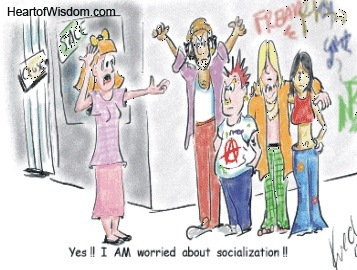
This cartoon is similar to the previous one in that it also indicates that public school socialization is all bad, but it depicts the expected reaction of the homeschool girl in the public school and implies that if your daughter goes to public high school (obviously radiating her feminine purity with a big hair bow and below-the-knee church skirt) that she will soon be shocked and horrified to encounter people dressed immodestly, young people openly dating, tattoos and piercings everywhere, vandalism and crime, blatant teenage rebellion, and big scary black boys that look more like grown men. So obviously the answer is to just have her at home not knowing that people who are different from her exist, and make most of the people her age out to be disgusting, immoral, and scary, right?
soc7

I followed this cartoon to its site, a blog called Heart of Wisdom, trying to get a higher resolution picture. The blog talked about how homeschool kids should only selectively socialize with other Christians and claims this is biblical. Yep, this is just the type of homeschooling “socialization” I am familiar with. It’s a form of social isolation and indoctrination called “sheltering.” This stuff is all about parental fear and desire for control and helicopter parenting to this extreme is very unhealthy for your child. It will mean that in adulthood that they won’t know how to function at an optimal level. You cannot shield your kid from all “bad influences” and indeed there is nothing in the bible that says your kids cannot play with the kids of people who have different beliefs. That is quite a stretch and it is insular, cultish thinking.

My Homeschool Kid is Smarter than Your Honors Student

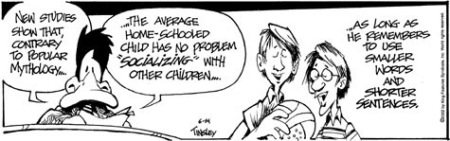
That same Heart of Wisdom blog had this other cartoon about homeschooling, so I followed that link and it was to a page dedicated specifically to homeschool cartoons. When I see stuff like this cartoon I have to once again ask – is this supposed to be funny? Do these people actually think this is accurate? My main question, though, is why the elitism and negativity? Even if your kid is getting a much better education in homeschooling, why talk trash about children who through no fault of their own don’t have as good of an education? Why make it into a competition, act like homeschool kids in general are “better” than other kids? It shows me some immature and defensive parenting, really. If you revel in it when someone else isn’t doing as good as you it shows you are 1) being a jerk and 2) secretly worried that you’re no good at what you’re doing. Nobody should ever be excited about other kids having a sub-par education, thinking it makes them and their kids look better. That’s just gross.
soc8

As it is, I find that there is a grain of truth in this cartoon but perhaps not quite in the way the cartoonist intended. I’ve known a lot of homeschool kids who do use big words in conversations and they soon realize that it comes across as awkward when they socialize with other non-homeschool kids. Admission: I was that kid myself. I read a lot of classic literature and became familiar with words that simply aren’t used in everyday speech anymore. Trying to use them in peer-to-peer conversations didn’t reflect on me being smarter. It reflected on me not having a modern day frame of reference as to what is appropriate. It reflected on me being socially backwards. Lots of public school kids who are bookworms like I was know many big words. They also know the right words to use for their audience. Context is everything. An unsocialized homeschool kid doesn’t have that context and very well might find that using 18th century literary terms in a conversation about basketball will indeed get people looking at them sideways. If homeschool parents want to be proud of that, think it makes their kid (and by extension them) “better,” it shows they truly don’t understand the issue at hand.

Parental Fear & Social Anxiety

That’s where I think we hit the crux of this whole thing. I think the main issue is parental angst and fearfulness. Too many homeschooling parents socially struggled in school themselves and/or got into drugs or unhealthy sexual relationships. Instead of taking a broader view today, they expect that they need to hide their kid away from these settings or the exact same thing will happen to their kid even though their kid is in a different school district in a different generation and *gasp* a different person. These parents become scared of or hurt by the society we live in, withdraw, and then use homeschooling as an excuse to be separatist, snooty, and helicopter over their kids. These are not positive reasons for homeschooling and these are the exact kind of fearful and overbearing attitudes that lead to socialization problems for homeschool kids.

soc9

Because people with strong views often find themselves in positions of leadership, those with exclusionary, separatist, and elitist attitudes often end up running things and then set this negative and divisive tone for the homeschooling group and the community it serves. It’s so pervasive that even some “second choicers” who start homeschooling simply because the other educational options in the area aren’t up to meeting their child’s particular needs (which is an excellent reason to homeschool, in my opinion), can get sucked into this culture, an “us versus them” mindset where homeschooling represents everything that is pure and good and healthy for children and public school and the people and structures that support it represents everything bad. This creates a parallel society of sorts and then you see people start calling public schools “government schools” in a pejorative sense. All this “us versus them” talk fans the fear that homeschooling parents are vulnerable (although still superior) outsiders who are or soon will be discriminated against and this in turn leads to easy exploitation of these scared people.

Why does widespread homeschool participation in things like the fundamentalist-led HSLDA, which capitalizes on these fears and requires dues money (that then goes into their cultish culture wars arsenal) for unnecessary “legal protection” exist? Because many these people are too freaked out to do anything more than cling onto a protector, ignoring all evidence that their “protector” just wants to use them – financially and for furthering a disturbingly anti-democratic agenda. This fear grows and leads to the kind of mindset that spawns ridiculous cartoons like the one below.
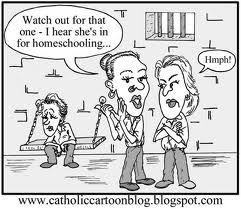
soc10

Put in prison for homeschooling – really? Of course in this cartoon there’s that same (expected) depiction of scary people with piercings, this time instead of a shocked daughter (projecting much?) it’s got a dejected homeschool Mom being shunned by hardened criminals who sarcastically note that her “crime” was homeschooling.

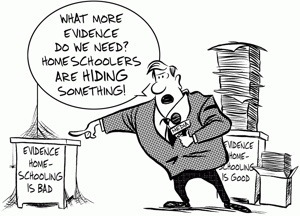
Homeschooling parents who follow these “leaders” (often starting because their local homeschool support group requires or recommends HSLDA membership) hear these divisive messages and become scared to death of being framed, exposed, persecuted, worrying that they will land in jail just for homeschooling. It may be a wacky and unrealistic fear given what’s actually going on, but if people hear it often enough they often come to believe it, along with the bogus stats and stories claiming that homeschooling is as close to perfect an educational option one can get in such a messed up society, and the myth that there is no evidence to the contrary because homeschooling is just so awesome.
soc11

Because homeschoolers test scores aren’t made public and often not even expected, registration isn’t even required in many states, and most people don’t pay much attention to homeschooling unless their kids are being homeschooled. Homeschool movement leaders have been able to get away with exhibiting the cream of the homeschooling crop as representative of all homeschoolers. This has painted an inaccurate picture and hurt the vulnerable kids by leaving them ignored as they fall through the cracks.

Saying “our homeschool kids are socialized but socialization doesn’t matter and in fact it generally sucks if it isn’t coming directly from parents” is a very unhealthy attitude to go into educating with. Responsible homeschooling parents really need to do a bit of soul-searching as to why they tolerate these inaccurate depictions of what socialization is and isn’t, why there is this the across-the-board maligning of all public schools within many homeschool communities, and why so many participate in this ugly (and frankly in my opinion undeserved) elitism, and contribute to such extreme (and inaccurate) stereotyping and putting down of children who have had to attend lower quality inner-city schools, all in order to inflate the merits of homeschooling.

Two big question:

(1) Does this kind of attitude help do anything beyond artificially boosting homeschool egos?

(2) Is there any need for this behavior if homeschooling is really so awesome?

Also, if there is no good data on the problems of homeschooling then instead of celebrating the cobwebs we need to be collecting more data. Every single education method in this world has problems and the places where the problems are denied is where child maltreatment can and does flourish.

The Truth Between “Stereotype” and “Myth”

I get the message that not all homeschoolers are cloistered and don’t know how to talk to people their own age, but the fact is that too many are and we need to recognize that it is a real problem affecting a sizable percentage of homeschool kids. Also, homeschoolers are simply not the most brilliant people in the world or inherently “smarter” than other kids, and as such they shouldn’t need to feel pressured to achieve perfection, perform as child prodigies, or that there’s a black mark on them if they mix up “asocial” and “anti-social” in a conversation.

soc12

This “myth of the unsocialized homeschooler” is an issue in homeschooling but the prevalent idea that the socialization problem is a myth is the real problem, not the legitimate questions and concerns about socialization that homeschool parents keep being asked. Those questions actually need to keep happening because social isolation and ostracism in any setting (including homeschooling) often follows a person into adulthood, and can leave people struggling with social anxiety, a small social network, low levels of social capital, mental health issues, and an unnecessary amount of sad and lonely memories.

The least we can do is stop making fun of people, stop being in denial, stop pointing fingers elsewhere, and acknowledge that it is real, it happens too often and it should be assessed and addressed as the serious problem that it is.

Adult Homeschoolers Speak Out: Part One, Why I Wanted to Write This

Adult Homeschoolers Speak Out: Part One, Why I Wanted to Write This

HA note: The following series is reprinted with permission from Brittany’s blog BAM. Part One was originally published on May 24, 2012.

*****

Also in this series: Part One: Why I Wanted To Write This | Part Two: Survey Stats and Large Families | Part Three: Top 3 Reasons Parents Homeschool | Part Four: Academic and Emotional Experiences, K-8 | Part Five: The Highschool Experience | Part Six: College? Prepared or Not? | Part Seven: What About Socialization? | Part Eight: The Best Thing vs. What Was Missing | Part Nine, Do Former Homeschoolers Want to Homeschool? | Part Ten: Are the Stereotypes Better or Worse?

*****

Series Preface for HA

** In the introduction to my blog series in 2012 about Adult Homeschoolers I wrote that “everyone turned out fine.” This phrase may seem odd and may even seem hurtful to some HA readers and writers due to the fact that many of the stories on HA deal with the painful past of many adult homeschoolers. The purpose of sharing that “everyone turned out fine” was to state that everyone who participated in my series is now a strong, functioning adult who has worked through or is working through any struggles from their homeschooling background.

The purpose of my series was to look at the “good, bad, and ugly” issues of homeschooling in an honest and fair way, with the underlying thread of hope by sharing the experiences of many adults from all around the USA. I hope that, as you read, you will be able to identify with the stories of these men and women as they share the reasons their parents home schooled, their elementary and high school years, the “best” and “worst” thing about homeschooling, adjusting to college, socialization issues, and if they plan to homeschool their own children.

I hope that as you read, you will also feel hope; know that you are not alone.

*****

Part One: Why I Wanted to Write This

I was a first generation homeschooler.

…meaning my parents starting homeschooling in in the late 1980s right after it became legal in Nebraska (where I was born). In my elementary years, when someone asked where I went to school, 99% of the time my answer would produce a furrowed brow and the question, “What is homeschool?”

Nowadays, everyone knows someone who is homeschooling or who was homeschooled. First generation homeschoolers have grown up, gone to college, and have started families of their own.

My own children are now almost school age (I have twins who will be 5 in October) and in recent months I have been contemplating my own schooling experience.

I wondered:

  • Do former homeschoolers want to homeschool?
  • What do they think of their homeschool experience?
  • Were they happy and satisfied? Did they wish for more?
  • Were they prepared for college academically and socially or were they scared, unprepared and awkward?
  • Are they stereotypes of homeschoolers true? (homeschoolers are brainy/stupid/socially stunted/well rounded/fill in the blank?)

I spent hours on the internet, trying to find articles, blogs, anything written by former homeschoolers about their homeschool experience. I was disappointed by what I found (or the lack there of). Either I found stats about how homeschoolers are successful (with no personal testimony involved) or personal testimonies that I distrusted because I thought they were too “Pollyanna” in nature. I wanted to read about the honest experiences of adults homeschoolers, the good and the bad, the advantages and disadvantages, their thoughts on their academic experiences and the issue that homeschoolers everywhere never seem to escape:

“What about socialization???”

So I put together a short survey and and used the wonderful world of social networking to launch this blog series. I received 42 responses from adult homeschoolers from all over the USA (childhood friends, people I went to college with, friends, and friends of friends).

I am excited to share the data I have collected with you: adults who were homechooled, parents who are homeschooling their own children (and may be wondering, “Am I doing the right thing? Am I messing up my kid? WHAT ABOUT SOCIALIZATION????”), or anyone else who is curious about the lives and experiences of homeschoolers.

Here is a little sneak peek at the end of the story: Everyone [that took my survey] turned out fine. **

Not always “happily ever after” and not without some bumps, awkwardness, struggles, and obstacles on the journey to adulthood.

But, really, everyone [that took my survey] turned out fine.

[Some] parents, breathe a sigh of relief.

And keep reading.

You can look forward to personal testimony about topics such as:

  • Why first generation homeschool parents decided to homeschool
  • The academic and emotional experience of homeschoolers in grades K-8
  • The academic and emotional experiences of homeschoolers in grades 9-12
  • Do homeschoolers pursue higher education?
  • Were they truly prepared academically?
  • Were they truly prepared socially?
  • What is the best thing about homeschooling (so many people said the same thing! amazing!)
  • What former homeschoolers wish was different about their experiences
  • The inside perspective about the advantages and disadvantages of homeschooling
  • Do former homeschoolers plan to homeschool their own children?
  • The homeschoolers perspective on society’s thoughts and opinions about homeschooling

This series will be honest in every way, exploring the good, the bad, and everything in between. While my posts will primarily be focused on the results of the survey, I will also share my thoughts and experiences as they relate to the survey results.

I hope that this series inspires conversation, stirs up memories (for former homeschoolers), incites conversation, provides insight and information, and ultimately encourages those who read. Please feel free to comment, ask questions, and share your own thoughts and experiences.

*****

To be continued.

His Quiver Full of Them: Jeri Lofland’s Thoughts

His Quiver Full of Them: Jeri Lofland’s Thoughts

Jeri’s post was originally published on her blog Heresy in the Heartland. It is reprinted with her permission. Also by Jeri on HA: “Generational Observations” and “Of Isolation and Community.”

Decades ago, I cross-stitched a scripture motto for my parents from Psalm 127, the favorite psalm of large families.

“Lo, children are a heritage of the Lord: and the fruit of the womb is his reward.”

The psalmist goes on to say: “As arrows are in the hand of a mighty man; so are children of the youth. Happy is the man that hath his quiver full of them…”

The term “quiverfull” is now used as both a noun and an adjective to describe a theology and lifestyle that glorifies human fertility while maintaining that God will provide the resources to raise as many children as he allows a couple to conceive. Contraception is held to be “playing God” and a violation of the command to be “Be fruitful and multiply”. The ideal Quiverfull couple are always open to “more blessings”, regardless of financial situation, health concerns, housing limitations, or needs of existing children.

I’m not certain when my parents decided that contraception was immoral. As a high schooler, Mom was an advocate of zero population growth and intended to adopt rather than bear children. A few years later, she graduated from a strict Catholic nursing school and married my dad. I was born a year later, my brother two years after that, and so on for the next 20 years.

Mail would arrive periodically from the Couple to Couple League and my parents had a couple of books by Catholic authors John & Sheila Copley explaining the practice of abstinence and/or breastfeeding as a means of birth control. Of course, even “natural family planning” (NFP) sounded too much like the evil “Planned Parenthood” so it was usually referred to as “child spacing”. Somewhere along the line my parents abandoned NFP (turns out it’s not all that effective at preventing pregnancy!) and the babies began to come even closer together.

Certainly Mom was influenced by Mary Pride’s 1985 book The Way Home, a story of the author’s journey from feminism to what she calls “reality”. Mary had just three young children when she wrote the book, in which she blasted away at contraception, lingerie, Marabel Morgan’s The Total Woman, and even Christian schools.

All forms of sex that shy away from marital fruitfulness are perverted. Masturbation, homosexuality, lesbianism, bestiality, prostitution, adultery, and even deliberate marital barrenness–all are perverted.”

“Since the word used for female is connected so strongly with the idea of nursing babies, whereas it has no connection at all with the idea of sexual activity, I believe that God is saying here that when women exchange their natural function of childbearing and motherliness for that which is ‘against nature’ [that is, trying to behave sexually like a man], the men tend to abandon the natural sexual use of the women and turn to homosexuality. When men stop seeing women as mothers, sex loses its sacredness. Sex becomes ‘recreational’, and therefore the drive begins to find new kicks.”    (Mary Pride, The Way Home, 1985)

(Pride’s position against family planning was more extreme than even the Catholic Couple-to-Couple League’s, prompting a correspondence between her and John Kippley, president of CCLI, and leading Pride to grudgingly endorse NFP in some situations in her sequel to The Way Home.)

Pride went on to birth six more babies and became a powerful force in the new homeschooling movement. My mom used to share The Way Home with all her friends and donated it to church libraries when she could. (When she encouraged me to read it, I was confused. Especially by the story about the lady wearing saran-wrap. Sexually naive young women raised in patriarchal, homeschooling isolation were definitely not Pride’s target audience.)

Mary Pride’s views fit rather well with the teachings of Bill Gothard–a middle-aged bachelor who handed out plenty of sexual and parenting advice at his seminars and encouraged couples to have surgeries to reverse previous vasectomies and tubal ligations. One of Gothard’s books informs us, “Labor in childbirth… was given to the woman for her spiritual benefit…” and points out that the God of the Old Testament “cursed several women by closing their wombs.” Attendees of Gothard’s conferences learned to associate infertility with God’s judgement. A full quiver, on the other hand, was a sign of God’s favor, a spiritual status symbol.

In 1990, a Nebraska couple published A Full Quiver: Family Planning and the Lordship of Christ. In this book, Rick and Jan Hess (homeschooling parents of ten) invite the reader to imagine a world where no one has ever had more than two or three siblings, effectively eliminating many historical figures. This exercise concludes with visualization of a future where enormous families are normal and God provides spacesuits for a missionary family moving their brood to evangelize a colony on the moon. My parents had this book, probably purchased at an IBLP seminar and still available on Gothard’s website.

Then there was Nancy Campbell’s occasional magazine for moms, Above Rubies. Nancy is a fierce promoter of anti-feminism from her compound in Tennessee. Her website includes multiple articles by women who felt guilt and regret over “the biggest mistake” of their life. After they repented, they went on to expand their families by four, five, six more babies. What mistake is reversed by more pregnancies? An abortion, perhaps? No, as it turns out, the biggest mistake of these women’s lives was a tubal ligation. Nancy also sells a book, A Change of Heart, encouraging couples to have surgeries to reverse both vasectomies and tubal ligations.

Vickie Farris, whose husband Mike is president of the Home School Legal Defense Association, homeschooled their ten children and lived to write a book about it. She encourages other women to reject birth control methods and embrace motherhood. Quiverfull women like Farris, and Michelle Duggar of “Nineteen Kids and Counting”, have built their lives on the mantra “God won’t give anyone more than they can handle”, sometimes phrased as “What God orders, he pays for”.

My parents were opponents of both birth control and sterilization. They even encouraged some of their friends to have reversal surgeries, resulting in many more babies. My mom had eleven children over 24 years, including ten [unassisted home]births. Pregnancy was not easy for her–she often referred to herself with the phrase from St. Paul, “a living sacrifice”. She spent most of my childhood breastfeeding, diapering, potty-training, and homeschooling on top of that. I understood that this was not culturally normal, but sought to convince myself that God was pleased with this self-sacrifice. I spent my teen years watching my mom’s body swell and deflate, and changing thousands of diapers.

In my twenties, as I waited for my turn to become a wife and mother, I quietly ticked off how many children I could have in years. I may have been ideologically persuaded that contraception was wrong, but I didn’t want to spend twenty years lactating either. When I got impatient for God to bring me a husband (no boyfriends on the horizon), I consoled myself by guessing how many fewer children I would bear in a shorter window of fertile sexual activity.

Fortunately, when I did get married, my husband and I quickly began to realize that many aspects of Quiverfull thought and practice were contradictory to our values. Not before taking NFP classes from a Catholic certified trainer, though. When we got pregnant anyway, we were told the method worked fine–we’d just had sex when [it turned out!] we were actually fertile. Well, what do you know?

I think my relationship with the Quiverfull movement finally ended a few years ago as I was perched on the end of an exam table in my doctor’s office. Looking up from my chart, she compassionately observed, “You’ve been raising kids for a long time,” and I burst into unexpected tears.

These days, stories of ex-Quiverfull moms and their “quivering daughters” are multiplying on the Internet like rabbits in the spring. The fruit of the movement has not turned out to be sweet; we deal with health problems, poverty, anxiety, depression, PTSD, eating disorders, cutting, sexual abuse, emotional incest, and divorce. (You can read far more than you want to know at the Homeschoolers Anonymous blog.)

In spite of these firsthand horror stories, Quiverfull continues to enjoy wide support in America and is gaining traction in other nations. Earlier this year, the BBC reported on the movement’s growth in the United Kingdom. You can listen to more, including scary-sounding clips from Nancy Campbell, here.

Meanwhile here in the States, Hobby Lobby and Catholic hospitals gnash their teeth over their employees’ rights to use birth control. Texan teenagers are taught that contraceptives don’t work. (The result? Texas has more than 10% of America’s teen births.) And TLC continues to profit from shows like “Nineteen Kids and Counting”, promoting Quiverfull ideology to some unsuspecting viewers.

The show should include a disclaimer: For your own safety, don’t try this at home.

I Was The Original CFC Fuck-Up: R.L. Stollar’s Story

I Was The Original CFC Fuck-Up: R.L. Stollar’s Story

R.L. Stollar, HA Community Coordinator, served as a Communicators for Christ conference instructor for three years, from 1998-2000. He wrote a book on intermediate debate theory, Beyond Baby Steps, that was published and sold by CFC. He created CFC’s very first website, too, and freely admits that, in retrospect, he sucked at HTML. 

*****

“Bottle it up, and the bottle goes crack.”

~Craig Minowa, “The Exploding People”

*****

I have a confession to make.

R.L. Stollar’s staff picture from his 2000 conference tour with Communicators for Christ.

I did not want to write a single post for this week.

I have spent over a decade carefully bottling up all my distress and rage, putting those bottles into reinforced cardboard boxes marked “Fragile,” and hiding those boxes in the deepest, darkest basements in my mind so I would never have to think about or feel them again.

This week hurts. It hurts a lot.

Honestly, I forgot just how much it would hurt. As I forced myself to slowly pull those boxes from my mental basement, unwrap the newspapers guarding the bottles, and uncork them and watch certain moments from my life flash before my eyes — I realized why I never wanted to remember those moments ever again. I had to re-live things I had literally blocked from my mind. My insomnia flared up. My appetite vanished. My heart rate accelerated. The blood of nervousness and self-doubt rushed to my head. I felt like that frazzled, insecure, and confused kid that I was, putting on an aura of self-confidence because the only confidence I had was the bit that forensics taught me to fake.

In a sense, I still am that kid. I don’t think I ever quite grew up. I think some important piece of my soul got lost on the side of a road during a CFC tour and maybe, someday, I will find it.

For this week, I had to feel those things that keep me wishing I could just re-live my life all over again. Wishing I could just have been a normal boy with a normal life.

Then there’s the persistent fact that, honestly, I wouldn’t change a thing. All my experiences, even the painful ones, make me who I am. They instill in me a fire and a fierce determination to stand up for my friends and the people that I love. It is my pain and sorrow and tears that drive me. It is the pain and sorrow and tears of my friends that inspire me to keep pushing, to keep doing my best to make the world — and our homeschool world — a better place.

Because this world is a very sad place. And for me, the homeschool debate world was likewise. It was a place filled with people who became my best friends, a place filled with some of my most favorite memories — but it is also a place filled with loneliness and confusion and psychological beatdowns and overwhelming hypocrisy.

Preparing for this week, therefore, was difficult. It only became more so as I heard the stories of others — in particular, the stories of former CFC interns, some of which we are publishing. These stories made me sad, because I could relate to what they said on such a deep level. But they also gave me peace, because for one of the first times, HA has helped me feel not crazy. Because their stories made me realize that I was not the only fuck-up.

See, I was the original CFC fuck-up.

I am the reason why CFC changed the structure of its internship program. Because CFC was determined that another me would not happen again.

I had a unique experience because, other than the Moons’ own children, I was the only student instructor who toured for so many consecutive years. When I think back to my high school years, I don’t have many memories of my own family. Between being uprooted from California as my family moved to Oregon, flying around the country to tournaments, and spending months at a time with the Moons, my high school years feel homeless. Most of my high school angst is directed not towards my parents but the Moons. They became surrogate parents of sorts, my adopted family with whom I traveled — circus-like — across the many and divided states of America, like Christian minstrels carrying our music of golden oratory to the untrained masses.

But as time progressed, as month after month of touring and teaching went by, as the months became years and I finally couldn’t take it any longer, my spirit began to twitch. I began to lose my ability to just shrug everything off like it was nothing. It was not nothing. It was something and there was a reason why I hurt. And when I began to lose control over my external placidity, when my soul split from years of parents looking down on me in my youth while I taught their youth to not be looked down upon, I snapped.

It happened at the very last conference, in Hawaii, during my third and final year of touring. It happened over something completely inane, something about going to a movie with friends after the conference. But it happened. And it was one of the only two times in my entire life when I yelled. I yelled at Teresa and she yelled back. And we kept yelling. And at some point we stopped talking to each other at all. She sent Wendell after me, to be our messenger because we were done talking with one another. And I refused to talk to Wendell then, too. I refused to talk to him and he was my best friend for the last three years.

I am not proud of that. I am not proud of my anger. I am not proud of the hurt I caused either my teacher or my friend. But I couldn’t control my psyche any longer. I had a full-blown nervous breakdown. Following that night, I would descend into a major depression marked by self-injury and consistent suicidal thoughts that I continue to fight to this day.

I don’t think I can summon a cogent narrative of how I got to that point. But I can relay some interesting stories to lighten the mood. Like how the very first time I got wasted was on a CFC tour.

The beginning of that story is that I didn’t get wasted with fellow CFC interns (not that time, that is; CFC interns did not start getting wasted together until the third year). I got wasted with the children of homeschooling leaders from around the country.

The second year I taught with CFC (I was 15 at the time), which was the first year we officially “toured” around the country in the Moons’ motor home, we stopped at Regent University. HSLDA was holding their National Leadership Convention. This convention was an invite-only event for recognized leaders in the conservative Christian homeschooling world: the directors of all the state homeschool organizations, for example. CFC was tasked with teaching the leaders’ kids about speech and debate.

So, pretty much our job was to babysit the kids while the parents got inspired. During the day, we taught our peers. During the evening, while the parents mingled together like God’s chosen socialites, the kids roamed the university, unsupervised. One of those nights I was offered hard alcohol by the son of a national homeschool leader. I accepted. I was too scared to follow up the shots with a prescription-level painkiller, but I watched as he and his friends — the children of some of the other leaders — all took shots and popped various types of pills. They commiserated with each other, and found solace in their mutual disdain for each other’s parents: “____ cares more about the idea of homeschooling than homeschooling his own fucking kids.”

I could name names that would shock you, but that is not the point of this particular story. The point of this story is that, the higher you climb the power structures of the homeschooling world, the more they resemble the power structures in any other world.

I can tell you other stories, like what it was like living in a motor home for months on end. How traveling in a motor home with David Moon was like traveling with Jekyll and Hyde. One moment he was the lighthearted, lovable counterpart to Teresa’s professionalism. Then he’d snap and turn into a completely different person — red-faced, terrifying, and raging — and Teresa would silently turn the other way until his “episode” subsided.

I can you about the occasionally strange and otherworldly host homes we would stay at. Like the home where my CD player got confiscated by adults I had only meet two hours prior, because I was listening to Newsboys and “Newsboys have a rock beat and rock beats are Satan’s mating call.” Or the home where I couldn’t fall asleep until past midnight because the dad was rotating between yelling at and spanking his own kids for hours in the room right next to where I had to sleep. Or the one that still feels unreal, the house up on that hill in the middle of nowhere that had no kids and thus no one attending the local CFC conference — that house where the woman kept “accidentally” coming into the bathroom whenever I was showering, the same house where Playboy and Maxim magazines were “accidentally” left out in prominent display right where I was supposed to be sleeping.

I can tell you how I’d modify our teaching material to ensure that we did not offend our increasingly conservative audiences, as we traveled further and further into the Deep South. And after my small group spent hours creating some skit based on Veggie Tales, Teresa would make me break it to them that our time was wasted, because some parent thought Veggie Tales were Satanic. That after so many moments like this repeated over and over, week after week, I would begin to show obvious signs of strain. That I would withdraw completely from social interaction and disappear for hours. That no one ever bothered to make sure I was ok. No one, except Wendell, who one night sought me out and sat next to me silently as my body shook itself to sleep.

That was one month before the breakdown.

I can tell you how, in spite of everything I just said, I will be forever grateful to Teresa Moon for the gifts of speech and debate she gave me, and I love her very much.

I could tell you other things, too. I could write a book, really.

But right now I do not have the energy.

Right now, I am just trying to write this little bit without all my soul’s pieces falling apart again.  Right now I just want to say that I am not alone.

I am not alone. 

I am not the only fuck-up.

I have waited over a decade to say that, though I wish I didn’t have to. But at least when I say it now, I can say it loudly, because there are others saying it with me. So even as I fall apart while I put these words together, I have a newfound sense of peace.

We are not fuck-ups. We are survivors of a mad, mad world.

There is hope in that realization. There is healing through our shared pain.

A Brief History of Homeschool Speech and Debate

A Brief History of Homeschool Speech and Debate

By R.L. Stollar, HA Community Coordinator

******

“There is warfare. We are soldiers. We have weapons.”

~Shelley Miller, NCFCA Oregon State Representative, 2013

*****

As we embark on our Resolved: series, you will see a lot of acronyms being thrown around. I figured it would be helpful for those unfamiliar with the homeschool speech and debate world to see a brief summary of what those acronyms mean. The following history of the key organizations and individuals is important to keep in mind as a general context for reading the posts this week.

HSLDA Debate

Homeschool Legal Defense Association (HSLDA) began a homeschool debate league in 1996. Christy Shipe (then Farris), the daughter of HSLDA’s chairman and co-founder Michael Farris, started the league when she was a senior at Cedarville University. The goal of the league, according to Michael, was “to improve your child’s reasoning powers, clarity of thinking, and ability to stand for the truth of God’s word.” Whereas competitive forensics sees the skills of forensics as ends in themselves, homeschool debate sees them as means to a larger end: “to help homeschoolers address life’s issues biblically, with God’s glory, not their own, as the focus.”

The very first national tournament was held in October 1997 at Loudoun Valley High School in Purcellville, Virginia. Christy Shipe was the tournament organizer. The debate team from Cedarville, of which Shipe was a part, played a crucial role in the beginning. Deborah Haffey, Cedarville’s debate coach at the time, was influential in Shipe’s love for debate. HSLDA’s original debate teaching materials featured Haffey. And the very first homeschool debate summer camps — as far as I can remember — began at Cedarville, via the university’s Miriam Maddox Forum, led by Haffey, Jonathan Hammond, and later Jeff Motter.The final round of HSLDA’s first national tournament, by the way, took place a separate venue than the rest of the tournament. It occurred at the 1997 National Christian Home Educators Leadership Conference in front of 400 home school leaders from 44 states. It was judged by Michael Farris, Deborah Haffey, and Bob Jones University’s debate coach, Dewitt Jones.

NCFCA

After five years past, the homeschool debate league had grown significantly. HSLDA decided that the league should become a distinct entity from itself. So the National Christian Forensics and Communications Association was created in 2000, co-founded by Christy Shipe and Teresa Moon. The association’s original seven-member board of directors included: Shipe, Moon, Todd Cooper, Michael Farris, Skip Rutledge, Deborah Haffey, and Terry Stollar. NCFCA’s stated goal is “is to train students to be able to engage the culture for Christ.” From the very beginning, NCFCA had a significant amount of in-fighting, resulting in a rapid burning-through of its leaders. Todd Cooper, NCFCA’s original president from San Diego, was booted almost instantaneously. My father, Terry Stollar, became the second president, and resigned after significant disagreements with the board. The first two presidents — as well as Moon, who served as Director of Forensics — all hailed at some point from California, which is interesting considering what I will later mention about “Region 2” and its split from NCFCA. Mike Larimer took over the presidency after my father. Teresa Hudson is NCFCA’s current president.

While debate was primarily the focus when the league was under HSLDA, NCFCA branched out significantly in their more diverse inclusion of speech events. As of today, NCFCA includes two types of debate — Policy and Lincoln-Douglas — as well as a variety of speech categories — biographical narrative, oratory, persuasive, duo interpretations, humorous interpretations, apologetics, extemporaneous, impromptu, and so forth.

CFC/ICC

Crucial to the growth of both HSLDA debate and later NCFCA was Communicators for Christ (CFC). David and Teresa Moon began CFC in 1997. Teresa was also the personal debate coach of many of NCFCA’s original “legends.” In the early days, the Moons traveled around the country, from state to state in their motor home, with a team of student instructors — later termed “interns.” As CFC taught speech and debate to other homeschool parents and students, it served as a “feeder” of sorts into NCFCA.

As CFC’s popularity grew, Teresa expanded CFC’s focus from homeschoolers to Christian schools in general. She refashioned the for-profit CFC into the non-profit Institute for Cultural Communicators (ICC). Today, ICC continues its CFC tours, but also offers “a variety of programs, events and teaching materials designed to help all Christian students, from all educational backgrounds — public, private and home — [to] become ‘cultural communicators’ — people who can impact their culture through excellent communication of the truth.” ICC’s stated goal is “to provide support and guidance to Christian schools, churches, and community education programs as together we train well-rounded communicators.”

A crucial concept about ICC’s goal is embodied in their “Flood the Five” conferences. The premise of these conferences is that only 5% of Americans are “ready” and “willing” to command any sort of public platform. So ICC “is committed to coaching Christian speakers to flood that 5%.”

HSD

HomeschoolDebate.com (HSD) was created by Andrew Bailey, an NCFCA alumni. HSD is an online forum for competitors, alumni, parents, and coaches from all over the country to connect. HA’s Nicholas Ducote was a board administrator on HSD for four years, and also owned the site (after Bailey and McPeak moved on) for two years, from 2007-2009. I myself used HSD significantly to market Plethora, my research book series, from 2001-2005.

HSD features threads on the current year’s debate topics, on homeschool league politics, on ideas for improving debate skills, and — well, and everything else. Some of the most popular threads on HSD in the past had nothing to do with speech or debate. The most popular threads were the “Just For Fun” and “Controversy Corner” threads, where us homeschool kids would argue about everything from free will versus predestination to that year’s presidential candidates. We would also create role-playing games and fictional stories about each other, projecting fellow competitors into soap opera storylines or superhero graphic novel contexts. HSD was, and continues to be, extraordinarily popular. When competitors would actually gather in person at national qualifying tournaments or the national tournament itself, it was always a highlight to meet in person these people you would socialize with digitally for the year prior.

HSD became a microcosm of some of the speech and debate world’s important developments: the promotion of evidence and research books, the promotion of summer camps, the connecting of alumni with current competitors to pass on both competition strategies and life lessons, and a channel for graduates to help younger kids work through questions about faith and humanity. HSD was also the starting place for the Great BJU Protest of 2009.

The Great BJU Protest of 2009

In 2009, NCFCA announced that the National Tournament that year would take place at Bob Jones University. This caused an outcry from many competitors on account of BJU’s extreme legalism and history of institutionalized racism. Some competitors believed the board made a poor decision that could hurt the image of both Christianity as well as homeschooling. This issue was also exacerbated by two other issues: how NCFCA allegedly ignored California’s previous suggestion of Irvine as a location, and how the previous year NCFCA also held a national tournament event at a Shriner’s Temple. Going from a Shriner’s Temple to a place popularly conceived as racist and small-minded infuriated quite a few people. As early as March of 2009, months before the tournament happened, members of HSD were considering how best to address this — some suggesting a boycott of the tournament, others suggesting petitioning the board to change the location, and others suggesting wearing stickers or walking silently out of the opening ceremony when BJU would give their “come to BJU!” talk.

In the end, a petition was sent to NCFCA leadership to change the location. Mike Larimer, then-president of NCFCA, gave what one of the protest’s organizers called “an expected non-response.” But the petition picked up when alumni from all around the country started showing overwhelming support for the protest. (I myself proudly signed the petition, though I was long graduated from the league. Standing up for what you feel is just and right is what this whole training was about!) As support for the petition ballooned, and word got out that protestors were planning a “walk out” of the opening ceremony, the NCFCA regional coordinator of Region 8, Lisa Kays, did something highly controversial. Kays sent an email to all the other regional coordinators. In her email, she demanded (1) that any competitors from her own region that signed the petition must immediately remove their names, and (2) ban anyone that is unwilling to remove their name from competing at the National Tournament.

Yes, you read that right. Lisa Kays, one of the heads of NCFCA leadership and who is now on the board of ICC, wanted to ban people from the National Tournament for speaking up against legalism and racism. As one of the protest’s organizers said at the time, “I am incredibly saddened to see this. This is nothing less than strong arm tactics against a very legitimate and very respectful protest.”

As it turns out, this protest organizer was not the only one who was saddened by this tactic.

STOA

In 2009, after years of strained relationships between the leaders of Region 2 (primarily California) and the national leaders of NCFCA, secession happened. Due to differences in governance philosophy, the structure of tournaments qualifying students for Nationals, and allegedly how certain NCFCA leaders (mis)handled the BJU Protest, California broke from the homeschool forensics union. A new speech and debate league was formed, STOA — which is not an acronym but a reference to ancient Greek architecture. While there are several accounts discussing STOA’s split from NCFCA in 2009, and while the official date is listed everywhere as such, it seems that the original genesis of STOA as an organization began in 2008, as evidenced by STOA’s original blog post dating back to August of that year. This split was announced on HSD in July of 2009 with the title, “California secedes from NCFCA. NO JOKE!”

The original leadership for STOA were Lars Jorgensen, Scott York, Marie Stout, Jeff Schubert, and Dorr Clark. Lars Jorgensen, who was the NCFCA regional coordinator for Region 2 since 2004, was the one who officially announced the split on August 10, 2009. STOA’s goal does not differ significantly from NCFCA’s: “to train Christian homeschooled students in Speech and Debate in order to better communicate a biblical worldview.”

*****

As of today, there are two homeschool speech and debate leagues: NCFCA and STOA. HSLDA continues to sell speech and debate material geared towards these leagues. Many of the original movers and shakers are still involved. Christy Shipe is still on the board of NCFCA. Teresa Moon continues to run CFC and ICC. Lisa Kays, one of the key players attempting to shut down the BJU protest, is on ICC’s board. Scott York continues as president of STOA.

And most curiously, a lot of us competitors who frequented the HSD forums a decade ago still frequent that forum to this day. There’s something about HSD that feels like home.

Grassroots in Education: A History of the Modern Homeschooling Movement in America, Part 3, By Katy-Anne Wilson

Grassroots in Education: A History of the Modern Homeschooling Movement in America, Part 3, By Katy-Anne Wilson

Katy-Anne Wilson describes herself as “mommy to four public children who are or will be sent to public school (so thankful for special education programs).” She is about to graduate college with a degree in writing and sociology. This post was originally published on her blog on August 11, 2012, and is reprinted with her permission.

*****

In this series: Part One | Part Two | Part Three

*****

Right Wing Conservative Politics

"These fundamentalists are now unhappy with the public school system that was a Christan fundamentalist initiative in the first place."
“These fundamentalists are now unhappy with the public school system that was a Christan fundamentalist initiative in the first place.”

Christian fundamentalists consider America to be a Christian nation founded by Christians and on Christian principles. The Christian fundamentalists are highly involved in political activism, and their workforce is made up mostly of stay at home wives and mothers. (Gaither 2009, p. 337). Cooper and Sereau state that parents who homeschool are more highly involved in politics than parents of children in public or private schools, and they are involved by voting, contributing money, contacting officials and attending rallies. (Cooper & Sereau 2007, p. 122). They also say that homeschool families are politically savvy and have used an intense political commitment to advocate some real change in society on the issue of homeschooling. These families are very well organized and have lobbied for their rights. (Cooper & Sereau 2007, p. 125)

Coleman (2010, unpub.) claims that the religious fundamentalist homeschoolers are also politically motivated and intend on solving the culture wars through political platforms. She further says that the Christian fundamentalist homeschooling crowd are now a very strong and powerful political force. (Coleman 2010, unpub.) The Home School Legal Defense Association (HSLDA) which is run by Mike Farris fights for the rights of fundamentalist Christian homeschoolers.

These homeschoolers also have their own college to accept homeschooled children called Patrick Henry College.  And many a high school or college aged Christian fundamentalist homeschooled child finds themselves being involved in political activism for the conservative religious right. The religious right also successfully infiltrated the Republican party in the 1980’s and have been strong in their political involvement ever since. (Dowdy & McNamara 1997, p. 168).

Cimino and Lattin (1998, p. 137) claim that the religious right is heavily involved in wanting to make America into a Christian nation and therefore push their fundamentalist ideals onto everybody. Many of these fundamentalists are Christian Reconstructionists, a movement which advocates bringing back many of the Old Testament laws and living a life based strictly on the Bible. There are, however, some Christian fundamentalists who do not advocate reconstructionism but rather they fight for “traditional values” or “family values” which is where the culture wars come into the picture. (Cimino & Lattin 1998, p. 137)

Conclusion

The Ideologues see homeschooling as a major way to wage the culture wars and gain political clout, trying to get America to live by traditional white, Protestant, fundamentalist values. These fundamentalists are now unhappy with the public school system that was a Christan fundamentalist initiative in the first place. Many homeschool their children in order to teach them their own ideologies. If they can have lots of children and indoctrinate those children well enough into their belief system, they’ll have a new generation to carry out their plan as they will believe the same thing their parents did. If they sent their children to public school their children would be taught a different worldview and would have much less chance of growing up to be a right wing, conservative, Christian fundamentalist.

Although there are plenty of secular families who homeschool, this paper focused on the religious right, the Christian fundamentalists and evangelicals, because they make up the bulk of the homeschooling modern homeschooling movement and have certainly had the most influence. These people homeschool in order to wage a “war” on the culture, wanting to change American society into a Christian society based on Biblical values and rules, as interpreted by the religious right and not necessarily by what the Bible actually says.

It is very important for American society that they realize the magnitude of what is going on here. The Christian fundamentalists basically took over an entire movement and rallied their own crusades for homeschooling, so that they can pass these same ideologies on to their children whom they hope will repeat the pattern. Their goal is to infiltrate further into the political arena, in order to fight the culture wars. If Americans want to be sure that they won’t be executed for being homosexual or for having an affair, or live under other such laws, they had best keep a close eye on the actions of the conservative right wing Christian homeschoolers and not underestimate their influence.

End of series.

*****

References

Carper, J, & Hunt, T 2007, “Chapter 9: Homeschooling redivivus,” Dissenting tradition in American education pp. 239-264 Peter Lang Publishing, Inc. Education Research Complete, EBSCOhost, viewed 13 August 2011.

Coleman, R.E. 2010, Ideologues, pedagogues, pragmatics: a case study of the homeschool community in Delaware County, Indiana, Masters thesis, Ball State University, Muncie, Indiana.

Cimino, R & Lattin, D 1998, Shopping for Faith: American religion in the new millennium, John Wiley & Sons, New York.

Cooper, B & Sureau, J 2007, “The politics of homeschooling: new developments, new challenges”, Educational Policy, 21, 1, p. 110-131, Education Research Complete, EBSCOhost, viewed 13 August 2011.

Dowdy, T.E. & McNamara, P.H, 1997 Religion north American style, Rutgers University Press, New Brunswick, New Jersey.

Gaither, M 2009, ‘Homeschooling in the USA: past, present and future’, Theory and Research in Education, 7, 3, pp. 331-346, Education Research Complete, EBSCOhost, viewed 13 August 2011.

Goldfield, Abbott, Anderson, Argersinger, Argersinger, Barney, & Weir 2001, The American journey: a history of the United States, 2nd edition, Prentice Hall, Upper Saddle River, New Jersey.

Klicka, C.J, 1995 The right choice: the incredible failure of public education and the rising hope of home schooling: an academic historical, practical and legal perspective, Noble publishing associates, Gresham, Oregon.

Resolved: That We Should Talk about HSLDA Debate, NCFCA, STOA, and CFC/ICC, Part One

Resolved: That We Should Talk about HSLDA Debate, NCFCA, STOA, and CFC/ICC, Part One

By Nicholas Ducote, HA Community Coordinator

I was introduced to the world of speech and debate by Communicators for Christ in 2003. From that moment, I was obsessed with speech and debate. For four years, I competed in tournaments across the country, even interning and touring with CFC.

For me, as a child raised in a fundamentalist homeschooling cult, the Advanced Training Institute (ATI), speech and debate was a welcome diversion.  It emphasized critical thinking, research, and discussion about issues.  All of these concepts were relatively foreign to me, despite my inclination to argue at an early age.  Debate gave me the tools to deconstruct my fundamentalist worldview.  Most of my highschool “network” consists of students I met through NCFCA or CFC.  Some of my closest friends are the other CFC interns I toured with.

So everyone is clear, CFC was a non-profit ministry that held conferences around the U.S. teaching public speaking and debate.  When it began, it acted as a sort of feeder for NCFCA, but has since evolved its own purpose (and changed its name to the Institute of Cultural Communicators).  NCFCA is strictly a competitive forensics league, only open to homeschooled students, that sanctions local qualifying tournaments for an annual national tournament.  While NCFCA and CFC are not the same organization, in the 2000s there was much crossover in people and ideas.

While my experience was liberating and empowering, I was surprised to hear many of my female peers from NCFCA/CFC complaining about the sexism they experienced first-hand in these environments.  The patriarchal attitudes also lead to discrimination against any males that did not conform to the dominant ideal of “Godly masculinity.”  The male youths were given leaderships roles in worship (before the tournaments), while women sang or played an instrument (usually piano).  I can only imagine the torment of being homosexual in such an environment.  I know many of my former NCFCA friends now openly identify as homosexual and they have dealt with other NCFCA friends saying they should be stoned to death.

As a high school student, I remember noticing that everyone seemed preoccupied with the way women dressed and looked, but as an ATI student this was nothing new.  ATI discouraged women from wearing pants and a strict dress code was enforced at all the events.  I remember some of my female friends complaining about the strict enforcement of dress codes at events like formals and awards ceremonies, but it seemed normal to me at the time.

As I became more aware of my own patriarchal inclinations in college and became more of a feminist, I remember thinking “wow, if all these ideas about gender messed me up, I bet they really did a number on my female friends.”  One moment that stood out from the rest was a regional banquet I attended after touring with CFC (during a gap year before college).  The regional coordinator, Jan Smith, was literally standing at the entrance to the event passing judgment on each woman’s modesty.  Always the provocateur, I decided to enter the banquet with my arms locked with another guy’s.  As the banquet had a nautical theme, Mrs. Smith informed me that there were “no gays allowed aboard this ship!” and we were told to stop.

My conversations in the last few months have identified some troubling themes from our collective experience in the NCFCA. (Caveat: I am six years removed from the league, but I’m sure some of these attitudes are still prevalent in some regions.)  It seems that, as a whole, men were given a sense of entitlement and women were held to an impossible standard of “Godly modesty” and submission.  The arbiter of all competitive rounds in the NCFCA is the judge (or judges), who are trained and informed by the NCFCA prior to their judging.  A mix of community volunteers, competitors’ parents, and alumni judge the events.  Often, sexist ideas about gender influenced a judge’s decision and they commented on ballots about girls’ appearance of modesty.  These sort of critiques of personal hygiene and “modesty” were encouraged usually before every tournament, if not every competition day, by tournament representatives.

All of these misogynistic themes are underscored by the fact that, in reality, women ran the league, coordinated the tournaments, and did much of the coaching of speeches and debate clubs.  In my experience in the Deep South, women would speak and lead public assemblies, but a man would always pray.  There was a certain sense of women in leadership having to defer ultimate responsibility and authority to a man, even if she was more qualified and informed.

Ultimately, the standards of modesty promoted a rape culture (which is not to say that they promoted rape), where women would be “at fault” for dressing immodestly if they turned a man on.  The purity culture’s inversion of guilt can be detrimental to some young women.  Fundamentally, a binary is constructed where the “good girls” wear modest clothes, don’t lead boys on, and get happily married at a young age, whereas girls who dress in pant suits or develop friendships with male competitors are “slutty” and will not be “desirable for marriage.”  In a culture that extols “godly motherhood” as the life purpose of females, not being desirable for marriage is an affront to a person’s intrinsic worth.  Recently, Elizabeth Smart discussed how the purity culture influenced her negatively to feel worthless like “an old piece of gum” during her captivity.

Now that I’ve established that this problem is somewhat systemic and promoted in a top-down manner, I’ll provide some examples of this sexism in action (these examples are from eleven different women).  In debate rounds, young women were often chastised (or given a loss) if they took an “aggressive tone” with male debaters.  If young women wore pant suits, they would be criticized for looking slutty, or even lose the round because they wore pants.  Female debaters were expected to prove their points in a submissive, womanly way, while males were given more leniency with tone.  In many cases, a young woman’s confidence in “looking good” would be smashed by a snide criticism of her modesty.  One young woman who struggled with an eating disorder and body dysmorphia would have comments about her “immodest appearance.”  Young women with natural curves faced the most potential for trouble and they were ordered to hide their body’s shape.

Sexual contact at tournaments (usually kissing) was strictly forbidden — and those restrictions were enforced. On one occasion, a young woman kissed a boy at a tournament and her parents told their host family.  As a result, the host mother approached the young woman and told her that she did not “feel safe” allowing her son to be around her slutty behavior.  Some young women were barred by their fathers from even participating in competitive debate, instead being forced to participate only in speech.  To be sure, any insecurities a young woman faced about her appearance would be challenged and highlighted at a speech and debate tournament.  Despite often spending hours picking out “appropriate” attire, they still faced criticism.

*****

I sent the above to a close friend from NCFCA to have it proofread.  She responded with some reflections about her own time in NCFCA — my essay stirred some memories.  I asked for her permission to post her thoughts alongside my essay because I wanted a female voice on this topic and her response was very sincere, visceral, and empathetic. Read Bethany’s post here.

****

Contribute your story or thoughts to homeschool speech and debate week!

Is this a healthy or unhealthy environment for young people to grow up in? What are your stories and experiences with the homeschool speech and debate world? Were they positive, negative, or a mixture? These organizations were a vital part of many of our experiences with homeschooling in high school and no subject or institution is off limits here.

As always, you can contribute anonymously or publicly.

If you are interested in participating in this series, please email us at homeschoolersanonymous@gmail.com. The tentative deadline for submissions will be Saturday, June 29.

Resolved: That We Should Talk about HSLDA Debate, NCFCA, STOA, and CFC/ICC, Part Two

Resolved: That We Should Talk about HSLDA Debate, NCFCA, STOA, and CFC/ICC, Part Two

Note from Nicholas Ducote, HA Community Coordinator: I sent my thoughts on homeschool speech and debate to a close friend from NCFCA to have it proofread.  She responded with some reflections about her own time in NCFCA — my essay stirred some memories.  I asked for her permission to post her thoughts alongside my essay because I wanted a female voice on this topic and her response was very sincere, visceral, and empathetic. This is what she wrote.

*****

By Bethany*

This is such an important issue.

Listening to Elizabeth Smart when she gave that talk, I cried, because I used to think that way, too, and I know how trapped she must have felt and how disgusting. For so long, I absolutely thought “impurity” made you worthless. (As far as I can tell, that belief was something I picked up from a youth group leader, Harris books, unfortunate miscommunication in evangelical circles, and some of the NCFCA culture rather than my parents. I don’t think my parents really had fully figured out what they felt about the “purity culture” — they both had pretty wild pasts and wondered if there was a way they could protect their kids from it.)

I also know that I judged girls who behaved a certain way — girls that I now know I could’ve been close friends with and probably given a huge amount of companionship and emotional support to. The culture within the NCFCA kept friendships like that from happening on a large scale. (Especially as I consider myself to have been far more apt to “cross over” than many.) That makes me so angry.

I also remember a few occasions during NCFCA events when men made me feel genuinely unsafe — some guys were very predatory and harassing. And I remember every time I would be put upon by their advances, I would end up feeling guilty and shameful, like it was my fault. I really believed it was. It kept me from talking about it with anyone ever. (Fortunately I was emotionally safe enough with family and friends that I was never fully victimized.)

One thing that strikes me most about that culture we were in was the mixed messages. So much of the culture and ideology depended on the individual leading your local speech and debate club (usually 10-30 families).  These families would plan and host tournaments.  My mom and some local coaches who were far less patriarchal — they would give us long talks about how, as a woman, what you had to say was JUST as legitimate, that you should never be intimidated by a guy in a debate round and you should just be confident and hold your own, etc, etc.

Then I would go to another club or tournament and the local people there would give me the whole “women must carry themselves graciously and submissively.” I remember losing a round once because I was too assertive to a man in cross-examination, which was “unbecoming.” And it was really confusing.

I do want to say that I owe my professional confidence almost entirely to that experience, and the experience with CFC and NCFCA. Despite the mixed messages and plentiful paternalism to go around, the overwhelming lesson I carried away was to communicate as well as you could — to communicate better than the next person, male or female. Bottom line.

And that training has stuck. Part of it came from facing and facing down paternalistic attitudes — knowing there was something wrong with them and then in college developing the foundation to really push it off. Now, as a woman in a male-dominated business culture, I don’t experience the feelings of intimidation many of my female coworkers talk about and I have become a spokesperson for my company on account of that.

I’m grateful for the training.

*****

Contribute your story or thoughts to homeschool speech and debate week!

Is this a healthy or unhealthy environment for young people to grow up in? What are your stories and experiences with the homeschool speech and debate world? Were they positive, negative, or a mixture? These organizations were a vital part of many of our experiences with homeschooling in high school and no subject or institution is off limits here.

As always, you can contribute anonymously or publicly.

If you are interested in participating in this series, please email us at homeschoolersanonymous@gmail.com. The tentative deadline for submissions will be Saturday, June 29.

*****

HA note: The author’s name has been changed to ensure anonymity. “Bethany” is a pseudonym.

Michael Farris’ Strange Allies

HA note: The following is reprinted with permission from Sarah Jones’ blog Anthony B. Susan It was originally published on May 13, 2013.

Michael Farris, chairman of the Homeschool Legal Defence Association (HSLDA) and president of ParentalRights.org, has established himself as a leading figure in the Christian homeschool movement.  His suspicion of the state and his emphasis on parental rights–his definition of liberty.

In my last blog post, I published documentation of homeschool parents’ reactions to revelations of abuse within the Christian homeschool movement. The themes revealed — anti-statism and a consuming, passionate belief that parents know best — reflects in micro the message Farris so effectively peddles at the national level.

These concerns make for some strange bedfellows, as a close examination of ParentalRights.org’s list of allied organizations reveals. Allies include AbleChild, an anti-psychiatry organization affiliated with the Church of Scientology, and Glenn Beck’s Black Robe Regiment. Several allies erroneously link vaccines to autism. These allies include the Canary Party, an anti-vaccination group. Given Farris’ belief that parental rights are absolute, even divinely derived, his alliance with organizations that lobby for the end of state interference in private affairs is not a surprise.

However, the other entries on this list of allies reveals a new facet to Farris’ parental rights advocacy. Nine allies lobby for fathers’ rights, either explicitly or under the guise of ‘parental alienation syndrome’ or ‘shared parenting.’ Superficially, these sound like benign causes. Nobody sane wants to deprive fathers of their rights, or alienate children from their parents. Shared parenting sounds entirely fair–and in many cases, it is.  But further research reveals another, more sinister reality. The overlap between the fathers’ rights movement and men’s rights activism has been well-documented by a variety of media sources. Both are often referred to as the ‘domestic abusers’ lobby’ and with reason. The leaders of Fathers and Families, listed as one of ParentalRights’ allies, actively lobbied against the passage of the Violence Against Women Act.

According to the members of Fathers Unite, another ParentalRights ally, the judicial system systematically discriminates against men in divorce and custody proceedings. This is a common complaint of men’s rights activists. According to the Fatherhood Coalition, yet another ally, this amounts to nothing short of a war on fatherhood itself.  And let’s not forget Farris’ association with Doug Phillips of Vision Forum, an organization that explicitly promotes extreme female submission and discourages the higher education of women. The enemies here are mothers, and by extension, a judicial system that supports them unconditionally.

So why would Farris ally himself with these groups? After all, he supports parental rights, and mothers are parents. The healthy families Farris promotes are, presumably, also free of domestic violence. His alliance with this movement therefore appears to be totally contradictory. But for those of us who grew in conservative Evangelical and fundamentalist families, the reason is obvious: Farris allies with these groups because the only rights he really seeks to preserve are father’s rights. His primary interest is the protection of the patriarchy. No fault divorce, the Violence Against Women Act, and current custody laws threaten paternal supremacy. Farris fights for limited government because the state’s interference in domestic affairs usurps the role his movement assigns to fathers. If Farris and allies succeed in their goal of establishing parental rights as a constitutionally recognized right, the cultural hierarchy he seeks to protect will be successfully embedded in federal law.

And let’s be clear: that is their ultimate goal. Homeschooling is merely a means unto an end.

Michael Farris’ unusual allies are further evidence that he, and the organizations he has founded, have no intention of addressing abuse within their ranks. They can’t. If they acknowledge that abuse is a problem, then the limitations of the cultural hierarchy they promote will become publicly evident and will become more difficult for them to successfully argue that it is superior to mainstream alternatives. Failures in leadership typically demand a change in leadership, and the patriarchy cannot sustain this. If homeschool parents are truly concerned for the well-being of children, it is therefore in their best interest to separate from Michael Farris, HSLDA and their allies.

The Southern Poverty Law Center has more information on the men’s rights movement.

Connecting Homeschooling and Religious Abuse

HA note: The following is reprinted with permission from Heather Doney’s blog Becoming Worldly. It was originally published on April 1, 2013.

I was asked a very good question by a homeschooler recently and figured I’d answer it here as well, expanding on it a little bit. The essence of that question (as I understood it) was “Why are you including homeschooling in your discussion of religious abuse? Aren’t those two separate things that you’re mistakenly combining?”

I guess the pattern and argument for why I include them together is very clear to me but I can see how most people would likely view them as two separate things. After all, abuse in a religious context can certainly occur without homeschooling ever being in the picture (Ex. See Catholic Church child sex abuse scandal), and homeschooling can be done without ever even having religion involved, not to mention religious abuse. Homeschooling and child maltreatment based on extreme (and in my opinion pretty warped) interpretations of Christianity (what I’m calling “religious abuse” for the sake of simplicity here) certainly do not have to be connected, and obviously curtailing the former would not stamp out the latter. So why would I be talking like this, like they’re connected? Is it because I am mistaken, somehow conflating factors, or because in some ways they really and truly are?

First off, let me say that I too wish that the issue of religious abuse could be decoupled from homeschooling (which I think is a legitimate and respectable educational option), but I don’t think it can be done as it currently stands. They have become intertwined.

I think that there are some important links and patterns that once recognized, change everything, but if I don’t highlight the pattern of what I see, I imagine it’s easy to conclude that I am just mistaken or generalizing based on my own personal experience. As it is, it’s also easy for me to assume that others will automatically see this system and to get frustrated when people don’t. Then I remember that everyone’s lived experience is a bit different and that I have also read and researched a heck of a lot on this topic in addition to having the lived experience of growing up in it. Additionally, I had six years of training (bachelors in political science and master’s degree in public policy) that taught me how to use certain tools, methods, frameworks, and analysis techniques. So here’s my “policy nerd” reasoning:

If you look at the individual or family level, homeschooling looks like a mishmash of various styles based on personal choice, varying from family to family. The pattern is not very apparent (and I would reach the same conclusion that these are two separate topics) but if you look at it at a system level the situation becomes stark (and to me very disturbing).

Homeschooling started out as a way to “liberate” children from authoritarian and rote desk-based learning, but leadership of the movement has been hijacked and become the main socio-political apparatus of a fringe group that has some very extreme practices and aims and has grown very politically powerful due to this takeover of homeschooling leadership. I mean just look at what kind of stuff the HSLDA advocates for with its dues money and the radical bent of its leaders. For brevity’s sake I will only list five things:

(1) They have said that “everyone” should have the right to homeschool, not making formal distinctions for convicted abusers or others who would not pass a background check or ever be seen fit to teach other people’s children.

(2) They have advocated for what is essentially a dismantling of the child welfare system and an expansion of parental rights in a way that essentially amounts to “ownership” of children, as opposed to simply having and carrying out a duty to raise and protect your offspring.

(3) They have called for a parental rights amendment to the United States constitution essentially saying that parents should not have checks or balances from outside entities. They ignore and paper over the unfortunate yet widely known fact that not all parents are fit or have their children’s best interests in mind and that absolutely awful things can and do happen when there is no mechanism to discern or intervene when things have gone wrong within a family.

(4) The HSLDA has funneled homeschoolers’ dues money and aptitude for activism and volunteerism into fielding political candidates such as Rick Santorum, Michele Bachmann, and Todd Akin and supporting others with similar radical socio-political agendas. (This has not just been about homeschooling deregulation either. These politicians’ records and agendas regarding family planning, women’s rights, gay people’s rights, religious freedom, and rape have been clear.)

(5) HSLDA fearmongering and political activism has helped them keep their coffers full and our nation awkwardly keeping company with only Somalia and South Sudan when it comes to not ratifying the U.N. Convention on the Rights of the Child. The whole recent debacle with the U.N. Convention on the Rights of Persons with Disabilities was similar.

So at first this stuff just seems weird, right? I mean why might homeschooling have anything to do with gay people or rights for the disabled or the idea that ordinary children should being treated like actual people deserving of similar protections to any other American citizen? Well, the short answer is it certainly doesn’t need to (well, except that homeschooling might be a desirable option for a disabled kid, or that homeschooling in certain circumstances is used to protect children). The thing is, if you are a fearful conspiracy theorist who also believes that you are the new set of God’s chosen people and you must “take back” our nation so that everyone can adhere to the most fundamentalist interpretations of biblical law, apparently these things have a lot more in common with homeschooling than first meets the eye. Homeschooling is one of the main tools to be used in this agenda. Additionally, if you believe in this stuff, you also think that all the “unbelievers” are out to take your homeschooling away and there is a good chance they are being led by Satan himself in an effort to do so, and as such they must be fought hard, smashed into the ground. If you look at the world this way, the crazy stuff suddenly makes perfect sense. The odd political advocacy goals of the homeschooling leadership suddenly make sense too.

I think Anderson Cooper’s incredulity at Michael Farris and the U.N. Convention on the Rights of Persons with Disabilities issue properly expresses what a normal person’s perspective might be when encountering this form of extremism, but the fact is we need to understand it and we also need to do something about it.

Things that normal homeschooling parents might want (opportunities for seamless and easy transitions into and out of public schools, the ability to participate and use public education resources on an “a la carte” basis, assistance with academic subjects that are not their forte, structures that make sure homeschooling kids at least know as much as their public school counterparts and are being given due credit for it, and an option for their kids to join local school sports teams) are not being advocated for by these people. The fringe doesn’t want these things. They want total control over children’s minds, bodies, and souls for their “holy” fight.

Under their leadership, homeschooling is not an educational choice. Instead it is pushed as being a lifestyle but it is really about using people as a culture wars tool. You soon learn that it is ultimately not about having a happy family life but rather about fulfilling “duties” with hope of rewards for it in heaven. I am not even going to get into how certain pastors and homeschool leaders are getting rich and powerful leading this movement. I will say that homeschooling of this sort is ultimately not about the children except that they are seen as tools in this crusade and so that is why it is seen as good to have or adopt as many of them as possible. They are weapons of sorts. This is so bad for children. I cannot overstate how bad this is for children (even when they seem to obey with a smile all the time).

This is why so many grown kids from this movement have totally rebelled against it and anything that even remotely looks like it and why others stay in, don’t question, and operate essentially as automatons working towards the objective. It hurts people in different ways and it’s why the former fundamentalist homeschool kids I know joke about whether someone “is still drinking the kool-aid” or not. It is why so many of us have “health problems” stemming from the years of being threatened, coerced, and told we were not measuring up to being what our parents were told they needed to craft us into if they were “Godly.” Yeah. Like that wouldn’t leave almost anyone with some issues.

I know plenty of homeschooling families definitely don’t buy into this extreme worldview and in fact are just as horrified by it all as I am. They just want to educate their children as best as they are able and enjoy family life. They don’t have some rabid agenda that requires building an “army.” They are more normal than that. The problem is that the crazy is louder than them, so the crazy gets heard and they get ignored or just lumped in and expected to put up with the crazy, as infuriating as that is.

So the bottom line is that an extreme fringe wing of the Christian religious right has taken over the homeschool movement leadership and continues to mold homeschooling as they see fit. They have turned something that was meant to liberate children into something that is often horribly oppressive. This is why the two issues cannot be decoupled – homeschooling is successfully being used as a powerful tool by these people, no matter how many kids their power grab disguised as “advice” hurts.

Anyway, I’m hoping this helps explain why both the religious abuse and homeschooling components are connected, and why I find that discussing them in tandem, with caveats, is the best approach to use when discussing this complicated issue.

I am not criticizing homeschooling as an educational option when I do this. In fact, I think this extreme fundamentalist homeschooling agenda is ultimately as toxic to “real” homeschooling (in all its various forms) as it has been to kids who grew up within this sort of damaging environment. If homeschoolers want to be associated with quality then they absolutely need to make sure they don’t sit back while people with extreme agendas claim to speak for them.

I think right now there is not much public awareness of these connections or how these extreme ideological agendas influence homeschooling (or our nation) as a whole, but in addition to needing to draw a distinction in motivations for homeschooling (and there are a wide range), there is also a huge need for responsible homeschoolers to “take back” the homeschooling movement leadership from the people who see it as a power and “culture wars” indoctrination tool rather than a way to give their kids the best skills and opportunities. I am not maligning homeschooling. I do not have a problem with homeschooling. I do have a problem with the current leadership of the homeschooling movement.

It is the real gorilla in the room.