How I Lost My Faith, Part Four: Doubt

Part Four: Doubt

HA note: The following story is written by lungfish, a formerly homeschooled ex-Baptist, ex-Calvinist, ex-Pentecostal, ex-Evangelical, ex-young earth creationist, current atheist, and admin of the Ask an Ex-Christian web page.

*****

Also in this series: Part One, Introduction | Part Two, Isolation | Part Three, Rejection | Part Four, Doubt | Part Five, Deconversion | Part Six, Conclusion

*****

Doubt: True Christians

Are not two sparrows sold for a penny? And not one of them shall fall on the ground without your Father . . . Fear not therefore: ye are of more value than many sparrows.” Matthew 10:29, 31

As a Christian, I was taught that God desired a personal relationship with each of His individual children – including me.

God spoke to me in that still, small voice in the back of my mind – giving me prophetic words and protecting me from danger. He even knew the exact number of hairs on my head. Nothing was more valuable to my God than this relationship. It was this arrogant idea that led to me to the path of doubt – but the log in my eye was too big and it was not my own arrogance that I first noticed.

But it sometimes takes noticing the faults in other people to notice the same faults in yourself.

It was during a prayer concert, that I noticed something strange that I had not noticed before. I found myself being moved by the praise music. It was a loud musical production accompanied by loud passionate prayers shouted from behind microphones on a stage. An hour in, the praise leader announced that he could feel the spirit of God moving through the room. People raised their hands and scattered shouts of amen swept across the congregation. My euphoria immediately dissipated, my heart sank, and, for the first time, I experienced a moment of clarity.

I suddenly began to wonder if this was truly the spirit of God or merely an emotional reaction to the music.

That is when a church elder stepped up to the pulpit. He and his wife were both medical doctors. He began talking about the importance of being thankful. I remember what he said as vividly as if it had happened today. He told a story of how he was merging onto the highway on his way to work when he realized that this was the tenth time in a row he had done so and no other cars were in his way. He then expressed his thankfulness to God for the small things in life and urged the congregation that we all should do the same. People shook their heads in agreement all over the sanctuary and loud cheers could be heard from across the room. My jaw dropped.

Why would God care about anyone merging onto the highway in their expensive car while driving to their high paying job when there are children all over the world starving to death?

It was this experience that eventually allowed me to open my eyes and see past the cover that Christianity held over my mind. I could not believe that this was the attitude of a true Christian. A few months later, that man’s son attempted suicide. I was never told why. I became confused. The Holy Spirit could not be in people like this. I began to believe I was surrounded by Christians who were not true. I remembered the vision of the beast that the pastor’s daughter shared at my previous church and decided that I needed to get out of this town.

I needed to find a community of Christians that truly held the Holy Spirit.

The earth is the LORD’S, and all it contains, The world, and those who dwell in it.” Psalms 24:1

A few years later, I got married.

Our wedding was not our own. The ceremony was focused completely on God. We used it as an opportunity for the church youth pastor to present the salvation message to everyone attending. We included prayer and praise songs anywhere we could. After the wedding, my mother promised to us a rental house – but first, she wanted to finish fixing it up. She said it would take only a month. We moved into my parents’ house while we waited.

This was the beginning of the end of my faith.

While we lived there, every word my wife said was harshly judged by my mother. Every morning I was confronted about something my wife said that was taken out of context. My wife was constantly ridiculed and her faith questioned. Adaptation to a harmful environment is not difficult. Adaptation sometimes can be so extreme, that a person does not even realize a problem even exists – until the person perceives that environment affecting somebody else. My mother’s religion was no longer just negatively affecting me, but now my wife as well.

I was extremely disappointed in my mother. This was not how someone who held the Holy Spirit was supposed to behave. My wife was raised in a nonreligious family and my mother was the only example of a Godly woman that she had – an example she no longer could look up to. This event did not cause me to doubt Christianity. I still strongly believe in the existence of a God. However, I stopped praying, I stopped reading my Bible, and I began to push my Christian walk to the back of my mind.

Commit thy works unto Jehovah, and thy purposes shall be established.“ Proverbs 16:3 

I took a management position at work and my wife and I had a child. I lost interest in my previous plans to attend seminary. After three years of contemplation, I began to gain an interest in biology and finally moved away from my hometown to pursue a degree in the subject. Here, in this new town, I prayed the last prayer I would ever utter to God. What I prayed was to be shown a community of true Christians so that I might know how to serve God as a true Christian would serve God.

Soon after, I received an interview at a local greenhouse run by a nonprofit organization. The organization’s goal was to provide respite and employment opportunities for people with mental disabilities. The organization wanted to begin raising fish in the greenhouse to be incorporated in a method of permaculture where the waste water from fish is utilized to fertilize a plant crop and re-circulated. It was the study of the biology of this method that brought me to the university in this town and I had applied to this organization completely unaware of their plans.

The greenhouse manager decided to hire me before she even met me due to my knowledge in the operation of this method and my previous volunteer work at churches. We hit it off immediately. We were both Christians and even attended the same church in town. It was as if God Himself had orchestrated events and interests in my life to bring me to this place. Finally, I could do God’s work and support my family while doing so. I was certain that my prayers were answered and my faith was rekindled. But what happened next was a barrage of events and realities that so vividly contradicted my beliefs.

I was left with no choice but to question my faith.

I have always wanted to use my life to help other people and, here at this organization, I believed I could do this. So I gave all my knowledge to the greenhouse. Everything I knew. I began to get to know my manager very well. We spent many hours in the greenhouse talking about our faith. After months on the job, I was told that the greenhouse had been seeing financial losses since it had started more than a year ago. I came to realize that this was because our methods were highly inefficient and I began to believe that we should be relying on university research in horticulture to maximize the greenhouse’s efficiency, thereby, maximize profits that would then be donated to the organization’s cause.

I consulted my manager on this idea and she agreed – but when I provided her with hundreds of pages of research data suggesting the use of methods that harshly contrasted our own, she refused to read any of them. I asked her why and she told me that pharmaceutical companies pay off scientists to falsify data for financial gain and this is true of every branch of science. I failed to see how this applied to our situation.

When I heard her say this, I realized that I had said these same exact words to others in the past and I could not determine how I came to believe this. 

A few weeks later, she admitted to me that she did not know how to manage a garden or a business, but kept the job because she wanted the paycheck. Her husband had a very high paying job and they owned a small business together. She was draining the finances of this nonprofit organization for a paycheck she did not need. I also soon found that she had lied to me during my interview about the organization’s plan to raise fish in the greenhouse. This was, in fact, solely her plan, and the organization had already declined the proposal. She was using me to convince the board of directors to change their minds – and, although they did change their minds after receiving a sizable grant, I found this to be a disgusting act.

She also began telling me about her son. He had a chemical imbalance in his brain that often caused him to act out. She was taking him to a neurologist who prescribed him a medication that greatly calmed his behavior. She told me of success stories that the neurologist shared of former patients. He talked of a former football player who began suffering from a sex addiction after a severe head injury. The areas of this man’s brain that controlled the sex drive were found to have become over-active. With medication, the over-activity was able to be cured and the man was eventually able to end his medication and live normally once again.

I found this confusing.

There was no mention of such a possibility in the Bible.

How did this fit into the doctrine the Bible? I wondered about all the people that lived before the age of science. People that were excommunicated, or even killed, in the name of religion because they suffered from similar curable brain afflictions. Would not an all-knowing God include this knowledge in his book so that his children would not persecute each other over these curable imbalances?

Her son came to help out at the greenhouse one day. She continually spoke down on him. She assumed the worst in everything he did. She complained and apologized for his behavior all day when he did nothing wrong in my eyes. She was very inconsiderate of him. He had come to volunteer for an hour in exchange for time at the skate park. But he ended up being forced to stay for three hours and had to give up his park time.

I saw myself in this kid. I saw the way I was treated as a child.

I began to see many aspects in my manager that reminded me of my own mother. It was as if they were the same person. I began to see her arrogance, self righteousness, and the same mistrust of all things scientific. Every attitude, every world view seemed to be identical. And I realized that this is the attitude of most of the Christians that I knew.

“Every person is to be in subjection to the governing authorities. For there is no authority except from God, and those which exist are established by God.” Romans 13:1

There was also a pastor that volunteered at the greenhouse. He often talked about God and about politics.

As most Christians, he held very conservative views. There was a recall election over a conservative governor happening at the time. The governor was attempting to bust the teacher’s union and take away their benefits. I believed this to be a huge mistake because it might cause an exodus of qualified teachers from our state and students, such as myself, would be negatively affected.

I was the only Christian I knew that believed this.

I shared this with the volunteer pastor and he disagreed. He returned the next day and shared with me a revelation he had the night before. He said that he realized Romans 13:1 meant that participating in an attempted recall of a government official was a sin against God. I thought this extremely narrow sighted and an obvious interpretation of scripture to suit his political ideal.

We also talked of social programs in the state. He believed taking advantage of these programs was also a sin and quoted II Thessalonians 3:10 as proof. I was on many social programs at the time. I wanted to gain a college education and better myself so that I could more effectively better the world. My parents did not contribute to paying my college tuition, so I worked many hours after classes in order to pay for school.

Even so, if it were not for food stamps, day care assistance, and our states social medical program, I would not be able to feed my child while in school.

In fact, I would likely not be in school at all and I would already be in debt from paying the hospital bill on my child’s birth – as I could not afford my employer’s unusually high medical insurance premium. Instead, I would be working my retail management job and living paycheck to paycheck for the rest of my life. How could I serve others when I lived a life that barely kept my own family fed? And why do they not consider these programs fulfillment of Jesus’ command to feed the poor? I knew that the Christian conservative majority was wrong on these issues and, if they were wrong about these issues, what else were they wrong about?

To be continued.
I Hope That I Get To See My Sister Again: Elizabeth’s Story

Screen Shot 2013-09-06 at 4.18.02 PM

I Hope That I Get To See My Sister Again: Elizabeth’s Story

HA notes: The author’s name has been changed to ensure anonymity. “Elizabeth” is a pseudonym.

Growing up in a fundamentalist family is a unique experience for everyone.

For my ten siblings and I, we were consumed by an “attitude of gratitude” that our parents instilled in us from an early age, and any lack of gratefulness was a rebellion that had to be beaten out. They also taught us that an illness was God teaching us something, and intervention was only acceptable under dire circumstances.

Due to this mentality, we were blind to the mental sickness that was creeping slowly into each and every one of us, accepting it as “normal” and “God’s will”.

Though we all suffer from varying degrees of mental sickness, one sibling experienced hardships that surpass anything the rest of us have faced. When my oldest sister was a little girl, our grandmother (we called her “Nana”) noticed that she was adopting a passive state and not acting normal for a girl her age. When Nana pointed this out to our parents, they just brushed it off and were offended that anything could be wrong with a child under such “attentive” care.

Another factor was that they didn’t (and still don’t) believe in health insurance, so any medical expense was out-of-pocket, and only mild care like dental health was taken care of due to the impoverished lifestyle our parents adopted for all of us. This selective blindness allowed our parents to see my sister as a girl in perfect health and focus on building character and obedience.

Years passed, and my sister became more and more withdrawn, putting on a face to keep our parents happy.

Her life was becoming a miserable mess, but she didn’t show it for fear of punishment and rejection. When she went off to Harvard (something that didn’t happen without a big fight), she was still marred by the view on healthcare we were raised with, and didn’t see a professional to start working through her issues, mostly because she didn’t see them herself. A life of neglect was all she had ever known.

Upon graduation from college, she moved to Germany for business and to be with her husband. She would visit home once or twice a year, trying to maintain a relationship with the rest of us at home even though her relationship with our parents was crumbling. She was able to keep this up for 12 years, but spring of 2007 was the last straw. As everything she had tried to smother surfaced, she was overcome by the depressive state our parents modeled as “normal”.

She stopped coming home.

We kept up by email over the next two years, but she stopped that also because I, in my naivety, had become the synapse between her and our parents. I was hurt then, but looking back, I see that it was the best choice given the situation.

In early 2009, my family came home from vacation to hear a phone message from her (my sister’s) sister-in-law. My sister’s husband had committed suicide. When our parents successfully contacted my sister to express their deepest sorrow, she was very upset that they knew, and replied via an official stamped letter from her lawyer stating that she was changing her legal name so we couldn’t find her. My understanding is that some siblings were in contact with her after that, but those communications were eventually cut off as well, and none of us have seen her in over 6 years, or heard from her in over 4 years.

My family was seen as the pinnacle of perfection by most, and what happened behind closed doors was viewed by select individuals who couldn’t do anything to help.

As I begin to realize how neglected my siblings and I were, it frustrates me even more that our parents think it isn’t their fault. Observing the individuals my siblings and I are becoming, they are blind to the reflection our instability has on them, thinking it’s our fault for leaving the community they created. As some of us seeked out therapy and realized that communicating with our parents regularly was hindering our ability to heal, they compared us to my oldest sister, assuming that the months will turn into years for the rest of us as well.

I hope that I get to see my sister again someday, but I am now starting to understand why she cut off contact.

I can’t hate her for that.

Life is Pain and Beauty and Truth: By Miriam

Screen Shot 2013-09-06 at 4.18.02 PM

Life is Pain and Beauty and Truth: By Miriam

HA notes: The author’s name has been changed to ensure anonymity. “Miriam” is a pseudonym.

*****

Trigger warning: graphic descriptions of self-injury and suicidal attempts and thoughts.

*****

“who does these things to you ?”

i do. i hate myself. and, i think i have lost the will to live. i’m tired of fighting to survive. i want to give up. i want to die.

the dark battle with the mental illness i still fight began with me.

i don’t remember a lot of my childhood. i have fragments of memories. but i’ve tried to forget the rest, the good along with the bad.

the bullying and the abuse began in junior high.

there were three adults. the first, a leader at a church. the second, an athletics coach. the third, an academics coach. they were all close friends with my parents. i trusted them. i looked up to them. i respected them. and i endured emotional abuse under each for a total of four years.

they taught me that i was worthless. that anything i tried to do was never good enough.

i can’t count the number of students that bullied me. but it came from everywhere: the church youth group, the debate team, the sports team. some were my friends. some were my role models. they were all tormentors in the end. i couldn’t escape being the victim, for four years of my life.

they taught me that i was fat, weak, gay, emo, worthless, stupid, dirty, and deserved to die.

i could only deal with so much. at age 13, i started fighting depression. it grew worse over the next two years.

at age 15, i was sad. i was tired of living. and i wanted more than anything to escape. to be happy again. i became an expert at pretending to be okay. fake smiles were second nature.

i wouldn’t let anyone close enough to let them hurt me. i couldn’t trust anyone. so no one knew. no one noticed how much it hurt.

i was alone.

may 25, 2012. i was home alone. the pain in my mind was unbearable. the heartache of the shame i felt was too heavy. i wanted to die. but i couldn’t kill myself. i wouldn’t let myself. i was too scared.

so i did the first thing that came to mind, to try and relieve the pain. i broke apart a plastic razor i found in the bathroom cabinet and i took the thin blade from it. i pressed it horizontally to my wrist. and i cut.

six small cuts. barely deep enough to break the skin, but still deep enough to bleed, to hurt. it brought relief like a flood in a way that i can’t explain with words.

i’ve tried to retrace my thoughts since then to figure out what ever gave me the idea of cutting myself in the first place. i’ve hit only dead ends.

but i had found an escape.

for the next month, i was okay. i knew i couldn’t cut my wrists because it was still summer and i couldn’t hide my arms easily. so i cut the skin across my thighs. every night. i got a little more courage. the cuts became a little deeper.

it hurt so good. no one noticed.

they taught in church that god is supposed to be the ultimate source of joy and peace.

i felt a deep shame. if god made christians joyful, why was i depressed. if god gave christians peace, why did i have to get relief from a blade.

i knew i was a bad christian. i knew that god must hate me.

they said that god loves the world and all the people in it. but he didn’t stop my bullies and abusers from hurting me.

i knew. god doesn’t love me. i stopped praying. i stopped reading the bible. i didn’t know why i should anymore. it wasn’t helping me get better. if god didn’t love me then i didn’t see why i should love him.

i didn’t love him anymore. i hated him. he made this happen to me. he made me hurt. he gave me life but then he made it so bad that i wanted to die.

i knew i was a bad christian. so i told my parents. they cried a lot. i promised i would get better and i would never cut myself again. i promised i would start loving god again. i said everything would be okay again.

i lied.

i tried hard to keep my promise. it only lasted a month. then i got worse. i broke down and starting cutting again. every night. deeper and deeper.

i wanted to die. maybe i could get enough courage to try and kill myself someday.

four months later. they found out. my parents took me to the doctor. he asked me a lot of questions and then gave me a bottle of pills to take. once a day. he said it would help me to feel better.

so they all pretended everything was okay now. i had pills. i should get better now.

i got worse again. it was winter now. i started cutting my wrists and worked my way all the way up to my shoulders. i could hide them under jackets and long sleeves. it didn’t matter anymore anyway.

the pills weren’t working. the doctor gave me higher doses of pills.

they took me to a psychologist. she seemed nice. she asked lots of questions. i told her about everything. she wanted to see my cuts. i showed her. she wanted me to talk to my parents. she wanted me to show them my cuts. she wanted me to promise to stop cutting.

i didn’t know what to do.

i said yes.

after it was over, i wore short sleeves again. people stared at the scars lining my arms. they asked me what happened. i told them a dog had scratched me.

i lied.

depression swallowed me again. the doctor gave me more pills. it was a different kind this time. he said they would help me not to feel tired.

but i was tired. i was tired of living. and i was sick. really sick.

i wanted to die. i thought i had enough courage to try.

it was 1:13AM. i couldn’t sleep. i didn’t want to live through the next day. i knew i could die now.

i thought about my knives. i got them and cut deeply into my wrist. i wanted to slice through a vein and bleed to death.

i failed. i was left with a mess of sticky blood. but i was too scared to cut deep enough to die.

i knew i would try again soon.

and i did. two weeks later. i tried reaching a vein again. i almost did it.

there was so much blood. my head hurt and i was dizzy. i couldn’t bring myself to keep cutting deeper. i was too weak and too tired.

i failed again.

i tried to keep living. i hoped that things would get better. maybe the pills would work now.

hope bred more misery.

i was brave enough to give it another shot. the knife couldn’t cut deep enough. i tried something different this time.

i found a large bottle of pills in the medicine cabinet. i swallowed a lot of them. i didn’t count how many. i drank a lot of water and tried to fall asleep.

my stomach hurt. i threw up all the pills.

i failed. for the third time. i used to think that the third time’s a charm.

i was too tired to try again. i cried and fell asleep.

a few weeks later, i tried again.

this time i got scared after i swallowed all the pills.

i called the only person i trusted.

he talked to me for an hour or two. i calmed down.

my stomach still hurt. my head was throbbing. i threw up all the pills.

i had failed. i was still alive, against my will.

i felt like god was laughing at me. i couldn’t stand to live but i couldn’t even get dying right. i was in limbo. in hell.

four attempts and still alive. i was sick. i hated myself. i wanted to die but i couldn’t.

the parts in between are a blur. i didn’t attempt again. i kept visiting the psychologist. i kept taking the antidepressants.

and i started talking to him more.

he asked me about my suicide attempts. we talked about my cutting. about my depression. about my self hate. about my shame. about the bullying and the abuse. about the hurt and the loneliness.

somewhere in all of that, i found myself. i realized that, amidst all the bullshit of life, there were some things that were worth living for. worth staying alive for. he was one of them.

i stopped cutting. i found an alternative. it made him really happy.

i started to talk to my psychologist more. it made him happy too.

i talked to him frequently. no one else cared about me.

the darkness started to clear.

i stopped practicing how to smile in the mirror. he made me smile spontaneously and for real.

i have never met a more beautiful person.

and that is why it hurt so much when he walked out of my life. without a clear explanation. without a spoken goodbye. just a phone call with a vague jumble of words put together that i couldn’t quite process through the shock i was feeling.

it hurt like hell.

and life does that. life is pain and beauty and truth. and i would rather have that than comfort and happiness.

i still have major depressive disorder. i still fight off anxiety attacks. suicidal thoughts dwell in my mind every day. i have constant flashbacks of the abuse.

there are things i’d rather not remember. and things still hurt.

but even though it hurt like hell when he abandoned me, losing my best friend taught me that the outstanding pain i felt from that was worth all that he had taught me when he loved me even though i hated myself.

he taught me how to love myself. to embrace brokenness. to turn shame into beauty. to turn lies into truth. to resist the urge to tear through my skin when i wanted to bleed. to appreciate life even when i felt like i would be better off dead.

through pain, i found myself. because of him.

and so, today, as i was thinking of how to write this, i remembered the first time i told him that i hated myself and wanted to die. when i told him about the abuse.

he asked me, “who does these things to you ?”

i didn’t have a clear answer.

i do now.

i know where i’ve been and what i’ve been through. i remember all the hate and the hurt. i remember all the shame and the sadness. i remember all the trauma and the tears.

and i know now that people like me who have mental illnesses never really do recover. after an experience like this, there is no way to reclaim the person i was before. there is no way i can recover who i once was.

and so, i have decided, to recreate myself. i will create a better life and a better world. there will be pain but there will be love. and i will learn to love myself as i live.

one of the hardest things i’ve ever done is share my story.

i’ve only told a few people. it scares me like hell. it’s tangled and it’s terrifying for me to relive some of the memories. but dragging shame out into the light drains it of its power. i share my story, not because it’s easy, but because it’s needed. because it’s real.

and to the reader: i don’t know what you’ve endured, how you’ve hurt, what you’ve done.

but i am glad that you are still alive.

Depression and I: By Kierstyn King

Screen Shot 2013-09-06 at 4.18.02 PM

Depression and I: By Kierstyn King

HA note: The following is reprinted with permission from Kierstyn King’s blog Bridging the Gap.  It was originally published on July 16, 2013. This is the first of Kierstyn’s three-part series on mental health. Read Part Two here and Part Three here.

*****

Trigger warning: suicidal thoughts.

*****

I’m going to be doing a series of posts about depression (my depression). I could do one long post but it’d be a small book…

I’ve struggled with depression since puberty. That’s about as far back as I remember anyway. At the time, I had no words for what I was feeling/going through, my parents dismissed it as “adolescence.” I thought it was normal — normal to hate myself as viscerally as I did and continued to (on new deeper levels as time went on), to completely shut down my emotions and stop feeling, to live in a constant state of melancholy and numbness.

I didn’t understand mood swings because I didn’t have any moods to swing from.

I alternated between meh and grumpy-meh. Nothing moved me, nothing made me cry. As time passed and I went through more changes, I began to loathe myself more, I began to believe that I was worthless, didn’t deserve to be human or treated as a person or with respect.

I was nothing more than a tool in my parents toolbox — a tool that would never please its operator.

When I started my period, and I was “fully a woman,” I added shame to my already hated existence. I hated that [bleeding/fertility] about myself — more biology that I couldn’t fix. Biology that would haunt me forever, end my life as I knew it [because children, eventually] — the debilitation (after I moved out and was no longer running on adrenaline) added so much negative to my already non-existent body image, and self worth.

I would lie in bed for a week, and just fantasize about plunging steak knives into my uterus and ripping it out.

When I was 17, I was borderline suicidal for 6 months.

I thought death would be better than continuing my existence at home — my shameful, guilt ridden, broken, worthless existence. Because of friends (and knowing that killing myself would defeat the purpose of my impending escape) I managed to stay away from self harm, and ultimately, suicide. I had a gun (16th birthday present), I knew where it was, I would imagine using it.

But I never took it out, I never tried anything, I just liked the thought.

*****

To be continued.

Have I Forgiven Them?: Katharine Diehl’s Story

Screen Shot 2013-10-02 at 9.12.37 PM

HA note: The following is reprinted with permission from Caleigh Royer’s blog, Profligate TruthIt was a guest post by Katharine Diehl for Caleigh’s “I Have a Voice” series and originally published on September 16, 2013.

About the author: Katharine Diehl is 22 and lives in Brooklyn, NY. She has a BA in psychology and her poetry has been published in Squalorly and Fickle Muses. She works part-time but she needs more money, so if anyone would like to pay her to write or be a professional poet, she is available. She blogs about writing and writes about other stuff at frozenseawriting.tumblr.com.

*****

I can never tell if I have forgiven my parents.

Not for spanking my baby brother, who was crippled from neuroblastoma and died at the age of 5. The spankings were rare, compared to other families; my dad had a sort of business going, creating “spankers” out of conveyer belt. My sister and I laughed at the children we knew whose parents hit them with spoons or pieces of wood. I was tough. I could take it. But I hid and shivered when I knew they were doing it to my sick brother.

Later my dad held my brother, after the coma, after he was gone, and sobbed.

Once I put a few acorns in my winter coat pocket and zipped it up; when I opened it months later, there were tiny dead worms. I was a little girl and squeamish and terrified, and my dad yelled at me for not knowing that the worms would hatch, and he put the worms in his hand and chased me in a circle around the living room, trying to get me to touch them and clean out my coat. Later I had a nightmare he was chasing me with a WWII Japanese sword his grandfather had given him.

When I told him about it, he cried because he did not know I was afraid of him.

That is the essence of my childhood. I think that my parents loved us but were disappointed that they did not have good children, and blamed themselves, and read too many books by Dobson and the Pearls. I was not good. I had a rebellious attitude. I asked too many questions. My sensory integration problems made me afraid to touch terrycloth or crumbs or let others brush me lightly, and loud noises made me feel ill, and my parents worried that they were signs of rebellion. The other children in our church were so well behaved.

My friends’ parents told them not to tolerate my behavior.

Things got better after the black years of early adolescence — nights when even God would not listen to my pleas to take the burden from my heart and cleanse it. I prayed to him every day and read the Bible, especially the Psalms, but the peace that passes all understanding would not come. But I began college on a scholarship, found new friends, and took long, lonely walks for hours where I was able to inhabit my body instead of dissociating constantly.

I learned to soothe myself with reading and walking instead of food.

My parents, grown more liberal, allowed me to visit a therapist after some panic attacks, and when I got on medication it was as if the dirty pane of glass blocking me from the world had finally lifted and there I was, naked and standing in the singing air.

Last fall my progress shattered, that delicate glass framework that held me up, when my little sister overdosed on ibuprofen. I had seen her, homeschooled, isolated, only one friend who lived a state away, spending more and more time in bed during the day. She woke, ate breakfast, and retreated to wrap herself in a blanket and sleep again. She looked like a sad burrito, I joked, and she looked at me blankly. I found her thinspiration blog, and saw the cuts in her arms. I was afraid to tell my parents, though they were concerned, because I felt homeschooling caused her isolation and I could not say that to their face. After all, I’d turned out okay. Maybe it was a phase. I am ashamed to say that I did not advocate for her, did not tell another adult.

I was afraid like a little girl instead of the woman that I was. That I am.

I was about to present my proposal for my senior honors thesis before a group of professors when she called my cell and hung up. I called back and left a message. Finally she picked up — she was home alone — and asked me what happened when you took too many pills. I said she should go to the hospital, and she started to cry. So I did the only thing I could do. I called 911 and they swooped in and took my skinny little sister, cuts all over her arms, to a hospital and kept here there for a week.

She told the doctors she was trying to kill herself, and then she changed her story.

My parents believed the second story.

She, too, has gotten better — it was the catalyst allowing her to receive therapy. She also has Celiac, and her moods have improved since changing her diet. She went through an out-patient eating disorder program and she is a healthy weight now. She is dealing with other problems now that I don’t feel comfortable sharing, but all together, she is healing herself. She is making herself whole and it has ripped me apart and put me back together, I think, being able to see her do that.

My boyfriend has helped me. He has been my rock and my shelter, as blasphemous as it is to say that- because he is not a god, but a friend and a lover. I met him when I was 20 (I’m 22 now), and he is not a Christian. My mother has suggested I marry him (a law student) and “be very poor” with him. I think she doesn’t want us to live in sin any longer, because when I visit him, I stay overnight. Whenever I return home, my dad says he hopes I had fun — but not too much fun.

My sister says I am wounding my family by dating an agnostic. My aunts asked me if he loved Jesus with all his heart.

The answer is no.

But I love him with all of my heart.

And that is that. My parents have apologized for things that never bothered me — criticizing me too much, fighting too much. I know they love me, but they will never see that their insistence on those rigid Christian values and their insular homeschooling, their need to shelter us, are the things that have harmed.

They did not cause my little sister to become suicidal, but like a mushroom grows best in moisture and the dark, the conditions were there.

I had a dream once that my dad’s mother — an alcoholic in his childhood — came to me and told me that she was the mother of all our sorrows. I have always tried to place my troubles (and triumphs) in a narrative, in archetypes, because it makes them easier to bear; but I have rarely had dreams with such truth in them.

Trouble and sadness are generational. My grandmother’s mother, a strict Spanish Pentecostal, made her kneel on rice and pray for hours until her knees were embedded and encrusted with the raw grains. My dad’s father died in his childhood. My mother told me once that she felt she lived her life in a dark room with no windows. My parents have never forgiven themselves, though I have made halting progress toward forgiving them.

I say this to say that placing blame, no matter how it helps, can also hurt.

My blood has sadness in it from generations of mental illness and cruel religion. I don’t know who to blame. Myself most of all and least of all, perhaps. The blame is dispersed and I hope and pray and tremble that the sadness will leave us — that my children, if I have them, will never be taught about an angry God or fear that they are not scrupulous, pleasing, or pretty enough.

My precious children, I will say, you exist. That is beautiful and I know that is enough.

I pray that God, whoever or wherever He is, feels the same.

A Call for Stories for HA’s Upcoming Mental Health Awareness Series

Screen Shot 2013-09-06 at 4.18.02 PM

A Call for Stories for HA’s Upcoming Mental Health Awareness Series

By R.L. Stollar, HA Community Coordinator

Mental health is a fundamentally important part of our daily lives. It is as important — and as natural — as any other type of health like dental or physical health.

But when we are mentally unhealthy, we are often afraid to talk about it.

We can feel ashamed. Embarrassed. Terrified of what others might think. Alienated. “Crazy.”

Mental illnesses are real, live medical conditions that mess with a person’s feelings, mood, thoughts, ability to relate to other people, and other aspects of daily functioning that everyone else takes for granted. They can be very serious conditions: ranging from major depression to bipolar disorder, from obsessive compulsive disorder (OCD) to panic attacks; from severe anxiety to post traumatic stress disorder (PTSD).

Here are some facts about mental illness and recovery from NAMI (National Alliance on Mental Illness): 

  • Mental illnesses are serious medical illnesses. They cannot be overcome through “will power” and are not related to a person’s “character” or intelligence.
  • 1 in 17 Americans live with a serious mental illness.
  • One in four adults experience a mental health disorder in a given year.
  • 10 percent of children and adolescents in the United States suffer from serious emotional and mental disorders that cause significant functional impairment in their day-to-day lives at home, in school and with peers.
  • The World Health Organization has reported that four of the 10 leading causes of disability in the US and other developed countries are mental disorders.
  • By 2020, Major Depressive illness will be the leading cause of disability in the world for women and children.
  • Mental illness usually strike individuals in the prime of their lives, often during adolescence and young adulthood.
  • Without treatment the consequences of mental illness for the individual and society are staggering: unnecessary disability, unemployment, substance abuse, homelessness, inappropriate incarceration, suicide and wasted lives.
  • The economic cost of untreated mental illness is more than 100 billion dollars each year in the United States.
  • With appropriate effective medication and a wide range of services tailored to their needs, most people who live with serious mental illnesses can significantly reduce the impact of their illness and find a satisfying measure of achievement and independence.
  • Early identification and treatment is of vital importance.
  • Stigma erodes confidence that mental disorders are real, treatable health conditions.

Children of Christian homeschool families are not immune to mental illnesses or disorders. Just like any other human beings, we can struggle with depression, anxiety, suicidal thoughts, and any other number of issues. In fact, the highly controlling and toxic environments that some of us grew up in can exacerbate or even create mental illness. Experiencing abuse as a child can actually prime one’s brain for future mental illness, prompting a writer for TIME Magazine to observe the following:

Child maltreatment has been called the tobacco industry of mental health. Much the way smoking directly causes or triggers predispositions for physical disease, early abuse may contribute to virtually all types of mental illness.

While there is a stigma around taking about mental health in our larger culture, that stigma is even more pronounced within the Christian homeschool movement. There can even be scientifically invalid information being propagated, labeling mental illness as something strictly spiritual (or worse, “demonic”) that does not necessitate medical or therapeutic treatments.

We need to break this stigma around mental illness. We need to speak out, both as adult graduates of the Christian homeschool movement and as human beings.

If you are interested in contributing, here are some ideas for what you could write about:

1) Your personal story of struggling with mental illness

2) Your personal story of being a friend to someone struggling

3) Your thoughts on the relationship between your homeschooling experience and mental health and/or illness

4) Your advice, as someone who personally struggles with mental illness, to other homeschool kids who are currently struggling

5) Practices, techniques, etc. that you have found helpful for managing your mental illness

6) Your advice, as a parent to a kid who personally struggles with self-injury, to other parents who have a kid currently struggling

You do not have to pick just one topic. You could combine several of these ideas, or bring your own ideas to the table, or — if you have a lot to say — contribute several pieces on a variety of these topics. The deadline for submission is Sunday, October 13.

As always, you can contribute anonymously or publicly.

If you interested in participating in this, please email us at homeschoolersanonymous@gmail.com.

Growing Kids the Abusive Way: Auriel’s Story, Part Five — The Aftermath of Childhood Abuse

Screen Shot 2013-08-12 at 3.13.05 PM

*****

Trigger warnings: references (sometimes graphic) to emotional, physical, religious, and sexual abuse; self-injury.

*****

HA note: The author’s name has been changed to ensure anonymity. “Auriel” is a pseudonym. Auriel blogs at Drying My Wings.

*****

Also in this series: Part One: Growing Kids the Abusive Way | Part Two: Isolation and Ideology | Part Three: Mini-Parents | Part Four: The Sound of a Sewing Machine | Part Five: The Aftermath of Childhood Abuse

*****

Part 5: The Aftermath of Childhood Abuse

Sometimes, I still marvel at how I survived, and am able to function. I threw myself into extra-curriculars, speech, debate, work, volunteering — anything to be out of the house.

I now have been diagnosed with Post-Traumatic Stress Disorder, Obsessive Compulsive Disorder, depression, and suffer from panic attacks. It’s hard to emphasize just how much stress, anxiety, and pressure I was under. For years, the only dreams I could have were nightmares, and I developed eye-twitches and frequent illness from all the stress. I lived in a constant state of dealing with adult stress, all as a child.

I remember that I wanted to die young as a saint.

Maybe then, people would appreciate my life. Fleeting thoughts like, “You could die,” “You could cut yourself,” “You could kill Mom,” “Life would be better if Mom died or committed suicide,” crossed my mind unwillingly. They were my mind trying to find solutions to an impossible scenario. Of course, they only compounded my shame.

I didn’t know sophisticated ways to self-harm. As a distraction, I’d pick at cuts and bruises, pick and tear off my finger and toenails, or pull out hairs from my head. Starting in elementary school, I decided to become tough so no one could hurt me. I pulled out my teeth too early so they’d hurt, and walked barefoot on gravel or on the blacktop in 100 degree weather.

One day in high school, after a particularly terrible day, I was working in the sweatshop. In my sweaty palm, I held a gleaming, sharp sewing machine ripper to undo hours of stitching. In that moment, I didn’t fear my parents.

I just wanted to hurt, to escape, to get away from it all.

Somehow, I didn’t do it, and managed to keep pretending for several more years that I was ok.

Suddenly, a year into college, some memories hit me. I was floored. Day after day, I would have flashbacks and nightmares. It was exhausting, waking up shrieking into the night, trying to stay awake to avoid the haunting terrors that stalked my dreams, only to be beset by a new round of flashbacks in my waking hours. There was no relief.

I felt like a walking shell, a skeleton.

I remember thinking, “I must be going crazy. I am insane.” The next thought… “Dying has to be better than this, right?”

As soon as I thought that, I kicked myself into counseling.

As an adult, I stood up to my parents and protected my siblings like a mama bear. My parents threatened many times to kick me out for undermining their “parental authority.” I reported to CPS several times. Now, the reportable abuse has ended, my siblings are thriving in private school, and after many years of splitting up and reconcilement, my parents finally legally separated. They are less dysfunctional when apart.

The effects of the abuse don’t leave though.

Among us 5 kids, 4 have been suicidal, 4 have been in counseling, 3 have depression, 2 have run away multiple times, 2 have distorted eating and body issues, and 2 have self-harmed.

And yet my parents still do not see what they did as traumatizing! If these incredible effects don’t convince them, then nothing will.

As for me, I am on track to get a graduate degree. I have a great counselor, am on anti-anxiety meds, and have many coping mechanisms.

I’ve actually grown in my Catholic faith as well.

Having a higher power than my parents or the homeschool community gives me hope. In my darkest moments, I draw on my faith to give me strength.

I know I’m going to be ok. I would tell anyone in a similar situation that it gets better. The memories stay, and the pain doesn’t fully leave, but there comes a time when the pain doesn’t control you anymore. The waves don’t wash you out to sea, and you learn to stand strong amidst the soft ebb and flow of pain and joy.

So, if you’re struggling right now, I know how you feel. It is going to be ok. You will make it through. Reach out and tell someone you trust. It’s ok to need help. You are worth the help.

You deserve the best.

*****

She shook her tresses that were now darkened and saturated with the glistening orbs. The air smelled sweet, as it does just after rainfall. Each inhale was refreshing, rejuvenating, breathing life into her deflated bones. Sliding her feet through the thick grass, she balanced between the property line and the open world. Swiftly, silently, her right foot slipped across the barrier, followed by her left. Her bare toes clutched the asphalt, toeing the grooves.

She felt lost. She was lost. But she had herself.

She had her life. Perhaps it was just a shell and this was all a mystery. Who cared?

The cosmos would go on in its cosmic cycle with all of its boring striped pageantry. All she had to do was breathe. The only important thing was the asphalt, the sweet smell of the rain, and the tug of that straight road.

So swiftly, silently, she stepped into the night.

*****

End of series.

Growing Kids the Abusive Way: Auriel’s Story, Part Four — The Sound of a Sewing Machine

Screen Shot 2013-08-12 at 3.13.05 PM

*****

Trigger warnings: references (sometimes graphic) to emotional, physical, religious, and sexual abuse.

*****

HA note: The author’s name has been changed to ensure anonymity. “Auriel” is a pseudonym. Auriel blogs at Drying My Wings.

*****

Also in this series: Part One: Growing Kids the Abusive Way | Part Two: Isolation and Ideology | Part Three: Mini-Parents | Part Four: The Sound of a Sewing Machine | Part Five: The Aftermath of Childhood Abuse

*****

Part 4: The Sound of a Sewing Machine

Staring at thread and machinery, she allowed her exhausted shoulders to slump against the hardback chair.

With each repetitive motion, her hands deftly cut cut cut cut cut across the stiff grey table. Tic tic tic tic the machines whir endlessly, in and out, in and out. Rip rip rip rip!

Hours of work are undone by hours more work. Half-completed items lie in growing heaps. Reds, greens, blues, salts and peppers, all become a muddy pile of blah. Daylight dims as the girl strains her neck forward. Red eyes betray stray tears that struggle down her face leaving a salty presence among the rows upon rows of pretty yellow prints.

Her hair falls tiredly across her face. The soft skin of her feet are pricked and pierced by the pins, needles, and scraps that litter the floor. Each calloused finger burns from the glue that cements itself to her fingertips. Of course she longs for freedom. But her owners need not chain her leg to the chair. The girl cannot escape. She has nowhere to go.

The poor child does not even know she is a slave. They have lied to her.

*****

I was trafficked into slavery for forced labor.

Yes, you read that right.

I was trafficked into slavery for forced labor. As a teen, my mother asked if I wanted to do a craft business with her. After the physical, sexual, emotional and spiritual abuse and neglect, obviously it was an offer I couldn’t refuse.

If I had, I knew there’d be hell to pay, and I’d still have to do it.

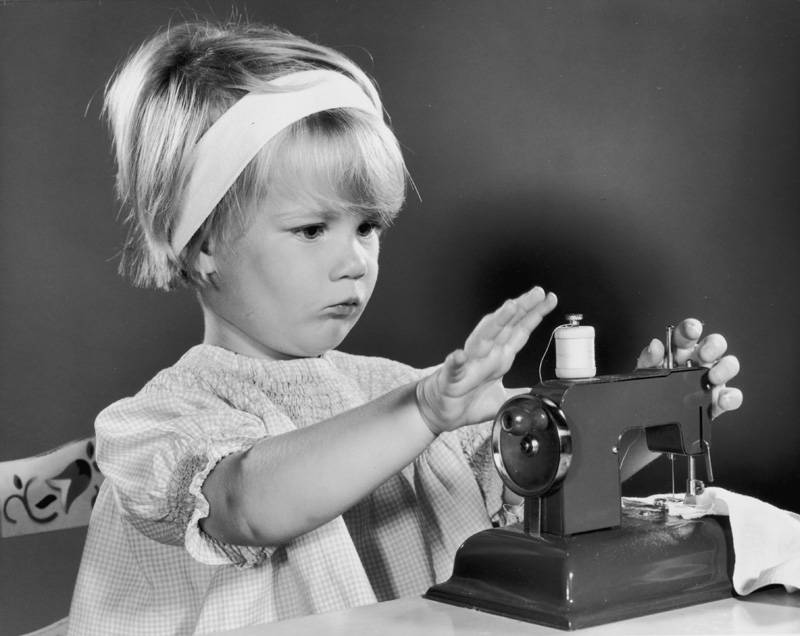
Boom. I found myself working in a sweatshop 13 hours a day sewing for two months straight, and then for weeks at a time afterwards. I was a literal slave. Mom would not let me do school while I sewed, saying that this was my school (never mind the fact that she called it a business when it suited her).

"I found myself working in a sweatshop 13 hours a day sewing for two months straight, and then for weeks at a time afterwards."
“I found myself working in a sweatshop 13 hours a day sewing for two months straight, and then for weeks at a time afterwards.”

I spent hundreds of long hours sewing, cutting cloth, embellishing each tiny item with complicated finishes. Furthermore, I was in charge of our website, web store and blog content, and all business records.

To add insult to injury, a person from the newspaper came, interviewed us, and made a story, with me smiling a painted story, telling lies, and gritting my teeth pretending it was fun.

Mom rarely lifted a finger to help me with “our business.” I cried so often. My nerves were shot. Even now, it’s hard to speak of. I wrote in narrative because somehow, that’s easier.

In between, I spent so much time trying to catch up on missed time for school. After hundreds of hours, I was never paid a cent. It broke at least 7 child labor laws in my country. Nevertheless, I was a passionate abolitionist. Through speeches, and human trafficking cases, I poured my soul into the hope that someday slaves would be free, even as I was a slave myself.

I finally escaped with the help of my dad at 16. Somehow, my pleading broke through to him, and he stood up to my mom, telling her it was over.

Even now though, I cannot bear to hear the sound of a sewing machine.

*****

To be continued.

Growing Kids the Abusive Way: Auriel’s Story, Part Three — Mini-Parents

Screen Shot 2013-08-12 at 3.13.05 PM

*****

Trigger warnings: references (sometimes graphic) to emotional, physical, religious, and sexual abuse.

*****

HA note: The author’s name has been changed to ensure anonymity. “Auriel” is a pseudonym. Auriel blogs at Drying My Wings.

*****

Also in this series: Part One: Growing Kids the Abusive Way | Part Two: Isolation and Ideology | Part Three: Mini-Parents | Part Four: The Sound of a Sewing Machine | Part Five: The Aftermath of Childhood Abuse

*****

Part 3: Mini-Parents

For both of my parents, I served as a surrogate spouse.

I mediated their fights, hoping they wouldn’t escalate to violence. They would come to me as their confidant. Dad would complain to me about Mom, sharing his quandaries, wondering how to deal with her.

He even consulted me as to whether he should divorce my mom when I was 14, or if he should take her to a psychiatric hospital when she was suicidal.

My mother, on the other hand, was a lonely soul. Many nights, she’d climb into my bed with me and spoon me. Then, she’d complain about my father, their sex life, how she was abused by her family and my father. At 13, my mother declared that my father raped her. My father denied it. I was so shocked and torn, not knowing who to believe. To appease her, I would sit on her bed daily, listening to hours long diatribes about her marriage problems.

She would expose her naked body to me, change in front of me, climb in the hot tub with just underwear, have me give her shoulder and feet massages, bring me into public restrooms with her, use excuses to see my body and make comments from the time I was a tot until I was 17 and more.

I had no voice, no way to say no.

She was my mother. I didn’t like it, but had no idea it was sexually abusive. I did not know females could be sexual abusers. I thought this was normal for mothers to do. I thought all girls knew what their moms looked like naked.

My mom was chronically and mentally ill, and slept most of the day, leaving us unsupervised. If she got up, it was to rage, dole out beatings, blame us for how terrible she felt, and then to sit in front of the computer screen. I’d sit with her, patiently watching her computer screen, hoping she’d appreciate me then. But normally, she’d ignore me.

So, I took over as parent and ran the house. Eventually, I was in charge of watching, caring for, and tutoring my younger siblings, cooking all family meals, picking up and cleaning our huge house, and doing dishes. I taught my youngest sibling to read, write, do math, use scissors, play, everything. At age 9, I was calling for all the appointments, hotels, stores, rides, and play dates for my family… everything an adult would do, I did. On top of this, I was my mother’s caretaker. I made her meals, checked on her hourly, and cleaned her room.

The best way to describe it is that I parented my mother and all of my siblings.

With the belief in the homeschooling community that teenagers don’t exist, my mom called me a “young adult” at 12. I was the oldest girl, the responsible one. I just wanted approval and respect, and to keep the peace as much as possible for survival. Indeed, it seems that our parent’s love was conditional on our love. Our value was tied to our obedience, to our service, to our usefulness, resourcefulness. But with so many adult pressures, so much fear of violence, and our worth conditional to reception of love, there was a terrible price to pay.

I was taught to abuse.

I was taught to beat my dogs…hit, kick, shock them with the shock collar, all while the poor dogs cowered and yelped in pain, struggling to escape. I hated it, but did not know it was wrong. If I refused, I would be in trouble. Either way, I was damned.

With my 4 siblings, I started raising them from the time I was 8. Growing up in such an isolated, violent environment, violence was one of the few ways I knew to handle problems.

Being taught Ezzo methods did not help.

Yelling or name-calling could keep them in line. If they didn’t cooperate, I would grab, push, drag, smack the back of their heads, slap them, or kick them (I always told myself it was a light kick, so it was ok). I thought all siblings did this. I thought all families acted this way. Due to my extreme isolation, I did not know I was a bully until I was 16 years old! When I found out, I cried bitter tears of guilt and shame. I apologized profusely, and made amends to them. It pains me to this day that I could not take back what I’d done.

We were trained to keep silent about the fights and abuse at home or face severe punishment.

Moreover, there was so much shame surrounding it. I made it my responsibility to be the guardian of outgoing words. Concurrently, I was my parent’s pawn. I believed them. They forced me to be an apologist for the very things I despised. Therefore, to preserve my sanity, my mind forgot the abuse. I told folks what great parents I had, and gave my parents cards saying “#1 Dad” and “Best Mother in the World!”

I stood up for spanking rights, parental rights, homeschooling rights, courtship, no kissing before marriage, and so many other things that I internally was at war with myself over.

*****

To be continued.

How I Learned To Stop Being Afraid and Love Other Religions: Part Two, When Buddhism Saved My Life

mandala

HA note: The following is reprinted with permission from R.L. Stollar’s personal blog. It was originally published on July 30, 2013.

< Part One: If Satan Made Xanax, And Other Worldview Myths

*****

“It’s not difficult to see why Eastern religion is such an attractive form of salvation for a post-Christian culture. It assuages the ego by pronouncing the individual divine, and it gives a gratifying sense of ‘spirituality’ without making any demands in terms of doctrinal commitment or ethical living.”

~Chuck Colson, How Now Shall We Live?, 2004

*****

Part Two: When Buddhism Saved My Life

There were two particularly eye-opening moments I had during my 12 months studying Eastern Classics at St. John’s College, and both revolved around Buddhism.

The first was when my discussion group read a Buddhist text. Going into the discussion, I expected that there would be a lively debate. After all, my class consisted of people with diverse religious beliefs — atheists, Christians, Hindus, Buddhists, and more. I assumed that disagreement would be plentiful. What I did not expect, however, was that the lively debate occurred primarily between the Buddhist students.

It gave me flashbacks to highschool when Christian homeschool debaters spent hours arguing with each other over free will versus predestination. 

Oh… there is more than one type of Buddhist, I realized. Which was a simple reality. But it was a reality that Summit Ministries, for example, omitted when they taught me about Buddhism. And it is a reality that makes a really big difference.

The second moment was when I became friends with a Buddhist for the first time in my life. I’ll call him C. here. C. was my best guy friend during my time at St. John’s. He practiced Diamond Way Buddhism. And he was nothing like the Christian stereotypes I had heard about Buddhists. In fact, he was the most emotional male I had ever known — and I mean that in a thoroughly positive way. He embraced emotions. He taught me that not all Buddhists believe that “enlightenment” is reached by avoiding emotions. Some Buddhists believe that you need to face emotions head-on, acknowledge their existence, let them be what they are, feel them fully, and then let them pass. Learning to master one’s emotions, he said, wasn’t a matter of ignoring them.

You look your emotions in the eyes and say, “Oh. Hey. You exist. I am going to feel you. Maybe even for a long while. But then you will pass. Because you are not me.”

What C. taught me about emotions is one of the most important lessons I have ever learned in my life. Growing in the conservative Christian homeschool world, where first-time obedience and purity culture were rampant, I was taught to distance myself from my emotions, to be afraid of them:

Don’t be angry at adults. Anger is rebellion.

Don’t look at attractive women. You will lust.

Don’t be sad. You must set an example for others.

Buddhism made me realize that emotions are. They exist. This is just a fact of life. It is ok to feel them.

When I feel attraction towards a woman, that is ok. The woman is attractive, and therefore I experience attraction.

It is ok to feel attraction.

When someone does something that is mean or unfair, I experience hurt.

It is ok to feel hurt.

While this might seem like common sense, it wasn’t common to my experience growing up. And it made me realize that this stereotype I had of Buddhists — emotional asceticism — was actually more descriptive of Christianity than Buddhism — at least the Christianity I was raised in.

It was my American Christianity, not Buddhism, that needed to be told Jesus wept and that was ok.

I owe something else to Buddhism as well, something really big. I owe Buddhism my life. While I never converted to Buddhism, I did practice meditation for that year at St. John’s. To be honest, I pretty much hated the process. I do not like sitting cross-legged, and I do not like keeping my back straight and closing my eyes for an hour. But I did it just to say I tried. And in the years since then, when my depression flares up and my suicidal tendencies become overwhelming, I always find myself going back to my Buddhist meditations.

There is nothing religious about this fact. It is, for me, purely psychological. When all else fails, when my body is shaking and all I can think about is ending my life, it is the repetition of karmapa chenno and the visualizing of running mandala beads through my hands that can get my mind re-grounded. These things — though distant memories from almost a decade ago — are lifelines back to reality when my mental health distintegrates.

Buddhism, not my American Christianity, taught me how to mentally ground myself.

On more occasions than I’d like to admit, Buddhism has saved my life.

People who have difficulty with understanding how complex the human mind is, and how complex religions actually are, would find this a terrifying prospect. You can’t be a real Christian and at the same time appreciate Buddhism, the line might go. But I am not terrified by this idea. Because I do not see Buddhism, or Christianity, as set of propositions that are either true or false. I see them as so much more than that.

I see that I cannot step foot into a Christian church (and have not been able to for years) without experiencing a panic attack. And I know that this honestly has nothing to do with the truth-propositions of Christianity. It has to do with just about everything about Christianity other than the truth-propositions. In the same way, my positive experience of Buddhism — that it has saved my life — also has little to do with truth-propositions.

This is a key part of what I mean, then, when I said in Part One that, “Religion is a complex totality of human and other elements, only one element of which is the sort of truth-claim that one can package into propositions.”

This is also a key reason why I am not ashamed in any way to say that I love more than one religion.

*****

Part Three: I Celebrate My Childlike Wonder >