How I Learned To Stop Being Afraid and Love Other Religions: Part Three, I Celebrate My Childlike Wonder

screen-shot-2013-07-30-at-8-26-49-pm

HA note: The following is reprinted with permission from R.L. Stollar’s personal blog. It was originally published on August 1, 2013.

 < Part Two: When Buddhism Saved My Life

*****

“If you were to say to the grown-ups: ‘I saw a beautiful house made of rosy brick, with geraniums in the windows and doves on the roof,’ they would not be able to get any idea of that house at all. You would have to say to them, ‘I saw a house that cost $20,000.’ Then they would exclaim, ‘Oh, what a pretty house that is!’”

~Antoine de Saint Exupéry, The Little Prince

*****

Part Three: I Celebrate My Childlike Wonder

The message I received growing up, from homeschool curriculums to highschool worldview camps, was a message about a dichotomy:

Everything is either for us or against us, us versus them, heaven or hell, Biblical Worldview™ or Bust.

Summit Ministries, for example, reduced every belief system in the world to only three — Secular Humanism, Transcendentalism, and Theism. And if you weren’t a member of that third category (and not just a member of the category, but also the sub-sub-sub-category of Biblical Worldview Theism), you were dangerous. You were to be kept at an arm’s distance, and it would be more than an arm’s distance, except that — if you were too far away, we couldn’t evangelize to you.

But as I left my youthful suburb behind, I realized life is far more complicated. The American Christian worldview was trying so hard to make everything neatly packaged, with a pretty bow on top, so that we wouldn’t “lose the faith” in college — that it forgot to take other people seriously. Looking back at Summit’s lesson plans, I cannot help but employ facepalm after facepalm. Reading quotations from Chuck Colson’s How Now Shall We Live?, which I remember made the rounds in my homeschooling community in highschool, I cannot help but cringe at its abundant use of straw men.

I wish I wasn’t raised to fear other ideas. 

I wish I wasn’t raised to fit people neatly into summer camp categories.

Most of all, I wish I didn’t have to fight so hard to free myself from the Biblical Worldview™ or Bust mentality. Because it took a whole lot of energy to extricate myself from that.

Once I broke free, once I began to see that what I was taught as “Christianity” wasn’t some pure set of doctrines but rather a particular moment-in-time’s interpretation of doctrines — and also a whole lot more — I began to see other religions differently, too. I began to see that they had a lot to offer me. Buddhism wasn’t just a line in a binder that gets stamped either “True” or “False.” Neither was Daoism or Hinduism or any other -ism. They were complicated movements full of people and history and ideas and passions, fueled by heartache and hope and joy and terror.

They were made of humans. They were just like me. They were asking the exact same questions I was, and for the exact same reasons. They breathed, they felt, they lived, they loved, they hated — everything that made them relatable and understandable and beautiful and tragic was everything that was conveniently omitted from my education.

I was taught to refute. I was not taught to relate.

I was taught to analyze. I was not taught to love.

I was taught to argue. I was not taught to appreciate.

As I learned to approach life with humility and openness, I began to see the complexity. I began to see what other religions had to offer. I learned so many important life lessons from this process — I learned from Buddhism, for example, how to ground my mind when my depression got overwhelming. I learned from Daoism how censorship, control, and domination are not the only forms of influence and leadership.

I learned that there are so many beautiful and good things in other religions that have nothing to do with the Biblical Worldview™. 

I can freely admit that beauty and that goodness without fear. Because I came to realize that religion is more than a set of propositions that are true or false.

It is a force that underlies and propels human thinking and interaction. At the same time it is also the final touch to that thinking and interaction, an acrylic fixative for the oil painting of human ingenuity. Human beings have a desire to make sense of their world, to find a meaning in that sense, and to be inspired by the meaning they find.

In this sense, therefore, religion is both true and false, Christian and pagan, personal and social, relative and universal, oppressive and liberating. It can be each and every one because religion is not one particular entity. It is an edifice of both the idiosyncratic and the profound. As propositional truth about the universe’s origin, it can be true or false; as revealing the delicacy of human nature, it can be beautiful or ugly; as a particular society’s intense struggle to understand itself and its universe, it can either be faithful to that struggle or unfaithful; as encompassing disciplines such as meditation or yoga, it can either be healing or aggravating; and so forth. In short, it is so much more than what the evangelical culture believes.

One cannot divide religion into the simple categories of “right” and “wrong” based on whether it affirms the humanity and divinity of Jesus.

Even if one does affirm Jesus as such, one cannot say this is the essence of religion.

To see religion from a broader perspective doesn’t need to threaten anyone. For example, Christianity’s understanding of the universe can easily be understood as underlying this analysis. According to the Book of Genesis, the God of Israel created humanity in His image. He created humanity with the tools of reason, a blistering curiosity, and the insatiable need to put together the puzzle pieces of the world into a coherent picture that makes sense of this world. No matter what religion one adheres to, therefore, since one is still human in the sense of being made in God’s image, one will experience this insatiable need for a coherent portrait of reality.

Religion as such is the product of this need. The various religions are the attempts of human cultures throughout the history of the world to create a coherent picture of reality.

Even the contemporary American interpretation of Christianity is not a flawless deduction from the Old and New Testaments but rather one more human attempt at coherence.

To some people, of course, this necessitates a cynicism or pessimism regarding religion. (To the contemporary American Christian, it just implies heresy.) If religion is interpretation, how can anyone claim to have the right interpretation? While an important question, this inquiry all too often implies that interpretation as a process lacks any sort of inherent value. I simply disagree.

Maybe I read too many children’s books, but I am a big fan of process. I am forever unfolding, learning new things each day.

I will hold onto my wonder until the day I die.

Even if the process becomes tedious, it bears many gifts. It bears treasures unto the painter, the musician, the lover, and the logician. While religions have no doubt caused catastrophic pain and suffering (and I don’t mean to diminish this fact, but my personal struggle is appreciating other religions, not hating them; I was raised to hate most of them), religions are also the artifacts of cultures worthy to be preserved in the grandest of museums—remnants of the human struggle to understand an alienating and a chaotic world; the courageous refusals to cave into meaningless; the unparalleled artistry and creativity employed to justify such refusals.

Consider the poetic fury of the Rg Veda, or the kaleidoscopic narrative of theMahabharata, an epic unparalleled in mass and muse by the greatest of Greek and Roman artists. (Really, just read the Mahabharata, period. It makes the Iliad look like a Young Adult novel.) Plumb the depths of Dante’s Inferno. Bask in the apocalypse of St. John in his Book of Revelations. Know the deeply felt vibration of the mystical Om, or the karmapa chenno of the Diamond Way. Hear the austere men of faith solemnly chat their divine liturgies, especially the “One Hundred and Second Psalm” by the Russian Patriarchate Choir; adore the children who delight in their Sunday School rhymes.

Say what one may about these people and their faiths, yet think about how amazing it is —

Human beings have created art, song, and dance; tens of thousands of gods; histories and philosophies and mythologies — all to figure out life.

And then think about something else.

Think about the negatives, too, for one moment.

You cannot escape the negatives, no matter how beautiful your religion is, no matter how “biblical” your view of the world is.

One moment the Roman Catholic Church finds itself embroiled in sex scandals—the next moment it is the American Protestant Church, as Calvary Chapel and Sovereign Grace crumble under the weight of child abuse. Before that, human sacrifice occurred, documented in the Mahabharata. Isaac of the Old Testament also intended to sacrifice his son for his deity’s pleasure. King David of Israel committed adultery. So did Pastor Ted Haggard. So did Arjuna of Hindu fame. Chuang Tzu was a lazy bastard. Prominent Buddhists are notable money machines; The Purpose-Driven Life is, too.

This is the human element of religion.

It is the element of Midas: everything humanity lays its eager fingers upon transforms into a human endeavor, no matter how superhuman the endeavor might have first manifested.

When the Buddha left his palace home to seek enlightenment, he did not intend to create a worldwide movement full of sects that constantly bicker and would try to oust each other out of power. Neither did Jesus. In the 1950′s, Jim Jones had a seemingly simple goal: to create the People’s Temple, an inter-racial mission for the sick, homeless and jobless. Decades later, the movement would end with over nine hundred adults and children drinking cyanide-laced grape Kool-Aid. The so-called Moral Majority seemed to have the blessing of God in 1978; by 1989 it fell apart, with many of its adherents later appearing in the news for sexual transgressions and drug abuse.

We cannot avoid this human element, any more than I think we can avoid the sense of wonder that provokes us to fashion religion. These things are essential to human being. To be human is to have a personality. And personality gives birth to the great fire that is the drama of human becoming—a drama in which religion plays a central role. It is the canvas on which we portray our search for truth.

I have come to appreciate that canvas, where it comes from. I have come to appreciate and love what each religion I have studied has to offer, and I do so with open arms, with a sincere desire to know and relate and understand.

I reject attempts to make myself and other people afraid to know and understand other humans and how they view the world from their own eyes. People who attempt that are snuffing out wonder, one book and one summer camp at a time.

I think of the child that Antoine de Saint Exupéry talks about, who sees the beautiful house and the grown-ups cannot understand the beauty in anything other than dollar amounts. Those of us who are learning to see the beauty in religions are scary to the “grown-ups” of American Christianity and Christian homeschooling because they cannot understand the beauty in anything other than disembodied doctrines:

“Does it fall under the Theism category?”

“Well, no, but I learned the most amaz—”

“Then off with its head!”

“But it contains an important truth about—”

“It’s not part of The Biblical Worldview™! End of story! Off with its head!

“But I really appreci—”

No! Off — With — Its — HEAD!”

I left that world. And I am not looking back.

If that’s what it means to be a grown-up, I’m choosing Neverland. I will live Where The Wild Things Are. Because I choose to celebrate my childlike wonder.

I choose to live in awe of the world, of humanity, of the amazingness that we — for whatever reason you want to say — have named tens of thousands of gods and created the Downward Dog pose; we sing songs and clap our hands and we eat wafers and say blood is wine; we laugh and cry together and we do all these things because we are that passionate about figuring out this maddening world we live in.

I mean, how amazing is that?

When I realized that, I stopped being afraid of other religions.

David Noebel, Summit Ministries, and the Evil of Rock: Jeri Lofland’s Thoughts

Screen Shot 2013-08-02 at 12.26.23 PM
Summit Ministries’ Jeff Myers and David Noebel on James Dobson’s radio show.

Jeri’s post was originally published on her blog Heresy in the Heartland with the title “Time Makes Ancient Good Uncouth.” It is reprinted with her permission. Also by Jeri on HA: “Generational Observations”, “Of Isolation and Community”, and “His Quiver Full of Them.”

*****

New occasions teach new duties, time makes ancient good uncouth,
They must upward still and onward, who would keep abreast of truth.

~James Russell Lowell, 1845

I ordered David Noebel’s booklet “Christian Rock: A Stratagem of Mephistopheles” from Summit Ministries in Manitou Springs as a teenager sometime in the early ’90’s.

I needed to know that Gothard and my parents weren’t crazy, that other intelligent adults had reasonable arguments with which to oppose Christian rock.

From the back cover: “It is The Summit’s purpose to arm Christian young people with facts and information concerning God, home and country so they will be able to hold fast to the true and the good in building their lives for the future.” I wanted facts; I wanted information.

And it turned out that Noebel supported my parents’ position:

“The church is beset with a relentless beat which weighs on the nerves and pounds in the head. And the syncopation evokes a most basic sensuous response from the body, since it is purposely aimed at the physical and sensual.”

“Squeezing in a few ‘thank you, Jesus’ or ‘Hallelujah, it’s done’ in rock music does not cleanse rock of its evils. Indeed, the lyrics were not its main sin for some time. The beat of the music was its evil.

Noebel presented 30 reasons, plenty of Bible verses, a study involving houseplants, and claims about applied kinesiology by a John Diamond. He quoted Henry Morris (a civil engineer and ardent young-earth creationist also opposed to modern art) and had a lot to say about sex and Marxism. Additionally, he linked the rock beat to atheistic Soviet communism and objectionable art styles like cubism and surrealism.

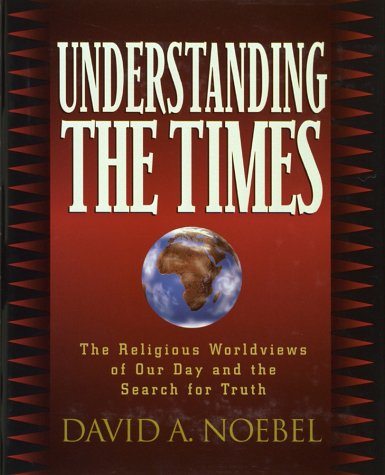
David Noebel is the author of "Understanding the Times," a book popular in evangelical and homeschool circles.
David Noebel is the author of “Understanding the Times,” a book popular in evangelical and homeschool circles.

I knew nothing about David Noebel.

I was not familiar with his much earlier work Communism, Hypnotism, and the Beatles, published in 1965–long before my birth–by Billy James Hargis’ Christian Crusade.

In one reviewer’s words: “Noebel is compelling because he’s intelligent, coherent, and well-researched, despite being absolutely paranoid and utterly mad. Aside from some inconsistent use of the Oxford Comma, he has a clear, if discursive thesis:

“Rock ‘n’ roll is turning kids into gay, Communist, miscegenators.”

Billy James Hargis was a right-wing evangelist and radio and television ranter long before Rush Limbaugh. He saw communist plots everywhere: in the NAACP and the civil rights movement, in the assassination of JFK, in water fluoridation. According to TIME magazine (Feb. 16, 1976), he founded American Christian College “to teach ‘antiCommunist patriotic Americanism'” from the city he called the “Fundamentalist Capital of the World”. From there, he promoted a hard line against drugs, homosexuality, sex education, abortion and the Beatles and toured with the college choir.

David Noebel was an aide to Hargis for twelve years, speaking around the country, founding The Summit in 1962 as a Christian Crusade program to combat anti-Christian teachings from secular universities (like the University of Tulsa) and contributing to Hargis’ television show where together they decried marijuana use and rock music. Later, Noebel became Vice President of Hargis’ new American Christian College in Tulsa.

In 1974, Noebel was staggered when students confided to him that Hargis, ardent promoter of traditional morality and father of four, had had sex with several of them.

Eventually four men and one woman exposed Hargis’ sexual abuse and manipulation over a period of years. TIME reported on the scandal in 1976, Hargis was forced to resign, and the school closed its doors the following year. Noebel went on to effectively “fold” Christian Crusade into Summit Ministries, building it into a successful international worldview training/brainwashing center targeting all ages, but teenagers in particular.

Noebel was an aide to Billy James Hargis, a right-wing evangelist and radio and television ranter who saw communist plots everywhere.

Postmodernism has replaced communism as the bane of our times. According to an article by Summit’s Steve Cornell,

“[The] pre-modern era was one in which religion was the source of truth and reality…. In a postmodern world, truth and reality are understood to be individually shaped by personal history, social class, gender, culture, and religion…. Postmoderns are suspicious of people who make universal truth claims…. Postmodern thinking is full of absurdities and inconsistencies.”

As a postmodern myself, I find it ironic that the decades have softened Noebel’s hardline position on Christian rock.

Apparently Mephistopheles has released it for other uses. Students at Summit’s youth conferences speak of the meaningful “corporate worship“, which now includes rock songs like “How Great Is Our God” by Chris Tomlin and “Jesus, Thank You” from Sovereign Grace Music.

The teens attending the worldview lectures today were not yet born when David Noebel penned Stratagem and would likely be surprised to learn that the religious anthems they find so powerful are actually “estranging them from traditional values”. According to the now retired, but still involved and revered, “Doc” Noebel, “although the lyrics might acknowledge the concept of true worship, the music itself expresses the unspoken desire to smash it to pieces.”

Summit’s John Stonestreet writes, “Truth does not yield to popular opinion. Unlike postmodernism, the biblical worldview can withstand all challenges and still speak to the dominant culture.” This belief is at the core of Summit’s “worldview” training.

And yet, Lowell’s line rings more true: time does make ancient “good” uncouth. Morality and truth are, in fact, shaped by history and culture.

As Summit’s stance on Christian rock illustrates so well.

Maybe, in another 30 years, Noebel’s successors will stop fighting same-sex marriage and even give up warning kids about “the gay agenda” as they “keep abreast of truth”? One can always hope…

How I Learned To Stop Being Afraid and Love Other Religions: Part Two, When Buddhism Saved My Life

mandala

HA note: The following is reprinted with permission from R.L. Stollar’s personal blog. It was originally published on July 30, 2013.

< Part One: If Satan Made Xanax, And Other Worldview Myths

*****

“It’s not difficult to see why Eastern religion is such an attractive form of salvation for a post-Christian culture. It assuages the ego by pronouncing the individual divine, and it gives a gratifying sense of ‘spirituality’ without making any demands in terms of doctrinal commitment or ethical living.”

~Chuck Colson, How Now Shall We Live?, 2004

*****

Part Two: When Buddhism Saved My Life

There were two particularly eye-opening moments I had during my 12 months studying Eastern Classics at St. John’s College, and both revolved around Buddhism.

The first was when my discussion group read a Buddhist text. Going into the discussion, I expected that there would be a lively debate. After all, my class consisted of people with diverse religious beliefs — atheists, Christians, Hindus, Buddhists, and more. I assumed that disagreement would be plentiful. What I did not expect, however, was that the lively debate occurred primarily between the Buddhist students.

It gave me flashbacks to highschool when Christian homeschool debaters spent hours arguing with each other over free will versus predestination. 

Oh… there is more than one type of Buddhist, I realized. Which was a simple reality. But it was a reality that Summit Ministries, for example, omitted when they taught me about Buddhism. And it is a reality that makes a really big difference.

The second moment was when I became friends with a Buddhist for the first time in my life. I’ll call him C. here. C. was my best guy friend during my time at St. John’s. He practiced Diamond Way Buddhism. And he was nothing like the Christian stereotypes I had heard about Buddhists. In fact, he was the most emotional male I had ever known — and I mean that in a thoroughly positive way. He embraced emotions. He taught me that not all Buddhists believe that “enlightenment” is reached by avoiding emotions. Some Buddhists believe that you need to face emotions head-on, acknowledge their existence, let them be what they are, feel them fully, and then let them pass. Learning to master one’s emotions, he said, wasn’t a matter of ignoring them.

You look your emotions in the eyes and say, “Oh. Hey. You exist. I am going to feel you. Maybe even for a long while. But then you will pass. Because you are not me.”

What C. taught me about emotions is one of the most important lessons I have ever learned in my life. Growing in the conservative Christian homeschool world, where first-time obedience and purity culture were rampant, I was taught to distance myself from my emotions, to be afraid of them:

Don’t be angry at adults. Anger is rebellion.

Don’t look at attractive women. You will lust.

Don’t be sad. You must set an example for others.

Buddhism made me realize that emotions are. They exist. This is just a fact of life. It is ok to feel them.

When I feel attraction towards a woman, that is ok. The woman is attractive, and therefore I experience attraction.

It is ok to feel attraction.

When someone does something that is mean or unfair, I experience hurt.

It is ok to feel hurt.

While this might seem like common sense, it wasn’t common to my experience growing up. And it made me realize that this stereotype I had of Buddhists — emotional asceticism — was actually more descriptive of Christianity than Buddhism — at least the Christianity I was raised in.

It was my American Christianity, not Buddhism, that needed to be told Jesus wept and that was ok.

I owe something else to Buddhism as well, something really big. I owe Buddhism my life. While I never converted to Buddhism, I did practice meditation for that year at St. John’s. To be honest, I pretty much hated the process. I do not like sitting cross-legged, and I do not like keeping my back straight and closing my eyes for an hour. But I did it just to say I tried. And in the years since then, when my depression flares up and my suicidal tendencies become overwhelming, I always find myself going back to my Buddhist meditations.

There is nothing religious about this fact. It is, for me, purely psychological. When all else fails, when my body is shaking and all I can think about is ending my life, it is the repetition of karmapa chenno and the visualizing of running mandala beads through my hands that can get my mind re-grounded. These things — though distant memories from almost a decade ago — are lifelines back to reality when my mental health distintegrates.

Buddhism, not my American Christianity, taught me how to mentally ground myself.

On more occasions than I’d like to admit, Buddhism has saved my life.

People who have difficulty with understanding how complex the human mind is, and how complex religions actually are, would find this a terrifying prospect. You can’t be a real Christian and at the same time appreciate Buddhism, the line might go. But I am not terrified by this idea. Because I do not see Buddhism, or Christianity, as set of propositions that are either true or false. I see them as so much more than that.

I see that I cannot step foot into a Christian church (and have not been able to for years) without experiencing a panic attack. And I know that this honestly has nothing to do with the truth-propositions of Christianity. It has to do with just about everything about Christianity other than the truth-propositions. In the same way, my positive experience of Buddhism — that it has saved my life — also has little to do with truth-propositions.

This is a key part of what I mean, then, when I said in Part One that, “Religion is a complex totality of human and other elements, only one element of which is the sort of truth-claim that one can package into propositions.”

This is also a key reason why I am not ashamed in any way to say that I love more than one religion.

*****

Part Three: I Celebrate My Childlike Wonder >

How I Learned To Stop Being Afraid and Love Other Religions, Part One: If Satan Made Xanax, And Other Worldview Myths

screen-shot-2013-07-29-at-7-46-16-pm

HA note: The following is reprinted with permission from R.L. Stollar’s personal blog. It was originally published on July 30, 2013.

*****

“Nothing short of a great Civil War of Values rages today throughout North America. Two sides with vastly differing and incompatible world-views are locked in a bitter conflict that permeates every level of society.”

~James Dobson and Gary Bauer, Children at Risk: The Battle for the Hearts and Minds of Our Kids, 1990

*****

Part One: If Satan Made Xanax, And Other Worldview Myths

When I enrolled in the Eastern Classics program at St. John’s College back in 2005, I encountered many and varied responses from fellow evangelical Christians. Some proved encouraging and others not so.

The most common response, though, was: “Are you a Buddhist?”

As the months passed and the time of graduation grew closer, the question changed, but only slightly:

“Have you become a Buddhist?”

At first the question provoked but a smile. As it grew more regular, however, and as I began to know more about Eastern philosophies and religions as well as what actually occurred in the minds of the questioners, it provoked a thought process. I realized that, to many Christians I knew, “Eastern” meant “Buddhist.” And “Buddhist” meant some tranquil species of rebellion against the American Jesus — like if Satan made Xanax for the mind. I vividly remember one individual who commented that, if I were to study Eastern religions, I better not become a Buddhist: Buddhists have no emotions whereas, you know, Jesus wept.

Such comments are likely the result of ignorance regarding world religions. A good number of the people who asked this question in 2005 did not shun inquiry. They merely lacked familiarity with Buddhism. They did not know (as I did not know prior to a year of study in the Eastern Classics) that Buddhism, like Christianity, has a dizzying number of denominations, each vying for doctrinal dominion. Consequently, when someone asks me now if I agree with Buddhism, I experience great difficulty answering the question: “Which denomination?” I have to ask. I have great fondness for the emotional freedom and experience-based practices of Diamond Way Buddhism, for example, whereas I dislike the asceticism of Theravada Buddhism. American Zen Buddhism is another story.

I have thus realized, after these conversations with friends and fellow students, that the American Christian mind (maybe even the American mind) has a paltry understanding of some of the longest-standing and deeply rooted ideas of the world. American evangelicals especially do not take time to appreciate, let alone understand, a good number of their strongest opponents in the sphere of religion. Those who have taken time (seemingly not much) only do so to construct flimsy card-houses with the purpose of a surprise attack.

You have groups like Summit Ministries and Worldview Weekend, training up the next generation with nothing more than an arsenal of generalizations, simplifications, and shameless reductionism.

No one seems interested in taking the ideas of other religions at face value and learning to see any sort of beauty or value in them.

To say that other religions can be beautiful or valuable is not an exercise in relativism. But granting this beauty or value will likely suffer the fate of being interpreted as such by many of today’s “worldview” champions. The old guard of American Christianity and Christian homeschooling — Dobson and Bauer, from this post’s opening quotation, and people like Summit’s David Noebel and John Stonestreet, or homeschooling’s Kevin Swanson and Ken Ham — is terrified of anything that sounds “postmodern.”

Postmodernism is like intellectual dub step to the old guard.

In today’s evangelical culture, a defense of religion as an aesthetic and social phenomenon seems indistinct from a defense of religious pluralism and intellectual apathy. But that’s because this culture is so afraid of “liberal” arts to the point that it cannot comprehend some basic philosophical and sociological concepts. The fact is, to understand religion as an aesthetic and social phenomenon grants humanity the freedom to explore a ground to aesthetics and society that condemns, rather than condones, an unwillingness to pursue truth.

But first: what does “religion” mean? And what would it mean, that one can perceive this noun’s content as “aesthetic” and “social”?

To the evangelical culture, religion is either Christian and thus true or pagan and thus untrue. This proves a stunted understanding, however, because religion is neither one nor many truth-claims which one can either affirm or reject. Religion is no doubt a phenomenon which entails truth-claims. But it also entails much more. Religion is a complex totality of human and other elements, only one element of which is the sort of truth-claim that one can package into propositions.

We need to start seeing religion — and any particular religion — not as a mass of disembodied doctrines but as what sociologist Peter Berger calls a “world conspiracy.” “World conspiracy,” in fact, seems the best definition for religion.

What does this mean?

In The Sacred Canopy, Berger explains that,

“The condition of the human organism in the world is…characterized by a built-in instability. Man does not have a given relationship to the world. He must ongoingly establish a relationship with it.”

The world abounds with the sort of innate precariousness that a Buddhist would term as impermanence — “All things pass,” sighs Kaoru, one of the main characters in Murasaki Shikibu’s Tale of Genji. This line is almost identical to Solomon’s sentiment in Ecclesiastes.

Human and other life forms, buildings and projects, ideas and romances—these all rise and fall, constantly, perpetually, each and every day. As a result of this precariousness, human beings go about selecting structures of meaning in which they can operate. Humans construct families, work places, technology, and institutions in which to control the elements of the world that bear chaos. Out of their constructions human beings hope for an order, a society. Peter Berger says,

“Society, as objective reality, provides a world for man to inhabit. This world encompasses the biography of the individual, which unfolds as a series of events within that world”

But humans need more than order: they need to feel meaningfulness within that order. They require that order to be “ordained” in some way. Thus,

“a meaningful order, or nomos, is imposed upon the discrete experiences and meanings of individuals.”

This nomos is religion:

“Religion is that human enterprise by which a sacred cosmos is established, wherein ‘cosmos’ implies not a galaxy but order.”

This final addition to the human world-building project grants the project and its everyday objects and endeavors a sense of purpose, an all-encompassing reason for pursuing the ends of the society. Berger terms this sense of purpose or reason a “sacred canopy” cast over world-building. It is a “world conspiracy” in the sense that humans work together to give their reality a meaning:

“Religion is the audacious attempt to conceive of the entire universe as being humanly significant”

What Berger as a sociologist calls a “world conspiracy,” or “sacred canopy,” a theologian like N.T. Wright might term “worldview.” (1) Jamake Highwater, a historian and philosopher of sexuality, preferred the term “mythology” in his 1991 book Myth and Sexuality:

“All human beliefs and activities spring from an underlying mythology—those metaphors, informing imageries, and paradigms which deeply influence every aspect of our lives and which determine our attitudes about reality—about the world and about ourselves: good and evil, normalcy and abnormalcy, fact and fiction, justice and injustice, beauty and ugliness, power and powerlessness.”

Whether one prefers world conspiracy, sacred canopy, worldview, or mythology as a descriptive, the common factor among the ideas is that human being itself contains within it a hope and passion for carving out a home in a hostile existence.

This hope and passion — and all its nuances, quirks, failures, and successes — is the stuff of religion.

*****

Part Two: When Buddhism Saved My Life >

Why I Am Proud of Myself: Philosophical Perspective’s Thoughts

Why I Am Proud of Myself: Philosophical Perspective’s Thoughts

HA note: The author’s name has been changed to ensure anonymity. “Philosophical Perspectives” is the author’s chosen pseudonym.

This is why I’m proud of myself.

This is not an article with arguments or nuanced thoughts, this is a declaration, for those of us who have survived.

I’m 27 years old, and I am so proud of myself.

My mom taught me to read when I was 5, and after that, I was mostly on my own.  Yes, she sought out volunteer experiences and free homeschool clubs for academic enrichment, but I had no formal education until college.

I grew up in a home where neglect was the norm.  My dad left for work in the morning, and my mom didn’t get out of bed until noon. As the oldest of three, it was my job to cook and clean, and make sure my siblings were “doing their school.”  What ability an eight year old has to make a 2 and 5 year old sit down and plow through math textbooks, I’ll never know.

My youngest sibling’s only memory of learning anything in his childhood was me, age 10, teaching him to read.

So, I’m proud of myself, because I was a voracious reader with a huge imagination and an incredible thirst for knowledge. I taught myself history, language arts, math, and science by sitting down and reading text books.

I was my own guidance counselor. As high school loomed, I knew I wanted to go to a “good college”.  So I read all of the rankings, and I figured out what I needed to learn to get where I wanted to go. I mapped out my four years of high school, asking my parents to enroll me in extension programs, community college, and co-ops. I figured out how homework worked, how to take tests, and how to build relationships with teachers so they would write me letters of recommendation.  I made sure I took math and science, because I couldn’t get those at home or through debate. I wrote tons of essays, so that I could write good applications for college. I worked 10 hours a week running a piano studio, so I could have my own spending money. I competed in the NCFCA, and won.  A lot.

I’m proud of myself, because I worked my ass off in high school, doing so much more than any of my peers. I had to figure out the system on my own, with no guidance or advice.

I’m proud of myself, because I had the drive and forethought and organization at seventeen, to call every university I wanted to apply to and ask their admissions counselors what extra information they would want, because I was homeschooled (and remember, this was 10 years ago, before homeschoolers in college was commonplace). I put together compelling and interesting application essays.  I figured out how to communicate the value of my education, by writing my own transcript and calculating my own GPA.  I had something like 10,000 volunteer hours by the time I graduated (for which I give my mom much credit). I applied for a won extremely prestigious scholarships, landing me in the top .01% of graduating high school seniors in the country, and beating out peers from prep schools who had parents, teachers, principals, and advisors prepping and nurturing them. I only had myself.

I got into a top five university, from which I earned a BA and MA in four years, and graduated with honors. I paid my way through college with no financial support from my parents. I now work for a nationally recognized organization, and am leading in their cross-cultural outreach.

I am so damn proud of myself.

Because, despite what the news articles would have you believe, I have not been successful because of my (lack of) education. I am thriving despite my homeschool experience. I have been successful because I have overcome every obstacle thrown in my path. I been smarter and worked harder than the vast majority of my non-homeschooled peers. I am tough, I am resilient, and I have already accomplished so much.

So yes, as I read and write and recall all of the bullshit I’ve lived through and coped with, I need to remember every once in awhile that I am overcoming it, and that is amazing.

I am not a homeschool success story.  I’m my own success story.

*****

Also by Philosophical Perspectives on HA:

How NCFCA Taught Me to Fight Sexism

Of Love and Office Supplies

A Tool In Someone Else’s Culture War

We Need Advocates

Brainwashed Shock Troops

HA note: The following is reprinted with permission from Libby Anne’s blog Love Joy Feminism. It was originally published on Patheos on July 17, 2013.

Michael Farris, founder of the Home School Legal Defense Association and probably the most visible Christian homeschool leader, is fond of calling his generation the Moses Generation and my generation the Joshua Generation. Christian homeschooling parents, he says, removed their children from the perils of Egypt (aka the public school system) and educated them in the wilderness (aka homeschooling them) in order to send them forth to conquer Canaan (aka take America back for Christ). This really is the entire point of Christian homeschooling (as opposed to homeschooling done by those who may or may not happen to be Christian but do not have religious motivations for homeschooling). This is also why Farris’s daughter started NCFCA—to train Christian homeschool youth in argumentation and debate in an effort to prepare them for their assault on “the world.” In that light, I recently saw an interesting comment left on a Homeschoolers Anonymous post:

The idea that someone thinks that they can find really bright young people, teach them exceptional skills of debate and argument, and then unleash them upon the world as adults while still controlling their thoughts and attitudes is nothing short of insane. Young people have been growing up into adults who reject the authoritarian views imposed upon them for literally centuries. Why does this group of fundamental Christians – who often behave abusively to that self-same group of bright young people – think that they are exempt from the questioning and breaking away process that all young adults do as they grown into independence?

Because they believe they have completely brainwashed their young people into absolute loyalty to The Party as part of their training/indoctrination. Like the Uruk-Hai coming from the spawning pits below Isengard, they were raised and indoctrinated to be living weapons and nothing more.

Why do they think they are exempt from their best and brightest living weapons breaking away? Divine Right, of course.

My father spoke at my graduation. It was a homeschool graduation held at a local church, of course, and each father presented his son or daughter and gave a short speech. I was preparing to begin university the following fall. In his speech, my father said that many people had questioned his wisdom in sending me off to a secular university, asking whether I was ready for that. His response, he said, was that the real question was not whether I was ready to attend that university, but rather whether that university was ready for me. His confidence in my performance disappeared over the following years as I did indeed become “corrupted” by my time at university, and halfway through college my father launched into a tirade against me in which he brought up his remarks at my graduation and told me, his voice full of emotion, that those who had warned him against sending me off to a secular university had been right, and that he wished he could go back and undo that.

What happened?

Put simply, the commenter quoted above is right.

It is completely unreasonable for Christian homeschool parents to think that they can train up ideological clones whom they can train in debate and argument and then unleash upon the world without at least some of them going rogue or asking questions they shouldn’t. If these parents limit their children’s interaction with the world outside of their religious communities and avoid teaching their children critical thinking skills, creating ideological clones is simpler. But if you’re going to train them in argumentation and debate and then send them out into the world to wage ideological war on your foes, well, that’s more complicated. My parents equipped me with the very tools that ultimately led me to think my way out of their mindset, and meeting and getting to know people in “the world” meant that I realized the portrayal of “the world” my parents had given me growing up was wrong and extremely backwards. The system my parents constructed around me, in other words, was built with an internal weakness.

Why, then, did my parents have so much confidence? The commenter quoted above does have a point when referring to divine right—my parents believed that they were right, that their ideology was sound and true and demonstrably so. They therefore assumed that if they equipped me with Truth, that would be enough.

That I might grow up to disagree with them on what is true and what is not wasn’t really a concern, because they believed that the truth of their beliefs was completely obvious to anyone with eyes. When they would talk about people who “left the faith,” they would always attribute it to some sin—the person just wanted to have premarital sex, or to be able to be selfish and not care about others, or what have you. In their conception, it was never a disagreement about fact that led people once saved astray, but rather fleshly desires—because the truth of their beliefs, they were certain, was manifestly obvious to anyone and everyone.

There was something else, too, something more related to Christian homeschooling. My parents believed they had hit upon the perfect formula for raising children who would never fall astray. They believed this because this is what they were told by the books, magazines, and speakers of the Christian homeschool world. And they had done everything on the list from keeping me from friends who might be bad influences to teaching me with curriculum that approached each issue from a Christian perspective. This, quite simply, is what I consider the number one reason my father said what he did at my graduation. He was convinced that he had produced a culture warrior, following the proper formula and all of the proper advice, and that I was, in a sense, infallible—that I couldn’t possible go wrong.

But what was I, really?

I was chock full of apologetics arguments and conservative talking points, but utterly without lived experience or any real understanding of the arguments against the ideas my parents had taught me. After all, I’d never really interacted with people with different ideas or beliefs and my parents provided me only with straw man versions of opposing arguments in order to then knock them down. I’d grown up in an echo chamber and was happy contributing to that echo chamber, but I had no experience stepping outside of it.

I wasn’t a culture warrior. I was a teenage girl who thought she knew everything and wanted very much to please her parents.

Confessions of a Homeschooler: Iris Rosenthal’s Story, Part Two

Confessions of a Homeschooler: Iris Rosenthal’s Story, Part Two

Iris Rosenthal blogs at The Spiritual Llama. This story is reprinted with her permission.

< Part One

"I remember how hard it was for me to adjust to being outside of the homeschooling bubble and in some ways, eight years later I am still adjusting."
“I remember how hard it was for me to adjust to being outside of the homeschooling bubble and in some ways, eight years later I am still adjusting.”

Since my original post I have come to the realization that I have just scratched the surface on everything that I have to tell about homeschooling. One of the problems I have with home education is that there is hardly any regulation. During the time I was homeschooled, K-12, I never once had to take the SAT or ACT or any other sort of evaluation test.

As long as it looked like I was studying I was pretty much left alone. The only subjects my mother was constantly involved in were; math, spelling and english. Occasionally she would check my work in the other subjects, but for the most part I was left to fend for myself and once I reached the age of 15 any involvement from her pretty much came to a stop.

I often hear the argument that not all parents homeschool are like this and that my mom was doing it wrong. While that may be the case, I don’t think that this should be lightly brushed off. We are talking about the education of children here! It is my belief that whichever route you choose, it’s very important that your children receive the best possible education. Be involved, be a part of their lives, listen, be aware of what they are learning about and learn with them!

With the lax requirements in place for homeschooling it only flings open the door for cases such as mine to happen. So much for homeschooling being better than public school (for those who don’t know me, that was sarcasm)!

I know my story is not the only one, my brother & sister and close friends have also experienced the same lack of education and preparedness to function in the real world because of being homeschooled. However, I’m not here to tell their story for them, I’m here to tell mine.

My first full time job experience happened when I was 21 at a call center. Yes I’d had jobs previously, but they were just odd jobs and the people I worked for I already knew from either homeschool group, church or 4-H. So I was always within that bubble my mother had me living in.

While working at the call center I got to know people who *gasp* went to public school, it was then that I started to realize that there were holes in my education. I didn’t know any math beyond the basic add and subtract. I could barely multiply or divide. Forget fractions and algebra.

I also realized that I was spelling a lot more words wrong than what I originally thought I was. It’s pretty bad (not to mention embarrassing) when your manager brings back your vacation time off request (written in clear handwriting) and asks you to tell what words you meant to put down. I found myself sticking out a lot in all the wrong ways, and my judgmental attitude towards people who were different than me didn’t help with that at all!

I had never been around so many people from so many different backgrounds before, it was quite an eye opener and culture shock for me! I still remember the first time I heard someone swear. If I didn’t agree with something someone said or did I made sure to let them know that it offended me. If I knew someone was a Christian and I heard them say something that I didn’t believe a Christian should say I made sure to let them know how wrong they were.

Looking back, I was quite obnoxious and judgmental towards my coworkers at that job. It is no small wonder that barely any of them talk to me anymore and I can’t say that I blame them!

I am so thankful that I have learned since then and now at my current job I am known among my coworkers for being helpful and a team player. I no longer allow my homeschooling experience to define me, in fact I hardly ever bring it up. I don’t feel as though I should have to defend my education (or lack thereof) to anyone.

It is my desire that people know and define me by who I really am, and not as some “failed product of home education.”

I hope that by sharing my experiences I can somehow prevent them from happening to someone else. I remember how hard it was for me to adjust to being outside of the homeschooling bubble and in some ways, eight years later I am still adjusting.

If anyone is reading this and is going through that rough transition period from the bubble to the real world, just know that you aren’t the only one who has traveled that path. It may be rough now, but in the end you will be stronger and wiser for it!

Young Earth, Young People, and Abandoned Faith

HA note: The following is reprinted with permission from Julie Anne Smith’s blog Spiritual Sounding Board. It was originally published on July 10, 2013 with the title, “Ken Ham, Young Earth Creationism, Young People Abandoning Their Faith: My Daughter’s Story.”

This story pains me.  It’s a personal one.

Parenting is very challenging. Homeschooling children has also been a challenge. When we began homeschooling our children, we chose to do so for a number of reasons.  We wanted to have better oversight over the curricula our children were taught because we wanted to give them a solid Christian foundation.

As typical Christian parents, we did not want them to have “worldly” influences. We got support at homeschool conventions, conferences. I spent time on the internet in e-mail groups, message boards, etc, and got support and information there. In the Christian homeschooling arena, Creationism was taught in the science curricula. Evolution was labeled as evil and we needed to protect our children from those false ideas.

Ken Ham spoke on the homeschooling circuit and we went to his seminars.  Others echoed his ideas and if you were a Christian homeschooler, you very likely taught your children Young Earth Creationism (YEC), as this was the primary science taught in the available Christian homeschooling texts – at least that I saw in my circles.

Science has never been my “thang.”  I don’t need to know the process of how we got here. The Bible told me how we got here.  I believed what it said and that settled the issue for me.   I didn’t need to discuss it further.

My husband, however, is an engineer.  He is very interested in knowing the process of things. I can’t imagine him not wanting to know how things work.  Engineers live and breathe processes.

Teaching creationism was a perfect fit for my husband.  He took the kids to creationism seminars over the years, bought quite a few creationist books about dinosaurs and the origins of the earth, and the kids soaked it up.  I found our eldest daughter devouring the books just for fun. She was sold. It was a foundational issue for faith, just like Ken Ham always said.

Here is a quotation by Ken Ham to students at Bob Jones University:

 “The majority of Christian colleges in this nation won’t take a stand on a literal Genesis, as you do here at Bob Jones University,” he said. And that compromise, according to Mr. Ham, is the very reason that some Christian young people are abandoning their faith. He said, “We have increasing numbers of people who have been led to doubt the history in the Bible, and so they don’t believe the Gospel based on that history.”

A couple of months ago, my older kids and I were at a restaurant and Hannah, 26 yrs old, shared with me a pivotal experience.  I hadn’t heard this story before.  Remember, science bores me.  When she talked this time about science, I was not bored.  I listened with great sadness and also understanding.  It made sense to me.  I asked Hannah if she would share her story here and she agreed.

I do not agree with Ken Ham anymore.  I hope my daughter’s story will open your eyes to another side of the story which Mr. Ham would not dare to admit.  His intentions may be good in holding so strongly to the YEC teachings, but we cannot dismiss that his ministry and possibly livelihood depend upon it.

I don’t care if people believe in Young Earth Creation or not.  To me, it is not a salvation issue or gospel issue.  But the YEC-only way of believing did not work for my daughter, it backfired. I think it’s important to take a closer look at this issue.  Hannah’s story follows.

*****

My Experience with Young Earth Creationism

by Hannah Smith

While on a break between classes at the local community college, a previous homeschooled friend I knew from church and I were sitting at a table chatting in the main lobby. I honestly have no idea how the subject came up, but we were talking about YEC and evidences for it. I was trying to explain Carbon-14 dating (it’s not the easiest thing to break down off-the-cuff, but I was pretty sure I knew the very basic fundamentals of it in order to have it make sense to her.

As I was trying to explain it, one of my classmates overheard our conversation and came over and joined the conversation. He very efficiently sliced-and-diced my YEC “points” and “evidence”, but since I felt I hadn’t brushed up on the subject in a year or two, I’d investigate it more in the light of the contradictions he’d brought to surface. I wanted to see if I could do more in-depth research on the topic and figure out if and how much of what he was saying could be verified and where the disconnect between our two viewpoints occurred.

So after I went home, I dug up our trusty creationism-is-true-sort-of books commonly found in good Bible-Believing Homeschooling YEC family’s libraries. After reading the articles and chapters, I did what my father always said to do and “checked the source” – probably more to see if there were books completely dedicated to the topic of Carbon-14 dating that I could look up in the local library.

Flipping to the end of the book with the citations I was shocked that pretty much all of the sources for their proof was from other Christian YEC-believing books. So I quickly determined that they were just quoting what other people who believed similarly where saying, rather than going to scientific journals and scholarly articles written by secular authors and scientists. For example, take a look at the following excerpt taken from an article at Ken Ham’s Answers in Genesis site (Doesn’t Carbon Dating Disprove the Bible?):

In 1997 an eight-year research project was started to investigate the age of the earth. The group was called the RATE group (Radioisotopes and the Age of The Earth). The team of scientists included:

    • Larry Vardiman, PhD Atmospheric Science
    • Russell Humphreys, PhD Physics
    • Eugene Chaffin, PhD Physics
    • John Baumgardner, PhD Geophysics
    • Donald DeYoung, PhD Physics
    • Steven Austin, PhD Geology
    • Andrew Snelling, PhD Geology
    • Steven Boyd, PhD Hebraic and Cognate Studies

That looks very impressive – every single person, a PhD. But they probably all have a vested interest in this – 3 of those 8 people have written books advocating YEC and you can find that information one simple mouse-click away from the article.

Look at the sources quoted at the end of the article – they go back to other Christian Scientists with published books on the subject (the scientists above) – unless they are quoting the opposing viewpoints for comparison.

I found this info out in about 1 minute while I was writing the first paragraph above, about the same amount of time it took me five and half years ago, when this originally occurred. This kind of circular reasoning raised (and honestly still raises) major red-flags for me from a logical and scientific standpoint. If they can’t find outside sources, how does them quoting from their friends make it true?

This was the starting point of me doubting my faith. I never recovered from it.

Confessions of a Homeschooler: Iris Rosenthal’s Story

Confessions of a Homeschooler: Iris Rosenthal’s Story, Part One

Iris Rosenthal blogs at The Spiritual Llama. This story is reprinted with her permission.

"I learned at a young age to keep my different opinions to myself and to let her have her say no matter what."
“I learned at a young age to keep my different opinions to myself and to let her have her say no matter what.”

I recently came across a blog called Homeschoolers Anonymous, it caught my eye since I was homeschooled for several years and never set foot in a public school.

As I started reading the blog, I found myself relating to things that were being said there more and more. And when I read the “About” section on their website, that is when I knew I had finally found a place that understood me and the struggles I have gone through to get where I am today, and wouldn’t just dismiss my misgivings about homeschooling telling me “Oh, not all homeschoolers are like that! You just weren’t homeschooled the right way!”

My mother homeschooled my brother, sister and I from K-12 grades. I’m not sure on her exact reasoning for homeschooling us since she was never homeschooled herself and also was a private school teacher for several years. I suspect she would have preferred to have us in a private school, however, living in a very, very very rural area of the state that wasn’t possible nor cost effective. So that left her with homeschooling or having her kids attend *dramatic gasp* public school.

The subject of our education was something that my mom and dad never could seem to agree on. My mom wanted to continue homeschooling us, while my dad wanted us to attend public school once we were older. This topic continued to be something that they both strongly disagreed on even after they divorced. My mom got custody of the three of us kids and we would see our dad every other weekend.

She continued to homeschool us and our curricula consisted of books she would find for us at yard sales and at the library, she also enrolled all of us in 4-H and told us that it was part of our schooling. Once I was in my 3rd or 4th year of high school she bought a computer program called Switched On Schoolhouse.

Once a week we would go to a homeschool co-op, once I was in high school it lost it’s appeal for me because everything was geared towards the younger kids and I was the only one in high school. It was very lonely and also frustrating at times because there were classes in the co-op that I wanted to take (such as the one where you were taught how to change the oil and other basic things on your car) but was told that those were only available for the boys. They had something called Contenders of the Faith (for the boys) and Keepers of the Home (for the girls), I don’t have much experience with either of those programs since they were (as I’ve said before) geared towards the younger kids.

There are times that I have huge doubts as to how intelligent I really am. At home my mother primarily focused on my brother and his education, while my sister and I got the leftovers. It was very tiresome to always hear all the time about how “smart” and “brilliant” my brother was, how well he always did on his schoolwork and how creative he was.

I suppose you must be wondering if my mother ever tried to pass a specific social, political and religious ideology on to us kids. Short answer, yes. She only ever had either conservative talk show, or the Christian music station playing on the radio. I grew up listening to Rush Limbaugh. She also made sure that we were very involved with the church we went to (even though it was a 45 minute drive one way) and was always volunteering us for things, while at the same time not letting us choose what we really wanted to do if it didn’t match her high ideals for us.

Being the oldest I was the first one to graduate of the three of us (even though my brother had skipped a grade or two). Two weeks after graduation I was taking college classes online, even though I had informed my mother that I didn’t want to start college right after high school. I wanted to take a year off and get a job (still hadn’t had a real job at that point, nor was I even driving on my own), work in an inner city church as a volunteer. I wanted to experience the world like I never had before being confined either to the secluded farm, homeschool group, 4-H or church. I didn’t even know what I wanted to go to college for, so it made sense in my 18 year old mind to not go to college until I knew what it was that I wanted to do. And I knew that when I did go to college I would want to stay in a dorm and not take classes online.

Of course that wasn’t good enough for my mom, who took it upon herself to enroll me in an online university to take classes to get an associates degree in business administration. It was her plan for me to eventually turn the farm into a “ranch for disadvantaged youth” and that’s why I had to take these courses.

After trying my very best in the first semester I came to her in tears wanting to drop out. I had toughed it out for a semester and that was enough to reinforce my belief that business administration wasn’t for me. I tried to tell her all of this, but instead got to hear a lecture about how she didn’t raise any quitters. I told her that I would rather have a job, and she told me that in order to have a job that didn’t involve “flipping burgers” that I would have to go to college. Disagreeing with my mother is near impossible if you want to be vocal about your differing opinion, she is very dead set on being right all the time so I learned at a young age to keep my different opinions to myself and to let her have her say no matter what.

I took online classes for eight more months before the university kicked me out because my grades had plummeted so low. It was a great relief for me even though my mother was constantly chewing me out about being a failure because now I could finally get a job.

Overall I would describe my homeschooling experience as negative. Now that I am close to 30 years old and about to have a child of my own, I know that I would not want my daughter to go through what I went through. I don’t want her to be as ill-prepared when it comes to functioning in the real world as I was. I understand parents wanting to protect their kids from all the bad stuff that goes on in the world…however, you have to have balance and know that eventually you will need to teach and equip them how to handle different situations that they will face once they get out on their own.

After all, doesn’t every parent (no matter what their religious or political standings) want their child to be an independent and self-reliant adult in the real world?

Part Two >

TeenPacters Speak Up: Part Eleven, TeenPact Needs Integrity, Not Money

TeenPacters Speak Up: A Series by Between Black and White

HA note: This series is reprinted with permission from Between Black and White. Part Eleven was originally published on May 25, 2013.

*****

Part Eleven: TeenPact Needs Integrity, Not Money, by Starfury

TeenPact is an organisation started in 1994 by Tim Echols in an effort to “turn students into statesmen.” In 1996, he formed Family Resources Network, of which TeenPact became a part. [1] Family Resources Network is a tax-exempt non-profit organisation. [2] As such, there are specific tenets that it needs to follow, particularly pertaining to support for political campaigns. Organisations with a 501(c)(3) status are restricted from engaging in political campaign activity. [3]

In 2010, an ethics complaint was made, partially regarding the amount of involvement TeenPact and TeenPact Students had during the election in question. “Student Project” is the name that was given to the campaigns Tim Echols (and others involved with his organisation, albeit with his blessing) decided his students should support. Be it for a handful of days, or a whole week, he would gather TeenPact students to come and spend long days campaigning for those running for office. Publicly, TeenPact refused to associate with the various “Student Projects.” The keyword here is “publicly.”

Many emails inside the organisation tell a different story. Here are a few excerpts of the many emails that I, and several others, have received. I have removed the names of most individuals and states, to protect their privacy at this time. These were all sent to TeenPact email lists: some staffing, some state specific, others had a wider base.

For those who could afford to travel to these events and pay the fees associated therewith, it was essentially a TeenPact event. I, for one, was told when I arrived that it was not an “official” TeenPact event, but we were held subject to the same TeenPact Appropriate rules – dress, media, behaviour, etc. The only distinguishing factor was that rather than be at a class, we were on a campaign trail.

Here follow seven examples spanning from 2006 to 2010 (about which time those who have been willing to contribute thus far stopped receiving TeenPact emails):

Date: Jul 12, 2010 8:21 PM

Subject: Your new TeenPact State Coordinator!

Dear [State] TeenPact family,

…It has truly been a blessing serving with you, whether we were in a TeenPact class together at our state capitol, or knocking on doors during a [State] Student Project! […] However, due to necessity of the [STATE] TP state coordinator actually living in [state] […] I now formally introduce Mr. [Name] as the next TP [State] State Co.! […] Mr. [Name] is now fully plugged in with the TP home office and will be running (or delegating any leadership roles) any state class or [State] Student Project from now on, and he assures us all that he is ready to go!

From: Tim Echols

Date: Mon, May 10, 2010 at 8:02 PM

Subject: Echols running for PSC

Hi All,

By now, you have probably heard about my statewide campaign for Public Service Commission. Please join our facebook group tonight at http://tiny.cc/cgy7i if you have time.

More importantly, I am looking for hundreds of students who can be a part of five different projects we are putting together. See attached. I need moms to drive and host families to host. It will be hot, and a lot of work, but we can win this seat.

We are having a Sunday night prayer call at 8pm every Sunday night after church as well. Let me know if you can join that.

Thanks,

Tim Echols

www.timechols.com (if you can make a small donation I would be very grateful)

PS We are having a call tomorrow and Wednesday to discuss the projects. Email me for the number and code.

Date: May 25, 2007 7:37 PM

Subject: Concerning TeenPact, this years[sic] Student Project, and [Name]!!

Hi Everybody!

It was so great to see you all at the TeenPact class. […] Because her seat is now vacant, there is going to be a special election held on June 12th. Mrs. [Name], a very godly and conservative lady, is running as the Republican candidate, and we have been asked, and given the opportunity to help her get elected! We are going to be working out of the GOP headquarters in [Capitol] on June 9th, 11th, and 12th. The state of [State], [Name], and I, need your help in order to “pull this off”! Therefore, if you want to put your recently honed and sharpened TeenPact skills to work for both our State and God’s kingdom, then please respond to [email] and let me know which day or days, you can come.

Date: May 23, 2007 11:24 AM

Subject: [City] Project

My Fellow Teenpacters, it is my pleasure to invite you to join Mr. Tim Echols and myself and many others as we do some grassroots campaigning in North [State] June 13th through the 19th for Dr. [Name]’s run for Congress. We will be focusing primarily on door to door campaigning during the week and this will be a great opportunity to apply the civic skills you have learned through TeenPact in an actual political environment.

From: Tim Echols

Date: Tue, Mar 13, 2007 at 11:26 AM

Subject: campaign in [City]

Dear TeenPact Campaign Veterans,

Dr. [Name], a good friend, is running for Congress here in a special election to occur June 19th. There will be a Student Project put together for this campaign. We need several paid staff for that.

Additionally, we need staff now that would like to come over and live here. This is also paid.

Please let me know if you are interested. I am giving significant personal time to this so we will be interacting regularly.

Please hit reply all if you are interested and let us know your availability and financial needs.

Tim Echols

From: The TeenPact Times Staff [official @teenpact.com address]

Date: Mar 1, 2007 2:24 PM

Subject: The TeenPact Times: March Edition

Vote Yes for Life in [State]!

In September of last year, about twenty students headed out to South Dakota to campaign for the referendum to ban abortion in the state. […] The following is an interview with [Name].

1) [Name], when it looked like TeenPact was not going to be able to mobilize students to go to [State], you wrote Mr. Echols a long note urging him not to give up.

I believe that abortion unless stopped, will cause the destruction of our great nation. I believe God told me to take a stand. Helping the Vote Yes for Life campaign was part of it.

2) How many students wound up going and approximately what did it cost to get them there?

Twenty-one students went to South Dakota. It cost us around $450.00 per attendee that totalled around $9450.00

[…]

*TeenPact thanks the many donors who made the trip to South Dakota possible. Special thanks to Don Wildmon of AFA, Joe Brinck of the Sanctity of Life Foundation, and the Arlington Group in Washington D.C.

[The following was sent to an email list of TeenPact Staffers]

From: Tim Echols

Date: Oct 4, 2006, 1:14 AM

Subject:

Dear Staffers,

On behalf of the Governor, I would like to invite you to the Governor [Name] “Student Project.”

[…]

Space is limited to 100 students, so go to www.studentproject.net and print out your application today. Parents, we need you too. Please fill out an application as well.

[Name] is our program director, and I’ll be there the entire time as well.

[…]

I hope you’ll join me in helping Governor [Name] win another term in office.

Sincerely,

Tim Echols

(1) – http://teenpact.com/about/statement-of-faith/

(2) – http://teenpact.com/about/statement-of-faith/

(3) – http://www.irs.gov/pub/irs-tege/election_year_phone_forum_slides.pdf

*****

End of series.